Showing posts with label Y-DNA. Show all posts

April 8, 2018

Luxmanda: a 3,000 years-old proto-Horner in Tanzania

I knew, more intuitively than rationally, that the Horner (Ethiopian, Somali, Eritrean) type of Afro-Eurasian admixture was very old but no idea it was so much. I knew that West Eurasian Upper Paleolithic had an impact on Africa (LSA) but I did not know it went so deep South nor that it had left such a massive legacy as ancient DNA reveals.

Pontus Skoglund et al. Reconstructing Prehistoric African Population Structure. Cell 2017 (open access). DOI:10.1016/j.cell.2017.08.049

The data analysis speaks volumes by itself:

Figure 1 - Overview of Ancient Genomes and African Population Structure


Figure S2 - Ancient Individuals and African Population Structure

Figure 2 - Ancestral Components in Eastern and Southern Africa

We show bar plots with the proportions inferred for the best model for each target population. We used a model that inferred the ancestry of each target population as 1-source, 2-source, or 3-source mixture of a set of potential source populations.


So much that I don't really know what else to say. Of course this is just a sample of what there is in the paper, read it. I'm sure there will be plenty of comments even if the study was published months ago.

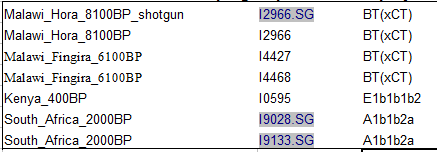
Regarding haploid DNA, I don't see anything outstanding but, as I know there is generally quite a bit of interest, these are screenshots of the ancient lineages found (full data in the supp. materials of the study):

Ancient Y-DNA (screenshot)
Ancient mtDNA (screenshot)

Related: No Iberian in Iberomaurusian.

Correction: I first titled this "a 30,000 years-old...". That was a major error on my part and I apologize for any confusion it may have caused. Thanks to Capra Internetensis for spotting it.

No Iberian in Iberomaurusian

After almost a century of controversy on the matter, it seems that archaeogenetics solved the riddle. Not in the sense I thought it would but it did anyhow.


Ancient DNA samples from Taforalt (Iberomaurusian or Oranian culture, Upper Paleolithic of North Africa) show no trace of Paleoeuropean ancestry (WHG), however they show strong affinity to West Asians of Palestinian type, showing also some significant amount of African Aboriginal ancestry, probably closer to East African Hadza and Sandawe and ancient Mota than to West African types. The result is something roughly similar to Afars but not quite the same in any case. 

Fig. S8 - Taforalt individuals on the top PCs of present-day African, Near Eastern and South European populations.


Fig. S11 - ADMIXTURE results for a few informative K values.

So the conclusion must thus be that the Eurasian influence in North African Upper Paleolithic (call it Iberomaurusian, Oranian or my personal unorthodox preference: Taforaltian) arrived from West Asia with whichever intermediate stage in Egypt and Cyrenaica, where that influence is quite apparently much older in the archaeological record. This seems contradictory to the chronology of Taforaltian, with Western sites producing older radiocarbon dates but the genetic data seems overwhelming. 

I must say I wish they would have contrasted with older (and available) Paleoeuropean samples than WHG (Epipaleolithic) but I guess that some WHG influence would have shown up if there was some older European influx because the various Paleoeuropean layers are not disconnected. But it is still something someone should test, just in case. 


Haploid DNA


The Taforalt sample was rich in mtDNA U6a, with also one instance of M1b:


All six male samples carried Y-DNA E1b1b, with most of them being well defined as E1b1b1a1-M78 (see table S16 for details).


Related: Luxmanda: a 3,000 years-old proto-Horner in Tanzania.

April 4, 2018

North African Neolithic was influenced by Europe... and European Chalcolithic by Iberian Neolithic

Or so it seems considering the data of Fregel et al., a study I have in my to-do list for some time and that I don't see cited often or ever at all.

Rosa Fregel et al., Neolithization of North Africa involved the migration of people from both the Levant and Europe. BioRxiv 2017 (pre-pub). DOI:10.1101/191569

The critical piece is probably this selection from Admixture results but which repeats over and over through the study with many more analyzed populations from all West Eurasia and North Africa:


We see how KEB (Morocco Neolithic) is a mix of European Neolithic intermediate between Iberia (purple) and Sardinian (blue) on one side and, on the other, something like Mozabites (not shown in this detail, cream). TOR is a new Neolithic sample from Andalusia.

Another ancient Moroccan sample IAM (pre-Neolithic, not shown here either) is fully cream-colored like mostly are modern Mozabites. 

Interestingly we see for the first time the emergency of a purple-colored component that differentiates Iberian Early Neolithic from the rest (although this does not happen at lower K-values, so they are still related), a component that, in the MNChL (Middle Neolithic and Chalcolithic) period, somehow appears as dominant in Italy (no data for earlier times) and becomes quite dominant in Central Europe. 

This is intriguing to say the least. It must be said that modern Sardinians and Basques (these probably, not labeled) are low in the purple component, although less than other populations, and that somehow the Early Neolithic (blue) component made a comeback:


I do not want to over-interpret all this (autosomal genetics are not an exact science) but, judging on KEB, the purple component is not just a generic southern branch (Cardium Pottery) distinction but something specifically Iberian or Italo-Iberian. The matter needs more research but it is in any case very intriguing that the purple component seems to expand from Iberia or somewhere nearby (France?, Italy?) in the period leading to the Chalcolithic, a most critical one in the formation of the genetics of Europe.

There is a also a little hoard of DNAmt and Y-DNA, with G2a-M201 (in Europe), E1b-L19* (in pre-Neolithic North Africa) and T-M184 (in Neolithic North Africa) in the patrilineal side and quite a bit of varied K1a in the matrilineal one, as well as JT (also in both shores) and U6 and M1 in North Africa.

Worth reading and keeping in mind, no doubt.

March 17, 2018

Oldest known Iberian R1b-S116 (and DF27) is NOT at all Indoeuropean

This study is very interesting but it is very wrongly argued, maybe in an attempt to fit their findings with what has sadly become the mainstream current of "explanation" about the origins Y-DNA haplogroup R1b-S116 (also P312, etc.)

Cristina Valdiosera, Thorsten Günther et al. Four millennia of Iberian biomolecular prehistory illustrate the impact of prehistoric migrations at the far end of Eurasia. PNAS 2018. DOI:10.1073/pnas.1717762115

The issue is that they found the very first known carrier of R1b-S116 (and R1b-DF27, the main Iberian haplogroup) in an individual of the Bronze Age of Lower Rioja (Cueva de Los Lagos, Alhama de Cervera), belonging very clearly to the Central Iberian culture of Cogotas I, even if it is at its very northeast margin.

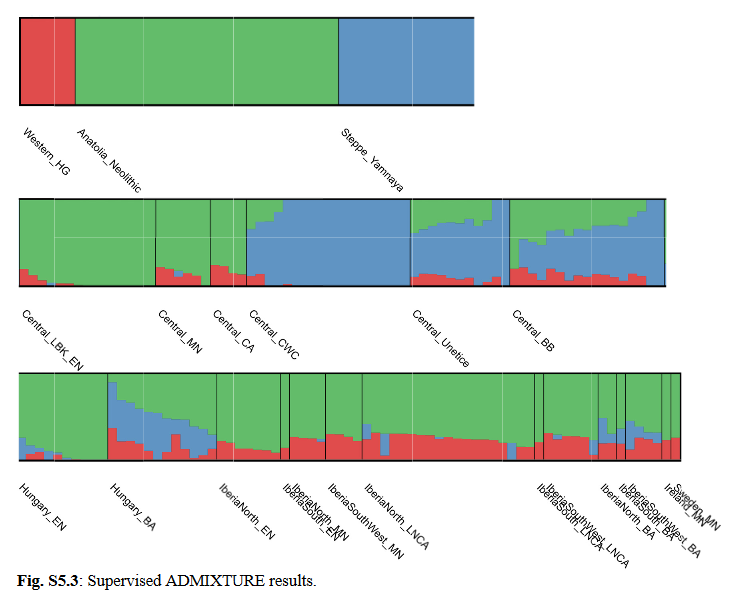
What is wrong? Well, the very title is wrong. It is nothing but an artifact produced by forced (supervised) results of Admixture within the simplistic 3-population model. Even then their result is in fact so weak that it immediately cried to me as "artifact" (noise or whatever you want to call it) and it is effectively nothing but that. 

And to demonstrate it is as simple as digging into the supplementary materials and look at the unsupervised Admixture run (dataset S03), whose optimal columns (lowest CV scores) are K=16-19 (all four are optimal, what is fine with me but makes explanation and understanding a bit more dense). 

As that unsupervised admixture is massive, with lots of global populations ancient and modern, I made a selection using only the four optimal K-values (K=16 to K=19, from left to right):

Click to expand (labels at bottom are mine)

And it is absolutely clear from K=16 to K=18 that there is not a speck of the Caucasus component which is absolutely universal in all the true Indoeuropean samples. There is a tiny speck of it in the K=19 column but there even Sardinians and some Anatolian Neolithic individuals have it at much greater values and thus cannot anymore be automatically interpreted as Indoeuropean marker, but just as extra Caucasus affinity present in some Neolithic-derived populations or individuals more than others since the very beginning of mainline (Vasconic) European Neolithic at the Aegean.

And this is it. Quod erat demonstrandum (Q.E.D): R1b-S116, at least in Iberia, has nothing to do with Indoeuropean expansion, nothing at all: it is absolutely clear that it is a pre-Indoeuropean thing. And it has been present in Lower Rioja since at least the Bronze Age.

Furthermore, when we look at the Central European Bell Beaker (Central BB) samples and compare them with their immediate chronological precursors of (definitely Indoeuropean) Corded Ware culture, we must admit that there is a decrease of the Caucasus component and an increase of the Vasconic Neolithic (light blue) element. This also speaks against the Indoeuropean "explanation" for the expansion of R1b-S116 into Central Europe, because the first known such ancient carriers are from the Bell Beaker period and not a moment earlier, and these clearly express an anti-Indoeuropean tendency in their autosomal genomes.

There is however a sizable Indoeuropean component in modern non-Basque Iberians, smaller than in most other European populations but very clear nevertheless. This must have arrived at later times: (1) with the Celts, who arrived to Catalonia at the end of the Bronze Age, later expanding into Central and Western Iberia, (2) with the Romans, (3) maybe also to some extent with the Germanic invaders of the late Roman period. None of these expansions seem particularly associated with R1b-S116, however the c. 1% R1a and the c. 8% J2 (with plausible Italo-Roman origin) should be related to it, along with an assortment of other haplogroups. 

For those willing to dig in the details, there is also a small treasure trove of other ancient Y-DNA, mostly I (which underlines the Paleoeuropean influence in Neolithic Iberia, regardless of whether this is local or was carried on from further East by the Neolithic settlers), as well as one instance of unspecific R1b, another of G and another of H.

Someone may ask, which is then the origin and means of expansion of R1b-S116, if not Indoeuropean? Good question to which I don't have yet a well defined answer. But my tentative explanation is that it should be related to two ultimately related processes within Western European "Neolithic" (Late Neolithic and Chalcolithic): 
  1. The well documented phenomenon of increase, in most areas at least, of the Paleoeuropean component time passes, this may be to some extent because of simple absorption of local subneolithic "hunter-gatherers" but it probably also produced different subpopulations within the Western Neolithic and in some cases we do see these peripheral "Second Neolithic" groups expanding at the expense of the "First Neolithic" peoples. This is most clear in Central Europe with the expansion of Funnelbeaker cultures from, probably, Denmark and nearby areas of Low Germany. In fact Michelsberg culture and its close relative in France Seine-Oise-Marne basically wipe out the first farmers of LBK (Linear Pottery) at what I usually describe as the Chalcolithic but is often described as Middle or Late Neolithic in other sources.
  2. Clearly Bell Beaker had something to do: we see their impact in Germany, Britain and Ireland and one could argue that Cogotas I is somehow derived from the Bell Beaker of Ciempozuelos, although in this I'm going to remain neutral and a bit skeptic until more evidence shows up. 
But what seems very apparent tome is that R1b-S116 should have expanded from somewhere in France, probably towards the South. And we do need better genetic studies, including archaeogenetic ones, on the Hexagon before we can jump to conclusions. France is not the most affected area by Bell Beaker, so I am cautious about attributing too much weight to only Bell Beaker and I would rather think on a complex succession of expansions associated to various cultures. 

Of great interest here should be the ill-known but fascinating Artenacian culture, which expanded in all West France and Belgium from a core at Dordogne before the BB period and coincident with the Corded Ware expansion in Central Europe. Like Bell Beaker folk, they were adept at bowmanship but their area is not densely affected by Bell Beaker later on (although there is indeed a scatter of findings). I do wonder if somehow Bell Beaker is derived from Artenac, even if it is clearly not the same thing. Food for thought.


Update (March 18): small steppe-like noise appears in diverse Iberian samples since the Late Neolithic/Chalcolithic.

This has arisen in the discussion below (h/t to MZ): when the supervised (forced assignment to rigid three populations) is used, the appearance of "steppe" ancestry is found here and there also before the Bronze Age. As we see above, this is not real: it does not happen in the unsupervised model at all but mere "noise" or "artifact" produced by the excessive simplicity of the three populations model.


This does not make the three populations model "wrong": it is still approximately right but "evidence" produced  ONLY from rigidly applying this model is not evidence of anything, just a hint to be confirmed or rejected via wider analysis at best.

March 16, 2018

Ancient DNA from the Balkans

This study has been for several months around but I have not discussed until now and is well worth a mention.

Ian Mathieson et al., The Genomic History Of Southeastern Europe. BioRXiv (pre-pub) 2017. doi:10.1101/135616

There is a lot of ancient autosomal DNA from the region but it basically says one thing: everything was almost exactly as expected from archaeology. The Karanovo-Gumelnita people, famed for inventing the Bronze Age a whole millenium earlier than anyone else, and nearby related cultures, were within the mainstream (Vasconic) Neolithic genetic grouping. This changed however with the kurgan invasion expressed primarily in the Ezero culture, which I've been told should be considered direct precursors of Thracians. But the change is not something radical: more genetic affinity with the steppe is visible than before and more generalized through all samples. 

Fig. 1-D - Supervised ADMIXTURE plot, modeling each ancient individual (one per row), as a mixture of
populations represented by clusters containing Anatolian Neolithic (grey), Yamnaya from Samara (yellow), EHG (pink) and WHG (green).
  (click to expand)


Well, it is not exactly everything what is as expected, if we consider Polish Globular Amphorae culture, which I would have expected to be at least somewhat steppary, Indoeuropean, already but were not. Thus it seems I have to concede on this culture and its precursors being still part of the Vasconic Neolithic. This makes Indoeuropean penetration into Central-North Europe a much more sudden episode and one directly tied to Corded Ware culture and nothing else. It must have been perceived by its victims like a massive catastrophe, because it was a huge area which they conquered and to a large extent colonized in a very short span of time.


Lots of R1b in Epipaleolithic Balkans

Most interesting anyhow is the huge hoard of ancient Y-DNA R1b in the Iron Gates region (Lepenski Vir) before the Neolithic. This not only demonstrates, again, that this haplogroup is Paleoeuropean, at least in part, but, quite intriguingly makes earlier findings on modern data suggesting a possible origin or R1b-M269 in or near modern Serbia (Morelli 2010 and Myres 2010) at least somewhat plausible. However none of the Iron Gates R1b is described as R1b-M269 and in some cases it is excluded that it could be this sublineage. 

Thus the issue of the ultimate origins of this key lineage remains open, but let me underline that these Iron Gate individuals belonged to the WHG grouping, as did Villabruna (so far the oldest R1b carrier kown) and that they breach this way the assumed haplogroup homogeneity I2 conceived on merely Central and Northern European samples. Just as happened with mtDNA U haplogroup homogeneity when mtDNA H was detected by several independent studies of Iberian ancient DNA. It is normal to expect more diversity towards the south for several reasons but maybe the most critical of them is just average temperature, which makes the southern lands naturally more fertile (notably so for crops domesticated in the Middle East) and easier to inhabit. 

This trend was only broken in the Middle Ages when the heavy plough allowed the improved exploitation of deep Oceanic soils, being useless in the Mediterranean region of shallow soils however. It was only then when the center of European development moved from south to north, to Belgium specifically, where it remains till present day. So let's take Southern Europe a bit seriously, please.

February 4, 2017

The patrilineage R1b-DF27 in North Iberia

Just weeks ago a new study on Northern Iberian Y-DNA, focused specifically on R1b-DF27, was published. It covers Asturias, Cantabria, Basque Country and Aragon, finding greater diversity in the Basque Country and Cantabria and lower in Aragon and Asturias.

Patricia Villaescusa et al., Characterization of the Iberian Y chromosome haplogroup R-DF27 in Northern Spain. FSI-Genetics 2017. Pay per viewLINK [doi:10.1016/j.fsigen.2016.12.013]

Abstract

The European paternal lineage R-DF27 has been proposed as a haplogroup of Iberian origin due to its maximum frequencies in the Iberian Peninsula. In this study, the distribution and structure of DF27 were characterized in 591 unrelated male individuals from four key populations of the north area of the Iberian Peninsula through the analysis of 12 Y-SNPs that define DF27 main sublineages. Additionally, Y-SNP allele frequencies were also gathered from the reference populations in the 1000 Genomes Project to compare and obtain a better landscape of the distribution of DF27. Our results reveal frequencies over 35% of DF27 haplogroup in the four North Iberian populations analyzed and high frequencies for its subhaplogroups. Considering the low frequency of DF27 and its sublineages in most populations outside of the Iberian Peninsula, this haplogroup seems to have geographical significance; thus, indicating a possible Iberian patrilineal origin of vestiges bearing this haplogroup. The dataset presented here contributes with new data to better understand the complex genetic variability of the Y chromosome in the Iberian Peninsula, that can be applied in Forensic Genetics.

The study, quite conveniently, differentiates between "native Basques" (those whose patrilineal ancestors lived in the Basque Country for at least the last three generations) and "resident Basques" (those whose recent patrilineal ancestors immigrated, mostly from NW Iberia).

R1b-DF27 is one of four major R1b sublineages in Western Europe and one of the three "brothers" that can be tracked to an origin somewhere in what is now Southern France, most likely, i.e. together they form part of R1b-S116. The fourth lineage would be, naturally, R1b-U106, "brother" of S116 and found typically around the North Sea. It is the one with the southernmost distribution, being very dominant in Iberia and among Basques. Probably it is also important in all the south of modern France but clear data is missing as of now.

Reconstructed spread of R1b to Western Europe and within it (dates objectively unknown so far, own work)

This is the key data table of the study, showing the frequency of the various sublineages of R1b-DF27 ("*" means "others", so "DF27", without asterisk, means "all DF27" and "DF27*" means instead "remaining DF27 after exclusion of the other mentioned subclades"):

Click to expand (frequencies are absolute, relative to whole sample)
It is also worth sticking this other graph, which shows (top right) the (SNP-based) true phylogeny of the haplogroup R1b-DF27 and, complementarily, the (somewhat messy) haplotype structure based on a limited number of short tandem repeats (STR), in which only Z220 appears clearly defined:

Click to expand

The study is very limited in its scope but it does show that there is a very high diversity for this lineage among Basques. This however does not necessarily indicate that Basques are the direct origin: much more data from the rest of Iberia and very especially from France is required before we can jump to any conclusion. Based on the limited data we have, I am of the opinion that the lineage did not originate in Iberia most likely but rather in what is now Southern France, migrating southwards via the two natural corridors: the Basque Country and Catalonia. 

Sadly enough we just do not have enough modern data, much less ancient one, in order to issue a definitive judgment on the matter. However the overall pattern of distribution of R1b-S116 strongly suggest a "Southern French" origin, not just for "Iberian" DF27 but also for the other two "brother" lineages: "Alpine" U152 and "North Atlantic" M529. 

The big question is how and when did this expansion took place. A "South French" origin was much easier to explain when the Paleolithic continuity model seemed reasonable, however recent ancient DNA findings strongly suggest that the Neolithic and Chalcolithic saw major population changes in much of Europe until stabilization was achieved -- exact patterns vary on specific regions: in some cases this does not happen until the Bronze Age, in others, like the Basque Country and quite possibly the Atlantic parts of France, it may have happened much earlier, even as soon as the early Neolithic. 

So my best recipe for an explanation is that we have to look very carefully at what happened in Western Europe, particularly towards the Atlantic Ocean in that "transitional" period, when not just large cultural phenomena like Dolmenic Megalithism or later also Bell Beaker manifested in quite expansive and dynamic manner but also a dearth of smaller cultures were the actual social or ethnic pieces making them possible. For example it is plausible that Michelsberg culture (originating in Lower Rhineland apparently and swiftly replacing the early Neolithic LBK culture in Germany, North France and nearby areas) could be involved in the expansion southwards of R1b-U106 and other traits of the modern genetic pools we observe. Another culture well worth taking a look at is the Artenac culture, which expanded from Dordogne towards the North up to Belgium soon after the Michelsberg/SOM era. Rather than one single and sudden expansion of a well defined population, it seems to me that we are before a jigsaw puzzle of several cultures and several chronologies, related maybe but not exactly the same.

See also:

Thanks once again to Jean Lohizun.

January 1, 2017

Reconstructing Sardinian population history

A very interesting pre-pub study, dealing with Sardinian genetics in great sub-national detail but also within the wider European and Mediterranean context, became available in the last weeks. I won't probably be able to make justice to it here, so please take a look yourselves.

Charleston W.K. Chiang et al., Population history of the Sardinian people inferred from whole-genome sequencing. BioRXiv 2016. Open access pre-pubLINK [doi:10.1101/092148]

Abstract

The population of the Mediterranean island of Sardinia has made important contributions to genome-wide association studies of traits and diseases. The history of the Sardinian population has also been the focus of much research, and in recent ancient DNA (aDNA) studies, Sardinia has provided unique insight into the peopling of Europe and the spread of agriculture. In this study, we analyze whole-genome sequences of 3,514 Sardinians to address hypotheses regarding the founding of Sardinia and its relation to the peopling of Europe, including examining fine-scale substructure, population size history, and signals of admixture. We find the population of the mountainous Gennargentu region shows elevated genetic isolation with higher levels of ancestry associated with mainland Neolithic farmers and depleted ancestry associated with more recent Bronze Age Steppe migrations on the mainland. Notably, the Gennargentu region also has elevated levels of pre-Neolithic hunter-gatherer ancestry and increased affinity to Basque populations. Further, allele sharing with pre-Neolithic and Neolithic mainland populations is larger on the X chromosome compared to the autosome, providing evidence for a sex-biased demographic history in Sardinia. These results give new insight to the demography of ancestral Sardinians and help further the understanding of sharing of disease risk alleles between Sardinia and mainland populations.

The authors call to some question the extreme simplicity of the three populations model of Lazaridis and subsequent studies. They do not flatly reject it but it seems that the lack of nuance bothers them a lot, as it does to me. This is quite clear when they find once and again Sardinian-Basque lines of relationship without going through Italian, Spaniard or French intermediaries, also when they face the issue of the largest Y-DNA haplogroups in the island, I2a1a (M26, almost exclusively a Sardinian and Pyrenean haplogroup) and R1b1a2 (M269), which are not typically associated with Neolithic farmers, suggesting that there is more to Neolithic settlement than meets the eye in the too simplistic three populations' model. They even seem to consider if Paleolithic peoples from Sardinia itself or maybe some other locations contributed heavily to what they feel is a sex-biased genetic pool.

They do confirm that Sardinians have both strong "Neolithic" (Stuttgart) and "Paleolithic" (Lochsbour) ancestry and no (negative even) "Steppe" (Yamnaya) one, although this last is truer for the most isolated sub-populations than for the more cosmopolitan ones. 

They also estimate that Sardinians have been generally isolated from the rest of Europeans for some 330 generations, what reads as approx. 9900 years, i.e. since the very early Neolithic settlement of the island. We would actually have to reduce that time span a bit but within reason, else it becomes Epipaleolithic in fact, what is most unlikely. Alternatively, as the main comparison is Northern Europe, this date could refer to the branching out of Painted-Linear (continental) and Impressed-Cardium (maritime) Neolithic cultures in the Aegean or the Balcans.

Ancient aboriginal DNA from El Hierro (Canary Islands)

The island of El Hierro (lit. The Iron) is one of the westernmost of the Canary Islands. I have never visited but it seems to be very beautiful, far enough from the Sahara to enjoy a warm yet humid climate. It wasn't far enough to remain uninhabited however and now we get to know something more about its original dwellers, generally known as Guanches (although technically this name only applied to the inhabitants of La Palma originally).

Alejandra C. Ordóñez et al., Genetic studies on the prehispanic population buried in Punta Azul cave (El Hierro, Canary Islands). Journal of Archaeological Science 2016. Pay per viewLINK [doi:10.1016/j.jas.2016.11.004]

Abstract

The aim of this study was to establish the genetic studies of the population from one of the most important known aboriginal funerary spaces of the island of El Hierro (Canary Islands), the Punta Azul cave, which harbors remains of 127 individuals. Sixty-one adult tibiae were examined, 32 left and 29 right. Radiocarbon dating yields an antiquity of 1015–1210 AD. We have obtained an overall success rate of 88.5% for the molecular sexing, and of 90.16% for the uniparental markers. Short tandem repeats (STR) profiles were also possible for 45.9% of the samples. This performance is a consequence of the good conservation of the bones in their archaeological context. The mtDNA composition of the sample is characterized by the complete fixation of the H1-16260 lineage. These results can be explained by a mixture of consecutive founding events, a bottleneck episode at the beginning of the colonization and/or as a consequence of genetic drift. Paternal lineages were also affected by these processes but in a less acute way. These differences lead us to propose social behaviors as an explanation for this difference. The maternal transmission of the lineages, mentioned in ethnohistorical sources of the Archipelago, could be an explanation. These results could be in agreement with endogamous practices, but the autosomal STR results indicate a relative high diversity. These results have allowed us to characterize the Punta Azul cave population and see the way in which geographical isolation, the process of adaptation and specific social behaviors affected the aboriginal population of the Island.

And now the interesting stuff, the findings:


As should be expected, the remote and rather small western island, which is the most direct threat to the security of the USA and the Western World in general because of the danger its volcano may slide into the Ocean and cause a huge tsunami of devastating consequences, something that no nuclear arsenal can do anything against, shows clear indication of very strong genetic drift relative to its relatives of the larger islands, caused either by founder effects and/or endogamous drift. Otherwise it is within the general patterns for the pre-colonial islanders. 

We see a lot of likely mtDNA H and certain Y-DNA R1b1a2. The Canary Islands were settled c. 1000 BCE (11,000 HE) by people arrived from what is now Morocco and the Western Sahara. They seem to retain a somewhat archaic genetic pool, relatively rich in Europe-related genetic elements, not so abundant at all today in Northwest Africa anymore, and by this I mean of course very especially Y-DNA haplogroups I and R1b. While we can still find some R1b in NW Africa, haplogroup I is almost impossible to find nowadays, yet it was present in the Canary Islands prior to European conquest and nearly disappeared afterwards (so it's definitely not a colonial input, accidentally misidentified, not at all). 

See also: Leherensuge: Ancient Guanche Y-DNA.

June 26, 2016

Ancient genomes from Neolithic West Asia

This week we got to know a lot more about the genetics of ancient West Asians, from the Mesolithic, Neolithic and later times. All in a single major study:

Iosif Lazaridis et al., The genetic structure of the world's first farmers. BioRxiv 2016. Freely accessible (pre-pub)LINK [doi: http://dx.doi.org/10.1101/059311]

Abstract

We report genome-wide ancient DNA from 44 ancient Near Easterners ranging in time between ~12,000-1,400 BCE, from Natufian hunter-gatherers to Bronze Age farmers. We show that the earliest populations of the Near East derived around half their ancestry from a 'Basal Eurasian' lineage that had little if any Neanderthal admixture and that separated from other non-African lineages prior to their separation from each other. The first farmers of the southern Levant (Israel and Jordan) and Zagros Mountains (Iran) were strongly genetically differentiated, and each descended from local hunter-gatherers. By the time of the Bronze Age, these two populations and Anatolian-related farmers had mixed with each other and with the hunter-gatherers of Europe to drastically reduce genetic differentiation. The impact of the Near Eastern farmers extended beyond the Near East: farmers related to those of Anatolia spread westward into Europe; farmers related to those of the Levant spread southward into East Africa; farmers related to those from Iran spread northward into the Eurasian steppe; and people related to both the early farmers of Iran and to the pastoralists of the Eurasian steppe spread eastward into South Asia.

Highlights:

  • There were (at least) two clearly distinct populations in West Asia in the Mesolithic and Early Neolithic times.
  • Both populations contributed to the West Anatolian farmers that are precursors of the settlers of Neolithic Europe.
  • The so-called "Basal Eurasian" component is not yet clarified if it is something local or admixture with Africans or both. However it is clear that it is associated with reduced Neanderthal admixture.
  • West Eurasian genetic composition can be now understood quite well as the mixture from four sources: two West Asian ones, favored by the Neolithic revolution, and two Paleo-European ones.

This graphic shows pretty well how the ancient populations of West Eurasia are expressed as a mixture of those four founder populations:


That is if you can get through the nomenclature, which is inherited in many cases from a long array of recent studies. I'm not even sure myself in many cases what samples exactly and where from are thrown in each category. But the most important part is that Iran_N and Levant_N are the two Neolithic-specific founder populations of the Fertile Crescent (yeah, N stands for "Neolithic", not "North") and that the other two founder populations from pre-Neolithic Europe are WHG (Epi-Magdalenian peoples from Western and Central Europe) and EHG (Eastern European hunter-gatherers, of Epigravettian culture and maybe even proto-Uralic in one case).

Then we see in the case of Europe how:

1. Anatolia_N (precursors of mainline European Neolithic) are a mix of both West Asian farmer groups, plus a sizable fraction of Western Paleo-european ancestry already.

2. This fraction of Western Paleoeuropeanness increases as the farmers expanded into Europe (EN) and then as there was probably some backflow of Western origins in relation to Megalithism and Bell Beaker (MNChL). But in general remains the same basic genetic composition and in no known case incorporates any Eastern Paleoeuropean component at all, not yet.

3. It is only with the Indoeuropean ("Kurgan") invasions reflected in the category LNBA, when the EHG component begins feeling very important in Europe. If I'm correct, all those samples are from Germany other areas of Central and North Europe, with the Iberian and Italian ones of similar chronology placed in the MNChL tag instead. The LNBA/MNChL contrast is not a strictly chronological analysis but an analysis by categories of ancestry that do overlap in time.

4. In Armenia instead, we see a decrease of the minor EHG component but then an increase in the MLBA ("middle and late Bronze Age") when Armenians arrive from the Balcans and Phrygia, conquering the pre-existing Hurro-Urartean peoples (whose language was probably related to Chechen and other NE Caucasian languages), which should correspond to the formation of Urartu and more specifically to the Hayasa-Azzi and Shupria stages, both considered Urartean (Hurrian). The WHG and Levant-N components we see since the Chalcolithic is similar to what we see in West Anatolia and probably reflect interactions corresponding to Central-Eastern Anatolia, Kurdistan and Syria, for which we have no direct ancient data yet.

Ancient samples (colored and labeled) projected on a PCA of modern West Eurasian populations (in gray):


For a reference on which are the modern populations in gray, a good reference is this older but fully labeled PCA by Olalde.

Briefly: Natufians fall on top of modern Palestinians, their slightly admixed Neolithic descendants fall between Palestinians and Jews, Middle Neolithic European Farmers fall on top of Sardinians, the so-called Europe-Steppe continuum (early Western Indoeuropeans) fall between Central Europe, France and the Balcans, most Western Europeans do not overlap with ancient samples but appear to have even greater Paleoeuropean admixture instead, etc.

Y-DNA Haplogroups

Iranian Mesolithic and Neolithic samples carried the following patrilineages:
  • Mesolithic: J(xJ2a1b3,J2b2a1a1)
  • Ganj Dareh Neolithic: P1(xQ,R1b1a2,R1a1a1b1a1b,R1a1a1b1a3a,R1a1a1b2a2a) and an undefined CT
  • Late Neolithic: G2a1(xG2a1a)

Meanwhile Palestinian Mesolithic and Neolithic samples carried: 

  • Natufian (Mesolithic): E1b1b1b2(xE1b1b1b2a,E1b1b1b2b), E1b1(xE1b1a1,E1b1b1b1), E1b1b1b2(xE1b1b1b2a,E1b1b1b2b), plus two undefined CT.
  • Pre-Pottery Neolithic B/C: H2, E(xE2,E1a,E1b1a1a1c2c3b1,E1b1b1b1a1,E1b1b1b2b), E1b1b1, T(xT1a1,T1a2a), E1b1b1(xE1b1b1b1a1,E1b1b1a1b1,E1b1b1a1b2,E1b1b1b2a1c), plus three ill-defined CT.

CT is the main pan-Eurasian macro-haplogroup and is not informative, except in Palestine because it implies exclusion of E.

Otherwise we see an important presence of E (mostly E1b1b) a lineage we know was carried by early farmers into Europe and that has ultimately African origins. It probably indicates migration of NE Africans into Palestine in the Mesolithic, something also supported by Archaeology. However these NE Africans were surely already mixed with Eurasian ancestry, which probably arrived to the Nile Basin in the early LSA, some 50-40 Ka ago. So it's a complex story of multiple admixture events in the continental crossroads that is Egypt and also Palestine and other nearby areas.

We also see G2a1 in Late Neolithic Iran, and this one is the main lineage brought to Europe by the early farmers if we are to judge on known ancient sequences (today it is not more important that E1b but it is maybe more evenly distributed). However we only see it in the Late Neolithic, so it may have originated further west.

We see too little J, only J(xJ1a,J2a1,J2b) in Chalcolithic Iran and in Bronze Age Jordan: J(xJ1,J2a,J2b2a) again and J1(xJ1a). I guess that a lot remains to be researched on this issue because J is by far nowadays the most common haplogroup of West Asia, and also impacted Europe and South Asia (J2) and North and NE Africa (J1).


On the issue of "Basal Eurasian": African or West Asian?

The question remains unanswered, as I said before but there are two clues: on one side the presence of E1b in Mesolithic and Neolithic Palestine clearly supports a direct NE African influence, also backed by archaeological evidence. But there is some nuance in the issue of FST distances that I want to highlight.

The distances are available in a very extensive supplementary table, so I took just a few to get a better understanding, not only of this issue but in general of the genetic distances of the four founder populations:


Quite ironically it is not the Natufians who are the closest to the African reference population (Yoruba) but the CHG, Iran-N and Levant-N groups. In fact the Natufians are the most distant ones after the WHG population. However this is tricky because the affinity to Yoruba may also be caused by the "ghost" Basal Eurasian population, claimed first of all by Lazaridis 2014, which would be a remnant of the Out of Africa Migration (not strictly African but close enough and impossible to discern from true African admixture in most analyses).

So we may imagine that the "Highlander" (CHG and Iran-N) populations were somehow influenced by that Basal Eurasian ghostly population, which might have survived in the Persian Gulf oasis, for example. Or whatever else.

The presence of the same or similar element in Levant-N reflects possibly admixture with Iran-N or a similar population, something that is implicit in the table above but I'll address below more explicitly.

If there is (and there must be, because of Y-DNA E1b) some African admixture in the Natufian population, it was very diluted already in the autosomal (general DNA) aspect before farming began.

Update (Jul 2): all the four paragraphs above are possibly misleading to some extent because, as several commenters have rightfully pointed out, generic drift alone just causes the effect of increased distance to general reference populations like Yoruba and Han, this genetic drift is caused by relative isolation, so it seems that Magdalenian Europeans (WHG) and Natufian Palestinians (Natufian) were both more isolated populations in general terms than the Iran-Caucasus-Eastern Europe ones, whose sheer numbers apparently kept them more similar to the generic root of Humankind, less endogamous. 

However, per archaeology, such "sheer numbers" are not to be expected in that area, rather the opposite (Western Europe and Palestine are much more richer areas in terms archaeological, suggesting denser populations). So the question remains open as far as I can tell but it should be discerner with more precise tools than mere FST.


A visual of smallest genetic distances between (each "-" represents 0.01 in the table above):

a) Ancient West Asians:

CHG-----IrN-------LeN----Nat
Neolithic peoples of West Asia, even if different, are closer among them than their pre-Neolithic precursors.

b) Pre-Neolithic West Eurasians:

WHG--------EHG----------CHG--------------Nat
The distances between Natufians and everyone else are comparable to those with Han Chinese, however only in the case of the populations that appear to have extra affinity to East Asia (Iran, Caucasus and Eastern Europe), otherwise it is smaller.
All four populations were distant enough from each other to be considered clearly distinctive. Even EHG and WHG were quite dissimilar.

c) The four West Eurasian founders considered above:

WHG--------EHG----------IrN-------LeN
There is much greater similitude between Iran and Levant Neolithic peoples than between their Mesolithic precursors. This implies some sort of intense admixture as agriculture and herding developed. Not enough to erase the differences but enough to blur them significantly.

Genetic influence from East Asia or a related population is also apparent in all Northeastern populations but even more so in Iran Neolithic. Why?

There is much more in the study and supp. materials but I can only review so much.

June 9, 2016

Neolithic DNA from Greece and NW Anatolia and their influence on Europe

This is a most interesting study that brings to us potentially key information on the expansion of European Neolithic and the formation of modern European peoples.

Zuzana Hofmanová, Susanne Kreutzer et al., Early farmers from across Europe directly descended from Neolithic Aegeans. PNAS 2016. Open accessLINK [doi:10.1073/pnas.1523951113]

Abstract

Farming and sedentism first appeared in southwestern Asia during the early Holocene and later spread to neighboring regions, including Europe, along multiple dispersal routes. Conspicuous uncertainties remain about the relative roles of migration, cultural diffusion, and admixture with local foragers in the early Neolithization of Europe. Here we present paleogenomic data for five Neolithic individuals from northern Greece and northwestern Turkey spanning the time and region of the earliest spread of farming into Europe. We use a novel approach to recalibrate raw reads and call genotypes from ancient DNA and observe striking genetic similarity both among Aegean early farmers and with those from across Europe. Our study demonstrates a direct genetic link between Mediterranean and Central European early farmers and those of Greece and Anatolia, extending the European Neolithic migratory chain all the way back to southwestern Asia.


Uniparental DNA

One of the most important findings is that the two Epipaleolithic samples from Theopetra yielded mtDNA K1c, being the first time in which haplogroup K has been detected in pre-Neolithic Europe. Sadly enough these two individuals could not be sequenced for full genome. 

The other five individuals are all Neolithic (three early, two late) and did provide much more information.
  • Rev5 (c. 6300 BCE): mtDNA X2b
  • Bar31 (c. 6300 BCE): mtDNA X2m, Y-DNA G2a2b
  • Bar8 (c. 6100 BCE): mtDNA K1a2
  • Pal7 (c. 4400 BCE): mtDNA J1c1
  • Klei10 (c. 4100 BCE): mtDNA K1a2, Y-DNA G2a2a1b (same as Ötzi's)
I color coded their abbreviated names according to the usage in the study's many maps, for easier reference: green shades are for Greece (Western Macedonia), red shades for Turkey (Bursa district). It is also very convenient to get straight their real geography because many of the map-styled graphs are not precise at all about that:

Fig. 1.
North Aegean archaeological sites investigated in Turkey and Greece.


Autosomal DNA affinities

This is probably the most interesting part. There is a lot about it in the supplementary information appendix but I find that the really central issue is how they relate to each other (or not) and to other ancient and modern Europeans. I reorganized figs S21 and S22 to better visualize this:


Ancient samples compared to each other and other ancient samples ("inferred proportions of ancestry")
Ancient samples compared to modern Europeans ("inferred proportions of ancestry")


So what do we see here? First of all that the strongest contribution of known Aegean Neolithic peoples on mainline European Neolithic is from Bar31, which is from NW Anatolia, and not from Greece. Bar8 is a less important contributor but may have impacted particularly around the Alps (Stuttgart-LBK, modern North Italians).

This goes against most archaeology-based interpretations, which rather strongly suggest a Thessalian and West Macedonian origin of the Balcanic and, therefore, other European branches of the mainline Neolithic of Aegean roots, and do instead support some sort of cultural barrier near the European reaches of the Marmara Sea. Of course we lack exhaustive sampling of Greek Neolithic so far, so it might be still possible that other populations from Thessaly or Epirus could have been more important. However the lack of Anatolian-like influence on the Western Macedonian Neolithic until c. 4100 BCE, makes it quite unlikely.

So it seems that, once again, new archaeogenetic information forces us to rethink the interpretative theories based on other data.

However we do see a strong influence of Greek Neolithic and particularly the oldest sample, Rev5, in SW Europe, very especially among Basques, who seem to have only very minor Anatolian Neolithic ancestry, unlike everyone else relevant here. This impact is also apparent in Sardinia and to some extent North Italy (but overshadowed in these two cases by the one from Anatolia, particularly Bar31).

There are also similar analyses for other four ancient samples (Lochsbour, Stuttgart, Hungary Neolithic and Hungary Bronze) but they don't provide truly new information, so I'm skipping them here. As I said before, there's a hoard of analyses in the SI appendix, enjoy yourselves browsing through them and feel free to note in the comments anything you believe important.

A synthesis of the various "inferred proportions of ancestry" analyses is anyhow shown in fig. 3:

Fig. 3. (click to expand)
Inferred mixture coefficients when forming each modern (small pies) and ancient (large pies, enclosed by borders matching key at left) group as a mixture of the modern-day Yoruba from Africa and the ancient samples shown in the key at left.

The fractions may be misleading however, especially for the ancients. For example: Lochsbour (a total outlier among the ancients in this study) appears best correlated with Pal7 but in fig. S24 it is clear that does no correlate with any Neolithic sample at any significant level. But in general terms it can give a good idea of where does ancestry, particularly for modern samples, come from.

Note: elsewhere someone was being a crybaby about the Polish sample (may well be an error) or the Kalmyk sample (who are obviously most related to East Asians, not used here) but those are minor issues.

Of course there's a lot more to learn from the remains of the ancients. Let's keep up the good work.

May 4, 2016

Large Paleoeuropean DNA survey

An unprecedented survey of ancient DNA from Paleolithic Europe has been just published:

Qiaomei Fu et al., The genetic history of Ice Age Europe. Nature 2016. Pay per viewLINK [doi:10.1038/nature17993]

The supplemental materials (PDF) are freely accessible, as are the figures and tables (HTML). 

Quick highlights:
  1. Oldest Y-DNA R1b1 (and therefore R1b and R1) ever documented (Villabruna, Veneto, 14 Ka ago, Epigravettian cultural context). Also more Japan and La Braña related C1!
  2. Oldest mitochondrial DNA H (H7) may be in Gravettian Moravia, also oldest U6 may not be in Iberia or North Africa but in Gravettian Romania.
  3. Very important insights in autosomal DNA: a distinct Paleoeuropean population since Gravettian, two different late UP/Epipaleolithic populations. 
  4. Still very important gaps, notably SW France (the core of Paleolithic Europe) and most of Iberia. Also still missing West Asian sequences altogether, except for the rather anomalous Caucasus population and whatever may be inferred from Early European Farmers, whose ancestry was mostly (aprox. 3/4) West Asian.

A good synthesis of the scope and some of the findings of this study is in fig. 1:

(click to expand)


Y-DNA

The survey confirms (supp. materials 4) that haplogroup I used to be the most common patrilineage in Paleolithic Europe. But it was not the only one:

The oldest ones (pre-Villabruna, c. 14 Ka BP) were largely C1:
  • Kostenki 14 (Russia, Gravettian): C1b
  • Goyet Q116-1 (France, Aurignacian): C1a
  • Vestonice 16 (Moravia, Gravettian): C1a2
Also in this oldest group (arbitrarily defined as pre-Villabruna), there was some I* or maybe pre-I (some markers are missing in many individuals), including: Pavlov 1 (Gravettian, Moravia), Paglicci 133 (Gravettian, South Italy), Hohle Fels 49 (Magdalenian, Swabia), Goyet Q2 (Magdalenian, France) and Bukhardtshohle (Magdalenian, Swabia). Notice that its prevalence and clarity as "I proper" increases after the LGM; the Gravettian ones seem to be pre-I rather than true I.

Other oldest lineages are BT* (Vestonice 15), CT* (Ciclovina 1, Kostenki 12, Vestonice 13), F* (Vestonice 43). Notice that in most cases not all the ideal SNP testing was performed, so it is still possible and even probable, I'd think, that BT* and CT* are actually F*.

In the more recent "post-Villabruna" group:

The revelation of the group is of course Villabruna, which carried R1b1

There are also two I* (Cuiry Les Chardaudres 1 and Berry Au Bac), one I2 (Rochedane) and one F* (Falkenstein).

I must also mention that previous studies found mostly I2 in Epipaleolithic samples, excepted La Braña, which carried C* (maybe some sort of C1 but unconfirmed). R1a1* was found in Karelia as well.

Synthesis: I and R1b1, the most common lineages of Europe West of the Elbe, only show up after the Last Glacial Maximum, at least as far as we know. I probably coalesced in the subcontinent, the issue of where R1b, the most common modern patrlineage of Western Europe, coalesced and how it expanded remains open but the Villabruna data point defines a terminus ante quem for this haplogroup, which MUST be older than 14,000 years necessarily, discarding some of the most outrageous recentist chronologies altogether. The great initial diversity of CT-derived lineages suffered bottlenecks with the LGM and probably also later, pruning most of them (although rare instances of some of those lines such as F* or C1 are still found among modern Europeans).


Mitochondrial DNA

Lots of interesting stuff in this issue of the matrilineages, but also some strange issues in the data that do raise eyebrows quite a bit. The full dataset is in the supplemental materials section 2. 

However they do not provide clear data on how the tests were performed, just a generic listing. This is very problematic, notably when they state that El Mirón is U5b, when Hervella (with more clear methodology) classified her as H just a year ago. Another similar issue is the apparent H7 (H7a1?) in Vestonice 14, which is first classified as "damaged" (based apparently on X-chr contamination, the CI for H7 is 0.9-1) and then listed as "U" in the extended table 1, with no reasoning whatsoever for the change. 

Rumor is already around about a mysterious H-hater "black hand" being at play here. I can't neither confirm nor reject it but I do think that the authors should explain themselves more clearly on this most important matter, which is beginning to be more than just annoying, fueling conspiracy theories and what-not.

Another interesting issue is a possible U6 in Muierii (Gravettian Romania, CI 0.88-0.97), labeled as "damaged" again and refurbished as mere amorphous "U". This is a very important issue and is directly related with the presence of mtDNA H in Paleolithic Europe and the origin of these lineages in North Africa. 

Northwestern Africa (not counting Cyrenaica) did not experience any sort of Upper Paleolithic (UP) until c. 22 Ka BP, when a new culture of very likely Iberian Solutrean affinity, the Iberomaurusian or Oranian expanded from Taforalt (Arif, North Morocco). In my understanding this is the most likely origin of mtDNA H (H*, H1, H3, H4 and H7) in North Africa and maybe also of mtDNA V, and also should be related to the bicontinental distribution of mtDNA U6 (in North Africa but also and quite diversely in Iberia) and the surely related distribution of Y-DNA E1b-M81. 

While it's easy to imagine mtDNA H (and maybe also V) migrating from Europe to North Africa in this context, less clear has been so far the issue of U6 origins: as U-derived lineage it must ultimately derive from the early UP populations of West Asia but then again the first UP in the region must have arrived from SW Europe in the Last Glacial Maximum (LGM) period. So something I've been wondering all this time, particularly since the crucial, rare and basal, U6c lineage was discovered to exist not just in Morocco but also in Andalusia, is if U6 actually arrived to NW Africa from Europe and not, as is often assumed, vice-versa. 

So you will understand how this issue of properly identifying ancient mtDNA H and U6 lineages is important not only for the understanding of the roots of Europeans but also for those of North Africans. There are interests at play here because many geneticists have made a personal issue of "molecular clock" age estimates (whose actual scientific, empirical, value is often close to zero but are "sold" as "scientific" instead) and also of exaggerating the West Asian Neolithic influence in Europe beyond reason, leading to true quasi-ideological "DNA wars" that are totally out of place. 

Please, let's be serious: there is no room for childish games on these matters, you guys and gals are grown ups with a PhD!

Otherwise a lot of U (as usual: U*, U5, U2), notable is U8c (CI 0.91-1 but declared "damaged" in spite of extremely low X-chr contamination), which, if confirmed, could offer clues about the origins of the rare Italo-Jordanian U8c (and indirectly about Basque U8a and the quite common but surely Neolithic haplogroup K). Also discarded are several samples that initially produced lineages under macro-haplogroup M, however Goyet Q116-1 was labeled as "pass" with this lineage. So there is Paleoeuropean M, or at least there was once upon a time, this one beyond any doubt.


Autosomal DNA

This last part is most interesting as well. As you can see in the figure 1 above, the authors described three Paleoeuropean clusters: blue (aka Vestonice), green (aka El Mirón, however El Mirón is actually green-red admixed) and red (aka Villabruna, equivalent to the WHG grouping seen in some recent studies). Black-marked samples are out of any group and the Siberian (Mal'ta) and Caucasus (Satsurbilia) clusters are not too relevant here. 

Annotated by me: in green approx. dates for reference, in gray approx. reconstruction of the ancestry of late Paleoeuropeans

First of all it is clear that all or most Paleoeuropeans form a unique macro-cluster (orange shaded) to the exclusion of the Mal'ta and Satsurbilia clusters and also of Early Neolithic Stuttgart (~3/4 West Asian). This macro-cluster is comparable in affinity to that of Han-Dai-Karitiana, so even the word "race" can be used. Some people have argued that "there was no Europe" back then, because the Bosporus was an isthmus, but from the genetic data it seems clear that Europe was more distinctive then than it is now, after the Neolithic massive admixture event that spanned from Europe to India with West Asian centrality. 

Then we see an older "Gravettian" or blue or Vestonice cluster, that is clearly pre-LGM and that does not include however peripheral Gravettians such as Mal'ta, Kostenki or Goyet Q53-1.

But the most interesting feature is that two different populations existed at the end of the Paleolithic period: the green one (El Mirón) is strictly Magdalenian and vanishes with the Epipaleolithic (at least for this sample, which has mayor gaps), instead the red one (Villabruna or WHG) was initially less common in Magdalenian and spans beyond its cultural borders into Epigravettian Italy too, however it becomes the only thing around in the Epipaleolithic, suggesting the expansion of a single population in that late period, maybe with the geometric microlithism which precedes in most areas the arrival of Neolithic and may well have expanded from France. 

Looking at the orange range of less obvious affinities, I tried to pinpoint tentative origins for those two populations. The green one relates best with GoyetQ116-1 (Aurignacian), while the red one does with GoyetQ53-1 (Gravettian). This is also somewhat apparent in the PCA and I tried to indicate it with the annotated arrows. 

Especial thanks for his insights to Jean Lohizun.

Back to work

My apologies to readers for being for so long in "lazy mode". Actually I got interrupted largely by a request to provide a quality article on Basque, Sardinian and European origins for a soon to be published collective book in Basque language. This took me a lot of time and energies in late March and early April, so basically I put everything else on hold. The last weeks I've been resting indeed, what may be aggravated by a declining health that makes me sleep irregularly and often for much longer than most of you do. Being fed up with Internet information feeds and a quite active political reality also drain my energies to other endeavors, not to mention paperwork.

In this sense I want to announce that I have begun recently a new multi-purpose blog in Spanish language: Bagauda. Most of it is politics, I warn you, but I have also included the unedited raw article for that book I mention in the previous paragraph (prior to translation to Basque and corrections). I'm reasonably sure that those of you who have Spanish as primary or even secondary language will be interested in having a look (→ here).

Another relevant entry was the announcement of the upcoming congress on Iruña-Veleia to be held on May 7 in Vitoria-Gasteiz. You can still register but hurry up.

I will now proceed to comment in a separate entry on the news of the week, the Fu et al. study of a large array of Paleoeuropean ancient DNA. But, before I get to that, I must mention some interesting studies that I have not been able to get time to even properly read, let alone discuss:

  • K. Voskarides, S. Mazières et al., Y-chromosome phylogeographic analysis of the Greek-Cypriot population reveals elements consistent with Neolithic and Bronze Age settlements. Investigative Genetics 2016. Open accessLINK [doi:10.1186/s13323-016-0032-8]
  • B. Vernot et al., Excavating Neandertal and Denisovan DNA from the genomes of Melanesian individuals. Science 2016. Freely accessible (with registration?)LINK [doi:10.1126/science.aad9416]
  • Y.Y. Waldman, A. Biddanda et al., The Genetics of Bene Israel from India Reveals Both Substantial Jewish and Indian Ancestry. PLoS ONE 2016. Open access → LINK [doi: 10.1371/journal.pone.0152056]

Another intriguing new independent paper by a regular visitor and commenter to this blog, Olympus Mons, that I have not yet read is:

→ R1b from Sulaweri-Shomu to Bell Beaker, available as PDF or in blog format.

He seems to argue for a Caucasus origin of both the lineage and Bell Beaker phenomenon. I have no opinion as of yet, because, simply put, I have not been able to read it in full.

Another regular visitor here to have put an independent paper online, also on the issue of R1b origins, is Paul Conroy:

→ Anatole A. Klyosov and Paul M. Conroy, Origins of the Irish, Scottish, Welsh and English R1b-M222 population. Available at Paul's Academia.edu account.

Again I have not yet got the opportunity to read it, so no opinion. 

Feel free to use this entry to comment on any of the aforementioned studies or articles or to provide info about stuff I may have missed.