Showing posts with label Basque origins. Show all posts

March 25, 2018

A bit of satire

Disclaimer: this is a fictional work, any coincidence with reality is, well, coincidence... or something...


I told you years ago it would be like this. Having a nervous breakdown are we? Mwahahaha!

Plenty of us in the Nordic Horde Party have also looked at this. It is settled.

Iberia, the French samples we have, plus the British Neolithic samples tell us what the rest of France was like...


So now France is part of Britain? I see, I see who's "losing it".


Game over!
 

The megalithism stuff too. Forget it. Admit you didn't interpret stuff right.

It is about you because...


... because I'm stating the inconvenient truth, the obvious contradictions and limitations of the Pan-Indoeuropeanist ideology?


Do you only see the pictures or read the papers?


(Laughing) I read cartoons only. Preferably manga with no text, all cries and extremely slow action designed to dumb down the newer generations.


But by all means, please keep the comedy rolling on.


Uh, alright. You want comedy, don't you? 


Just be at peace with the fact your predictions based on modern DNA were wrong. And we the Nordic Horde Party has THE TRUTH. You can't fight against The Nordic Horde, just as Elcano could never even dream to circumnavigate the World on a rotten carrack.


J.S. Elcano, first person to sail around Earth
(Elcano shows up from the Netherworld)

I did though!


Thanks buddy for clarifying that. 

(Elcano vanishes in a puff of smoke)


Just, deal with the facts: with our alternative facts!

Everyone in Europe has Steppe ancestry. Basques too, Sardinians too, everyone belongs to the Nordic Horde, hierarchically organized by greater purity of Nordic Horde ancestry!


... conveniently deformed by forced pseudoanalyses so the Brits and Germans retain top-dog position in your Nordicist revised hierarchy rather than being semi-Basque? I see...


...  they also influenced the Basque despite the fact Basque speak a non-Indo European language. 20-30% contribution.


Uh, here it says zero contribution. And here too, and here, and here, and here...


Nein, nein, nein, Impossible!

Is R1b Z2103 in Yamnaya not good enough for you?


No. It's a very high distinct branch within M269 and has no direct relation with either S116 nor U106, nor their direct precursors, M412, etc.


Deny, deny, deny. Eventually you'll accept the truth.

You're completely insane, but at the very least try and get the facts right. Our facts, our alternative facts!

Ancient DNA will never prove you right. You will have to deal with this sooner or later. And if it does: we'll claim it is 'dubious', 'contaminated', whatever we need to impose our doctrine, because remember that a lie repeated one thousand times becomes truth, mwahahaha!


Truth defends itself.


There's a new paper coming... I have connections, I know the future, mwahahaha! I'll enjoy seeing you try and squirm your way out of what you just said after you see the results.


I heard that before and most of the time it was nothing like you imagined.


There's no getting away from it.


OK, abracadabra, whatever, agur.

March 19, 2018

Quickie: the pre-Indoeuropean evolution of ancient Iberians: from 'Sardinian' to 'Basque'

This may be needed as transition between the ancient Iberian genetic data of Valdiosera and Günther that I discussed two days ago and the modern Iberian genetic data that I'm planning to discuss very soon (just chewing on the data, because it is a bit perplexing in some aspects, but ref. Bycroft 2018 if you want to peek on it on your own). 

Fig. 1B from Valdiosera, Günther et al. 2018, annotated by me.

Just that: we see very clearly how ancient Iberians were at the beginning of Neolithic like modern Sardinians and by the time of Chalcolithic in some cases and at the Bronze Age everywhere, they had turned into something like modern Basques, i.e. more Paleoeuropean but not yet more Indoeuropean at all. 

Modern Spaniards/Iberians seem to be mostly that Basque-like Bronze Age base plus some Indoeuropean admixture from either the continent (Celts surely) or Italy (Romans no doubt). 

Maybe it is like stating the obvious but the obvious is not always obvious for everyone and understanding this will be handy when dealing with modern Iberian DNA and its structure.

March 17, 2018

Oldest known Iberian R1b-S116 (and DF27) is NOT at all Indoeuropean

This study is very interesting but it is very wrongly argued, maybe in an attempt to fit their findings with what has sadly become the mainstream current of "explanation" about the origins Y-DNA haplogroup R1b-S116 (also P312, etc.)

Cristina Valdiosera, Thorsten Günther et al. Four millennia of Iberian biomolecular prehistory illustrate the impact of prehistoric migrations at the far end of Eurasia. PNAS 2018. DOI:10.1073/pnas.1717762115

The issue is that they found the very first known carrier of R1b-S116 (and R1b-DF27, the main Iberian haplogroup) in an individual of the Bronze Age of Lower Rioja (Cueva de Los Lagos, Alhama de Cervera), belonging very clearly to the Central Iberian culture of Cogotas I, even if it is at its very northeast margin.

What is wrong? Well, the very title is wrong. It is nothing but an artifact produced by forced (supervised) results of Admixture within the simplistic 3-population model. Even then their result is in fact so weak that it immediately cried to me as "artifact" (noise or whatever you want to call it) and it is effectively nothing but that. 

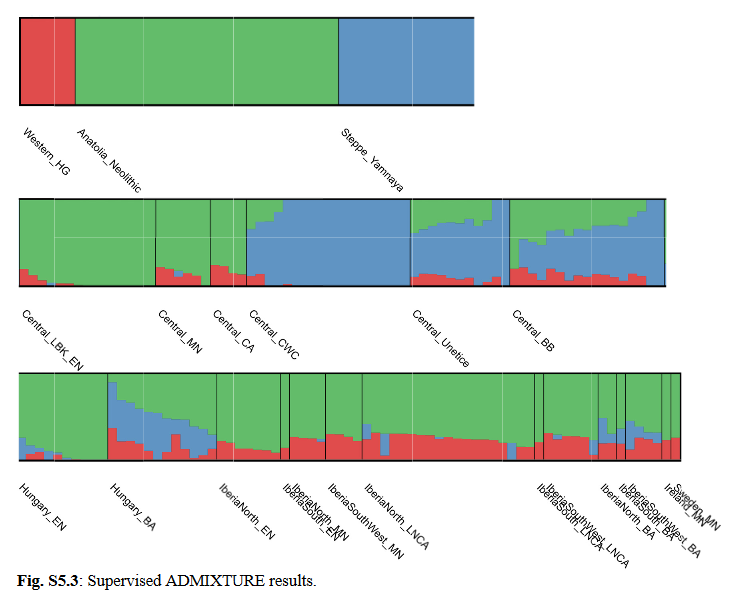
And to demonstrate it is as simple as digging into the supplementary materials and look at the unsupervised Admixture run (dataset S03), whose optimal columns (lowest CV scores) are K=16-19 (all four are optimal, what is fine with me but makes explanation and understanding a bit more dense). 

As that unsupervised admixture is massive, with lots of global populations ancient and modern, I made a selection using only the four optimal K-values (K=16 to K=19, from left to right):

Click to expand (labels at bottom are mine)

And it is absolutely clear from K=16 to K=18 that there is not a speck of the Caucasus component which is absolutely universal in all the true Indoeuropean samples. There is a tiny speck of it in the K=19 column but there even Sardinians and some Anatolian Neolithic individuals have it at much greater values and thus cannot anymore be automatically interpreted as Indoeuropean marker, but just as extra Caucasus affinity present in some Neolithic-derived populations or individuals more than others since the very beginning of mainline (Vasconic) European Neolithic at the Aegean.

And this is it. Quod erat demonstrandum (Q.E.D): R1b-S116, at least in Iberia, has nothing to do with Indoeuropean expansion, nothing at all: it is absolutely clear that it is a pre-Indoeuropean thing. And it has been present in Lower Rioja since at least the Bronze Age.

Furthermore, when we look at the Central European Bell Beaker (Central BB) samples and compare them with their immediate chronological precursors of (definitely Indoeuropean) Corded Ware culture, we must admit that there is a decrease of the Caucasus component and an increase of the Vasconic Neolithic (light blue) element. This also speaks against the Indoeuropean "explanation" for the expansion of R1b-S116 into Central Europe, because the first known such ancient carriers are from the Bell Beaker period and not a moment earlier, and these clearly express an anti-Indoeuropean tendency in their autosomal genomes.

There is however a sizable Indoeuropean component in modern non-Basque Iberians, smaller than in most other European populations but very clear nevertheless. This must have arrived at later times: (1) with the Celts, who arrived to Catalonia at the end of the Bronze Age, later expanding into Central and Western Iberia, (2) with the Romans, (3) maybe also to some extent with the Germanic invaders of the late Roman period. None of these expansions seem particularly associated with R1b-S116, however the c. 1% R1a and the c. 8% J2 (with plausible Italo-Roman origin) should be related to it, along with an assortment of other haplogroups. 

For those willing to dig in the details, there is also a small treasure trove of other ancient Y-DNA, mostly I (which underlines the Paleoeuropean influence in Neolithic Iberia, regardless of whether this is local or was carried on from further East by the Neolithic settlers), as well as one instance of unspecific R1b, another of G and another of H.

Someone may ask, which is then the origin and means of expansion of R1b-S116, if not Indoeuropean? Good question to which I don't have yet a well defined answer. But my tentative explanation is that it should be related to two ultimately related processes within Western European "Neolithic" (Late Neolithic and Chalcolithic): 
  1. The well documented phenomenon of increase, in most areas at least, of the Paleoeuropean component time passes, this may be to some extent because of simple absorption of local subneolithic "hunter-gatherers" but it probably also produced different subpopulations within the Western Neolithic and in some cases we do see these peripheral "Second Neolithic" groups expanding at the expense of the "First Neolithic" peoples. This is most clear in Central Europe with the expansion of Funnelbeaker cultures from, probably, Denmark and nearby areas of Low Germany. In fact Michelsberg culture and its close relative in France Seine-Oise-Marne basically wipe out the first farmers of LBK (Linear Pottery) at what I usually describe as the Chalcolithic but is often described as Middle or Late Neolithic in other sources.
  2. Clearly Bell Beaker had something to do: we see their impact in Germany, Britain and Ireland and one could argue that Cogotas I is somehow derived from the Bell Beaker of Ciempozuelos, although in this I'm going to remain neutral and a bit skeptic until more evidence shows up. 
But what seems very apparent tome is that R1b-S116 should have expanded from somewhere in France, probably towards the South. And we do need better genetic studies, including archaeogenetic ones, on the Hexagon before we can jump to conclusions. France is not the most affected area by Bell Beaker, so I am cautious about attributing too much weight to only Bell Beaker and I would rather think on a complex succession of expansions associated to various cultures. 

Of great interest here should be the ill-known but fascinating Artenacian culture, which expanded in all West France and Belgium from a core at Dordogne before the BB period and coincident with the Corded Ware expansion in Central Europe. Like Bell Beaker folk, they were adept at bowmanship but their area is not densely affected by Bell Beaker later on (although there is indeed a scatter of findings). I do wonder if somehow Bell Beaker is derived from Artenac, even if it is clearly not the same thing. Food for thought.


Update (March 18): small steppe-like noise appears in diverse Iberian samples since the Late Neolithic/Chalcolithic.

This has arisen in the discussion below (h/t to MZ): when the supervised (forced assignment to rigid three populations) is used, the appearance of "steppe" ancestry is found here and there also before the Bronze Age. As we see above, this is not real: it does not happen in the unsupervised model at all but mere "noise" or "artifact" produced by the excessive simplicity of the three populations model.


This does not make the three populations model "wrong": it is still approximately right but "evidence" produced  ONLY from rigidly applying this model is not evidence of anything, just a hint to be confirmed or rejected via wider analysis at best.

February 4, 2017

The patrilineage R1b-DF27 in North Iberia

Just weeks ago a new study on Northern Iberian Y-DNA, focused specifically on R1b-DF27, was published. It covers Asturias, Cantabria, Basque Country and Aragon, finding greater diversity in the Basque Country and Cantabria and lower in Aragon and Asturias.

Patricia Villaescusa et al., Characterization of the Iberian Y chromosome haplogroup R-DF27 in Northern Spain. FSI-Genetics 2017. Pay per viewLINK [doi:10.1016/j.fsigen.2016.12.013]

Abstract

The European paternal lineage R-DF27 has been proposed as a haplogroup of Iberian origin due to its maximum frequencies in the Iberian Peninsula. In this study, the distribution and structure of DF27 were characterized in 591 unrelated male individuals from four key populations of the north area of the Iberian Peninsula through the analysis of 12 Y-SNPs that define DF27 main sublineages. Additionally, Y-SNP allele frequencies were also gathered from the reference populations in the 1000 Genomes Project to compare and obtain a better landscape of the distribution of DF27. Our results reveal frequencies over 35% of DF27 haplogroup in the four North Iberian populations analyzed and high frequencies for its subhaplogroups. Considering the low frequency of DF27 and its sublineages in most populations outside of the Iberian Peninsula, this haplogroup seems to have geographical significance; thus, indicating a possible Iberian patrilineal origin of vestiges bearing this haplogroup. The dataset presented here contributes with new data to better understand the complex genetic variability of the Y chromosome in the Iberian Peninsula, that can be applied in Forensic Genetics.

The study, quite conveniently, differentiates between "native Basques" (those whose patrilineal ancestors lived in the Basque Country for at least the last three generations) and "resident Basques" (those whose recent patrilineal ancestors immigrated, mostly from NW Iberia).

R1b-DF27 is one of four major R1b sublineages in Western Europe and one of the three "brothers" that can be tracked to an origin somewhere in what is now Southern France, most likely, i.e. together they form part of R1b-S116. The fourth lineage would be, naturally, R1b-U106, "brother" of S116 and found typically around the North Sea. It is the one with the southernmost distribution, being very dominant in Iberia and among Basques. Probably it is also important in all the south of modern France but clear data is missing as of now.

Reconstructed spread of R1b to Western Europe and within it (dates objectively unknown so far, own work)

This is the key data table of the study, showing the frequency of the various sublineages of R1b-DF27 ("*" means "others", so "DF27", without asterisk, means "all DF27" and "DF27*" means instead "remaining DF27 after exclusion of the other mentioned subclades"):

Click to expand (frequencies are absolute, relative to whole sample)
It is also worth sticking this other graph, which shows (top right) the (SNP-based) true phylogeny of the haplogroup R1b-DF27 and, complementarily, the (somewhat messy) haplotype structure based on a limited number of short tandem repeats (STR), in which only Z220 appears clearly defined:

Click to expand

The study is very limited in its scope but it does show that there is a very high diversity for this lineage among Basques. This however does not necessarily indicate that Basques are the direct origin: much more data from the rest of Iberia and very especially from France is required before we can jump to any conclusion. Based on the limited data we have, I am of the opinion that the lineage did not originate in Iberia most likely but rather in what is now Southern France, migrating southwards via the two natural corridors: the Basque Country and Catalonia. 

Sadly enough we just do not have enough modern data, much less ancient one, in order to issue a definitive judgment on the matter. However the overall pattern of distribution of R1b-S116 strongly suggest a "Southern French" origin, not just for "Iberian" DF27 but also for the other two "brother" lineages: "Alpine" U152 and "North Atlantic" M529. 

The big question is how and when did this expansion took place. A "South French" origin was much easier to explain when the Paleolithic continuity model seemed reasonable, however recent ancient DNA findings strongly suggest that the Neolithic and Chalcolithic saw major population changes in much of Europe until stabilization was achieved -- exact patterns vary on specific regions: in some cases this does not happen until the Bronze Age, in others, like the Basque Country and quite possibly the Atlantic parts of France, it may have happened much earlier, even as soon as the early Neolithic. 

So my best recipe for an explanation is that we have to look very carefully at what happened in Western Europe, particularly towards the Atlantic Ocean in that "transitional" period, when not just large cultural phenomena like Dolmenic Megalithism or later also Bell Beaker manifested in quite expansive and dynamic manner but also a dearth of smaller cultures were the actual social or ethnic pieces making them possible. For example it is plausible that Michelsberg culture (originating in Lower Rhineland apparently and swiftly replacing the early Neolithic LBK culture in Germany, North France and nearby areas) could be involved in the expansion southwards of R1b-U106 and other traits of the modern genetic pools we observe. Another culture well worth taking a look at is the Artenac culture, which expanded from Dordogne towards the North up to Belgium soon after the Michelsberg/SOM era. Rather than one single and sudden expansion of a well defined population, it seems to me that we are before a jigsaw puzzle of several cultures and several chronologies, related maybe but not exactly the same.

See also:

Thanks once again to Jean Lohizun.

January 1, 2017

Reconstructing Sardinian population history

A very interesting pre-pub study, dealing with Sardinian genetics in great sub-national detail but also within the wider European and Mediterranean context, became available in the last weeks. I won't probably be able to make justice to it here, so please take a look yourselves.

Charleston W.K. Chiang et al., Population history of the Sardinian people inferred from whole-genome sequencing. BioRXiv 2016. Open access pre-pubLINK [doi:10.1101/092148]

Abstract

The population of the Mediterranean island of Sardinia has made important contributions to genome-wide association studies of traits and diseases. The history of the Sardinian population has also been the focus of much research, and in recent ancient DNA (aDNA) studies, Sardinia has provided unique insight into the peopling of Europe and the spread of agriculture. In this study, we analyze whole-genome sequences of 3,514 Sardinians to address hypotheses regarding the founding of Sardinia and its relation to the peopling of Europe, including examining fine-scale substructure, population size history, and signals of admixture. We find the population of the mountainous Gennargentu region shows elevated genetic isolation with higher levels of ancestry associated with mainland Neolithic farmers and depleted ancestry associated with more recent Bronze Age Steppe migrations on the mainland. Notably, the Gennargentu region also has elevated levels of pre-Neolithic hunter-gatherer ancestry and increased affinity to Basque populations. Further, allele sharing with pre-Neolithic and Neolithic mainland populations is larger on the X chromosome compared to the autosome, providing evidence for a sex-biased demographic history in Sardinia. These results give new insight to the demography of ancestral Sardinians and help further the understanding of sharing of disease risk alleles between Sardinia and mainland populations.

The authors call to some question the extreme simplicity of the three populations model of Lazaridis and subsequent studies. They do not flatly reject it but it seems that the lack of nuance bothers them a lot, as it does to me. This is quite clear when they find once and again Sardinian-Basque lines of relationship without going through Italian, Spaniard or French intermediaries, also when they face the issue of the largest Y-DNA haplogroups in the island, I2a1a (M26, almost exclusively a Sardinian and Pyrenean haplogroup) and R1b1a2 (M269), which are not typically associated with Neolithic farmers, suggesting that there is more to Neolithic settlement than meets the eye in the too simplistic three populations' model. They even seem to consider if Paleolithic peoples from Sardinia itself or maybe some other locations contributed heavily to what they feel is a sex-biased genetic pool.

They do confirm that Sardinians have both strong "Neolithic" (Stuttgart) and "Paleolithic" (Lochsbour) ancestry and no (negative even) "Steppe" (Yamnaya) one, although this last is truer for the most isolated sub-populations than for the more cosmopolitan ones. 

They also estimate that Sardinians have been generally isolated from the rest of Europeans for some 330 generations, what reads as approx. 9900 years, i.e. since the very early Neolithic settlement of the island. We would actually have to reduce that time span a bit but within reason, else it becomes Epipaleolithic in fact, what is most unlikely. Alternatively, as the main comparison is Northern Europe, this date could refer to the branching out of Painted-Linear (continental) and Impressed-Cardium (maritime) Neolithic cultures in the Aegean or the Balcans.

October 27, 2016

Mitochondrial DNA from post-Neolithic Santimamiñe (Basque Country)

Four human remains dated to the Bronze Age were sequenced for mitochondrial DNA in Santimamiñe cave (Kortezubi, Biscay, Basque Country), along with single instances from the Neolithic, Chalcolithic and Roman period.

J.C. López Quintana et al., NUEVOS DATOS SOBRE LA SECUENCIA DE USO SEPULCRAL DE LA CUEVA DE SANTIMAMIÑE (KORTEZUBI, BIZKAIA). Arqueología y Prehistoria del Interior Peninsular (ARPI), 2016. Freely accessible (PDF) → LINK [no DOI]


The mtDNA study is not "brand new" but a synthesis of a previous doctoral thesis and advance publications:

Un primer avance de este estudio fue publicado en la monografía de las campañas de 2004 a 2006 de Santimamiñe (Cardoso et al. 2011), incluyendo el conjunto completo en la Tesis Doctoral de L. Palencia Madrid (Palencia 2015).

So we are talking of relatively old data, that has partly remained within the (sometimes absurdly greedy and anti-social) academic circles until now. The relative antiquity of the DNA study is important when assessing it, because genetic analysis is evolving very fast and, in most cases in the rather closed and under-budgeted Spanish universitary circles, they tend to do things "the old way", so we are almost certainly dealing here with HVS-I sequencing, something that is not explicit in the paper (I'm searching for Leire Palencia's thesis to make sure but no luck until now). 

If I am correct in this (and I should be), then we must understand that it is impossible in many cases to determine the exact haplogroup in the crucial R0 upper tier haplogroup, which includes HV and the extremely common H. Lacking the original HVS-I sequences by the moment, I can't but take the authors labels at face value but I must warn here that where it reads "R0" it is almost certainly H (HV0 or V are easy to recognize with this method, as is R0a) and where it reads "H1" it is probably H1 but not 100% certain. 

For more details see the relevant PhyloTree page, where the HVS-I markers are the last bloc in blue, beginning always with the sequence "16" (the other markers in blue of lower numerical value are HVS-II, more rarely used, and the ones in black are the coding region markers, which are in this case fundamental for proper assignment).


The mtDNA haplogroups (as reported) are:

  • Neolithic:
    • U5a2a (S2011-M2, c. 5100 BCE)
  • Chalcolithic:
    •  T2b (S-1, c. 2000 BCE)
  • Bronze Age:
    • U5b (S2011-M1 c. 1700 BCE) 
    • H1 (S2011-M4, c. 1700 BCE)
    • R0 (S2011-M6, c. 1500 BCE)
    • U3a (S2011-M3 c. 1300 BCE)
  • Roman period: 
    • R0 (S2011-M5, c. 300 CE)


Interpretation attempts


It's difficult to extract conclusions from them but they should be compared with other sequences from the area, for which I recommend my 2013 synthesis. In general, treat "R0" as meaning "H", even if I chose to use a different color (magenta instead of red) for exactitude. 

In order to aid that analysis, I reproduce here my 2013 graphic:


We cannot compare the single Neolithic and Roman Era individuals but we can compare the Satimamiñe Chalcolithic+Bronze group of five sequences with the peripheral Chalcolithic large dataset of De La Rúa:

  1. R*+H (very similar):
    1. Peripheral "Basque" Chalcolithic: ~40%
    2. Santimamiñe Chalcolithic+Bronze: 40% 
    3. Santimamiñe Bronze only: 50%
  2. U(xK) (very different):
    1. Peripheral "Basque" Chalcolithic: ~15%
    2. Santimamiñe Chalcolithic+Bronze: 40%
    3. Santimamiñe Bronze only: 50%
  3. Other lineages (all them of certain Neolithic immigrant origin, very different too):
    1. Peripheral "Basque" Chalcolithic: ~45%
    2. Santimamiñe Chalcolithic+Bronze: 20%
    3. Santimamiñe Bronze only: 0%

However one of the U(xK) lineages in Santimamiñe is U3, which is also quite certain to be of Neolithic immigrant origin, and one is an important figure when n=5 so we can also see it this way:
  1. Paleolithic lineages:
    1. Peripheral "Basque" Chalcolithic: ~55%
    2. Santimamiñe Chalcolithic+Bronze: 60%
    3. Santimamiñe Bronze only: 75%
  2. Neolithic lineages:
    1. Peripheral "Basque" Chalcolithic:  ~45%
    2. Santimamiñe Chalcolithic+Bronze: 40%
    3. Santimamiñe Bronze only: 25%

The comparison of #1 with #2 is much more similar. This could be important, because Santimamiñe is not anymore a "peripheral" site, as are those from De La Rúa's dataset, but a rather central one with a extremely long and uninterrupted Paleolithic sequence, dating to Neanderthal-made Chatelperronian culture. It is still a single site with a small number of samples but it does provide a counterpoint that, in one approach could produce similar results. 

But, surprisingly, when we consider a distinct Bronze Age category, comparing not anymore with #2 but with #3 everything changes, suggesting a totally different interpretation of the available dataset, in which, the "Chalcolithic interlude" (if real at all, more data is needed) would be reversed quickly with the onset of the Bronze Age. 

I am sorry but I cannot lean for either interpretation: the data is just not extensive enough to allow for conclusions. I am tempted to support the continuity hypothesis, allowing only for lesser changes to happen, and keep the Chalcolithic dataset under a big question mark, but the question mark is admittedly a bit smaller now: something in terms demographic may have happened in the Chalcolithic period and may have been reversed in the Bronze Age. But "may" is not "for sure", we need more data points.

Feel free to discuss in good mood, as always.

Thanks for the heads up to Jean Lohizun (again).

June 9, 2016

Neolithic DNA from Greece and NW Anatolia and their influence on Europe

This is a most interesting study that brings to us potentially key information on the expansion of European Neolithic and the formation of modern European peoples.

Zuzana Hofmanová, Susanne Kreutzer et al., Early farmers from across Europe directly descended from Neolithic Aegeans. PNAS 2016. Open accessLINK [doi:10.1073/pnas.1523951113]

Abstract

Farming and sedentism first appeared in southwestern Asia during the early Holocene and later spread to neighboring regions, including Europe, along multiple dispersal routes. Conspicuous uncertainties remain about the relative roles of migration, cultural diffusion, and admixture with local foragers in the early Neolithization of Europe. Here we present paleogenomic data for five Neolithic individuals from northern Greece and northwestern Turkey spanning the time and region of the earliest spread of farming into Europe. We use a novel approach to recalibrate raw reads and call genotypes from ancient DNA and observe striking genetic similarity both among Aegean early farmers and with those from across Europe. Our study demonstrates a direct genetic link between Mediterranean and Central European early farmers and those of Greece and Anatolia, extending the European Neolithic migratory chain all the way back to southwestern Asia.


Uniparental DNA

One of the most important findings is that the two Epipaleolithic samples from Theopetra yielded mtDNA K1c, being the first time in which haplogroup K has been detected in pre-Neolithic Europe. Sadly enough these two individuals could not be sequenced for full genome. 

The other five individuals are all Neolithic (three early, two late) and did provide much more information.
  • Rev5 (c. 6300 BCE): mtDNA X2b
  • Bar31 (c. 6300 BCE): mtDNA X2m, Y-DNA G2a2b
  • Bar8 (c. 6100 BCE): mtDNA K1a2
  • Pal7 (c. 4400 BCE): mtDNA J1c1
  • Klei10 (c. 4100 BCE): mtDNA K1a2, Y-DNA G2a2a1b (same as Ötzi's)
I color coded their abbreviated names according to the usage in the study's many maps, for easier reference: green shades are for Greece (Western Macedonia), red shades for Turkey (Bursa district). It is also very convenient to get straight their real geography because many of the map-styled graphs are not precise at all about that:

Fig. 1.
North Aegean archaeological sites investigated in Turkey and Greece.


Autosomal DNA affinities

This is probably the most interesting part. There is a lot about it in the supplementary information appendix but I find that the really central issue is how they relate to each other (or not) and to other ancient and modern Europeans. I reorganized figs S21 and S22 to better visualize this:


Ancient samples compared to each other and other ancient samples ("inferred proportions of ancestry")
Ancient samples compared to modern Europeans ("inferred proportions of ancestry")


So what do we see here? First of all that the strongest contribution of known Aegean Neolithic peoples on mainline European Neolithic is from Bar31, which is from NW Anatolia, and not from Greece. Bar8 is a less important contributor but may have impacted particularly around the Alps (Stuttgart-LBK, modern North Italians).

This goes against most archaeology-based interpretations, which rather strongly suggest a Thessalian and West Macedonian origin of the Balcanic and, therefore, other European branches of the mainline Neolithic of Aegean roots, and do instead support some sort of cultural barrier near the European reaches of the Marmara Sea. Of course we lack exhaustive sampling of Greek Neolithic so far, so it might be still possible that other populations from Thessaly or Epirus could have been more important. However the lack of Anatolian-like influence on the Western Macedonian Neolithic until c. 4100 BCE, makes it quite unlikely.

So it seems that, once again, new archaeogenetic information forces us to rethink the interpretative theories based on other data.

However we do see a strong influence of Greek Neolithic and particularly the oldest sample, Rev5, in SW Europe, very especially among Basques, who seem to have only very minor Anatolian Neolithic ancestry, unlike everyone else relevant here. This impact is also apparent in Sardinia and to some extent North Italy (but overshadowed in these two cases by the one from Anatolia, particularly Bar31).

There are also similar analyses for other four ancient samples (Lochsbour, Stuttgart, Hungary Neolithic and Hungary Bronze) but they don't provide truly new information, so I'm skipping them here. As I said before, there's a hoard of analyses in the SI appendix, enjoy yourselves browsing through them and feel free to note in the comments anything you believe important.

A synthesis of the various "inferred proportions of ancestry" analyses is anyhow shown in fig. 3:

Fig. 3. (click to expand)
Inferred mixture coefficients when forming each modern (small pies) and ancient (large pies, enclosed by borders matching key at left) group as a mixture of the modern-day Yoruba from Africa and the ancient samples shown in the key at left.

The fractions may be misleading however, especially for the ancients. For example: Lochsbour (a total outlier among the ancients in this study) appears best correlated with Pal7 but in fig. S24 it is clear that does no correlate with any Neolithic sample at any significant level. But in general terms it can give a good idea of where does ancestry, particularly for modern samples, come from.

Note: elsewhere someone was being a crybaby about the Polish sample (may well be an error) or the Kalmyk sample (who are obviously most related to East Asians, not used here) but those are minor issues.

Of course there's a lot more to learn from the remains of the ancients. Let's keep up the good work.

May 4, 2016

Back to work

My apologies to readers for being for so long in "lazy mode". Actually I got interrupted largely by a request to provide a quality article on Basque, Sardinian and European origins for a soon to be published collective book in Basque language. This took me a lot of time and energies in late March and early April, so basically I put everything else on hold. The last weeks I've been resting indeed, what may be aggravated by a declining health that makes me sleep irregularly and often for much longer than most of you do. Being fed up with Internet information feeds and a quite active political reality also drain my energies to other endeavors, not to mention paperwork.

In this sense I want to announce that I have begun recently a new multi-purpose blog in Spanish language: Bagauda. Most of it is politics, I warn you, but I have also included the unedited raw article for that book I mention in the previous paragraph (prior to translation to Basque and corrections). I'm reasonably sure that those of you who have Spanish as primary or even secondary language will be interested in having a look (→ here).

Another relevant entry was the announcement of the upcoming congress on Iruña-Veleia to be held on May 7 in Vitoria-Gasteiz. You can still register but hurry up.

I will now proceed to comment in a separate entry on the news of the week, the Fu et al. study of a large array of Paleoeuropean ancient DNA. But, before I get to that, I must mention some interesting studies that I have not been able to get time to even properly read, let alone discuss:

  • K. Voskarides, S. Mazières et al., Y-chromosome phylogeographic analysis of the Greek-Cypriot population reveals elements consistent with Neolithic and Bronze Age settlements. Investigative Genetics 2016. Open accessLINK [doi:10.1186/s13323-016-0032-8]
  • B. Vernot et al., Excavating Neandertal and Denisovan DNA from the genomes of Melanesian individuals. Science 2016. Freely accessible (with registration?)LINK [doi:10.1126/science.aad9416]
  • Y.Y. Waldman, A. Biddanda et al., The Genetics of Bene Israel from India Reveals Both Substantial Jewish and Indian Ancestry. PLoS ONE 2016. Open access → LINK [doi: 10.1371/journal.pone.0152056]

Another intriguing new independent paper by a regular visitor and commenter to this blog, Olympus Mons, that I have not yet read is:

→ R1b from Sulaweri-Shomu to Bell Beaker, available as PDF or in blog format.

He seems to argue for a Caucasus origin of both the lineage and Bell Beaker phenomenon. I have no opinion as of yet, because, simply put, I have not been able to read it in full.

Another regular visitor here to have put an independent paper online, also on the issue of R1b origins, is Paul Conroy:

→ Anatole A. Klyosov and Paul M. Conroy, Origins of the Irish, Scottish, Welsh and English R1b-M222 population. Available at Paul's Academia.edu account.

Again I have not yet got the opportunity to read it, so no opinion. 

Feel free to use this entry to comment on any of the aforementioned studies or articles or to provide info about stuff I may have missed.

January 7, 2016

Alert Iruña-Veleia: quite apparent new destruction of archaeological evidence

Tonight I got a most undesirable alert: the controversial archaeological site of Iruña-Veleia, has been again excavated with heavy machinery, with the very possible intent of destroying key evidence.

For background see here, here, here, here, here and here.

The area affected by the destructive excavation by the partisan director Julio Núñez is exactly within the bounds of the exceptional graffiti findings area that triggered all the controversy (conservative linguists and historians didn't like what was found, as it challenged their "theories", so they organized an Inquisition of sorts to condemn, hide and even destroy the evidence). The following map published at Ama Ata, shows the original situation of the ancient house upon the intervention by the institutions:

In red: the area of exceptional findings (texts)

Judging on J.M. Elexpuru's photos, the whole sector has been dug and then recovered with new earth, what is totally not what archaeologists usually do, much less with such a hurry:


The visual survey of the discard pile shows at least one piece of sigilata pottery and a broken millstone, as well as a common fossil. This is surely just the tip of the iceberg, as nobody by the perpetrators know where the rest of the materials extracted went and what they may have included.

The most likely motivation for this excavation is the throughout destruction of archaeological material, which is potential evidence in the languishing judiciary case against the previous archaeological team, based on nothing but made-up accusations. Not a single piece of actual evidence has been put against them, while their right to defense has been infringed once and again, with pitiful, if not crony, actuations on the side of all involved institutions: a powerless judge, police lab that wash their hands, governments that act in the hiding, manipulating evidence while reporting to no one, researchers that produce junk reports, and then this replacement "archaeologist" who took part in the inquisitorial "expert commission".

Dozens of studies support the authenticity of the findings precisely in this spot, now under destruction. Not a single paper other than those created ad hoc (and belatedly) for the inquisitorial commission, most of them linguists' opinions with zero probatory weight, support the hypothesis of falsehood. However an institutional conspiracy seems determined to do their worst, after all who cares about ancient archaeology and historical truth? Not the masses obviously.

Main responsible persons (currently), according to Euskararen Jatorria.
Left: Department of Archaeology (EHU-UPV), middle: Regional Government of Araba, right: top directors of EHU-UPV.

To the list above we must add all those who took part or impelled the inquisitorial commission, notably linguists Joseba Lakarra and Joaquín Gorrochategui and the former Deputy of Culture Lorena López de Lacalle, whose continuous presence (along with her Opus Dei patron R. Larreina and her sister) in the recent electoral lists of supposedly leftist and pro-transparency EH Bildu coalition is most worrisome. 

More details in the blogs linked in-text (Spanish and Basque languages).

January 1, 2016

Basque R1b-DF27

Jean sent me a copy of this study (many weeks ago, admittedly), which is an update on the maybe more interesting previous paper by the same UPV-EHU team of June 2015, discussed in this entry.

Patricia Villaescusa et al., Dissection of the DF27 paternal lineage. FSI Genetics 2015. Freely accessibleLINK [doi: http://dx.doi.org/10.1016/j.fsigss.2015.09.172]

Abstract

The genetic evidence provided by the analysis of the Y chromosome is a valuable tool for the study of the evolution of paternal lineages. The dissection of S116, the major M269 subhaplogroup in Western and South-Western Europe uncovered an outstanding frequency of DF27 sublineage in the Basque region. In this study, a dissection of DF27 haplogroup was performed to the highest resolution to date in 340 individuals from the Basque Country. Our results describe frequency distribution patterns for some DF27 sublineages for the first time, and reveal a possible substructure of its paragroups.


And that's basically what it is. They found that Basque R1b-DF27 (70%) mostly belong to two categories: DF27* (31%) and S356 (28%), which are neatly distinct in the neighbor-joining haplotype structure, suggesting to the authors that the remaining DF27* may constitute a yet undescribed subhaplogroup.

Fig. 1. MJN of the DF27 haplogroup in the autochthonous Basque population sample. Two phylogenetic splits into DF27* and S356* paragroups can be observed.

Table 1 lists the frequencies in their Basque sample for a variety of markers under DF27, which includes 70% of Basque Y-DNA lineages. However there's also a significant fraction of R1b-S116* which they only mention by passing:
The high frequencies of DF27* and S116* paragroups indicate a probable existence of new subhaplogroups supporting the subdivision of both of them.

To understand this we have to go back to Valverde 2015, which detected high frequencies of paragroup R1b-S116* among Basques and Irish (but not other Iberians nor Bretons). There is a blank of knowledge about the exact details of R1b-S116 in France but otherwise we have a pretty good idea of the phylogenetic and geographic structure (what I call the "geostructure") of this most important European patrilineage. 

I won't repeat everything (please check the provided link and other links stemming from there for full details) but I will again synthesize what it means here because there is still some people who seems oblivious to factual reality about this haplogroup. An image is worth a thousand words:


My reconstruction of the origins of R1b-S116 based on known 'geostructure'

The three ovals represent very generically the distribution of the three major subclades of R1b-S116 (check the Valverde 2015 maps for full details), the two green stars represent confirmed areas of high R1b-S116* frequencies and the pale green star with the question mark represent possible other such areas in France, particularly an unconfirmed (unsourced) claim on this paragroup being very important at the Massif Central. If you know something more on this fine detail of R1b-S116 in France (or other relevant areas such as Britain, Germany), please share (with references). 

It has been recently known that some Bell Beaker period Irish already carried R1b-M529, what forces the origins of the overall S116 haplogroup to an older date necessarily, at the very least Early Chalcolithic, more likely Neolithic. I'll discuss those findings in an upcoming entry.

Personally I'm tempted for a Dordogne or Greater Aquitaine area of origin, i.e. rather to the West than to the East of the pink delimited region, but cannot be sure with the data we have as of now, particularly the many blanks in France's coverage. 

The claims about this major European lineage being original from Central Europe or even Eastern Europe are totally inconsistent with the data we have: they are nothing but wishful Indoeuropeanist thinking and totally within the realm of pseudoscience.

September 17, 2015

Vasco-Nubian?

This is something I've been chewing on for more than a year now and yet never got myself to blog about (although I have mentioned in private or in comments here and there). Impelled by the minor but quite apparent NE African influence, genetic and cultural, on the Neolithic peoples of the Levant, whose offshoots eventually landed in Greece triggering the European Neolithic, I decided in the Spring of 2014 to explore, via mass-lexical comparison, if Basque language (and by extension the wider Vasconic family, which I believe now to be that of mainline European Neolithic) might have any relation with Nubian languages. I did not expect to find anything but noise but to my surprise the number of apparent cognates is quite significant. 

My primary analysis was this one but now I have combined it with a comparison with Proto-Indoeuropean (PIE), which is also very probably related to the roots of Vasconic: LINK (open office spreadsheet). 

The synthesis is as follows:


Of course the "cognates" are only apparent cognates at this stage of the research and the evaluation is necessarily subjective. But judge yourselves. 

If we discard the "weak" apparent cognates, the vocabulary correlation between Basque and Nubian and between Basque and PIE is pretty similar. But, in my understanding, both are well above the noise threshold, an example of which could be the PIE-Nubian apparent cognates, which are many many less. 

I must say anyhow that the oblique apparent cognates, that is when one word sounds much not like its strict synonym but a related one (for example words meaning hot and fire), look all very solid and most intriguing. 

Also, when attributing probabilities to origins of Basque words, Nubian appears to be at the origin of almost double the words (26%) that can be attributed to PIE (15%). Of course, for lack of data or because they actually have other origins, the unknown origins apply to the majority of words (56%), double than the Nubian origin ones.

However Nubian here is constituted of three different languages (Dilling, Nobiin and Midob), while PIE is just a single theoretical construct. This last must be done this way because many modern and historical IE languages, notably in Europe, have other Vasconic substrate influences, which must be studied separately from general PIE-Vasconic shared vocabulary. This kind of late Vasconic influence is very much unlikely in the case of Nubian instead. In any case I don't know of any a proto-Nubian Swadesh list readily available. 

Finally I must mention that because the PDF format is horrible for copy-pasting, I chose to re-transcribe the Nubian words according to my best approximation using a normal keyboard (not always the same characters that the original list uses).


Strongest Basque-Nubian apparent simple cognates

  • Basque - Nubian languages (English)
  • azal - àzì, àzzì-di (bark)
  • haragi - árízh (meat)
  • odol - ógór, èggér (blood)
  • buru - úr (head)
  • oin - ó:y (foot)
  • esku - ish-i, ès-sì (hand)
  • hil* - di-ìl (to die)
  • euri - are, ara, áwwí, áré, árí, áró (rain)
  • harri - kugor, kakar (stone) [notice also the pre-IE root *kharr- speculated to be at the origin of Karst, etc.] 
  • lur - gùr (soil, ground)
  • haize - irsh-i, éss-í (wind)

There are some others that are shared with Indo-European and with similar subjective "weight", not listing them here to keep things clear. There are also other apparent cognates that are arguably less clear like bat - be (one) that I'm also skipping here but you can find in the spreadsheet.

*Hil (meaning both to die and to kill in Basque, which can't be confused because they conjugate differently) seems ancestral to English ill and kill (this one via a Germanic precursor).


The intriguing oblique cognates

Notice that these words do not mean the same, yet their meanings seem strikingly related.
  • Nubian (English) - Basque (English)
  • hor, koy, kà:r (tree) - harri (stone) [notice that zuhaitz (tree) can be interpreted etymologically as zur-haitz = wood-rock, so the relation is not that weird]
  • ok-i, og (breast) - ogi (bread)
  • a-l (heart) - ahal (can (verb), potential, power)
  • azh, àz-ír, àzza (to bite) - (h)ortz (tooth), aitz (rock, peak) [some argue that originally "to cut", present in many cutting tool names: aizkor = axe, aitzur = hoe, aizto = knife, etc.*]
  • shu, zhúù (to walk) - joan (to go) [often pronounced jun or shun]
  • é:zhi (water) - heze (wet) [also archaic particle *iz-, meaning "water" by all accounts: itxaso = sea, izurde = dolphin, izotz = ice, and common in Vasconic river toponymy]
  • zhuge (to burn) - su (fire) 
  • zhùg, sù, sú:w (hot) - su (fire)
  • úr-i, úrúm (black) - urdin (blue) [archaic also green, grey]

*This one is an obvious and very prevalent Vasconic substrate infiltrator in Western IE languages: axe, adze, azada (hoe in Spanish), etc.


How can this be possible?

It is of course a mere working hypothesis and ultimately you judge but I find it hard to disdain. However there is no apparent connection, notably no significant genetic connection, between Basques and Nubians. So how can we explain this?

I have it reasonably clear myself, so I made a map to explain it:


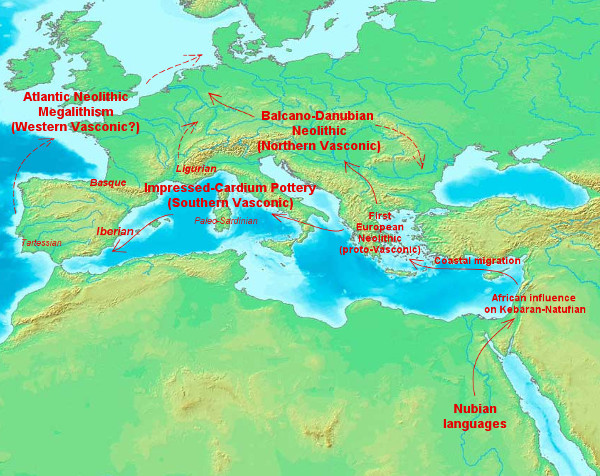
Basque is after all just the last survivor of a once much larger family (Vasconic), a family that most likely corresponds to the languages spoken by the early European farmers (mainline Neolithic of Aegean roots). As that expansion was largely done in about a mere thousand years, I estimate that when both branches met near the Rhine, the two peoples could still understand each other, even if with some difficulty. Only the Southern/Western branch(-es) survived long enough to leave historical evidence, so it is hard to guess how the Northern branch evolved anyhow.

The Nubian linguistic connection is anyhow not the only thing that requires the Levant or Palestinian Neolithic step, also Y-DNA E1b-M78 (mostly V13 in Europe, attested in some early farmers and still very important among Greeks and Albanians particularly) and probably the so-called "Basal Eurasian" component that Lazaridis detected among early European farmers and that could well be the signature of African genetics from the Nile.

Linguistically, also the very notorious presence of Semitic (an Afroasiatic branch) in West Asia is surely another legacy of the same African influences in the Mesolithic Levant. Before this research, I thought it was the only one but now I strongly suspect that at some point Nubian (Nilo-Saharan) languages were also present in the region. Maybe one (Nubian evolving towards Vasconic) corresponded to Natufian proper and the other (proto-Semitic) to Harifian, the semi-desert pastoralist facies of the same wider culture. Can't say for sure.

The chain was once long but now only some of the most distant links remain unbroken. It is difficult to imagine that they were ever connected at all...


To do...

A lot remains to be done, of course:
  • These mass lexical comparisons only apply to a few families in the region and the rest should also be tested for. My energies are limited and so are my qualifications as "linguist", so I encourage others, hopefully more energetic and knowledgeable, to expand.
  • Grammatical features cannot be analyzed by this methodology. Again my means are limited. 
  • Anthropological research would be an interesting complement. So far the only shared cultural trait I could spot would be the use of bells attached to ankles for dancing but there could be others. 
  • ...