Showing posts with label Bronze Age. Show all posts

March 19, 2018

Quickie: the pre-Indoeuropean evolution of ancient Iberians: from 'Sardinian' to 'Basque'

This may be needed as transition between the ancient Iberian genetic data of Valdiosera and Günther that I discussed two days ago and the modern Iberian genetic data that I'm planning to discuss very soon (just chewing on the data, because it is a bit perplexing in some aspects, but ref. Bycroft 2018 if you want to peek on it on your own). 

Fig. 1B from Valdiosera, Günther et al. 2018, annotated by me.

Just that: we see very clearly how ancient Iberians were at the beginning of Neolithic like modern Sardinians and by the time of Chalcolithic in some cases and at the Bronze Age everywhere, they had turned into something like modern Basques, i.e. more Paleoeuropean but not yet more Indoeuropean at all. 

Modern Spaniards/Iberians seem to be mostly that Basque-like Bronze Age base plus some Indoeuropean admixture from either the continent (Celts surely) or Italy (Romans no doubt). 

Maybe it is like stating the obvious but the obvious is not always obvious for everyone and understanding this will be handy when dealing with modern Iberian DNA and its structure.

March 17, 2018

Oldest known Iberian R1b-S116 (and DF27) is NOT at all Indoeuropean

This study is very interesting but it is very wrongly argued, maybe in an attempt to fit their findings with what has sadly become the mainstream current of "explanation" about the origins Y-DNA haplogroup R1b-S116 (also P312, etc.)

Cristina Valdiosera, Thorsten Günther et al. Four millennia of Iberian biomolecular prehistory illustrate the impact of prehistoric migrations at the far end of Eurasia. PNAS 2018. DOI:10.1073/pnas.1717762115

The issue is that they found the very first known carrier of R1b-S116 (and R1b-DF27, the main Iberian haplogroup) in an individual of the Bronze Age of Lower Rioja (Cueva de Los Lagos, Alhama de Cervera), belonging very clearly to the Central Iberian culture of Cogotas I, even if it is at its very northeast margin.

What is wrong? Well, the very title is wrong. It is nothing but an artifact produced by forced (supervised) results of Admixture within the simplistic 3-population model. Even then their result is in fact so weak that it immediately cried to me as "artifact" (noise or whatever you want to call it) and it is effectively nothing but that. 

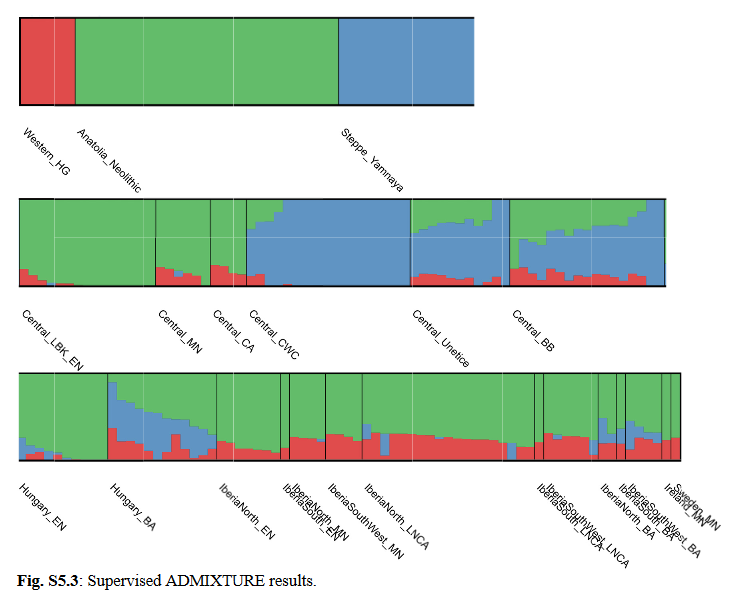
And to demonstrate it is as simple as digging into the supplementary materials and look at the unsupervised Admixture run (dataset S03), whose optimal columns (lowest CV scores) are K=16-19 (all four are optimal, what is fine with me but makes explanation and understanding a bit more dense). 

As that unsupervised admixture is massive, with lots of global populations ancient and modern, I made a selection using only the four optimal K-values (K=16 to K=19, from left to right):

Click to expand (labels at bottom are mine)

And it is absolutely clear from K=16 to K=18 that there is not a speck of the Caucasus component which is absolutely universal in all the true Indoeuropean samples. There is a tiny speck of it in the K=19 column but there even Sardinians and some Anatolian Neolithic individuals have it at much greater values and thus cannot anymore be automatically interpreted as Indoeuropean marker, but just as extra Caucasus affinity present in some Neolithic-derived populations or individuals more than others since the very beginning of mainline (Vasconic) European Neolithic at the Aegean.

And this is it. Quod erat demonstrandum (Q.E.D): R1b-S116, at least in Iberia, has nothing to do with Indoeuropean expansion, nothing at all: it is absolutely clear that it is a pre-Indoeuropean thing. And it has been present in Lower Rioja since at least the Bronze Age.

Furthermore, when we look at the Central European Bell Beaker (Central BB) samples and compare them with their immediate chronological precursors of (definitely Indoeuropean) Corded Ware culture, we must admit that there is a decrease of the Caucasus component and an increase of the Vasconic Neolithic (light blue) element. This also speaks against the Indoeuropean "explanation" for the expansion of R1b-S116 into Central Europe, because the first known such ancient carriers are from the Bell Beaker period and not a moment earlier, and these clearly express an anti-Indoeuropean tendency in their autosomal genomes.

There is however a sizable Indoeuropean component in modern non-Basque Iberians, smaller than in most other European populations but very clear nevertheless. This must have arrived at later times: (1) with the Celts, who arrived to Catalonia at the end of the Bronze Age, later expanding into Central and Western Iberia, (2) with the Romans, (3) maybe also to some extent with the Germanic invaders of the late Roman period. None of these expansions seem particularly associated with R1b-S116, however the c. 1% R1a and the c. 8% J2 (with plausible Italo-Roman origin) should be related to it, along with an assortment of other haplogroups. 

For those willing to dig in the details, there is also a small treasure trove of other ancient Y-DNA, mostly I (which underlines the Paleoeuropean influence in Neolithic Iberia, regardless of whether this is local or was carried on from further East by the Neolithic settlers), as well as one instance of unspecific R1b, another of G and another of H.

Someone may ask, which is then the origin and means of expansion of R1b-S116, if not Indoeuropean? Good question to which I don't have yet a well defined answer. But my tentative explanation is that it should be related to two ultimately related processes within Western European "Neolithic" (Late Neolithic and Chalcolithic): 
  1. The well documented phenomenon of increase, in most areas at least, of the Paleoeuropean component time passes, this may be to some extent because of simple absorption of local subneolithic "hunter-gatherers" but it probably also produced different subpopulations within the Western Neolithic and in some cases we do see these peripheral "Second Neolithic" groups expanding at the expense of the "First Neolithic" peoples. This is most clear in Central Europe with the expansion of Funnelbeaker cultures from, probably, Denmark and nearby areas of Low Germany. In fact Michelsberg culture and its close relative in France Seine-Oise-Marne basically wipe out the first farmers of LBK (Linear Pottery) at what I usually describe as the Chalcolithic but is often described as Middle or Late Neolithic in other sources.
  2. Clearly Bell Beaker had something to do: we see their impact in Germany, Britain and Ireland and one could argue that Cogotas I is somehow derived from the Bell Beaker of Ciempozuelos, although in this I'm going to remain neutral and a bit skeptic until more evidence shows up. 
But what seems very apparent tome is that R1b-S116 should have expanded from somewhere in France, probably towards the South. And we do need better genetic studies, including archaeogenetic ones, on the Hexagon before we can jump to conclusions. France is not the most affected area by Bell Beaker, so I am cautious about attributing too much weight to only Bell Beaker and I would rather think on a complex succession of expansions associated to various cultures. 

Of great interest here should be the ill-known but fascinating Artenacian culture, which expanded in all West France and Belgium from a core at Dordogne before the BB period and coincident with the Corded Ware expansion in Central Europe. Like Bell Beaker folk, they were adept at bowmanship but their area is not densely affected by Bell Beaker later on (although there is indeed a scatter of findings). I do wonder if somehow Bell Beaker is derived from Artenac, even if it is clearly not the same thing. Food for thought.


Update (March 18): small steppe-like noise appears in diverse Iberian samples since the Late Neolithic/Chalcolithic.

This has arisen in the discussion below (h/t to MZ): when the supervised (forced assignment to rigid three populations) is used, the appearance of "steppe" ancestry is found here and there also before the Bronze Age. As we see above, this is not real: it does not happen in the unsupervised model at all but mere "noise" or "artifact" produced by the excessive simplicity of the three populations model.


This does not make the three populations model "wrong": it is still approximately right but "evidence" produced  ONLY from rigidly applying this model is not evidence of anything, just a hint to be confirmed or rejected via wider analysis at best.

Most interesting video-conference on Luwians, Troy and the Sea Peoples

All archaeogenetics and no archaeology makes people go mad. So let's spice this a bit with this absolutely enticing video of a conference by Dr. Eberhard Zangger, which I have watched thrice already, twice tonight alone.


I love the general outline of the exposition even if I know some details, like the outline of Lower Troy are controversial. 

I also did pose the following questions as commentary to the video:
  1. How can the professor be so sure that all ancient Western Anatolian nations were Luwian and not from other diverse ethnicities? How that they were the only ones in the last Sea Peoples' wave? Just the same we see some non-Greeks in the Greek side of the Trojan war, I would expect some non-Luwians in the Trojan side as well, assuming the Trojans were Luwians and not Tyrsenians or something else. 
  2. What about the Phrygians who show up in Anatolia, West and East (Armenians) after the Bronze Age collapse, out of nothing (they seem to originate in an obscure Paeonian tribe, the Bryges)? Not a single mention of them: I guess they would blurr the nice "Luwian" homogeneity. 
  3. What about the Greeks (Danaoi, Denesh) and their Pelasgian (Peleset, Philistine) neighbors and often allies (Achilles himself and his Myrmidons were that)? They seem also involved in that late Sea Peoples wave and there is coincidence of cultural Hellenization (and not Luwianization) of Cyprus precisely in that period of the late Sea Peoples' attacks against Syria, Egypt and whatever else. Let's not forget that the Egyptians speak of the foreign peoples making a COALITION in their "islands", and I would say that this coalition involved peoples from all the Aegean, and not just the Asian side of it (although very good point about Evans' racism and his horrible influence on Aegean studies). 
But please don't let my nit-pickiness wrong what I think is a great conference dealing with a topic that has been way too neglected and even purposely ignored. There is a lot of good stuff in the video.

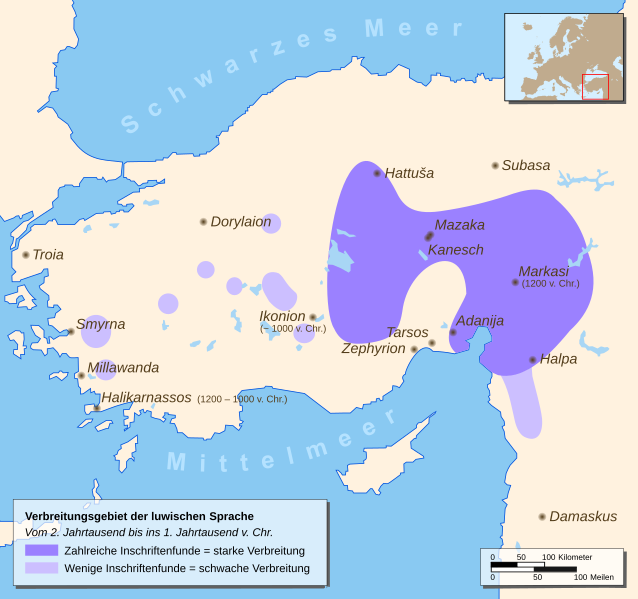
By the way, this is the Wikipedia map of Luwian inscriptions (unsure of what exactly the German legend says, "early" and "late" maybe?, but it's definitely about Luwian inscriptions):

Credit: Hendrik Tammen (CC-license)

March 16, 2018

Ancient DNA from the Balkans

This study has been for several months around but I have not discussed until now and is well worth a mention.

Ian Mathieson et al., The Genomic History Of Southeastern Europe. BioRXiv (pre-pub) 2017. doi:10.1101/135616

There is a lot of ancient autosomal DNA from the region but it basically says one thing: everything was almost exactly as expected from archaeology. The Karanovo-Gumelnita people, famed for inventing the Bronze Age a whole millenium earlier than anyone else, and nearby related cultures, were within the mainstream (Vasconic) Neolithic genetic grouping. This changed however with the kurgan invasion expressed primarily in the Ezero culture, which I've been told should be considered direct precursors of Thracians. But the change is not something radical: more genetic affinity with the steppe is visible than before and more generalized through all samples. 

Fig. 1-D - Supervised ADMIXTURE plot, modeling each ancient individual (one per row), as a mixture of
populations represented by clusters containing Anatolian Neolithic (grey), Yamnaya from Samara (yellow), EHG (pink) and WHG (green).
  (click to expand)


Well, it is not exactly everything what is as expected, if we consider Polish Globular Amphorae culture, which I would have expected to be at least somewhat steppary, Indoeuropean, already but were not. Thus it seems I have to concede on this culture and its precursors being still part of the Vasconic Neolithic. This makes Indoeuropean penetration into Central-North Europe a much more sudden episode and one directly tied to Corded Ware culture and nothing else. It must have been perceived by its victims like a massive catastrophe, because it was a huge area which they conquered and to a large extent colonized in a very short span of time.


Lots of R1b in Epipaleolithic Balkans

Most interesting anyhow is the huge hoard of ancient Y-DNA R1b in the Iron Gates region (Lepenski Vir) before the Neolithic. This not only demonstrates, again, that this haplogroup is Paleoeuropean, at least in part, but, quite intriguingly makes earlier findings on modern data suggesting a possible origin or R1b-M269 in or near modern Serbia (Morelli 2010 and Myres 2010) at least somewhat plausible. However none of the Iron Gates R1b is described as R1b-M269 and in some cases it is excluded that it could be this sublineage. 

Thus the issue of the ultimate origins of this key lineage remains open, but let me underline that these Iron Gate individuals belonged to the WHG grouping, as did Villabruna (so far the oldest R1b carrier kown) and that they breach this way the assumed haplogroup homogeneity I2 conceived on merely Central and Northern European samples. Just as happened with mtDNA U haplogroup homogeneity when mtDNA H was detected by several independent studies of Iberian ancient DNA. It is normal to expect more diversity towards the south for several reasons but maybe the most critical of them is just average temperature, which makes the southern lands naturally more fertile (notably so for crops domesticated in the Middle East) and easier to inhabit. 

This trend was only broken in the Middle Ages when the heavy plough allowed the improved exploitation of deep Oceanic soils, being useless in the Mediterranean region of shallow soils however. It was only then when the center of European development moved from south to north, to Belgium specifically, where it remains till present day. So let's take Southern Europe a bit seriously, please.

January 9, 2017

Extensive ancient Iberian mtDNA analysis

A very interesting thesis on Iberian ancient mitochondrial DNA is available (found via Bell Beaker Blogger):

Christina Roth, Once upon a time in the West : paleogenetic analyses on Mesolithic to Early Bronze Age individuals from the Iberian Peninsula. University of Mainz (thesis), 2016. Freely availableLINK

As all theses, it is very extensive, and I can only make some comments here (space and time are always too limited, you know), hoping to grasp the most interesting aspects of it.

First of all Roth finds that Iberian hunter-gatherers (HGW in the paper) were not quite like Central European ones (HGC), at least not in the mtDNA. Instead, in this aspect the Central European hunter-gatherers were closer to Eastern European ones (HGE), as well as to the Pitted Ware late subneolithic population of Gotland.


Iberia-only mtDNA analysis


This will be a recurrent issue along the analysis she makes. But let's focus on Iberia by the moment. Notice that she does not just use her own data but also from many other sources, including some unpublished materials, this makes a bit difficult to follow all the details, so I feel I can only focus on the statistical analysis she makes and which is the core of the thesis.

Annotated by me, because I found the abbreviations quite hard to follow

The general overview is confirmed, with minor variations, in the cluster analysis (which I also took the liberty of annotating, but take my notes for what they are: mere scribbling on the margin in an attempt to better understand the data, nothing else):


Particular care not to take the arrows of my notes too seriously: they are just conceptual, a very loose sequencing of the available data for a very tentative visualization of it. If it helps you, cool, else ignore please.

In any case, it seems clear cluster 2 is more influenced by hunter-gatherer genetics and that, with the data available in this study, we reach the end of the timeline within it in the following regions: Upper Ebro and Basque Country (data up to Late Neolithic but see my own 2013 compilation for a longer period), Southern Iberia (up to Chalcolithic) Southeast and Northeast, this one after originally being in the "more Neolithic" cluster 1 (in fact the author does argue for Catalonia as main "gate" for Neolithic genetics into Iberia on light of the available data, which does not include another important "gate", the SE one, for lack of data for the early period).

Inversely, cluster 1 is more influenced by "farmer" genetics, first detected in the Northeast (Catalonia and nearby areas of Aragon) but then also affecting the Northern Plateau and the West (Central Portugal). This last is very important because it is here where a key civilizational hub, the oldest known civilization of the Atlantic shores, emerged in the Chalcolithic, playing a key role in the wider Megalithic and Bell Beaker phenomena. I have at times speculated that it might be the origin of "modernity" in Western European genetic pools but on light of this data I have to recant, the origin should be elsewhere, probably in/around what is now France (and therefore it's not likely to be directly related to Bell Beaker, except maybe in the islands, but rather to Michelsberg/SOM, Artenacian and such -- always in wait of more data, just a cautious hypothesis). 

Finally the farmer-leaning cluster reaches the Southern Plateau, near Madrid, what suggests a N→S move of the then-forming Cogotas I herder culture, rather than the opposite. 

What we do see is not inconsistent with modern Iberian genetics anyhow: while Central Europe seem to have seen an increase of "hunter-gatherer" genetics along time, in Iberia the main tendency is the opposite: an increase of "farmer" genetics and further dilution of the aboriginal genetic pool. There is however at least one clear exception in the Northeast and that is also consistent with modern Iberian genetics. Some regions (south, southeast and the totally unknown northwest) have only fragmentary sequences here, so unclear, although the final tendency, up to the Bronze Age, is to cluster 2b (i.e. mixed but rather tending to "hunter-gatherer" genetics).

To finish with the Iberia-only bloc, notice that these are the lineages found among early Iberian farmers by region (in color those haplogroups associated to the arrival of Neolithic per the available data):


Notice how the pool in the Northern region is quite modern-like, not yet exactly as it is locally today but it would pass quite unnoticed in a map of Europe.


Iberia and the rest of Europe


What about the pan-European context (with the usual huge blanks in France, Britain, etc.)? Quite interesting as well:

Annotated by Maju on fig. 23 (click to enlarge)


As mentioned before, the Iberian hunter gatherers (HGW) appear clearly distinct from their Central and Eastern cousins in the mtDNA analysis. And with all this Iberian dataset it becomes apparent that there seem to be two "zones of admixture": one for Iberians and another for Central Europeans, the difference being on which aborigines they mix with. 

Notice that it is not possible to differentiate here between local Central European and intrusive Eastern European admixture, as both aboriginal hunter-gatherer populations appear closely related in all analyses (maybe an artifact of the sampling strategy or maybe actually relevant, can't say). 

It also caught my eye that a German site (Blätterhöhle, Westfalia, famed because farmer and hunter-gatherers living side by side were located there some years ago), clusters intensely with Iberian hunter-gatherers and related populations. I have to research more on this matter (which I had ignored so far) but I suspect it may be very relevant, because we could get an even longer chain of early "modern" mtDNA pools, adding this site to Paternabidea (Navarre) and Gurgy (Burgundy), spanning a long stretch of Western Europe, an area quite neglected by archaeogenetics so far, it must be said.

It is also worth mentioning that UC (which I believe stands for Unetice Culture) pulls the "Central European zone of admixture" in the PCA downwards, with a polarity of its own, a polarity that should probably be considered as specifically Indoeuropean. 

The cluster analysis confirms much of what I just said above, not annotated for a change:


We see very clearly here a larger cluster more influenced by "farmer" genetics and a smaller one that includes all pre-Neolithic aborigines, plus two populations already post-Neolithic but clearly identifiable as at least largely aboriginal (PWC and BLA), plus a subcluster of Neolithic Iberians, from the North (NSE and EVN) and the West (CPE). 

The author notices that: Bernburg (BEC) and Funnel Beaker (FBC) samples (...) show almost no significant differences to any Iberian group, except to the Early Neolithic of Northern Spain (NSE) and Chalcolithic of East Spain (ESC). Hard to interpret but worth noticing, no doubt.

And there is a lot more in the thesis but I can only review so much, so take a look and tell me and the World if I'm missing something of relevance or you feel I'm misinterpreting something or whatever.

October 27, 2016

Mitochondrial DNA from post-Neolithic Santimamiñe (Basque Country)

Four human remains dated to the Bronze Age were sequenced for mitochondrial DNA in Santimamiñe cave (Kortezubi, Biscay, Basque Country), along with single instances from the Neolithic, Chalcolithic and Roman period.

J.C. López Quintana et al., NUEVOS DATOS SOBRE LA SECUENCIA DE USO SEPULCRAL DE LA CUEVA DE SANTIMAMIÑE (KORTEZUBI, BIZKAIA). Arqueología y Prehistoria del Interior Peninsular (ARPI), 2016. Freely accessible (PDF) → LINK [no DOI]


The mtDNA study is not "brand new" but a synthesis of a previous doctoral thesis and advance publications:

Un primer avance de este estudio fue publicado en la monografía de las campañas de 2004 a 2006 de Santimamiñe (Cardoso et al. 2011), incluyendo el conjunto completo en la Tesis Doctoral de L. Palencia Madrid (Palencia 2015).

So we are talking of relatively old data, that has partly remained within the (sometimes absurdly greedy and anti-social) academic circles until now. The relative antiquity of the DNA study is important when assessing it, because genetic analysis is evolving very fast and, in most cases in the rather closed and under-budgeted Spanish universitary circles, they tend to do things "the old way", so we are almost certainly dealing here with HVS-I sequencing, something that is not explicit in the paper (I'm searching for Leire Palencia's thesis to make sure but no luck until now). 

If I am correct in this (and I should be), then we must understand that it is impossible in many cases to determine the exact haplogroup in the crucial R0 upper tier haplogroup, which includes HV and the extremely common H. Lacking the original HVS-I sequences by the moment, I can't but take the authors labels at face value but I must warn here that where it reads "R0" it is almost certainly H (HV0 or V are easy to recognize with this method, as is R0a) and where it reads "H1" it is probably H1 but not 100% certain. 

For more details see the relevant PhyloTree page, where the HVS-I markers are the last bloc in blue, beginning always with the sequence "16" (the other markers in blue of lower numerical value are HVS-II, more rarely used, and the ones in black are the coding region markers, which are in this case fundamental for proper assignment).


The mtDNA haplogroups (as reported) are:

  • Neolithic:
    • U5a2a (S2011-M2, c. 5100 BCE)
  • Chalcolithic:
    •  T2b (S-1, c. 2000 BCE)
  • Bronze Age:
    • U5b (S2011-M1 c. 1700 BCE) 
    • H1 (S2011-M4, c. 1700 BCE)
    • R0 (S2011-M6, c. 1500 BCE)
    • U3a (S2011-M3 c. 1300 BCE)
  • Roman period: 
    • R0 (S2011-M5, c. 300 CE)


Interpretation attempts


It's difficult to extract conclusions from them but they should be compared with other sequences from the area, for which I recommend my 2013 synthesis. In general, treat "R0" as meaning "H", even if I chose to use a different color (magenta instead of red) for exactitude. 

In order to aid that analysis, I reproduce here my 2013 graphic:


We cannot compare the single Neolithic and Roman Era individuals but we can compare the Satimamiñe Chalcolithic+Bronze group of five sequences with the peripheral Chalcolithic large dataset of De La Rúa:

  1. R*+H (very similar):
    1. Peripheral "Basque" Chalcolithic: ~40%
    2. Santimamiñe Chalcolithic+Bronze: 40% 
    3. Santimamiñe Bronze only: 50%
  2. U(xK) (very different):
    1. Peripheral "Basque" Chalcolithic: ~15%
    2. Santimamiñe Chalcolithic+Bronze: 40%
    3. Santimamiñe Bronze only: 50%
  3. Other lineages (all them of certain Neolithic immigrant origin, very different too):
    1. Peripheral "Basque" Chalcolithic: ~45%
    2. Santimamiñe Chalcolithic+Bronze: 20%
    3. Santimamiñe Bronze only: 0%

However one of the U(xK) lineages in Santimamiñe is U3, which is also quite certain to be of Neolithic immigrant origin, and one is an important figure when n=5 so we can also see it this way:
  1. Paleolithic lineages:
    1. Peripheral "Basque" Chalcolithic: ~55%
    2. Santimamiñe Chalcolithic+Bronze: 60%
    3. Santimamiñe Bronze only: 75%
  2. Neolithic lineages:
    1. Peripheral "Basque" Chalcolithic:  ~45%
    2. Santimamiñe Chalcolithic+Bronze: 40%
    3. Santimamiñe Bronze only: 25%

The comparison of #1 with #2 is much more similar. This could be important, because Santimamiñe is not anymore a "peripheral" site, as are those from De La Rúa's dataset, but a rather central one with a extremely long and uninterrupted Paleolithic sequence, dating to Neanderthal-made Chatelperronian culture. It is still a single site with a small number of samples but it does provide a counterpoint that, in one approach could produce similar results. 

But, surprisingly, when we consider a distinct Bronze Age category, comparing not anymore with #2 but with #3 everything changes, suggesting a totally different interpretation of the available dataset, in which, the "Chalcolithic interlude" (if real at all, more data is needed) would be reversed quickly with the onset of the Bronze Age. 

I am sorry but I cannot lean for either interpretation: the data is just not extensive enough to allow for conclusions. I am tempted to support the continuity hypothesis, allowing only for lesser changes to happen, and keep the Chalcolithic dataset under a big question mark, but the question mark is admittedly a bit smaller now: something in terms demographic may have happened in the Chalcolithic period and may have been reversed in the Bronze Age. But "may" is not "for sure", we need more data points.

Feel free to discuss in good mood, as always.

Thanks for the heads up to Jean Lohizun (again).

January 3, 2016

Irish ancient DNA

This study was published just a few days ago but is already from the previous year, tricks of the calendar. It is a scheme-breaker in several aspects, so I hope to be able to reflect here the most important aspects of it.

Lara M. Cassidy, Rui Martiniano et al., Neolithic and Bronze Age migration to Ireland and establishment of the insular Atlantic genome. PNAS 2015. Freely accessibleLINK [doi: 10.1073/pnas.1518445113]

Abstract

The Neolithic and Bronze Age transitions were profound cultural shifts catalyzed in parts of Europe by migrations, first of early farmers from the Near East and then Bronze Age herders from the Pontic Steppe. However, a decades-long, unresolved controversy is whether population change or cultural adoption occurred at the Atlantic edge, within the British Isles. We address this issue by using the first whole genome data from prehistoric Irish individuals. A Neolithic woman (3343–3020 cal BC) from a megalithic burial (10.3× coverage) possessed a genome of predominantly Near Eastern origin. She had some hunter–gatherer ancestry but belonged to a population of large effective size, suggesting a substantial influx of early farmers to the island. Three Bronze Age individuals from Rathlin Island (2026–1534 cal BC), including one high coverage (10.5×) genome, showed substantial Steppe genetic heritage indicating that the European population upheavals of the third millennium manifested all of the way from southern Siberia to the western ocean. This turnover invites the possibility of accompanying introduction of Indo-European, perhaps early Celtic, language. Irish Bronze Age haplotypic similarity is strongest within modern Irish, Scottish, and Welsh populations, and several important genetic variants that today show maximal or very high frequencies in Ireland appear at this horizon. These include those coding for lactase persistence, blue eye color, Y chromosome R1b haplotypes, and the hemochromatosis C282Y allele; to our knowledge, the first detection of a known Mendelian disease variant in prehistory. These findings together suggest the establishment of central attributes of the Irish genome 4,000 y ago.


The two sample sites are from North Ireland, being the so-called Neolithic one from the interior (Co. Down, c. 3200 BCE) and the so-called Bronze Age ones are from a small island (Rathlin) north of the main island (Rathlin 1 and 2 from c. 1900 BCE, Rathlin 3 from c. 1600 BCE). 

I say "so-called" because I'm not really confident that the terms "Neolithic" and "Bronze Age" apply in fact to most of them (I'd rather use Chalcolithic, shorthand for "advanced Neolithic with social complexity, regardless of metals", for all but Rathlin 3). I think in any case that the divider here is not metallurgy as such but actually the Bell Beaker divide: before and after Bell Beaker.

Bell Beaker is becoming a key element to our understanding of the demographic changes in Northern Europe, more than I would have expected admittedly. In the case of Ireland (and to a lesser extent parts of Britain) the arrival of the Bell Beaker phenomenon is accompanied with striking demographic growth, which may (or not) imply new settlement from outside. For Ireland, it seems growingly clear now, it probably does, unless Rathlin is a very unusual site, what is not parsimonious as we will see. 

Enough with the intro, let's get to the substance.

 
Haploid genetics

Ballanyhatty (Co. Down), a woman, carried the mitochondrial haplogroup (matrilineage) HV0. Rathlin 1 carried U5a1b1e, Rathlin 2 U5b2a2 and Rathlin 3 carried J2b1a. The only thing remarkable here is the lack of haplogroup H, the most common one in Europe today and detected since the Magdalenian era in Iberia, but more commonly later on within Neolithic. It can be a fluke of course but the shallow impression is that the mtDNA pool is "pre-modern". However all the rest is very "modern" in Rathlin Island, so... let's assume it's a mere fluke.

The three Rathlin individuals are all men, and their Y-DNA haplogroup has been successfully sequenced: they all belong to R1b-M529, the most common patrilineage in Ireland (and much of Britain and also Brittany) to this day. There's some hints that some of them could belong to downstream subhaplogroups but, if you read the fine print (the supp. materials) this is quite unclear, so let's leave it at this. 

R1b-S116 structure per Valverde 2015
The implications of this data point are important: it clearly defines a terminus ante quem for all possible R1b-M529 and upstream haplogroups' chronologies. Whoever defended a shorter chronology was clearly wrong. Together with a German Bell Beaker individual, these are the oldest R1b-S116 known so far, what is hardly surprising considering the huge blank in aDNA sampling in Western Europe but also suggests that, at least in some areas, Bell Beaker was implicated in the expansion of this most important European patrilineage and in general in the formation of modern-like Western European populations.

There are many open questions here yet because we lack ancient DNA data from France, West Germany, Belgium, Britain, much of Iberia, etcetera. But, with these new data points, I am beginning to believe that Bell Beaker was, if not a general cause, at least a key pivot around which these demographic changes leading to modern populations took place. It was probably a cause in Ireland but it's truly hard to extrapolate to other regions, where aDNA information is missing and archaeological one suggests different patterns of change or continuity. 


Autosomal DNA

The most striking implication of the autosomal DNA of these two Irish sites is that Rathlin men are almost identical to modern Irish (also Scots, Welsh and Cornish), while the much older Ballanyhatty woman is only slightly similar to modern Irish (and Scots), being much more like Sardinians and some South Iberians (what is congruent with what happens to all other Neolithic samples through much of Europe). 

Selection from fig. 3
So we are before a clear-cut demographic change in Ireland (and maybe other regions) at some point in the third millennium BCE. The most plausible date for the beginning of this change is probably around 2500 BCE, when we see the start of significant demographic growth in Ireland and is also the approx. date for Bell Beaker arrival to the island and other parts of Northern Europe (several centuries older in the South however).

Putting these samples in the wider context the authors get this:

Fig. 1. Genetic affinities of ancient Irish individuals. (A and B) Genotypes from 82 ancient samples are projected onto the first two principal components defined by a set of 354,212 SNPs from Eurasian populations in the Human Origins dataset (29) (SI Appendix, Section S9.1 and S10). (A) This PCA projects ancient Eurasian Hunter–Gatherers and Neolithic Farmers, where they separate clearly into Early Neolithic, MN (including the Irish Ballynahatty genome), and several hunter–gatherer groups. (B) PCA projection of Late Neolithic, Copper, and Bronze Age individuals where the three Rathlin genomes adopt a central position within a large clustering of European Bronze Age individuals. (C) A plot of ADMIXTURE ancestry components (K = 11) of these same ancient genomes. In West and Central Europe, ancient individuals are composed almost entirely of two dominant strands of ancestry, linked to hunter–gatherer (red) and early farmer (orange) populations, until the Late Neolithic. At this point, a third (green) Caucasus component features. Previously, this component was only seen in ancient Steppe and Siberian populations such as the Yamnaya. The three Rathlin genomes each display this Caucasus strand of ancestry whereas the Irish Neolithic does not.

Sure: a key element here is the "teal" Caucasus-related component, which is a tell-tale signature of the Indoeuropean or Kurgan expansion into Europe. As exercise to get a rough estimate of how much Indoeuropean (Yamna-like) ancestry there is in each sample, I propose you to get a ruler and a calculator, measure it for each sample and find the resulting fraction. You can also do the same for the early Neolithic (EEF) ancestry, using the "orange" component. There is an interesting substantial leftover fraction that can only be extra "hunter-gatherer" (HG), wherever it comes from. 

My own estimates are as follows:
  • Late Neolithic (LN) samples: 80% EEF + 20% extra HG.
  • German LN (early Kurgans) = 23% IE + 40% EEF + 37% HG → 27% extra HG relative to LN
  • Corded Ware = 64% IE + 21% EEF + 15 HG → 10% extra HG rel. to LN
  • Elbe Bell Beaker (avg.) = 13% IE + 44% EEF + 43% HG} → 32% extra HG rel. to LN
  • Irish BA = 25% IE + 34% EEF + 41% HG} → 32% extra HG rel. to LN
There is some data in the supp. materials (S12.2.2) which is roughly consistent with this, although their fraction of extra HG (using Lochsbour as reference) is smaller than mine, while their Yamna or IE one is larger instead (no idea why this lesser contradiction, honestly, although they almost overlap once we include error margins). 

Where does this extra HG fraction comes from? It is quite apparent that the currently available samples do not include its source. As I have mentioned many times, there is a huge "Atlantic" blank in the autosomal samples, including nearly all France and many areas around it: Switzerland, West Germany, Low Countries, Britain and about 3/4 of the Iberian Peninsula. 

In this study however we get a hint in the supp. materials: KO1, an Epi-Magdalenian sample from Hungary, stands out like a sore thumb in the f3 analyses of all three Rathlin samples:

Figure S12.1. Outgroup f3-Statistics for each ancient Irish Individual. Tests in the form f3(Mbuti; IA, X), where IA is an Irish ancient genome and X is any other ancient individual or population. Data points are coloured by archaeological context.

Obviously the origin of the extra HG cannot be KO1 as such but there must be one or several populations, as of yet unsampled, in which this extra HG (most akin to KO1) was notorious. My best candidates as of now are the following cultures:
  • Michelsberg, which replaced LBK in most of Germany, North France, Belgium, Switzerland, etc. prior to the Corded Ware shockwave. It's part of the wider Funnelbeaker and Megalithic phenomena and one of the ancient cultures I really want to see sampled in some depth. 
  • Artenac, which replaced previous layers in all West France and Belgium and is part of the wider Megalithic and Bell Beaker phenomena. It originated around Dordogne and is usually considered proto-Aquitanian, i.e. proto-Basque.
  • The major civilization of Zambujal or Vila Nova de Sao Pedro in Portuguese Estremadura, which was a key pivot in the Megalithic and particularly the Bell Beaker phenomenon.
And in general I'd complement these with samples from all the Atlantic facade of Europe, including Britain, the Basque Country (a lot was going on in the Chalcolithic here in spite of the small size), West France, Belgium, the Rhône valley and Switzerland, etc. If we'd have data points for all these areas in the Chalcolithic period, we'd surely have a much more clear picture of what was going on in Europe in this critical period of demographic change. Definitely it's not just Corded Ware and the Elbe basin can only give us so much information anyhow. 

This is also important regarding the origins and spread of R1b-S116 and its "brother" haplogroup U106, no kidding. Let's sample the West, it's about time.

October 14, 2015

Neolithic genomes from Northwestern Turkey

Or yet another ancient European DNA study, with some quirks and, critically, the first ancient farmer sample from the Eastern Mediterranean, specifically Northwestern Anatolia, near Yenişehir (Bursa province).

Iain Mathieson et al. Eight thousand years of natural selection in Europe. BioRxiv (pre-pub), 2015. Freely accessibleLINK [doi: ]

Abstract

The arrival of farming in Europe around 8,500 years ago necessitated adaptation to new environments, pathogens, diets, and social organizations. While indirect evidence of adaptation can be detected in patterns of genetic variation in present-day people, ancient DNA makes it possible to witness selection directly by analyzing samples from populations before, during and after adaptation events. Here we report the first genome-wide scan for selection using ancient DNA, capitalizing on the largest genome-wide dataset yet assembled: 230 West Eurasians dating to between 6500 and 1000 BCE, including 163 with newly reported data. The new samples include the first genome-wide data from the Anatolian Neolithic culture, who we show were members of the population that was the source of Europe's first farmers, and whose genetic material we extracted by focusing on the DNA-rich petrous bone. We identify genome-wide significant signatures of selection at loci associated with diet, pigmentation and immunity, and two independent episodes of selection on height.

As you can see from the title and the abstract, much of the study is focused on more or less debatable selection signatures. Interesting, of course, but not what my greatest interest, less so as I perceive that there is missing data that may be crucial for the understanding of some of such selection, notably the mainstream European LCT 13910-T allele.

How can you do an analysis of selection on this allele while ignoring the first known carriers of it: Chalcolithic (proto-)Basques and Swedes (Gökhem particularly)?

Luckily there are other highlights...


Northwestern Anatolian ancient genetics

The new ancient Neolithic samples come from two sites: Menteşe Höyük (n=5) and Barcın Höyük (n=21), both located in the Yenişehir plain, southeast of Istanbul across the Marmara Sea. The archaeological context of the samples, as well as that of many other European ones, resequenced for this study with new technology, is discussed in the Supplementary Information section.

These ancient Northwest Anatolian farmers have shown to be very similar to early European farmers. The authors estimate that these were only some 10% admixed with Paleoeuropeans, relative to the Anatolian samples, although later individuals from the West did of course had further Paleoeuropean admixture.

I must emphasize the adjective "Northwestern" because Anatolia Peninsula is a large territory where the Neolithic had differential implementation in time and cultures. Critically we cannot be certain that there is any identity between these Western Anatolian first farmers and those from South-Central Anatolia, for example those of the world-famous Çatal Höyük village. This is because the Neolithic of South-Central Anatolia is much older and there are archaeological indications that suggest that the settlement of Western Anatolia and Greece took place via coastal migration. The origin of this coastal migration probably involved Cyprus, which in turn was more directly related to the Neolithic of the Levant (PPNB) than to that of South-Central Anatolia. Some genetic data also seem to suggest that the precursors of early European farmers were from the Levant, rather than from further North. But of course the full resolution of this mystery will have to await for ancient DNA from the relevant regions, something that may be aided by the recent technological breakthroughs but that will also require peace, so geneticists and archaeologists can do their field work (there are of course many other much more excruciating reasons to hope for peace and normalization in West Asia, naturally, don't get me wrong).

In any case we finally have a reference genome for what can be termed the Aegean Neolithic and it seems it was even closer to European derivatives. We cannot anyhow discard that there was some backflow from Greece or other parts of the Balcans to Western Anatolia because there was indeed some interaction across the Aegean. However a much more clear cut cultural divide has been argued to exist between the cultures of the Marmara Sea and those of inland Thrace, so, if there was any such backflow, it probably happened before the expansion of Thessalian Neolithic northwards.


Principal Component Analysis

This is the Principal Component Analysis provided by this study (fig. 1B). The modern samples are in gray with no labeling whatsoever but I guess most readers will approximately identify them easily, as the basic layout has been repeated in so many recent aDNA studies:


Figure 1: Population relationships of samples. (...) B: Principal component analysis of 777 modern West Eurasian samples (grey), with 221 ancient samples projected onto the first two principal component axes and labeled by culture. Abbreviations: [E/M/L]N Early/Middle/Late Neolithic, LBK Linearbandkeramik, [E/W]HG Eastern/Western hunter-gatherer, [E]BA [Early] Bronze Age, IA Iron Age.

As in Olalde 2015 or Haak 2015, or even Lazaridis 2014, WHGs appear located rather "towards the South", unlike in some other PCAs, particularly Europe-only ones. I do find this to be interesting and potentially informative, at least while we await for Atlantic European ancient nuclear DNA.

Therefore, you'll forgive me for the redundancy of reusing the above image a couple of times in order to make a couple of points.

The thesis that most of these studies are pushing for is a simplistic triangular scenario for the formation of modern Europeans with a formula that can be described as {x.EEF+y.WHG+z.Kurgan}. I don't deny that this is quite approximative but I am also quite certain that it is missing important clues. In fact, the triangular thesis seems to fail to explain most Northern European genetic makeup, while the origins of Basques also remain somewhat unexplained by it. Let's see:

Annotations on the PCA: triangular thesis fails, extra HG (EHG?) is needed.


It would seem quite apparent that the triangular thesis (described on the PCA by a slashed line) fails to explain most of Western and Northern European genetic makeup, which is clearly much more deviated towards Paleoeuropean hunter-gatherers than it allows.

Just including on the equation Eastern European hunter-gatherers (dotted line) would be enough to solve most of the problem, although it does of course arises other questions about how and when this extra Paleoeuropean blood was incorporated.

This solution would still leave Basques outside of it. It requires instead of a Western hunter-gatherer extra admixture on top of a simple Neolithic cluster basis:

Annotations on the PCA: Basques can be explained (?) as simple {Neo-European + WHG admixture}

Of course that the actual sources of Paleoeuropean admixture can be more complex, as suggested by some studies, like Günther & Valdiosera 2015, who claimed Scandinavian HG admixture not just in Gökhem farmers but also in Ötzi ("Iceman" in the above graph). These did not use EHG samples but in any case, if correct, it is a pre-Kurgan admixture from the Northeast of the subcontinent.

A key excerpt from the Supplementary Information 2 section that someone (Simon, I think) used to argue for steppe ancestry in Basques in a discussion at Eurogenes blog:
The Iberian Chalcolithic population lacks steppe ancestry, but Late Neolithic central and northern Europeans have substantial such ancestry (Extended Data Fig. 3E) suggesting that the spread of ANE/steppe ancestry did not occur simultaneously across Europe. All presentday Europeans have less steppe ancestry than the Corded Ware5, suggesting that this ancestry was diluted as the earliest descendants of the steppe migrants admixed with local populations. However, the statistic f4(Basque, Iberia_Chalcolithic; Yamnaya_Samara,Chimp)=0.00168 is significantly positive (Z=8.1), as is the statistic f4(Spanish, Iberia_Chalcolithic; Yamnaya_Samara, Chimp)=0.00092 (Z=4.6). This indicates that steppe ancestry occurs in present-day southwestern European populations, and that even the Basques cannot be considered as mixtures of early farmers and hunter-gatherers without it4.

What does this say in fact? It says nothing about Western Hunter-Gatherers, only that Basques appear as more Yamna-like than the Iberian Chalcolithic sample. I see no reason why this cannot be caused by simple extra WHG admixture, although it can also imply other Paleoeuropean such as SHG or EHG inflow. What I do see from other studies (and again for all I can discern in this one) is that Basques do lack any clear Yamna signature and notably their Caucasus or Northern West Asian component (always present where Kurgan admixture is unmistakable and therefore a clear indicator of it) is effectively zero (some individuals may have tiny non-zero such component, all very normal).


Admixture analysis with two and three source populations

The authors find that, while many populations can be modeled as product of simple two-way admixture, many need a three-way model, notably from the late Chalcolithic onwards:

Extended Data Figure 2: Early isolation and later admixture between farmers and steppe populations. A [actually B]: Mainland European populations later than 3000 BCE are better modeled with steppe ancestry as a 3rd ancestral population. B [actually A]: Later (post-Poltavka) steppe populations are better modeled with Anatolian Neolithic as a 3rd ancestral population. C: Estimated mixture proportions of mainland European populations without steppe ancestry. D: Estimated mixture proportions of Eurasian steppe populations without Anatolian Neolithic ancestry. E: Estimated mixture proportions of later populations with both steppe and Anatolian Neolithic ancestry. [F is below]

However this varies, because notably the Iberian Chalcolithic sample can still be modeled as a two-way admixture, what is in conformity with the consideration that the increase in the complexity took place not in any single event but rather first in Central and Eastern Europe and only later further West. This is in full conformity with the Kurgan model of Indoeuropean expansion, although it may require some refinement here and there.

For example it is becoming quite obvious that there was not only a westward movement of Eastern European populations but also a subsequent eastward backflow of the resulting admixed Central European ones. This is discussed in the supplementary materials, from page 43 onwards.

Extended Data Figure 2: (...) F: ADMIXTURE plot at k=17 showing population differences over time and space.
(click to expand)

To this I must add my conviction that the triangular model is not enough to actually explain modern European genetics and that greater Paleoeuropean genetic input in Northern and Western Europe is required as well. The great challenge in this regard is to sample Atlantic (and Baltic) Europe properly and extract whatever consequences that ancient genomes from these areas may provide. 

Naturally there is also some other research to be done in West Asia, where a good deal of the European (and also West Asian, naturally) ancestors lived once upon a time. That is the other major challenge. In this sense this study must be commended for its breakthrough in sampling ancient Northwestern Anatolians, which is a step in the right direction.

There are other blank zones to be researched as well in Southern Europe (Italy, Balcans) that may well provide complementary information.


Alleged selection

The authors claim to have found evidence for selection in twelve different alleles. I remain mildly skeptic because it is hard to judge if this was all selection or founder effect was involved as well. 

Some of the alleged targets of selection are:

Lactase persistance: rs4988235, also known as 13910-T, already mentioned above. The authors mention that the allele’s earliest appearance in our data is in a central European Bell Beaker sample (individual I0112) that lived between approximately 2300 and 2200 BCE. Older signals from the Chalcolithic Basque Country (fixated in a subpopulation) and Sweden are totally ignored. Of course it is a draft so far but it is clear that key information, widely available, is being ignored.

A light skin allele known as rs16891982 (in the gene SLC45A2). This allele was low in the studied ancient populations (but again might have been higher in the blank under-researched areas, I can't say). Unlike it, the derived allele of gene SLC24A5, was fixated in Neolithic NW Anatolians, as well as derived European ancient populations, being a clear case of founder effect (although it may have also helped with adaption to the low vitamin D diet caused by transition to agriculture). There are other pigmentation genes that may have been selected in complex interaction, as they seem to be partly correlated with latitude and are hard to explain based on ancient populations alone.

An important datum here is that: unlike closely related western hunter-gatherers, the Motala samples have predominantly derived pigmentation alleles at SLC45A2 and SLC24A5. So... is there another source of these light skin alleles (there are others and much is unknown anyhow) that is not from Neolithic farmers?

Another selection target is in the TLR1-TLR6-TLR10 gene cluster, which seems related to resistance to mycobacteria such as those causing leprosy, tuberculosis, etc. Regarding this complex cluster, I rather quote:
The strongest signal is at rs2269424 near the genes PPT2 and EGFL8 but there are at least six other apparently independent signals in the MHC (Extended Data Fig. 3); and the entire region is significantly more associated than the genome-wide average (residual inflation of 2.07 in the region on chromosome 6 between 29-34 Mb after genome-wide genomic control correction). This could be the result of multiple sweeps, balancing selection, or background selection in this gene-rich region.

The EDAR gene, related to tooth morphology (remember Pippi?) and hair thickness, as well denser sweat and mammary glands, in East Asians is also listed. Curiously enough, half of the Motala individuals (Epipaleolithic Sweden), carried the derived allele of rs3827760. Modern Scandinavians often have this derived allele, although the authors believe that it is because of more recent admixture:
The EDAR derived allele is largely absent in present-day Europe except in Scandinavia, plausibly due to Siberian movements into the region millennia after the date of the Motala samples.

Uh, really? How can you be so sure? I am very skeptic here again and would rather suspect a more complex pattern of partial Paleolithic (or at least Epipaleolithic) continuity, which may indeed have been brought from East Asia with the proto-Uralic migrations (or whatever). 

Another trait for which the authors claim selection is what they call "genetic height", i.e. height not measured from the actual individuals but from alleles that are believed to influence it. They argue for selection for lower height in Neolithic and Chalcolithic Iberia and for greater height in the Steppe instead, both being corrected to greater height in modern populations. Without objective measures to control for the assumed "genetic height", among other reasons, I find the whole story a bit hard to believe but who knows?


The production of this entry took a whole 8 hours working journey, including a half hour break but not preliminary reading and related discussions. If you liked it and have some coin to spare, consider donating. Thank you.

September 23, 2015

Which is the correct date for the beginning of the SE Asian Bronze Age

Quickies


According to this new study of Thai sites, the SE Asian Bronze Age, whose dating has been controversial, began probably in the late 2nd millennium BCE and not before.


Charles F.W. Higham et al., A New Chronology for the Bronze Age of Northeastern Thailand and Its Implications for Southeast Asian Prehistory. PLoS ONE 2015. Open accessLINK [doi:10.1371/journal.pone.0137542]

Abstract

There are two models for the origins and timing of the Bronze Age in Southeast Asia. The first centres on the sites of Ban Chiang and Non Nok Tha in Northeast Thailand. It places the first evidence for bronze technology in about 2000 B.C., and identifies the origin by means of direct contact with specialists of the Seima Turbino metallurgical tradition of Central Eurasia. The second is based on the site of Ban Non Wat, 280 km southwest of Ban Chiang, where extensive radiocarbon dating places the transition into the Bronze Age in the 11th century B.C. with likely origins in a southward expansion of technological expertise rooted in the early states of the Yellow and Yangtze valleys, China. We have redated Ban Chiang and Non Nok Tha, as well as the sites of Ban Na Di and Ban Lum Khao, and here present 105 radiocarbon determinations that strongly support the latter model. The statistical analysis of the results using a Bayesian approach allows us to examine the data at a regional level, elucidate the timing of arrival of copper base technology in Southeast Asia and consider its social impact.


Fig 8. Bayesian probability functions (PDFs) for the beginning of the Bronze Age in Thailand.

September 9, 2015

Detailed analysis of ancient Atapuerca genomes

Everybody seems to be buzzing about this study on Atapuerca (El Portalón) site's Chalcolithic and Bronze Age genomes and I do think it is indeed worth taking a good look.

Torsten Günther, Cristina Valdiosera et al., Ancient genomes link early farmers from Atapuerca in Spain to modern-day Basques. PNAS 2015. Open accessLINK [doi: 10.1073/pnas.1509851112]

Abstract

The consequences of the Neolithic transition in Europe—one of the most important cultural changes in human prehistory—is a subject of great interest. However, its effect on prehistoric and modern-day people in Iberia, the westernmost frontier of the European continent, remains unresolved. We present, to our knowledge, the first genome-wide sequence data from eight human remains, dated to between 5,500 and 3,500 years before present, excavated in the El Portalón cave at Sierra de Atapuerca, Spain. We show that these individuals emerged from the same ancestral gene pool as early farmers in other parts of Europe, suggesting that migration was the dominant mode of transferring farming practices throughout western Eurasia. In contrast to central and northern early European farmers, the Chalcolithic El Portalón individuals additionally mixed with local southwestern hunter–gatherers. The proportion of hunter–gatherer-related admixture into early farmers also increased over the course of two millennia. The Chalcolithic El Portalón individuals showed greatest genetic affinity to modern-day Basques, who have long been considered linguistic and genetic isolates linked to the Mesolithic whereas all other European early farmers show greater genetic similarity to modern-day Sardinians. These genetic links suggest that Basques and their language may be linked with the spread of agriculture during the Neolithic. Furthermore, all modern-day Iberian groups except the Basques display distinct admixture with Caucasus/Central Asian and North African groups, possibly related to historical migration events. The El Portalón genomes uncover important pieces of the demographic history of Iberia and Europe and reveal how prehistoric groups relate to modern-day people.

It must be said to begin with that the Atapuerca samples are actually similarly related to Basques as to Sardinians: they have more Paleoeuropean admixture than Sardinians and early European farmers but not quite as much as Basques. The various formal analyses, such as the one displayed to the right (fig. 3-B) confirm this intermediate position between what I'd call First Neolithic and Atlantic Neolithic genetic configurations, which can be directly associated to modern Sardinians and modern Basques respectively. 

Other data such as the mtDNA pool or lack of the lactase persistance allele also places them rather in the First Neolithic group in spite of their greater Paleoeuropean admixture, which is undeniable. The El Portalón samples have much lower frequencies of mtDNA H and U than Neolithic Basques or Burgundians, let alone the "hyper-modern" Neolithic Portuguese with their >80% mtDNA H (Chandler et al. 2005).

Similarly their lack of the T-13910 lactase persistence allele, dominant among modern Basques and many other Western Europeans, and already detected in at least some Chalcolithic Basques from an intermediate area (Upper Ebro banks), suggest that the old archaeological and anthropometric narrative of Mediterranean colonists migrating up the Ebro and establishing intermediate (but still rather Mediterranean) populations in the Upper Ebro banks, somewhat distinct of proto-Basques proper of a distinctive Pyrenean (Keltid?) type, was not completely wrong. It is true that the Pyrenean type cannot be anymore considered a pure derivate from Paleoeuropeans but rather a mixed population with strong Mediterranean Neolithic input but there is still some distinction very apparent in the archaeogenetics we know so far that cannot be totally ignored. 

Not a highlight of the study or the press release but I think it is very worth mentioning that the Bronze Age ATP9 woman also shows strong affinity with Britons, particularly Cornish and Scots. In general there is stronger mainland European affinity for this sample but still Basques and Sardinians, as well as the mentioned Britons, are the closest matches.


The general details of the samples are as follow:


As you can see only four samples had sufficiently good coverage to be considered for most analysis. Mitochondrial DNA, as usual, is the exception (all are good enough) but Y-DNA cannot be reliably assailed from such a poor quality sequence, nor actually much more that is not fuzzy. 

Stopping for a moment on Y-DNA, it must be said that haplogroup H2 was formerly known as F3, being a rare West Eurasian haplogroup (with some presence in the Persian Gulf and Zagros mountains area, as well as a scatter through Europe) which has seen its phylogeny recently refined under H (otherwise a South Asian and Roma lineage). 

I2a2a is not the typical Sardinian and Pyrenean lineage that is generally considered to be part of the Cardium Pottery package, originating probably in the Balcans, even I first thought it would be (thanks to Krefter for the correction). Instead it is some other Paleoeuropean lineage, which is today most concentrated in Northern Europe (→ map).

Genetiker claims that ATP3 should be R1b1a2-M269, while ATP17 would be also I2a2a. However given the very low coverage of these genomes, I would take such claims with great caution. As I've written somewhere else the question is not anyhow if there are some R1b of any sort here or there because the M269 → L11 stage has left only a scattered legacy, except for two large subhaplogroups: S116/P312 and U106. These two subhaplogroups are the big mystery and for them we only have so far late Chalcolithic terminus ante quem dates from Bell Beaker Germany and Corded Ware Sweden respectively. The lack of Atlantic Neolithic samples, be them British, French, Basque or Portuguese surely has a lot to do with this lack of evidence because, you know, follow the trail of modernity traits such as early "modern" mtDNA pools (Neolithic Basques and North French, Portuguese also) or early presence of the lactose tolerance allele (Chalcolithic Basques and Swedes). The answer to this pressing question must be in the Atlantic basin of Europe, just sequence it for Chaos' sake!

As for the mtDNA, the genetic pool is partly typical Neolithic (K, J, X) but with notable highlights: on one side, there are 3/8 U5 lineages, which are surely a legacy of the admixture with Paleoeuropeans, and, on the other side there is this H3 haplogroup that is nowadays important especially in Southwestern Europe. Unlike H1 or H6, which are known to have been carried by Paleoeuropeans, H3 so far has only been found among Neo-Europeans (i.e. from Neolithic onwards) but we do not know so far its ultimate origins for sure, as happens with haplogroup V (similar situation). 

In any case the low frequency of haplogroup H, makes the overall pool not yet "modern", unlike what happens with at least some Neolithic Basques (Paternabidea) and certainly with proto-Basques from Chalcolithic onwards, as well as other mentioned groups like North French Neolithic, Portuguese Neolithic and later also German Bell Beaker peoples. A more complete comparison of various ancient mtDNA pools can be found in fig. S4. 

Going back to the main focus of the study, which is autosomal DNA, I guess that we can continue with the following excerpt from the ADMIXTURE analysis:


Fig. 3(A) - Population structure of ancient and modern-day individuals. (A) Admixture fractions among modern-day individuals from Eurasia and North Africa together with 16 ancient individuals. Only ancient and modern-day individuals from Southwestern Europe are shown (see Dataset S1 for the complete plot with all individuals). Admixture components are labeled based on the populations/geographic regions in which they are modal.

The two main components are (1) the Paleoeuropean of HG modal, whose fractions may well be close to real in this case, at least judging on the strict alignment of Europeans between Paleoeuropeans and West Asians  provided by the PCA with North African samples (see below) and (2) the West Asian or EEF modal. We see that the First Neolithic populations were around 20-25% Paleoeuropean (the orange fraction would be West Asian or mostly so), while the Atapuerca samples show double HG scores, c. 40-50%. Modern Basques are even higher, around 50-60% Paleoeuropean in this analysis (although obviously a small fraction should be attributed to the Early Farmers' inflow).

In any case we see that in general the increase of the Paleoeuropean fraction is very notable in Atapuerca and Gokhem, and was plausibly even greater among other Atlantic early farmers, judging on the modern Basque and Gascon ("French South") data.

The next most relevant component is the Caucasus/Central Asian one, which should be attributed to the Indoeuropean expansion almost certainly. These would also have contributed with a proportional fraction of Paleoeuropean blood (maybe double than the black segment or something in that line). We see that this Indoeuropean influence is most important among the French and much less relevant in Iberia (but still much greater than among Basques or Sardinians). Nothing really new in this after Lazaridis 2014, Haak 2015 and Alentoft 2015, just a complementary perspective on the same issue. 

As for the North African component it seems to follow the same pattern of it being mostly a feature of the Western third of the Iberian Peninsula rather than something attributable to "historical events" (such as the Muslim period or the Phoenician conquest, much more influential in the South and East instead). Again lack of ancient DNA from those regions have hindered the understanding of the origin of this component which can be either (1) a Neolithic founder effect or (2) a Paleolithic founder effect dating from as early as the Solutrean-Oranian interaction around the Last Glacial Maximum. The fact that La Braña in some analysis shows North African or otherwise African affinities suggests that it is a Paleolithic element that has remained basically a Western Iberian thing (excepted the occasional founder effect such as certain district of Northern Wales and some diffuse scatter of related markers like E1b-M81 along the Atlantic coast of Europe).

If this interpretation is correct, then it strongly weights against the hypothesis of widespread (Western) Iberian origin of Chalcolithic (Megalithic, Bell Beaker) founder effects through Western Europe, because we would see it everywhere. Instead I'm much more inclined for a major role of what are now the Western parts of France, which were clearly involved in the (late) Neolithic colonization of Britain. I'd rather advocate for a "French" origin of Y-DNA haplogroup R1b-S116 for example. 

True that studying the Hexagon is sadly hampered by a hostile bureaucracy, legal framework and state ideology but no such obstacle seems to impede the study of ancient Britons, for example. In due time I guess. 

Another highlight is the TreeMix graph. However I must say that I am much more comfortable with the S10 tree rather than the highlighted one in the main body of the study. The main difference is that Ötzi (Iceman) is in this one placed near Gokhem and also with some Pitted Ware type admixture. And this is new and therefore a bit disturbing. Instead the S10 tree is not so surprising:


Compare with the simplified 2-A tree to the right...

You choose, as not enough data is provided in the paper to argument one choice above the other.

It is apparent in any case that Gokhem seems to have strong admixture from a source that is precursor of Pitted Ware Ajv58. This may also be the case of Ötzi (?), although it'd be weaker. 

Also, in spite of claims of La Braña admixture in Atapuerca I do not see that element clear in either graph. In one it is apparent that the Paleoeuropean influence is rather Lochsbour-like, while in the other it seems something rather ancestral to both WHG individuals. 

Confused? Well, what about the pre-Motala 46% admixture in Mal'ta 1? That is indeed new and it is consistent in both graphs. I would think it is suggesting that, rather than Ma1 (ANE) admixture in SHG, what we have is an ancient flow from Europe to LGM Siberia. Which can that be? Gravettian culture only. Oddly enough it makes some sense but, if this is correct, then it should also say that all the ANE buzz was a bit nonsensical after all. Confounding factors at play. 

To finish this review I'll copy here the various Principal Component Analyses, eye-candy, which in this case have diverse sampling strategies. Oddly enough for someone who has asked for Europe-only PCAs, it seems to me that in this case the one including West Asians is a better approximation to the reality of Atapuerca's ancients:

Fig S7

As you can see, the three Chalcolithic samples properly sit in this case right between Basques and Sardinians. The position of the Bronze Age sample should be explained by the British affinity, rather than being truly closer to Spaniards.

All this is less clear in the Europe-only analysis:

Fig 2-C

They do appear correctly between Basques and Sardinians but a shallow look could make them look as almost Spaniards, something that is not quite correct. Again the Bronze Age sample is pulled towards Britain, incidentally (and misleadingly) overlapping Spaniards. 

Someone somewhere asked for a PCA with North African samples. Well, this study also includes one. However no North African influence is apparent in any European, ancient or modern, so the best use we can have for it is using the lineal reorganization of Europeans between the Paleoeuropean and the West Asian polarities as a ruler of sorts to estimate the levels of admixture of the various populations:

Fig S6


And that's all for today. Soon to come (hopefully): new Y-DNA age estimates (I promised more than a month ago, shame on me), genetics of Baltic peoples (new study) and the Vasco-Nubian linguistic connection (something I've been ruminating for more than a year now).


Update (Oct 16): I just stumbled on this review[es] of a Bronze Age weapon hoard in Los Cascajos (Upper Rioja, unrelated to the Neolithic site of the same name in Navarre), not too far from Atapuerca, and the authors mention a practical identity in design between one of the swords and another one from Stratford (England), which is known to be of local manufacture. Hence he ponders that at least some of the weapons could have been imported from Great Britain.

The, very apparently ritual, destruction of the weapons, including the use of fire, before their burial also resembles a lot British rituals of the same period.

All this, along with other well known Iberia-Britain exchanges in the Bronze Age, may help to support the notion of ATP9 being partly of British ancestry.