Showing posts with label Magdalenian. Show all posts

October 28, 2016

The destiny of a cave lion: to serve as decoration

Quickies

Spanish researchers have concluded that a carpet or other comparable fur ornament (a tapestry?, a cape?) is why a late cave lion remains, the latest ones known in Iberia, were found in an otherwise human (Magdalenian) context in the cave of La Garma (Asturias, Spain): it was a fur, claws included, used as decoration of some sort.

Marian Cueto et al., Under the Skin of a Lion: Unique Evidence of Upper Paleolithic Exploitation and Use of Cave Lion (Panthera spelaea) from the Lower Gallery of La Garma (Spain). PLoS ONE, 2016. Open accessLINK [doi:10.1371/journal.pone.0163591]

Abstract

Pleistocene skinning and exploitation of carnivore furs have been previously inferred from archaeological evidence. Nevertheless, the evidence of skinning and fur processing tends to be weak and the interpretations are not strongly sustained by the archaeological record. In the present paper, we analyze unique evidence of patterned anthropic modification and skeletal representation of fossil remains of cave lion (Panthera spelaea) from the Lower Gallery of La Garma (Cantabria, Spain). This site is one of the few that provides Pleistocene examples of lion exploitation by humans. Our archaeozoological study suggests that lion-specialized pelt exploitation and use might have been related to ritual activities during the Middle Magdalenian period (ca. 14800 cal BC). Moreover, the specimens also represent the southernmost European and the latest evidence of cave lion exploitation in Iberia. Therefore, the study seeks to provide alternative explanations for lion extinction in Eurasia and argues for a role of hunting as a factor to take into account.

Fig 4. Cave lion distal phalanxes from the Lower Gallery of La Garma.
Note that only eight of nine specimens are depicted in the figure.

Above: the claws that are the only remnants found of said lion, whose cut marks are fully coincident with skinning techniques used in more recent times with similar decorative purpose. They are believed to be all anterior claws and that one is missing therefore. That is why they imagine the fur to have been cut with an aesthetic interest, because the hind claws would not be visible if the fur was, for example, hang on the wall, so they were probably cut off.

Whether hunting of lions by humans was a decisive, contributing or negligible factor in cave lion extinction remains unclear.

October 21, 2016

Armintxe: new rock art site discovered in the Basque Country

A week ago a new rock art site was revealed to exist right in the town of Lekeitio (Biscay). The art, estimated to be from some 14,000 years ago (Magdalenian culture), is made up of several groups of engraved animals: bisons, horses, goats and deers. The cave is not far from other known sites like Lumentxa, Atxurra and Santa Catalina.

Video of the cave and art[es]:


More information:
Arkeobasque
Pileta de Prehistoria[es] (has several videos and news from several sources, quite extensive)

February 14, 2016

A Magdalenian campsite map from Catalonia

Quickies


A neat curiosity from the Ice Age:

Marcos García Díez & Manuel Vaquero, Looking at the Camp: Paleolithic Depiction of a Hunter-Gatherer Campsite. PLoS ONE 2015. Open access → LINK [doi:10.1371/journal.pone.0143002]


Abstract

Landscapes and features of the everyday world were scarcely represented in Paleolithic art, especially those features associated with the human landscape (huts and campsites). On the contrary, other figurative motifs (especially animals) and signs, traditionally linked to the magic or religious conceptions of these hunter-gatherer societies, are the predominant themes of Upper Paleolithic art. This paper seeks to present an engraved schist slab recently found in the Molí del Salt site (North-eastern Iberia) and dated at the end of the Upper Paleolithic, ca. 13,800 years ago. This slab displays seven semicircular motifs that may be interpreted as the representation of dome-shaped huts. The analysis of individual motifs and the composition, as well as the ethnographic and archeological contextualization, suggests that this engraving is a naturalistic depiction of a hunter-gatherer campsite. Campsites can be considered the first human landscape, the first area of land whose visible features were entirely constructed by humans. Given the social meaning of campsites in hunter-gatherer life-styles, this engraving may be considered one of the first representations of the domestic and social space of a human group.

January 1, 2016

Caucasus and Swiss hunter-gatherer genomes

I know I'm late for the party but better late than never, right?

A recent study sequenced three hunter-gatherer genomes from Georgia and one from Switzerland, expanding our understanding of the pre-Neolithic genetic landscape of West Eurasia.

Eppie R. Jones et al., Upper Palaeolithic genomes reveal deep roots of modern Eurasians. Nature Communications 2015. Open accessLINK [doi:10.1038/ncomms9912]

Abstract

We extend the scope of European palaeogenomics by sequencing the genomes of Late Upper Palaeolithic (13,300 years old, 1.4-fold coverage) and Mesolithic (9,700 years old, 15.4-fold) males from western Georgia in the Caucasus and a Late Upper Palaeolithic (13,700 years old, 9.5-fold) male from Switzerland. While we detect Late Palaeolithic–Mesolithic genomic continuity in both regions, we find that Caucasus hunter-gatherers (CHG) belong to a distinct ancient clade that split from western hunter-gatherers ~45 kya, shortly after the expansion of anatomically modern humans into Europe and from the ancestors of Neolithic farmers ~25 kya, around the Last Glacial Maximum. CHG genomes significantly contributed to the Yamnaya steppe herders who migrated into Europe ~3,000 BC, supporting a formative Caucasus influence on this important Early Bronze age culture. CHG left their imprint on modern populations from the Caucasus and also central and south Asia possibly marking the arrival of Indo-Aryan languages.


Figure 1: Genetic structure of ancient Europe.
 (a). Principal component analysis. Ancient data from Bichon, Kotias and Satsurblia genomes were projected11 onto the first two principal components defined by selected Eurasians from the Human Origins data set1. The percentage of variance explained by each component accompanies the titles of the axes. For context we included data from published Eurasian ancient genomes sampled from the Late Pleistocene and Holocene where at least 200000 SNPs were called1, 2, 3, 4, 5, 6, 7, 9 (Supplementary Table 1). Among ancients, the early farmer and western hunter-gatherer (including Bichon) clusters are clearly identifiable, and the influence of ancient north Eurasians is discernible in the separation of eastern hunter-gatherers and the Upper Palaeolithic Siberian sample MA1. The two Caucasus hunter-gatherers occupy a distinct region of the plot suggesting a Eurasian lineage distinct from previously described ancestral components. The Yamnaya are located in an intermediate position between CHG and EHG. (b). ADMIXTURE ancestry components12 for ancient genomes (K=17) showing a CHG component (Kotias, Satsurblia) which also segregates in in the Yamnaya and later European populations.


The Swiss one (Bichon, Jura) is maybe less of a novelty, roughly falling within the already known parameters for Western European hunter-gatherers of Magdalenian tradition (WHG in the jargon) but the three samples from the Caucasus (CHG) are really a much needed new data-point, different from everything else that what we knew and surprisingly close to modern Caucasus populations. 

They are however very distant from all other known ancient West Eurasian samples. Fig. 2 shows an estimated divergence with early Neolithic Europeans (EEF, Stuttgart) dating from before the Last Glacial Maximum, to 24,000 years ago. The divergence of this composite West Asian macro-population (EEF's Paleoeuropean admixture is accounted for separately) with the pre-Neolithic Europeans seems to be of c. 46,000 years, what is consistent with early Upper Paleolithic (the large error margin allows for a secondary Gravettian genesis contact anyhow). On the other hand the divergence between Bichon and Lochsbour seems to fit with the Magdalenian time-frame as one would expect.

CHG are surprisingly close to modern Caucasus population, particularly to Georgians. CHG also appear to be an excellent candidate population for the formation of the early Indoeuropean Yamna people, which fit best as a mix of CHG and EHG (Eastern European hunter-gatherers). 


Figure 4: The relationship of Caucasus hunter-gatherers to modern populations.
a). Genomic affinity of modern populations1 to Kotias, quantified by the outgroup f3-statistics of the form f3(Kotias, modern population; Yoruba). Kotias shares the most genetic drift with populations from the Caucasus with high values also found for northern Europe and central Asia. (b). Sources of admixture into modern populations: semicircles indicate those that provide the most negative outgroup f3 statistic for that population. Populations for which a significantly negative statistic could not be determined are marked in white. Populations for which the ancient Caucasus genomes are best ancestral approximations include those of the Southern Caucasus and interestingly, South and Central Asia. Western Europe tends to be a mix of early farmers and western/eastern hunter-gatherers while Middle Eastern genomes are described as a mix of early farmers and Africans.

I find notable that the CHG component (do not confuse with the African one of similar color) is still apparent in the Indian subcontinent, something that was already detected in other analyses. The CHG component seems to be the core of the so called "ancient North Indian" (ANI) component, also known as "Gedrosian" or "Caucaso-Baloch". What they call in the above analysis "South Asian" would be approximately the also known as "ancient South Indian" (ASI) component, which is presumably pre-Neolithic. 

"Farmer" means European Early Farmer (EEF) and already implies some Paleolithic European admixture, until we have some Levant and Mesopotamian genuine first Neolithic samples, we should not assume that all the Fertile Crescent Neolithic people were just like that, although some may have been close. In fact, I tend to think that the CHG or a similar "highlander" component was probably important in the Zagros Neolithic and consequently in the Mesopotamian and Iranian one, reaching eventually to South Asia. See here for more details on how the Neolithic expansion in Europe and India were largely parallel but not identical at all in source populations. 

To illustrate this early Neolithic complexity, still apparent to some extent in West Asian genetics and, as I just said, in European and South Asian ones, the following archaeo-cultural map should help:

Source: Eleni Asouti 2006 (red color annotation is mine)

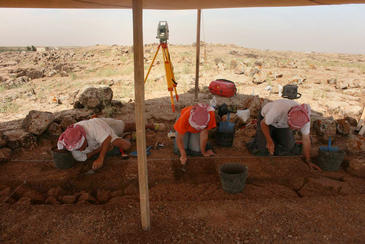
I strongly recommend to read the full source study, because it is very informative about what were some of our ancestors¹ doing when farming and herding were being developed in West Asia, but the map above alone gives a very good glimpse of the ethno-cultural complexity of these ancient West Asian populations. 

My understading is that the mainline (Thessalian or Aegean) European Neolithic founders must have originated within the PPNA/B complex, although uncertain about which specific culture within it (most likely not Harifian because that one is surely at the origin of Semitic languages but almost any other one would do, notably those close to the Mediterranean coast: Sultanian, Aswadian and Mureybetian). Instead the populations affecting Eastern European, Mesopotamian-Iranian (Sumer and Elam) and Indian Neolithic are most probably rather linked to what is here called as M'lafatian or Zagros Neolithic, which in turn were most likely linked one way or the other to Caucasus hunter-gatherers and in general to the "highlander" West Asian element apparent in other studies in contrast to a more EEF-like "lowlander" one. 

________________________________________
¹ Sure: I'm thinking mostly of Euro-Mediterranean and Central-South Asian peoples but even if you are East Asian or Tropical African it's still very probable that some random ancestor comes from this crucial paleo-historical knot (or almost from anywhere else: admixture never ends and we are all related, even if thinly, within the last millennium or so).

April 3, 2015

19 Ka BP old mtDNA H from Cantabria

Jean Lohizun points me to this new study by the EHU-UPV paleogeneticist team, which reviews the ancient DNA evidence from the Cantabrian strip (or "fringe" as they call it) and, most importantly announces the oldest confirmed mtDNA H to date: belonging to an individual from El Mirón cave (Ramales, Cantabria, bordering the Basque Country), which is assigned to earliest Magdalenian culture and dated to 19,000 BP.

Update (Apr 24): the genetic findings of El Mirón were first published (in Spanish) in: M. Hervella et al., El ADN mitocondrial de los cazadores-recolectores de la región cantábrica: nueva evidencia de la cueva de El Mirón, Revista Española de Antropología Física - Vol. 35 (2014). I could not find an online reference but I have a copy of the article thanks again to Jean.

Concepción de la Rúa et al., Ancient DNA in the Cantabrian fringe populations: A mtDNA study from Prehistory to Late Antiquity. Quaternary International, 2015. Pay per viewLINK [doi:10.1016/j.quaint.2015.01.035]

Abstract

The present mtDNA study on human remains of fourteen archaeological sites from Cantabria, Basque Country and Navarra provided a diachronic overview from Paleolithic–Mesolithic to Late Antiquity period of some communities settled in the Cantabrian fringe. Ancient DNA studies in European human remains indicated a genetic discontinuity between the hunter–gatherers and later populations. However, some of the mtDNA lineages found in the Cantabrian fringe in Paleolithic–Mesolithic times persist in present-day populations.

The mtDNA variability observed in hunter–gatherers and farmers in Europe denoted a complex pattern for the Neolithic transition, occurring along several different routes into and across Europe. The mtDNA lineages found in the Cantabrian fringe indicated that the dispersion of Neolithic farmers had a different genetic impact in this area with respect to Central and Mediterranean regions of Europe. The differences in mtDNA variability were also apparent after the Neolithic, as shown by the genetic distance between the Chalcolithic populations from the Cantabrian fringe and the Bell Beaker Culture (BBC) populations of Central Europe. 

It must be mentioned that they seem to have forgotten the thesis of Marie Lacan[fr], which reported mtDNA H in Linatzeta cave (Basque Country, Epipaleolithic) and Franchthi cave (Greece, Meso-Neolithic transition), among other more recent aDNA sequences. See here for my English language synthesis.

Otherwise they list all the sequences considered in their paper in table 1:

Annotations by Maju: red: El Mirón (new sequence), orange: other Paleolithic or Epipaleolithic sequences

After including Linatzeta (Lacan 2011), we get the following frequencies in the Eastern Cantabrian sub-region (Basque Country + Cantabria) for pre-Neolithic times:
  • H: 4/6=2/3=67%
    • H-CRS (H1 surely): 33%
    • H6: 16%
    • H*: 16%
  • U5: 2/6=1/3=33%
    • U5*: 16%
    • U5b1: 16%
Notice anyhow that if we choose to draw a line between Cantabria and the Basque Country, then we get a sharp contrast: 
  • Cantabria: 100% H
  • Basque Country: 67% U5 + 33% H* (or even an illusory 100% U5 if we use only the table above, ignoring Lacan's data)
Does this apparent sharp contrast make any sense? Well, one possible interpretation comes from carefully taking into account the data we have on Iberian Solutrean and Magdalenian, which indicates that:
  1. South Iberian (from Valencia to Portugal) Solutrean is heavily influenced by the Gravettian substrate (otherwise "pure Solutrean" is restricted to two caves), configuring a unique facies sometimes called Gravetto-Solutrean.
  2. South Iberian Gravetto-Solutrean, probably in its way to Portugal, strongly affected the Upper Paleolithic of Northwest Africa, being a decisive force in the Iberomaurusian or Oranian genesis. Backflows can't be discarded because of the innovation of tanged and winged arrow points, which may have been inspired by North African Aterian technology.
  3. The Portuguese branch of this Gravetto-Solutrean was the actual source (via Salamanca) of Asturian Solutrean, unlike what happened in Cantabria and the Basque Country, directly influenced by Aquitaine. 
  4. In the subsequent Magdalenian there might have been an expansion eastward of the Asturian population, because the facies divide moves to the east (so we have a Cantabro-Astur facies and a Basque facies).
In addition to that, it may be worth considering the issue of North African genetic influence in the Western Third of the Iberian Peninsula, which incidentally and irregularly includes Cantabria but not the Basque Country. Also Chandler et al. 2005 reported high frequencies of mtDNA H (and low of U) in Epipaleolithic Portugal.

I guess that other interpretations are possible such a more subtle cline or patchy distribution but I would not discard this hypothesis, which in essence proposes that Solutrean and Magdalenian were in general dominated by U5 but this did not affect (at least not very intensely) most of Iberia, nor surely other regions like Italy or Eastern Europe, where we see haplogroups that are not U5 (Sunghir's and Karelian H, Italian mysterious HV, etc.)

This implies that the main redistribution of mtDNA H in Europe, that part organized around H1 (which also includes H3 and various H*) actually happened mostly in the Neolithic from areas like Portugal. However we know nearly nothing about the Atlantic pre-Neolithic DNA North of the Bidasoa River (some of which could also be H, particularly R*-CRS reported in Britain) so multiple sources are possible. The huge blank of data corresponding to the Western French State and also Atlantic Islands, etc. is crying for a comprehensive sampling, and not just for mtDNA. 


Neolithic Basque mtDNA is unlike what is found in Continental Europe

The authors pay limited attention to the issues relative to Paleolithic and dedicate most of the paper to analyze the Basque ancient mtDNA in contrast to other comparable data from elsewhere in Europe. This is synthesized in fig. 2:

Fig. 2. Multidimensional Scaling analysis (MDS), based on a Fst genetic matrix calculated from the frequency distribution of the mtDNA haplogroups of different populations [Neolithics (green), Chalcolithics (purple), Late Antiquity (red), present-day Near East and northern Caucasus (orange) and Europeans (black)]. Abbreviations for present-day populations in Europe: Eastern Mediterranean (MdE), Central Mediterranean (MdC), Western Mediterranean (MdW), Northeast Europe (NE), NortheCentral Europe (NC), Northwest Europe (NW), Southeast Europe (SE) and Alps (ALP). (For interpretation of the references to colour in this figure legend, the reader is referred to the web version of this article.).


Notice that all the ancient mtDNA from the so-called "Cantabrian Fringe" in this graph is from the Basque Country (Navarre included), often outside of the Cantabrian strip and rather from the Upper Ebro basin. Notice also that the all the Chalcolithic data belongs to military contexts from the Ebro Valley and are probably therefore not representative of the overall Basque region, although they may represent well the Upper Ebro in that period (more influenced apparently by Mediterranean inputs of Cardial affinity).

Also I already discussed all this (and more) quite in depth in my dedicated entry of 2013

The authors argue that Germany's Bell Beaker samples (BBC) are not quite similar to the Basque ancient and modern pools, what is true if you are nit-picky enough, but they share the same common tendency in PC1 towards modernity. In contrast all other Neolithic samples are clearly non-modern European and must have been largely suffered by replacement in the Chalcolithic or later periods.


PS- I forgot to mention that apparently Paabo and co. had already sequenced this very same specimen in 2013, yet they have not published anything for unknown reasons, some think that ideological ones. It's of course possible that they do have good reasons but two years is a long time to await publication really, we the people, who pay their salaries and budget with our extreme economic pains, expect reliability from our well-paid researchers.

May 11, 2013

Praileaitz cave to have even less protection

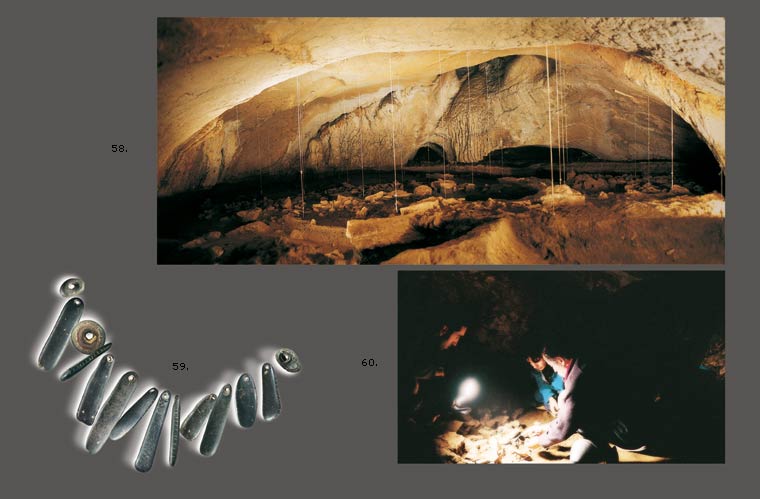
The new law of coasts passed by the conservative Spanish government and allowing construction only 20 meters from the coast (it used to be 100m), a scandal on its own right, will have direct effects on the already extremely fragile protection of the cave of Praileaitz, located within an active quarry and holding evidence of human existence from the Magdalenian period but also, we know now, from Neanderthal times some 100-120 Ka ago.

Years ago, the (then unelected) Western Basque Government limited the protection area to just 65m, considered by all experts wildly insufficient (Jean Clottes asked for 500m, for example), however a tribunal ruled later that 50m was enough. This new law allows for constructions and economic activities (such as the quarry) to take place just 20m away from the cave galleries, what may be very damaging.

There are possible mechanisms to counter this legislation but require of a political will that so far has been lacking or rather negative, hostile. 

The utmost fragility of the cave is very apparent in this air view highlighting the archaeological sites near the controversial quarry:

Source: Caminando por Iberia
Some ornamental findings and archaeological works at Praileaitz (Bertan)

Sources[es]: Gara, Caminado por Iberia, Bertan, Amigos de Praileaitz.


Update (May 11): a report (in Spanish language) on the Mousterian and new Magdalenian findings from Praileaitz can be read at Noticias de Gipuzkoa (via Pileta).

February 23, 2013

Screw stoppers of Upper Paleolithic Dordogne

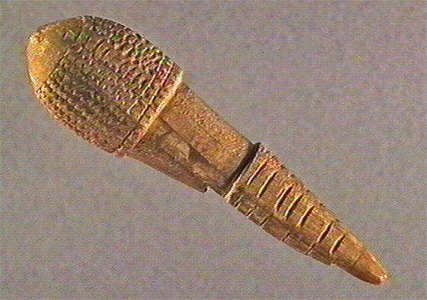
While not really a novelty, I bet that most readers have never heard of this (I had no idea myself admittedly). David Sánchez discusses this week at his (Spanish language) blog Noticias de Prehistoria - Prehistoria al Día the existence of several most intriguing conic screw pieces found in Gravettian and Magdalenian sites from Dordogne (Aquitaine, French Republic), a district that (because of its great density of findings and cultural centrality for Middle and Late UP European prehistory) I have sometimes dubbed the Paleolithic Metropolis of Europe.

Drawing of two ivory (?) stoppers from Combe-Capelle and Fourneau du Diable
(from Don's Maps, ultimately from S. Lwoff 1968)

Stopper of bone (?).
First reported as
from Laugerie-Haute
but apparently the
same as above (bottom),
from Forneau du Diable.
What are these magnificent pieces of Paleolithic craftsmanship? Apparently they are nothing else that that waterskin stoppers. Don's Maps suggest (scroll down) that the waterskin's neck hole would be made with a long bone hollow piece (just get out the marrow and tie it tightly to the skin's neck with a couple of thin ropes after performing two grooves on the external surface of the bone piece), then just apply the screw stopper forcing the bone (which is hard but somewhat flexible) to adapt to it. Naturally the inner groove would be created as you repeat the process once and again, surely having to push a little more each time (the bone tends to expand somewhat under the internal pressure).

Why are they conical and not cylindrical like modern ones? Surely because the same stopper (hard high quality work) was expected to serve many different waterskins, with different neck sizes. Also the very process of creation of the neck's perfect fit requires of an initial process of expansion for which a cylindrical stopper was not fit.

It never ceases to amaze the ingenuity and creativity of our Paleolithic ancestors, right?


Sources: Noticias de Prehistoria[es], Don's Maps.


Update (Jan 7 2014):

I just got feedback from Don Hitchcock (the author of Don's Maps and main ultimate source for this entry) saying that he found that the photographed stopper and the second drawn ones are the same (from Forneau du Diable and not Laugerie-Haute, as originally reported), complaining that the artist 'gilded the lily' more than a little with regard to the perfection of the screw thread.

I fear he must be right because some details in the handle are very similar. It is a bit disappointing but I believe that the original hypothesis about their use as stoppers stands anyhow. 


Update (Jan 10):

Don Hitchcock has updated his page on the Paleolithic tools with other two example of water bag stoppers. These don't seem to have any clear spiral design in the screw but at least one uses instead parallel groves.

To the right: ivory stopper from Laugerie Haute Est.

Below: ivory stopper from Brassempouy (Aurignacian):


February 11, 2013

Atlantic thermohaline currents nearly stopped in some cold spells of the Ice Age

That is what researchers claim in a new study:

Stephan P. Ritz et al., Estimated strength of the Atlantic overturning circulation during the last deglaciation. Nature Geoscience 2013. Pay per viewLINK [doi:10.1038/ngeo1723]

Abstract

The Atlantic meridional overturning circulation affects the latitudinal distribution of heat, and is a key component of the climate system. Proxy reconstructions, based on sedimentary 231Pa/230Th ratios and the difference between surface- and deep-water radiocarbon ages, indicate that during the last glacial period, the overturning circulation was reduced during millennial-scale periods of cooling. However, much debate exists over the robustness of these proxies. Here we combine proxy reconstructions of sea surface and air temperatures and a global climate model to quantitatively estimate changes in the strength of the Atlantic meridional overturning circulation during the last glacial period. We find that, relative to the Last Glacial Maximum, the overturning circulation was reduced by approximately 14 Sv during the cold Heinrich event 1. During the Younger Dryas cold event, the overturning circulation was reduced by approximately 12 Sv, relative to the preceding warm interval. These changes are consistent with qualitative estimates of the overturning circulation from sedimentary 231Pa/230Th ratios. In addition, we find that the strength of the overturning circulation during the Last Glacial Maximum and the Holocene epoch are indistinguishable within the uncertainty of the reconstruction.

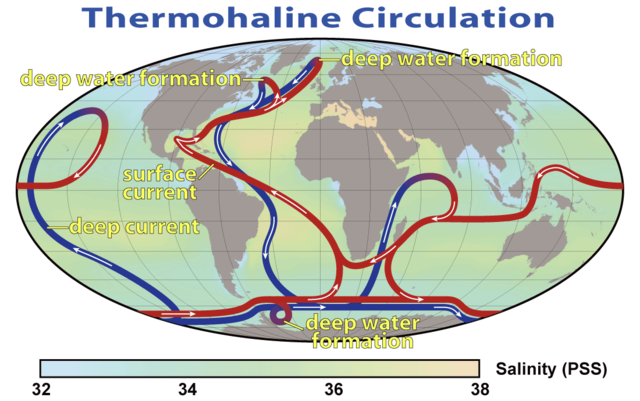
Summary of thermohaline circulation (public domain, NASA)


In the North Atlantic the best known thermohaline current is the Gulf Stream, which effectively keeps Europe several degrees warmer than it would be otherwise, allowing a relatively dense population at latitudes unheard of elsewhere on Earth. This current was weak at best in the Ice Age. 

Notice that they say that they can find any difference between present day (Holocene epoch) and the Last Glacial Maximum, so it cannot be inferred, it seems, that the glaciation itself had anything to do with the thermohaline currents but only with  some particular cold spells of the late Upper Pleistocene, particularly the HE1 (c. 18-14.6 Ka ago) and the Younger Dryas (c. 10 Ka ago).

January 31, 2013

Maps of lamp usage in Paleolithic SW Europe

Illustration by Arturo Asensio
Decorating Altamira Cave
As I have briefly mentioned before David Sánchez has a most interesting series of articles (in Spanish language) these days, at his blog Noticias de Prehistoria - Prehistoria al Día, dealing with the usage of oil lamps in SW Europe (France, Iberian Peninsula) in the Upper Paleolithic. If you are familiar with Spanish language (or willing to use an online translator), you can read them at the following links: PART 1, PART 2 and PART 3 (update: part 4 is now also online).

To be most synthetic I will essentially borrow the excellent maps which shall give us a glimpse of the spread and time frame of this illumination fashion in the region:

Lamps found in France with chronology and type of site (Beaune & White 1993)
Lamps found in Iberia (by David Sánchez)

It must be mentioned, following the original articles, that the lamps of Iberia have all been found inside caves (while in France the locations are more diverse) and also nearly all them belong to the Magdalenian period. The exceptions are Bolinkoba (8), which is from a Solutrean chronology, La Trinidad de Ardales (1), which has no context, and a possible ill-documented lamp from Lezetxiki (14), originally argued to be of either Aurignacian or Mousterian context. 

Even if you don't understand Spanish, I would suggest to take a look at the original articles for the many illustrations of a varied array of lamps.

January 29, 2013

Whale remains reinforce the notion of Magdalenian being linked to sea mammal predation

First it was the whale bone spear point of Isturitz (Basque Country), then the isotope evidence of sea mammal based diet of a Magdalenian individual from Kendric Cave (Wales) and now direct evidence of whale remains in the cave of Nerja (Andalusia). The evidence mounts up for a quasi-Inuit lifestyle of at least some people of the Magdalenian culture of late Upper Paleolithic Europe.

Esteban Álvarez Fernández et al., Occurrence of whale barnacles in Nerja Cave (Málaga, Southern Spain): indirect evidence of whale consumption by humans in the Upper Magdalenian. Quaternary International 2013. Pay per viewLINK [doi:10.1016/j.quaint.2013.01.014]

Abstract

A total of 167 plates of two whale barnacle species (Tubicinella majorLamarck, 1802 and Cetopirus complanatus (Mörch, 1853)) have been found in the Upper Magdalenian layers of Nerja Cave, Mina Chamber (Maro, Málaga, southern Spain). This is the first occurrence of these species in a prehistoric site. Both species are specific to the southern right whale Eubalena australis, today endemic in the Southern Hemisphere. Because of Antarctic sea-ice expansion during the Last Glacial Period, these whales could have migrated to the Northern Hemisphere, and reached southern Spain. Whale barnacles indicate that maritime-oriented forager human groups found stranded whales on the coast and, because of the size and weight of the large bones, transported only certain pieces (skin, blubber and meat) to the caves where they were consumed.

The barnacles
According to the authors, this is the first case of consumption of whale meat and blubber ever documented in Europe. 

The hearth where the remains were found is dated to c. 14,000 years ago. 

Previous evidence from this prolific Andalusian cave have previously informed of consumption of seafood and fish, along with rabbits and the occasional goat, a tradition that dates to Neanderthal times in that region. 

A perplexing curiosity is that one of the whale kinds identified is the southern right whale, which was not known to have lived so far north at all (its main habitat is the Antarctic seas with some extension towards Brazil and the Mozambique Strait). I wonder if it is a case of misidentification and the species is either the North Atlantic right whale or an extinct relative of both.

Sources: Materia[es], Pileta[es].


PS- And what was the blubber used for (besides eating)? Our friend David Sánchez coincidentally just published two successive and quite interesting articles (in Spanish) at his blog on the lamps of the Upper Paleolithic: 1st part, 2nd part.

A particularly beautiful lamp from Lascaux (Dordogne)


Update (Jan 29): another finding of whale consumption in Magdalenian contexts unknown to me until now (h/t David) is from Las Caldas (Asturias). One of the two co-researchers is the same as the lead author of the Nerja paper → direct PDF link.


Update (Feb 22): David again added more interesting information on the matter of possible whaling in the Magdalenian period by pointing us to Colchón Rodríguez & Álvarez Fernández 2008, where they discuss (in Spanish) the presence of sea mammal remains in the cave of Las Caldas (Asturias): a seal tooth (pierced as to be part of a necklace or similar decoration), a pilot whale tooth (only initially worked), a sperm whale tooth (fully sculpted into low reliefs of whale and bison) and also several whale and other sea mammal bones used for tool-making (they made spear points on whale bone, as was documented years ago for Isturitz in the same period) and some mollusks, notably the shell of a whale barnacle (Coronula diadema).

Las Caldas (locator map) is some 20 Km. inland nowadays, in the Magdalenian period maybe 30 Km. or so. The whale barnacle suggests that whale meat was moved all that distance from the coast.

August 3, 2012

Research continues in Santimamiñe Cave (Basque Country) and produces some new information

Littorina littorea
(winkle, magurio, faocha)
Santimamiñe Cave, near Gernika, has one of the most complete archaeological records of all Europe, from Chatelperronian to Iron Age with the only exception of Aurignacian, including some Magdalenian rock art, although not as spectacular as in other sites.

Research continues however and these days a new hearth, at the innermost human habitation area of the cave, dated to c. 12,000 years ago (end of the Upper Paleolithic) has been discovered with tools and food remains that should help us to better understand the way of life of our ancestors.

They ate stuff like deer, goats, bisons, aurochsen, game, salmon, sea snails (winkles) and sea urchins.

The hearth belongs to the Late Magdalenian culture and, for what chief archaeologist Juan Carlos López Quintana says, they are probably contemporary with the artwork located deeper in the cave, in a small hidden room.

Part of the Santimamiñe rock art


The research continues at good pace financed by the Chartered Government of Biscay, having made the work of some 20 campaings in just eight years. They expect to reach the Early Magdalenian layers by 2020 or so. It's a methodical work. 

Follows video in Spanish:


Sources[es]: ETB, Pileta.

April 27, 2012

For those only reading the RSS: Magdalenian mtDNA H in Cantabria confirmed by RFLP testing

Just a short heads up mostly for RSS-only readers to an important update/edit of one of today's entries:


... on Hervella et al., 2012 (oa).

The key element of novelty is that the authors themselves have confirmed to me by email that they did test for RFLP markers, specifically Alu I in the case of mtDNA H. 

Therefore, against all rumors and confusion, we finally have unmistakable confirmation of the presence of mtDNA H (and H6) in Magdalenian Europe, specifically in Cantabria. It is not any Neolithic arrival to Europe and the studies (not peer-reviewed) of Chandler 2005 and Kéfif 2005, both reporting high mtDNA H in pre-Neolithic Portugal and Morocco can now be seen with a bit more credibility, with less systematic doubts.

For more details read the edited section in the relevant entry.  

Thanks again to the authors for the quick clarification.

Ancient mitochondrial DNA from the Basque Country and Cantabria: unmistakable mtDNA H in Magdalenian Cantabria

This seems a very important paper because, if everything is correct, it is the first peer-reviewed publication to establish conclusively that mitochondrial haplogroup H, the most common matrilineage of Europe today, existed in Paleolithic populations in Europe, specifically in Cantabria, Spain.

There have been previous reports of such important presence of mtDNA H in the area, notably Chandler 2005 (on Epipaleolithic and Neolithic Portuguese) and Kéfi 2005 (on Upper Paleolithic Moroccans). However both studies were informal for some reason, what has been used by some to grasp for straws in their claim of this lineage having arrived to Europe (and North Africa) only after Neolithic and oversimplify the Paleolithic genetic pool of Europe to almost only variants of haplogroup U (never mind that U is such a large, ancient and widespread haplogroup that saying "U" is almost like saying nothing).


Edited section: the authors did test for RFLPs, the haplogroup assignation is as good as it can be.

After the first read to the paper my impression was that they had only tested the HVS (both subsectors I and II), leaving some, even if smaller, doubt about the adscription of the Cantabrian Magdalenian lineages to mtDNA H.

But, luckily for truth, Jean Lohizun (see comments) found that the authors, who are partly the same team as Izagirre & De la Rúa 1999 and are using the same methodology up to a point, have actually tested not for coding region SNPs but for a standard list of RFLP markers. However the mention is so cryptic that it is most difficult to find: 

In order to classify the mitochondrial variability of the individuals analyzed in this study, we proceeded to amplify 11 markers, which are required for defining the 10 Caucasian haplogroups described [63]. The protocol and primers are described in [17], [20], [42]. The digestion patterns were verified using a fragment Bioanalyzer (Agilent Technologies).

This seemed to imply that when the authors say "H" they mean -7025a (aka -Alu I) but this marker as such are listed nowhere that we can see easily.

So I squeezed my mind until I concluded that Jean must be correct but a very slight doubt remained, so I emailed the authors, who quickly responded confirming Jean's keen reading.


Excerpts and translations:


Concepción De la Rúa (corresponding author) said:

Para conocer con más seguridad el haplogrupo, se hicieron además  RFPLs, que es una tecnica que permite evaluar la existencia de mutaciones puntuales en la region codificante del mtDNA.
Translation: In order to know with greater certainty the haplogroup, RFLPs were performed, which are a technique that allows for evaluation of punctual mutations in the coding region of mtDNA.

She added in relation to a previous study of her authorship:

Ambos analisis se realizaron en el paper recien publicado, pero no en el paper de Izagirre & de la Rúa de 1999, en donde solo se hicieron RFPLs.

Translation: Both analysis [RFLPs and HVS] were made in the recently published paper but not in that of Izagirre & de la Rúa from 1999, where only RFLPs were tested for.

Montserrat Hervella (lead author) said:

También, hemos realizado PCR-RFLPs con el fin de determinar los SNPs de la región codificante y así reconfirmar el haplogrupo al que pertenecen cada uno de los haplotipos que hemos obtenido mediante secuenciación. Los enzimas que hemos utilizado aparecen en varias citas bibliográficas en el articulo (17, 20, 42, 63).

La cuestión que nos plantea en torno a la determinación del haplogrupo H, la respuesta es que si hemos usado la enzima Alu I para determinar el SNP en la posición  7025 de la region codificante del ADNmt.

Translation: We have also performed PCR-RLFPs with the purpose of determining the SNPs from the coding region and therefore confirm the haplogroup to which each of the haplotypes obtained by sequenciation belong. The enzimes we used appear in several bibliographic citations in the article (17, 20, 42, 63).

About the question that you ask on the matter of the determination of haplogroup H, the answer is that we have indeed used the enzyme Alu I to determine the SNP in position 7025 of the coding region of mtDNA.

This should dispel any doubt: there was mtDNA H (and H6) in Magdalenian Cantabria.

(End of the edited section)


In any case these are the results as reported by the researchers (and synthesized by me in a single image):


Notice that the dots are not really precise in their geographic locator role (I may try creating a better map later).

Instead of using numerals I repeated the name of the reported haplogroup with the intention of giving a more visually intuitive impression (without going through the process of creating charts). 

The results for Paternabidea (tested for coding region markers) were discussed in November. They basically seem to establish that modern Basques are almost identical to Neolithic Basques.

But what about Paleolithic ones? The results of this one study rather suggest that a little bit of both: on the side of continuity, the same U5 sequence is reported for Erraila (Magdalenian) and Marizulo (Neolithic) but, on the side of change, all Paleolithic Basque sequences (n=2) are U5 lineages, while U5 today is a much less important matrilineage. 

It may well be argued that this result is a fluke, a coincidence, but it is consistent with what we see in Epipaleolithic Central and North Europe (mostly U5 with some U4, Bramanti 2009), suggesting that, while the model of recolonization of much of Europe from the Franco-Cantabrian region may well be correct, the story does not end there at all.

On the other side we see that the dominant lineage today among Basques and Western Europeans in general, haplogroup H, was already present in Magdalenian times in Cantabria, what is consistent with it being found in Epipaleolithic Portugal and Oranian Morocco and really puts to rest the hypothesis that promoted that it had arrived from West Asia with Neolithic colonists (something argued as a matter of fact but without any clear evidence). 


Food for thought (a hypothesis)

As of late, although I have yet to formalize it somehow, I've been thinking that a serious possibility is that mtDNA might have spread partly with Dolmenic Megalithism. While there is some apparent Neolithic expansion of H in the Basque area (apparent in this paper and resulting in an almost modern genetic pool), in other parts of Europe this is less obvious, with H showing up but not reaching modern levels just with Neolithic. In fact the loss of other Neolithic lineages like N1a strongly suggests that the populations of Central Europe were largely replaced after the Early Neolithic. Where from? Again from Southwest Europe, I suspect but not in the context that was once believed of Magdalenian expansion, but maybe in the context of Megalithic expansion instead, with origin not in the Franco Cantabrian region but in Portugal. 

This is just a draft hypothesis that I have mentioned before only in private discussions or at best in the comments section somewhere, and certainly it would need more research. My main argument is that before these results for Cantabria, the only pre-Neolithic location where the data clearly suggested very high levels of mtDNA H (near 75%) was Portugal (Chandler 2005) and Portugal played a major role in Neolithic and Chalcolithic Western Europe. As I said above, ancient Portuguese apparently developed the Dolmenic Megalithic pehnomenon (culture, religion...), later they developed some of the earliest Western European civilizations, since the Third millennium BCE, specially Zambujal (also at Wikipedia), which were central elements of this long-lasting Megalithic culture and later of the Bell Beaker phenomenon as well.

And we need very high levels of mtDNA H in a colonizer population to changed the genetic landscape from c. 20% H into c. 45% H, we need something like a 70-80% H ancestral population unless replacement was total, what I think unlikely. 

What happened to that overwhelmingly H population of Portugal (assuming that the hypothesis is correct)? They were probably colonized in due time, possibly in the Bronze Age (the mysterious archaeological "horizons" that replace urban life in much of Southern Portugal in that period with their strange crab-shaped elite tombs, vaguely resembling Mycenaean circular walled ones)  and/or in the period of Celtic invasions from inland Iberia later in the Iron Age (Hallstat periphery).

It's just a tentative hypothesis so far but one that I believe I must state for your consideration.

Air view of some the acropolis of Zambujal (the roofed area is a modern farm that sits atop)

March 19, 2012

Another matrilineage spawning from the Franco-Cantabrian Region: HV4a1a

Interesting and straight to the point: that can be said of this new paper. That and that a number of high profile geneticists have co-authored it (Olivieri, Behar, Achilli, Torroni and Salas). The only less known name is in fact that of the lead author:


The finding here is that along with many H subclades and probably V, which have been discussed in older studies, the lineage HV4a1a seems to have originated in the Franco-Cantabrian region, with branches to North-West Europe and, secondarily, South Italy, as can be seen in fig. 1:


Notice that the territory under French jurisdiction has been sampled much more sparsely than that under Spanish rule. This surely explains that most of the apparent diversity is located in the Cantabrian strip and not in Gascony, Occitania or otherwise in French territory. 

Number of known basal subclades of HV4a1a per Upper Paleolithic province:
  • Franco Cantabrian region: 9.5
  • Iberian province: 3
  • NW Europe: 3
  • Italy: 0.5
Or maybe you prefer the representation in fig. 2:


HV4 overall may have originated in or near Eastern Europe however, where most of the basal diversity seems to be.

February 17, 2012

Echoes from the Past (Feb 17)

And again a quick look to many things which have been showing up around the Net these last few days:


Neanderthal society

Bryan Hayden has a very interesting (and freely accessible!) paper at the Oxford Journal of Archaeology on reconstructing Neanderthals society, which was apparently much like ours for similar conditions (small operative bands of 12-30 people linked in larger ethnic and/or clannic groups through seasonal meetings and general social networks). M. Mozota has a quite interesting review at his blog as well for those who can read in Spanish.


Natufian Mesolithic Syrian site dug

The site of As-Suwayda (or Sweida), dated to c. 14-9 thousand years ago, had 12 circular huts, two of which were more complex, suggesting to some the beginnings of social stratification (or could be communal buildings?)  The two more complex (not larger) huts were located to the south of the village and show, one, inner divisions and an internal elevated platform, and, the other, external platforms and a trench. All huts are 4-5m. round.

The Natufian culture is one of the beginnings of sedentarism, as their members lived largely on recollection of wild cereals, although it is generally understood that there was no productive agriculture yet.


Neolithic driven by aridification in South Asia

D. Fuller at Indian Ocean Corridors discusses how an increasingly drier climate may have aided the expansion of agriculture in the Indian subcontinent:

The significant aridification recorded after ca. 4,000 years ago may have spurred the widespread adoption of sedentary agriculture in central and south India capable of providing surplus food in a less secure hydroclimate.

Relevant paper: Holocene aridification of India (C. Ponton et al. 2012, PPV)


Chalcolithic oxen traction in Iberia

A very interesting article in Spanish language by J.M. Arévalo discusses the use of animal traction in the Chalcolithic of Mucientes in the Northern Iberian Plateau during the 3rd millennium BCE (c. 2830-2290 BCE). Article available at Periodista Digital[es] and Asociación los Dólmenes[es].

The production, use and export of threshing teeth, made on flintstone at Cantalejo, emphasizes the almost necessary use of ox traction (horse domestication is unclear for the period while oxen remains are consistent with such kind of work). Interestingly the article is accompanied by an image of what may well be the oldest preserved wheel in Europe (Ljubljana, 4th millennium BCE, many centuries before Indoeuropean arrival, pictured).


Other archaeology/prehistory

Nerja rock art will be directly dated: the calcite layer over them will be dated so the doubts on authorship may be clarified. ··> Pileta[es].

East Asturian Magdalenian cave sites Tito Bustillo and El Buxu were used by the same group ··> Pileta[es].

Rock art found at Paleoindian site in Clarke Co., Virginia (USA) ··> Clarke Daily News.

England's Neolithic submerged town had market street ··> BBC

The IVC seal represents a goat
Rare Indus Valley Civilization seal found at Cholistan (Punjab) ··> Dawn.

20 megalithic cairn circles and an apparent fortification from the Iron Age found at Andrah Pradesh, India ··> Firstpost.

Conservation plan to protect the Hill of Tara (Ireland) ··> The Meath Chronicle.

Spanish language specialized open access e-magazine Trabajos de Prehistoria vol. 68, no. 2 is available.


Human genetics

You may want to take a look at the latest exploration of Northern Europe's autosomal genetics by Fennoscandia Biographic Project, using the most advanced analysis tools available (it seems): as always Scandinavians are somewhat distinct within Western Europe but Finnic peoples are a world on their own.


Other genetics

Rice varieties indica and japonica may have been independently domesticated (paper): Independent Domestication of Asian Rice Followed by Gene Flow from japonica to indica (Chin-chia Yang et al. at MBE, PPV).

January 18, 2012

Artistic styles of the rock art of the Cantabrian Strip

Doe of Arenaza
While it is always a pity that scientists allow modern artificial borders such as the one between French and Spanish states, to restrict their research, the information obtained can still be full of interest in spite of this undeniable handicap. This is the case of this delightful paper (only available in Spanish language) on the style and chronology of rock art in the Cantabrian Strip (Northern coast of the Iberian Peninsula):

Aitor Ruiz Redondo, Convenciones gráficas en el arte parietal del Paleolítico cantábrico: la perspectiva de las figuras zoomorfas [Graphic conventions in the rock art from Cantabrian Paleolithic: the perspective of the zoomorphic figures]. Trabajos de Prehistoria 2011. Freely accessible. 

The author reviews previous work on the stylistic differences of the rock art of the area concluding that there are three clearly distinct stylistic groups:

Fig. 4 Multivariant analysis

The three groups have not just stylistic differences but also some geographical and chronological variations:


My visual synthesis (on top of fig. 1: map of sites mentioned)
Animal type indicated only where more than 60% of all figures per tab. 1

In spite of the clear stylistic differences group 1 and 2 overlap in time, specially after considering the wide error margins of dates based mostly on accretion layers (I'm showing above only the most overlapping ones, for reference). They also overlap in the dominant motif, which is the doe (less importantly also horses in group 1, buck deer in group 2 and bison in both). These groups are considered to belong to the Gravettian or even Aurignacian periods.

On the contrary, group 3, which is the most stylistically advanced, post-dates the rest by at least the full span of the Last Glacial Maximum. According to Ruiz, there are at least six millennia between these groups and the Magdalenian rock art, which is the most famed one because of the full perspective and great realism achieved. Contradicting previous work, he suggests that there was no rock art in the region in the Solutrean and Early Magdalenian periods. 

Fig. 7 - comparison of three proposed timelines (right: Ruiz Redondo)

While the author thinks that the difference between groups 1 and 2 is chronological, I fail to see the evidence clear. Instead a geographical difference is rather obvious (see map above), with group 1 concentrated in Asturias and Western Cantabria and group 2 in Eastern Cantabria and Western Biscay.

Group 3, which is much better dated than the others, is clearly dominated by the bison, painted almost obsessively, as in the famed Altamira ceiling. Another important animal is the goat, usually painted in black, as well as the horse.

Santimamiñe rock art

There are more interesting articles (all in Spanish however) in the same magazine: Trabajos de Prehistoria (hat tip to Pileta).