Showing posts with label France. Show all posts

September 29, 2015

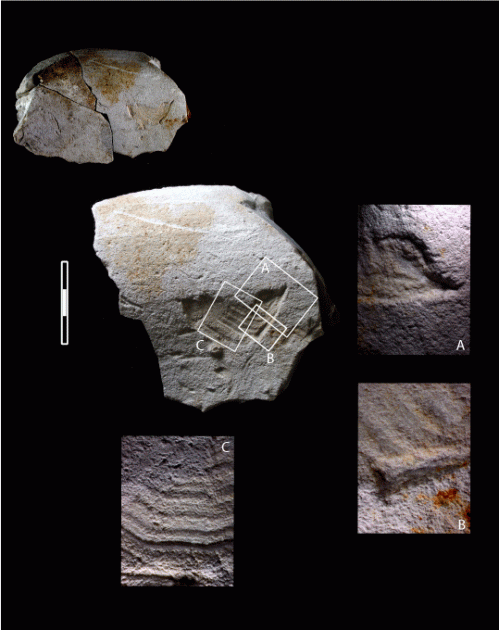
Twitter in the Aurignacian?

Heh, why not?

The curious fact is that a flint stone engraving recently found in the Aurignacian layers of Cantalouette II (Dordogne, SW France) bears a striking resemblance to the logo of the social network, what is quite funny at the very least.


Otherwise it is a very impressive early artistic expression of a rare type (avians are not common in Upper Paleolithic rock art). The Cantalouette II site was a flint stone quarry used by groups of the area and Arkeobasque (which is my source) speculates that it could be an expression of "art for the sake of art", an artist's caprice with no further meaning but excellent and very unusual technique, that was probably abandoned after its execution.

August 30, 2015

France's autosomal genetics highlight Gascon-Basque distinctive cluster

A rather decent analysis of French autosomal genetics has been privately pre-published recently (thanks to Jean Secques for calling my attention to it and to the lead author for making it available online). 

Aude Saint Pierre et al. The fine-scale genetic structure of the French population. Submitted to the American Journal of Human Genetics in 2015. Freely accessibleref. LINK, direct PDF link.

A highlight of the study is that the samples all belong to people born in the 1930s and locations refer to their place of birth, so the results should be reflecting the historical demographics of the French Republic in the early 20th century. 

There are no supplemental materials available at this point, so it's only possible to get a glimpse of the general results and we can't go too much into fine detail. These general results are anyhow interesting. Let's see:

Figure 6: Prediction of geographic location of individuals from the test set (n=3,733) using multiple linear regression model. A) Expectation: The seven geographical regions of France according to the geographical coordinates of individuals in the test sample; B) Prediction of geographical coordinates according to the multiple linear regression model.

This figure alone synthesizes the findings: most French citizens cluster in a single unit, which geographically would correspond to NE France (GE region), only SW French (Gascons and Basques mostly) deviate very clearly and roughly fit their own geography towards the Bay of Biscay (or Bay of Gascony, as the French call it). Some samples from the SE (MED and RA regions) also follow this trend. A few outlier samples from the East (GE, RA) look rather Rhenish German, although the lack of controls from outside the Hexagon does not allow me to confirm this appearance. 

You may have noticed that I ignored the IDF samples but that is because it is the Paris region (Île-de-France), which was already back in the 1930s too cosmopolitan to be informative. That is of course reflected in all the results with "orange" dots being nearly of all affinities. 

Follow the principal component analyses, whose more salient information is again the peculiarity of Southwesterners, i.e. Gascons, Basques, and nearby populations.


Figure 2: The scatter plot of the first three PCs from PCA performed on the SNP
genotype data of the 4,433 individuals from the 3 Cities study. Individuals are coloured
according to the region where they were born. (Note: the legend corresponds to both PCAs)

Other than the "Gascon" specificity, which takes over PC1, I'd say that PC2 shows an "anti-Mediterranean" tendency and that PC3 instead shows a "pro-Mediterranean" tendency. This I gather from the relative position of the "red" MED cluster. They both weight the same.

Interestingly there is a prominence of the GO region (Mid-West between the Seine and the Garonne) which may indicate some sort of "Armorican" or "Briton-like" specificity. In appearance it could melt both the "pro-" and "anti-Mediterranean" tendencies but without being able to discern the particular dots (ID and location), I cannot swear for that. 

Much more clear is the "anti-Mediterranean" tendency of Gascons, Basques and allies when they are strongly detached from the main French cluster and instead they show a "pro-Mediterranean" tendency, overlapping at the extreme with the MED cluster, the closer they are to mainstream French. This happens in both PC2 and PC3. 

Little more to say, honestly. Maybe that the small Eastern group of outliers prominent in "anti-Mediterranean" tendency in PC2 probably corresponds pretty well with the outliers of the first graph, which looked German-like. So I guess that the positive side of PC2 probably corresponds with a Northern European tendency.

Interested on what you have to say on this one very particularly, reader.

May 7, 2015

Neolithic mtDNA from the Seine basin

Finally we get some ancient DNA from the French demarcation, which should be one of the focus of the research, because of the importance of the territory of the French state in European paleo-history since the depths of the Paleolithic.

This data set is, in spite of its limitations, most important because it seems to support the notion of Megalithism being an important factor in the formation of European populations as we know them.

I strongly recommend reading the whole paper because it does not only deal with the genetic aspects but also offers excellent background on the archaeological context of the region to which these (non-monumental) burials belong to.

Maïté Rivollat et al., When the Waves of European Neolithization Met: First Paleogenetic Evidence from Early Farmers in the Southern Paris Basin. PLoS ONE 2015. Open accessLINK [doi:10.1371/journal.pone.0125521]

Abstract

An intense debate concerning the nature and mode of Neolithic transition in Europe has long received much attention. Recent publications of paleogenetic analyses focusing on ancient European farmers from Central Europe or the Iberian Peninsula have greatly contributed to this debate, providing arguments in favor of major migrations accompanying European Neolithization and highlighting noticeable genetic differentiation between farmers associated with two archaeologically defined migration routes: the Danube valley and the Mediterranean Sea. The aim of the present study was to fill a gap with the first paleogenetic data of Neolithic settlers from a region (France) where the two great currents came into both direct and indirect contact with each other. To this end, we analyzed the Gurgy 'Les Noisats' group, an Early/Middle Neolithic necropolis in the southern part of the Paris Basin. Interestingly, the archaeological record from this region highlighted a clear cultural influence from the Danubian cultural sphere but also notes exchanges with the Mediterranean cultural area. To unravel the processes implied in these cultural exchanges, we analyzed 102 individuals and obtained the largest Neolithic mitochondrial gene pool so far (39 HVS-I mitochondrial sequences and haplogroups for 55 individuals) from a single archaeological site from the Early/Middle Neolithic period. Pairwise FST values, haplogroup frequencies and shared informative haplotypes were calculated and compared with ancient and modern European and Near Eastern populations. These descriptive analyses provided patterns resulting from different evolutionary scenarios; however, the archaeological data available for the region suggest that the Gurgy group was formed through equivalent genetic contributions of farmer descendants from the Danubian and Mediterranean Neolithization waves. However, these results, that would constitute the most ancient genetic evidence of admixture between farmers from both Central and Mediterranean migration routes in the European Neolithization debate, are subject to confirmation through appropriate model-based approaches.

The studied sample comes from Gurgy (NW Burgundy, near Auxerre) and is very large: 55 successful SNP-defined haplogroups, 39 HVS-I sequences, including 27 distinct haplotypes. The burials are dated to the 6th millennium BCE, when the area was reached by Neolithic. The following haplogroups were found (table S1):

  • HV: 22, of which:
    • V - 2 (4%)
    • H - 20 (36%), of which:
      • H* - 6
      • H1 - 10
      • H3 - 4
  • U - 20, of which:
    • U* - 3 (5%)
    • U4 - 1 (2%)
    • U5 - 5 (9%)
    • K - 11 (20%)
  • JT - 8, of which:
    • J - 6 (11%)
      • J* - 4
      • J1 - 2
    • T - 2 (4%)
  • X - 2 (4%)
  • N1a - 3 (5%)


For some reason the total I get from table S1 is 51 individual haplogroups instead of the 55 expected ones. I have double and triple-checked and can't find the four missing sequences, sorry. Count corrected (May 9): there were indeed 55 sequences (my bad).

In any case the mtDNA pool is surprisingly "modern" with most haplogroups in very similar frequencies from what we would find in present day Western European populations. This is not at all like what was found in Germany's Neolithic, at least initially, characterized by low frequencies of H and high frequencies of presently rare haplogroups like N1a, being instead more similar in its "modernity" to what has been found in the Basque Country (see HERE for a quick reference).

This suggests that we have in Neolithic Europe the following regions, judging on the "modernity" of their mtDNA pools (only):
  1. Central Europe (Germany, Hungary): low H, clearly "pre-modern"
  2. Mid-Western Europe (France, Basque Country): normal H and roughly also other lineages, almost "modern"
  3. Portugal: seemingly very high H, "hyper-modern"

And this strongly hints again, along with the early presence of lactose tolerance among Chalcolithic Basques and the massive consumption of dairies among British farmers (of North French origin) to an Atlantic Neolithic origin of at least the bulk of the genetic pool of modern Western Europeans.

Sadly for the fans of patrilineal genetics, no single Y-DNA sequence could be produced.


Mostly Danubian origins?

Paradoxically these early farmers from Burgundy do not seem strongly related to the South, at least not judging by the North Iberian data used as reference but rather to the Danubian Neolithic peoples of Germany instead. This is most apparent in the haplotype graph of fig. S7:

Fig. S7 - Median-joining network


We can see that most Gurgy haplotypes (red) cluster with Danubian Neolithic ones (green) rather than with North Iberian (blue) or Paleolithic ones (purple). Basically there is only one clear exception: an H lineage that seems indeed more related to the South than to Central Europe but the red-green exclusive connections are much more common. 

However when analyzed statistically, the Gurgy population appears intermediate between the Central European and North Iberian ones. For example:


Fig 1. Principal Component Analysis (PCA) on the ancient mtDNA dataset.


Not sure if this is yet another warning about the limitations of statistical analysis or instead suggests that there is more importance of the southern ancestry but that it has a different origin in Occitania (SE France) that is not being taken into account. 

My best hunch is that the statistical result is product of the relative affinity to Basque Neolithic (the "modernity" of the overall pool as discussed above, Basque samples are by far the most numerous of Northern Iberia) combined by a more direct affinity with the German Neolithic in the detail of the sequences. 


Closer to Chalcolithic than to Early Neolithic populations

There is no haplotype structure to consider here but the statistical analysis that the authors perform does find that the Gurgy population was, oddly enough, closer to later populations in both Germany and Iberia than to their contemporaries. If this could be confirmed, we would have a candidate population for the origin of the changes that affected Europe (at least Central Europe) in the early Chalcolithic (prior to the Indoeuropean invasions). 

Fig 4. Pairwise FST distances.

It is apparent in the above figure that FST distances of the Gurgy population are much shorter (hence probably more related) with late Neolithic and Chalcolithic populations of both Central and Southwestern Europe than with any population that pre-dated the abandonment of the necropolis. Among these however it is Karsdorf the one most closely related, reinforcing the notion of a mainly Danubian origin, albeit a bit peculiar one (Derenburg, Halberstadt and the average "PRE_Central_F" are not particularly close).

But the most interesting part is surely the much greater affinity to the populations after the 4000 BCE chronological divide, which is also the baseline of the expansion of the Megalithic phenomenon. This matter requires more detailed analysis but it does suggest that the Franco-Basque area could well have been important in the formation of Chalcolithic and therefore modern European populations in the Western half of the subcontinent. A vehicle for this demographic "reform" should have been Megalithism, no doubt.

But we do need more data, sure we do.

April 26, 2014

Diversity and legacy of ancient European farmers

Two new Swedish papers, published almost simultaneously, add important extra information and, of course, also some more questions to the previous analysis of European ancestry by Lazaridis et al. (see here, here and here). They are:

Evangelia Dasakali, A late Neolithic Iberian farmer exhibits genetic affinity to Neolithic Scandinavian farmers and a Bronze Age central European farmer. Paper IV of the greater collection Archaeological Genetics - Approaching Human History through DNA Analysis. Acta Universitatis Upsaliensis, 2014. Freely accessible PDF → LINK [ISBN 978-91-554-8816-1]

Pontus Skoglund, Helena Malström et al., Genomic Diversity and Admixture Differs for Stone-Age Scandinavian Foragers and Farmers. Science 2014. Pay per view (supp. info. freely accessible)LINK [doi:10.1126/science.1253448]

I must say that it seems a bit odd that, being colleagues of the same university, Dasakali and Skoglund/Malström have decided to publish such two strongly related studies separately. But, well, whatever...

The first study briefly compares the genome of a Chalcolithic Iberian farmer from El Portalón (Atapuerca) to modern Europeans and some previously published ancient genomes, mostly Neolithic but also one from Epipaleolithic Iberia (La Braña).

The study is just a very short synthesis and lacks detail but provides this PCA graph:


On it's own, it already provides evidence of ancient European farmers not being as homogeneous as the  Lazaridis sample (n=3 but all from near the Alps) may suggest. The Iberian sequence deviates more towards modern Italy than the Alpine ones (here represented only by Ötzi), who tend to cluster towards modern Sardinians. Also the Gökheim sequence from Southern Sweden, the only clearly Megalithic sample so far to be studied, clusters with Basques. But Gökeim is better addressed in the Skoglund paper in fact.

This is because Skoglund & Malström use more samples from Neolithic Scandinavia: four from the Gökheim site (Megalithic and Funnelbeaker farmers) and six from Götland's Pitted Ware late semi-foragers of the Baltic (probably with partial Eastern European roots).

The results are more directly visualized and comparable with those Dasakali and Lazaridis in the Principal Component Analysis:


Fig. 1. Population structure and genetic affinities of ancient Eurasians. (A) Ancient individuals were projected on principal components computed on 57 modern-day Western Eurasian groups. (...)
Notice that ancient samples are projected on the modern PCA, what explains especially the anomalous position of Mal'ta 1 (MA1), which is actually much more divergent from all modern Europeans. SF11 = Stora Förvar 11.

Obviously not all is just a simple PCA, together we find these heatmaps that help us to better understand the affinities of the ancient farmers:


Fig. 1. Population structure and genetic affinities of ancient Eurasians. (...)
(C) Shared genetic drift between Western Eurasian populations and Ajvide58, a Neolithic hunter-gatherer from Scandinavia.
(D) Shared genetic drift between Western Eurasian populations and Gökhem2, an early farmer from Scandinavia.

In fact Gökheim 2 shares a bit more genetic drift with Sardinians than with Basques, an that's probably the reason why she is located rather towards Spain and Italy in the PCA, even if they don't share greater genetic drift with these than with Basques and Sardinians (PCAs can be misleading). However the shared drift is probably less than among Alpine farmers, owing largely to Gökheim's greater aboriginal hunter-gatherer admixture.

In general, like other early European farmers, Gökheim people seem to align best with Western Mediterranean peoples, particularly those with low paleo-Siberian (MA1) affinity, which are Basques and Sardinians. 

Judging on the PCA, there seems to be some diversity among them, with one being more extremely "Atlantic". It is very possible that in the Neolithic and Chalcolithic Atlantic Europe there were others like her (most Gökheim samples are female although I'm uncertain about this unnumbered one).

On the other hand, Pitted Ware sequences share greatest drift with modern Baltic peoples, including the oversampled Swedes but also with Eastern Baltics (Estonian, Finnish, Lithuanians). This last surely owes to the origins of this culture in Eastern Europe but in what regards to Sweden, it must imply that their kind of Eastern-like genetics were very strongly favored when the Kurgan macro-culture (Single Burials, part of the wider Corded Ware culture) took over the region c. 2500 BCE. Instead the ancient megalithic farmers quite obviously suffered a genocide in this part of the world.  

Overall, it seems obvious to me by now that Eastern European genetics distributed by the long-term Kurgan expansion (Indoeuropeans) must have been somewhat similar to aboriginal Western European hunter-gatherers but with greater paleo-Siberian affinities (MA1-like), which they also distributed by Europe for the first time.

For a wider comparison with World genomes, take a look at figures S3 and S4 please. In them we can see that Ajv58 is comparatively closer also to South Asians, Siberians and Native Americans, while Gök2 is instead relatively closer to Palestinians, Arabians and slightly to Egyptians too (not apparent in the above graph but certainly in the global one).

This is quite interesting because it directly relates to the mysterious "Basal Eurasian" element that Lazaridis et al. detected in their ground-breaking study, which is more clearly perceived as something "Palestinian", with whatever NE African and/or residual out-of-Africa element in it, which partly detaches the ancient farmers from the main Eurasian ("out-of-India") branch.

Some of all this is also quite apparent in the attempts of Skoglund & Malström to infer the ancestry of the various paleo-populations:


Fig. 2. (A) Sample locations of ancient human remains that are included in the population history model. (B) Admixture graph of population history fitted to ancient genomes showing more hunter-gatherer admixture in Neolithic Scandinavian farmers than in central European farmers (table S15).

The above "admixture graph" is identical in essence to fig. S6. However I find even more very interesting the fig. S7:


Fig. S7. A) Admixture graph of population history fitted to ancient genomes and two modern-day genomes from Europe. (...)

This alternative result has been produced by merely adding modern French and Sardinians to the analyzed pool and allowing for two extra admixture axes. The result is quite different:

Essentially the overall unity of all Europeans, ancient and modern is restored as a single derived branch distinct from the circum-Pacific populations. The deviation to "Basal Eurasianness" of Neolithic Europeans and Sardinians is instead largely explained by an admixture axis from the Dinka, which act as a proxy for whatever Red Sea area input in the early European Farmers. This is just as I expected and have tried to explain before, so I guess you understand why I do prefer this second admixture graph over the other.

In this sense, I feel that Skoglund & Malström could have done a bit better by testing more alternative models (different samples, different pre-definition of the admixture axes, etc.) but I guess it's good enough for their Swedish focus. Not so much for the pan-European one though. 

It is also very striking that the French sample appears unrelated to any of the ancient samples, be them farmers or not. Instead they show up as a branch of their own with proto-Sardinian admixture. This probably owes to the fact that neither of the sampled ancient populations is directly ancestral to the French, unlike what happens with Lochsbour, for which the French show the longest IBD segments, indicating a more direct ancestry. So I guess that we can take the French branch as being partly Lochsbour-like, plus whatever Eastern European (but not Scandinavian) extra ancestry the Celts, Romans and Germanic tribes brought with them (and of course the strong Neolithic element indicated as paleo-Sardinian admixture). Sadly the analysis strategy is not designed to provide us with such information here, but it can still be inferred if we consider all the available data.

Of course most modern samples show less drift because they are more cosmopolitan populations than the ancient ones, whose demographic base should be more like that of Australian aborigines, the only modern sample that shows a similarly high drift parameter. 

As concluding remarks, I wish to underline the greater aboriginal European (WHG or blue color) admixture in the Megalithic farmers of Gökheim, which resemble modern Basque genetics. It is very likely that more populations like those existed in the Megalithic axis from Southern Iberia to Southern Sweden, although naturally each one had its own peculiarities and we should not take Gökheim as any sort of ideal representative of such ancient Atlantic population but rather as one of its many likely subpopulations. 

Before the Indoeuropean consolidation of the Corded Ware period, these Atlantic farmers must have greatly contributed to at least a preliminary stage of "modernization" of the Central Europan (and possibly also others') genetic pool, as discussed in this entry. Notice also that the demographic expansion was much greater with Megalithism than with Corded Ware and Bell Beaker and that this applies in general terms to nearly all studied regions, with the main exception being Jutland. However in Scania (Southern Sweden), there is a clearly second demographic expansion with the arrival of Corded Ware. 

Sadly there is no direct comparison of modern Swedes as hypothetical admixture between Pitted Ware Chalcolithic foragers and Megalithic/Funnelbeaker farmers. It would have been interesting to know more details about that, especially if a third element from Germany, Poland or Russia is needed to explain their modern genetic pool, as I suspect, and in which apportions.

As for the Neolithic farmers, they were clearly somewhat more diverse than the Lazaridis study suggested, varying at least in their amount of "Basal Eurasian" and Western hunter-gatherer ancestry, and possibly also in other subtle aspects we still do not understand well, as suggested by El Portalón sample.
Their most direct legacy is in any case concentrated towards Southwestern Europe.

February 28, 2014

Grotte Chauvet's Aurignacian dates strongly questioned

The famous rock art of the Cave of Lions (Grotte Chauvet, Ardèche) seems now not to be of such an early date as was claimed by Valladas et al. in 2001 but rather from the Gravettian and Solutrean periods, with more solid dates between 26,000 to 18,000 BP.

Jean Combier & Guy Jouve, New investigations into the cultural and stylistic identity of the Chauvet cave and its radiocarbon dating. L'Anthropologie 2014. Pay per view → LINK [doi:10.1016/j.anthro.2013.12.001]

Abstract

The discovery of Chauvet cave, at Vallon-Pont-d’Arc (Ardèche), in 1994, was an important event for our knowledge of palaeolithic parietal art as a whole. Its painted and engraved figures, thanks to their number (425 graphic units), and their excellent state of preservation, provide a documentary thesaurus comparable to that of the greatest sites known, and far beyond what had already been found in the group of Rhône valley caves (Ardèche and Gard). But its study – when one places it in its natural regional, cultural and thematic framework – makes it impossible to see it as an isolated entity of astonishing precocity. This needs to be reconsidered, and the affinities that our research has brought to light are clearly incompatible with the very early age which has been attributed to it. And if one extends this examination to the whole of the Franco-Cantabrian domain, the conclusion is inescapable: although Chauvet cave displays some unique characteristics (like every decorated cave), it belongs to an evolved phase of parietal art that is far removed from the motifs of its origins (known from art on blocks and on shelter walls dated by stratigraphy to the Aurignacian, in France and Cantabrian Spain). The majority of its works are therefore to be placed, quite normally, within the framework of the well-defined artistic creations of the Gravettian and Solutrean. Moreover, this phase of the Middle Upper Palaeolithic (26,000–18,000) coincides with a particularly intensive and diversified local human occupation, unknown in earlier periods and far less dense afterwards in the Magdalenian. A detailed critique of the treatment of the samples subjected to AMS radiocarbon dating makes it impossible to retain the very early age (36,000 cal BP) attributed by some authors to the painted and engraved figures of Chauvet cave.


February 10, 2014

Neolithic and Chalcolithic demographics of Western and Northern Europe

Somehow I missed this important study on the Neolithic and Chalcolithic demographics of Europe, as inferred from the archaeological record (h/t Davidski):

Stephen Shennan et al., Regional population collapse followed initial agriculture booms in mid-Holocene Europe. Nature Communications 2013. Open accessLINK [doi:doi:10.1038/ncomms3486]

Abstract

Following its initial arrival in SE Europe 8,500 years ago agriculture spread throughout the continent, changing food production and consumption patterns and increasing population densities. Here we show that, in contrast to the steady population growth usually assumed, the introduction of agriculture into Europe was followed by a boom-and-bust pattern in the density of regional populations. We demonstrate that summed calibrated radiocarbon date distributions and simulation can be used to test the significance of these demographic booms and busts in the context of uncertainty in the radiocarbon date calibration curve and archaeological sampling. We report these results for Central and Northwest Europe between 8,000 and 4,000 cal. BP and investigate the relationship between these patterns and climate. However, we find no evidence to support a relationship. Our results thus suggest that the demographic patterns may have arisen from endogenous causes, although this remains speculative.


The most interesting aspect is maybe that the (apparent) demographic changes are detailed for many regions of Europe, but first let's see the general outlook for the whole area surveyed (Western and Northern Europe, Iberia excluded):


Figure 2: SCDPD-inferred population density change 10,000–4,000 cal. BP using all radiocarbon dates in the western Europe database.
Colored arrows and their annotations are mine.

I decided that it was important to mark the main cultural episodes for reference.

1st Neolithic refers to Impressed-Cardium and Linear Band Pottery cultures, which arrived almost simultaneously to Germany and France (of the surveyed areas), although the Rhône-Languedoc Neolithic is a few centuries earlier than the arrow, which has been standardized to 7500 BP.

Atlantic Neolithic refers to the quite belated arrival of Neolithic to Britain, Ireland and Northern Europe (standardized at 6000 BP). This process was quickly followed and tightly associated with the widespread cultural phenomenon of Dolmenic Megalithism. It is most interesting that the main deviation from the pattern of regular growth concentrates in this period and is clearly positive.

Corded Ware culture (Indoeuropean consolidation in Central and Northern Europe) affected only to Germany and Denmark-Scania within the surveyed regions. It was followed by a more widespread subcultural phenomenon known as Bell Beaker, which almost invariably cases manifests within pre-existent locally rooted cultures. Neither seems to be correlated with demographic expansions in the general overview.

Now let's take a look at the regional graphs:

Figure 3: SCDPD-inferred population density change 8,000–4,000 cal. BP for each sub-region.
Colored arrows, excepted the blue ones (which mark the local first Neolithic), are mine and mark general pan-European initial chronologies (not local!) for Megalithism, Corded Ware and Bell Beaker in those regions where they had some clear influence.

Here we can appreciate that:

Atlantic Neolithic and its associated Megalithic phenomenon are clearly related to notable demographic expansions in Ireland, Scotland, South England, Denmark and Scania. Megalithic influence may also be associated with some more irregular growth in South and Central Germany but rather not in France nor West Germany. A contemporary weak and irregular growth in North Germany (Brandenburg, Mecklemburg and Schlewig-Holstein) may be correlated with Funnelbeaker (with roots in Denmark) and the first Kurgan development of Baalberge and successor cultures (with roots in Eastern Europe), which would eventually evolve into Corded Ware.

Corded Ware only seems related to clear demographic growth in Jutland (and less resolutely in Scania). Bell Beaker is only linked with clear demographic growth in Ireland (and much more weakly in South England and Central Germany), while elsewhere it is rather associated with decline.

For the exact extension of the various regions as defined for this study, see fig. 1 (map).

As provisional conclusion, it seems obvious to my eyes that the most important demographic growth processes were the various Neolithic cultures but that the Atlantic Neolithic (and associated Megalithism) was particularly dynamic. In contrast Indoeuropean-associated cultural phenomena had a much weaker impact, with some localized exceptions, and are generally associated with local demographic decline instead, at least judging from the archaeological record.

See also:

Belated update: a follow up study was published in 2014 studying other regions of North, West and Central Europe → Bell Beaker Blogger discussed it.

December 11, 2013

Rhône-Provence Bell Beaker

Just a brief note on two French language papers from a decade ago that have shown up in my academia.edu alerts.

The most relevant one because of its wider scope is:

Olivier Lemercier, Muriel Pellissier & Yaramila Tchérémissinoff, Campaniforme et sépultures, au-delà du standard. La place du Campaniforme dans l évolution des sépultures du sud-est de la France au 3e millénaire avant notre ère. Proceedings of the International Conference held at the Cantonal Archaeology Museum (Sion, Switzerland), 2001. → available (with free registration) at academia.edu.

Abstract (only part in English)

Where are the famous Bell Beaker individual burials in the south east of France? What is the nature of the burials wherein we actually find Bell Beaker elements ? And what kind of Bell Beaker is it ? And also : where does the Bell Beakers stand in the evolution of the funeral architectures and rites between the end of the Middle Neolithic and the Early Bronze Age? Answering these questions, thanks to the presence of more than a hundred funeral sites in the area, would change our vision of the Bell Beakers fenomenon itself. These questions are also the occasion to present the diversity and the traditions of the funeral practices by the 3rd millenium BC.


I took some time to read it in spite of my limited skills at French (but it's still Romance, so well... any educated Romance speaker can read it with some effort) and the overall conclusions are not too surprising: Bell Beaker is not only a burial thing, Bell Beaker appears in burial contexts of older local tradition, etc. 

The details and nuances are many more, of course. On one side the authors discern (much as it happens overall within European Bell Beaker) three groupings: 
  • Corded style in Ardèche
  • International style in the left margins of the Rhône
  • A local variant in the later period
Notice that the authors argue that both the Corded and International styles are roughly contemporary. I can't judge this but, if real, it may mean a blow against the classical notion of Corded style being older and arriving to SW Europe via the Rhône. 

Another interesting aspect of the paper is that the authors argue for overall continuity of burial styles, which are varied:
  • individual burials with roots in early Neolithic
  • collective burials of both dolmenic-megalithic and cave typology
  • other rarer types, with a handful of examples each
Bell Beaker seems mostly related to collective burials, although in the BB period Megalithism seems to recede somewhat in favor of collective burials in caves, a tradition common in other parts of Europe, especially in the South and SW. This really casts all kind of doubts about BB in this region being able to be explained as some sort of migration from Central Europe (or anywhere else) because, unlike in this Indoeuropeanized area, BB individual burials as such are extremely rare; instead we must talk of BB elements inserted in local traditions of collective or "clannish" nature, just as we can see in Iberia and other Western areas where Indoeuropean influences was still non-existent. 

The other paper is:

Robin Furestier et al., 1974-2004 le site du Fortin-du-Saut (Châteauneuf-les-Martigues, Bouches-du-Rhône) et le Campaniforme 30 ans aprés. Congrès du Centennaire: Un siècle de construction du discours scientifique en Préhistoireavailable at academia.edu (registration needed as well).

This is about a particular Bell Beaker site near Marseilles, whose typology seems mostly influenced by the Portuguese VNSP civilizational center. Otherwise there is other non-BB pottery without decoration and what seems locally rooted stone tools and arrow points.

If you are fluent in French and happen to find out any error in my interpretation, please feel free to correct me in comments, thanks in advance.

February 23, 2013

Screw stoppers of Upper Paleolithic Dordogne

While not really a novelty, I bet that most readers have never heard of this (I had no idea myself admittedly). David Sánchez discusses this week at his (Spanish language) blog Noticias de Prehistoria - Prehistoria al Día the existence of several most intriguing conic screw pieces found in Gravettian and Magdalenian sites from Dordogne (Aquitaine, French Republic), a district that (because of its great density of findings and cultural centrality for Middle and Late UP European prehistory) I have sometimes dubbed the Paleolithic Metropolis of Europe.

Drawing of two ivory (?) stoppers from Combe-Capelle and Fourneau du Diable
(from Don's Maps, ultimately from S. Lwoff 1968)

Stopper of bone (?).
First reported as
from Laugerie-Haute
but apparently the
same as above (bottom),
from Forneau du Diable.
What are these magnificent pieces of Paleolithic craftsmanship? Apparently they are nothing else that that waterskin stoppers. Don's Maps suggest (scroll down) that the waterskin's neck hole would be made with a long bone hollow piece (just get out the marrow and tie it tightly to the skin's neck with a couple of thin ropes after performing two grooves on the external surface of the bone piece), then just apply the screw stopper forcing the bone (which is hard but somewhat flexible) to adapt to it. Naturally the inner groove would be created as you repeat the process once and again, surely having to push a little more each time (the bone tends to expand somewhat under the internal pressure).

Why are they conical and not cylindrical like modern ones? Surely because the same stopper (hard high quality work) was expected to serve many different waterskins, with different neck sizes. Also the very process of creation of the neck's perfect fit requires of an initial process of expansion for which a cylindrical stopper was not fit.

It never ceases to amaze the ingenuity and creativity of our Paleolithic ancestors, right?


Sources: Noticias de Prehistoria[es], Don's Maps.


Update (Jan 7 2014):

I just got feedback from Don Hitchcock (the author of Don's Maps and main ultimate source for this entry) saying that he found that the photographed stopper and the second drawn ones are the same (from Forneau du Diable and not Laugerie-Haute, as originally reported), complaining that the artist 'gilded the lily' more than a little with regard to the perfection of the screw thread.

I fear he must be right because some details in the handle are very similar. It is a bit disappointing but I believe that the original hypothesis about their use as stoppers stands anyhow. 


Update (Jan 10):

Don Hitchcock has updated his page on the Paleolithic tools with other two example of water bag stoppers. These don't seem to have any clear spiral design in the screw but at least one uses instead parallel groves.

To the right: ivory stopper from Laugerie Haute Est.

Below: ivory stopper from Brassempouy (Aurignacian):


January 31, 2013

Maps of lamp usage in Paleolithic SW Europe

Illustration by Arturo Asensio
Decorating Altamira Cave
As I have briefly mentioned before David Sánchez has a most interesting series of articles (in Spanish language) these days, at his blog Noticias de Prehistoria - Prehistoria al Día, dealing with the usage of oil lamps in SW Europe (France, Iberian Peninsula) in the Upper Paleolithic. If you are familiar with Spanish language (or willing to use an online translator), you can read them at the following links: PART 1, PART 2 and PART 3 (update: part 4 is now also online).

To be most synthetic I will essentially borrow the excellent maps which shall give us a glimpse of the spread and time frame of this illumination fashion in the region:

Lamps found in France with chronology and type of site (Beaune & White 1993)
Lamps found in Iberia (by David Sánchez)

It must be mentioned, following the original articles, that the lamps of Iberia have all been found inside caves (while in France the locations are more diverse) and also nearly all them belong to the Magdalenian period. The exceptions are Bolinkoba (8), which is from a Solutrean chronology, La Trinidad de Ardales (1), which has no context, and a possible ill-documented lamp from Lezetxiki (14), originally argued to be of either Aurignacian or Mousterian context. 

Even if you don't understand Spanish, I would suggest to take a look at the original articles for the many illustrations of a varied array of lamps.

September 20, 2012

Alert: Foissac cave threatened by pig farm expansion

The expansion of an existent pig farm from 1000 to 8000 heads per annum threatens to contaminate the cave, inhabited in the Chalcolithic and Paleolithic, with pig manure.

Foissac (Aveyron department, Languedoc) is particularly wealthy in burial, pottery and other Chalcolithic remains, which are preserved in situ because of exceptional conservation conditions (it was dug up by F. Rouzaud, M.-A. Garcia and H. Duday between 1978 and 1988). 

More recently (2006) a branch of the same cave was found to have Paleolithic rock art, which would be at risk by this farm. 

There is an ongoing public inquest (ending on September 27) which has been given no publicity. However you may want to write to the authorities at the following address:

Monsieur Le Commissaire Enquêteur
Mairie de Causse et Diège, Loupiac
12 700 CAUSSE ET DIEGE.

There is also an online petition that you may sign.

More information (in French language in principle) at:
Sébastien du Fayet de la Tour : sebastien.dufayet@voila.fr
mobile phone : 06 11 75 97 02
Grotte de Foissac : 05 65 64 60 52


Source: Hominidés.com.

June 12, 2012

Timeline of the conquest of Navarre by Castile 1512-21

About these days some 500 years ago, the Kingdom of Castile decided to put to use the silver robbed to the Native Americans into a new military campaign. This time it was Navarre, the state of the Basques.


Navarre and associated states c. 1512


The Castilian-Aragonese conquest

In mid-June, a huge army under the command of the always infamous Duke of Alba, was concentrated at Vitoria, conquered in 1200. Meanwhile the English, then allied with Castile, had posted troops at Bayonne to curtail any French attempt of aid. The Castilian army marched without difficulties through Burunda and Arakil and on July 23rd, camped outside Pamplona, at Arazuri.

Unable to defend the city against such an oversized conquest force, the Navarrese monarchs went to their northern possessions in Gascony (Bearn). The city surrendered and on July 25th the invaders took possession with all the religious paraphernalia they styled.

After conquering Pamplona, a second invading army from Aragon (in dynastic union with Castile already) commanded by the Archbishop of Zaragoza, Alfonso, illegitimate son of King Ferdinand, occupied the Ribera (Erribera) and put siege to Tudela (Tutera) on August 14th. The city resisted for a month and only surrendered, on September 9th,upon oath that the traditional charters (fueros, laws) would be honored by the invaders.

Reconstruction of the historical walls of Tudela on a modern photo


First liberation attempt

John of Albret (King consort) finally mustered a diverse army made up of Navarrese, Gascons and Albanian and German mercenaries, which set up march at Pau (Bearn, part of the lands of the crown back then) on October 15th, commanded by Francis, Dauphin of France and Duke of Angouleme, with King Jean as sub-commander. They expelled the Duke of Alba from Donibane Garazi (St. Jean Pie-de-Port) and arrived to Pamplona on October 26th but could not capture the city.

When the winter set on, the liberation army retreated before the snow would close the passes.


The formal annexation

The Court (Parliament) of Navarre was called by the invader on March 23rd and, under obvious pressure, they swore loyalty to the invader.

Meanwhile the Castilians occupied again the Low Navarre (now under French rule) taking hostages and calling district Court to force the county to also swear loyalty to the occupant.

There was some hope of a peaceful resolution with a generational change among the monarchs: Francis I, who had personally commanded the Navarrese liberation army, became new King of France, while Charles of Burgundy (would-be Emperor Charles V) also showed signs of not being too interested in holding Navarre by force.

This pushed Ferdinand of Aragon (regent of Castile) to take the decision of annexing Navarre to Castile, formally suppressing its distinctiveness as independent kingdom. The formal ratification of this matter was done in the city of Burgos, Castile, before the Court of Castile on June 11th 1515. Navarre as such was not even asked.

However the Navarrese Kingdom retained all formal and legal distinctions, including parliament and tribunals, as had been allowed previously to the provinces formed from Western Navarre in 1200. It is at this point when Navarre is (forcibly) made a semi-autonomous part of Castile (Spain since the 18th century).


Second liberation attempt

Upon the death of Ferdinand of Aragon (January 23rd 1516), there were uprisings in is domains, circumstance that fueled a new attempt of liberation by John of Albret. The invasion attempt crossing the Pyrenees was ambushed at Isaba however and the commander, Marshall Peter of Navarre, made prisoner. He would die in strange circumstancesTM in 1522, still a prisoner.

Castile was then under transitional control of the strongman cardinal-regent Francisco Jiménez de Cisneros, who decided to punish the separatist feelings of the Navarrese people by means of political persecution. The most visible element was the dismantling of all kind of fortifications, leaving towns and villages undefended.

The very walls of Pamplona were reconstructed anew with the Machiavellan detail of making them clearly separate from the homes, so the citizens could not take them again from inside. More than a fortified city, Pamplona was now a prison, with walls conceived more for defense against the citizens than against any possible invader.

Wall of Pamplona


Third liberation attempt

Andrew of Foix, Lord of Asparrot
Meanwhile in Bearn, Henry II Zangotzarra became king of an occupied realm. Spanish historians, always so partial, treat him as "French" and "Prince of Bearn", even if he was not just the legitimate monarch but also born in Sangüesa (Zangoza), and his campaigns as "French invasions".

Castile was then (1521) under the popular revolt of the Comuneros, who demanded from Charles V respect to the traditional law and freedoms, making the occasion ideal for an attempt of liberation of Navarre.

Henry mustered an army of mostly Navarrese and Gascons, which was put under the command of Andrew of Foix, Lord of Asparrot (also known as Asparrós). The Comuneros had just been defeated at Villalar (April 23rd) when the campaign began (May 10th).

Upon the arrival of the liberation army, Pamplona surrendered and proclaimed Henry II as true monarch. Only a castle outside the walls resisted and was bombed. Among those inside was Iñigo of Loiola (later known as Ignatius) a Gipuzkoan professional soldier working for Castile... before and after the injury.

The liberation march was welcomed everywhere in Navarre but then Asparrot committed what is considered a key error: licensed much of the infantry and marched against Logroño (which had been Navarrese centuries earlier). The Castilian counter-attack pushed the Navarrese army towards Pamplona, with the final showdown happening at Noain on June 30th. 6000 people lost their lives in that battle.

There was still some resistance, notably in Baztan, where a Navarrese garrison resisted bravely in the castle of Amaiur, now a ruin with a monolith.

Monolith of Amaiur

The Northern tip of Navarre, known as Low Navarre, remained independent. Lacking any cities however, the Court installed itself in Pau, Bearn, where it would be a center of the Huguenot camp, eventually leading Henry III to the throne of Paris (where is known as Henry IV).

It was also a center of Basque and Gascon literature, making of a military defeat the seed of a long ethno-cultural and political resistance with the more than occasional popular and military uprising. Up to this day.

500 years of occupation, 500 years of resistance.


See also: A history of the Basque Wars: chapter I and chapter II (still have to write the 3rd part)
May 29, 2012

Another decorated cave discovered in Ardèche

The Ardèche or Ardacha region, so-named for a tributary of the Rhône, is one of the most important and older districts of modern human presence in SW Europe. Its importance was underlined with the discovery of the Grôte Chauvet, the cave of lions.

Now another discovery has been made in the same area with a decoration of what seems to be a horse head. The finding actually was made in 2011 by some speleologist but kept secret till it was researched preliminarily.


Sources[fr]: Pileta, France 3, Paleos Blog.

June 20, 2011

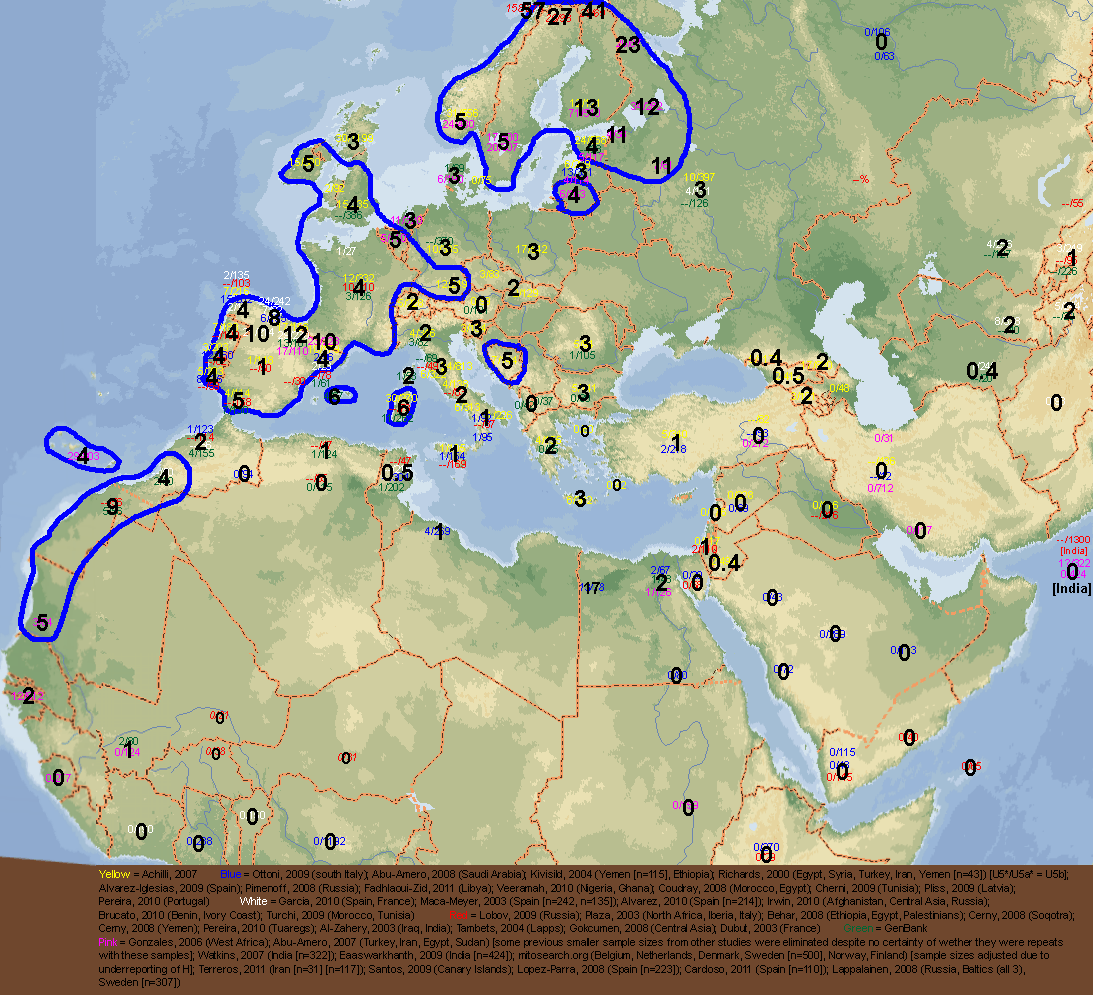
Basque-specific mtDNA lineages

Forewarning: the maps illustrating this entry are from the discussed paper BUT they seem to fail to adequately capture the actual frequencies of the discussed clades in some areas, notably the Atlantic Islands. 

A reader points me to this paper (in Spanish with introduction in Basque):


Starting from a rather unoriginal sample (four Basque provincial samples plus Cantabrians from nearby Valle del Pas) they make some noticeable discoveries on less common mtDNA lineages. First of all they find that haplogroups U5b and J1c have their highest densities among Basques (>10%):


Regarding U5b, a particular sublineage U5b1f is mentioned as being notably frequent among Basques and also found in other sub-Pyrenean populations (Crespillo et al. 2000; Martínez-Jarreta et al. 2000; Alfonso-Sánchez et al. 2008).

The highest apportion of U5b worldwide is in Northern Navarre (15.5%).


In the case of J1c, it is mentioned in the text that a sublineage J1c2d, defined by a transition in site 16366, is common among Basques and that this particular lineage has also been found in some other populations, specifically the Irish (McEvoy et al. 2004). 

Besides these two, the most common mtDNA lineages among Basques are H1, H3 and V. Among these, this paper finds that sublineages H1j1 and V10 are notably common in the country.

Overall and based in an array of older papers, the authors feel that they must support the post-LGM recolonization theory, which would have originated from a Franco-Cantabrian refuge. However they argue that U5b1b, which has been claimed to be of similar origin for being found in remote populations such as the Berbers or Saami (Achilli et al. 2005) has not been found in their survey of (a fraction) of the Franco-Cantabrian refuge. Here I must say that while the datum is surely valid, the argument is somewhat weak however because they have not sampled all the Franco-Cantabrian refuge but just a small fraction: 2/3 of what is now France remain largely unresearched.

[Update: in the comments section, Heraus, who has deep Bearnois roots, confirms my hypothesis: U5b1b may not be found among Basques but it's found for sure among Gascons. Himself is this particular lineage].

This is something that I cannot emphasize too much: in order to understand properly European genetic correlations France, specially the southern half, must be studied properly, because the Basque Country is only a small subregion of that Franco-Cantabrian refuge and the rest of the Iberian Peninsula is not even part of it (excepted Cantabria and Asturias) but a different, less important, archaeological province.


Franco-Cantabrian province: dots indicate rock art sites, white areas are glaciers, light green is land now submerged

Update: check the supplemental material of a previous paper by the same author. I understand from this paper's text that the samples studied are the same ones.

Update (June 22):

U5b frequencies by Argiedude (synthesis of many diverse papers):

Click to enlarge. Figures in percentile points.


See the discussion for details. Importantly he argues that he is working in a diversity map but that preliminary data appears to show that U5b in SW Europe is more diverse than in Fenno-Scandia (I'd be surprised if it'd be the other way around, honestly, because this region was covered in ice until some 10,000 year ago).


Update (June 29): Argiedude has also worked out this map of U5b diversity (see comments):


Not sure what conclusions may be reached, if any.

March 15, 2011

Provenzal genetic data... and weird speculations

The following paper offers some information on the genetics of Provenzals and some specific populations of Turkey (Foça, Izmir) which is compared with older studies (on Turkey and Greece) to reach quite unfathomable conclusions:


I'm split on this paper: on one side it does provide some interesting data and makes some common sense claims (like Provence having been little affected by Neolithic expansion direct colonization) but then you stumble upon absurd ideas, such as Cardium Pottery stemming somehow from "Anatolia":
Using putative Neolithic Anatolian lineages: J2a-dys445=6, G2a-M406 and J2a1b1-M92 the data predict a 0% Neolithic contribution to Provence from Anatolia.
There is absolutely no reason to be looking at Anatolia: the Neolithic wave that arrived to Provence did not originate in Anatolia but in the Western Balcans. It is very possible that Anatolia was the ultimate origin of Greek Neolithic and this was in turn at the origin of Cardium Pottery Neolithic somehow, but the real origin of the Neolithic wave that arrived to Provence must not be looked for in any case in Western Anatolia - that is a total nonsense.

We know way too little as of yet to explain the exact process of cultural transference from West Asia (Anatolia specially) to the Balcans (Thessaly in particular) and from Thessaly to the Adriatic, where the cultural elements are so distinct anyhow. There is no particular reason to expect any arrival directly from Anatolia into Italy or SW Europe in the Neolithic. Any such migration would have been dampened in two filters: one in Greece and another one in the Adriatic Balcans.

From my ongoing (and slow) work of summarizing  European Neolithic in maps:


Here you can see in brown the first area of Cardium Pottery Neolithic: Dalmatia, Montenegro, Coastal Albania, most of Bosnia, Italy (in a second moment)... It has a precedent in Otzaki (Thessaly) and a derived influence in Biblos (Lebanon) but by no means can it be linked to "West Anatolia" of all possible places.

Universities and grants should require that any geneticist doing historical population genetics hire a prehistorian for assessment, sincerely.

Still there is a very interesting amount of data that is of interest, summarized (as I said before) in figure 2 specially. This is an extensive table that I cannot reproduce here with enough resolution without some previous work. So for reason of its relevance and novelty I'll focus on the Y-DNA data of Provence (n=51, only attested lineages shown):

  • E1b1b1b1a2 (V13): 4%
  • E1b1b1b1c (M123): 2%
  • G(xG2a3a) (M201): 8%
  • I1 (M253): 2%
  • I2(xI2a2,I2b) (M438): 4%
  • J1 (M497): 2%
  • J2a4h1a (DYS445=6): 8%
  • J2a4b(J2a4b1) (M67): 2%
  • R1a1a (M198): 10%
  • R1b1b2 (M269): 59%

Up 26 to 30% (depending on how you evaluate I2*) of the genetic pool is "Eastern Mediterranean" in Provence. E1b1b1b1a2 (V13) is probably from Albania or other Adriatic areas (see Battaglia 2009). That can also be argued to be the case for all the other "transmediterranean" lineages, which agrees well with a Neolithic origin of all them. However it is not impossible that these Neolithic arrived in batches and with intermediate stops in Italy for example or, why not, in Phocaea in some cases. 

But the research falls very short from demonstrating what they claim to demonstrate. If they have demonstrated something at all they have failed to explain it properly. So the only interest of this paper is the raw data, which adds to other such data to be integrated into a careful and comprehensive exploration of all (and not just some) data with proper prehistoric assessment. 

It is in any case important to understand that under the Neolithic colonization hypothesis, E1b1b1a2 should not be expected to originate neither in Anatolia nor in Greece but in Albania, Montenegro and Dalmatia. And, if anything, in Greece rather than Anatolia. Attributing European Neolithic directly to Anatolia or West Asia in general is not an acceptable assumption but a wacko fetish that should be discarded altogether.