Showing posts with label European prehistory. Show all posts

March 17, 2018

Oldest known Iberian R1b-S116 (and DF27) is NOT at all Indoeuropean

This study is very interesting but it is very wrongly argued, maybe in an attempt to fit their findings with what has sadly become the mainstream current of "explanation" about the origins Y-DNA haplogroup R1b-S116 (also P312, etc.)

Cristina Valdiosera, Thorsten Günther et al. Four millennia of Iberian biomolecular prehistory illustrate the impact of prehistoric migrations at the far end of Eurasia. PNAS 2018. DOI:10.1073/pnas.1717762115

The issue is that they found the very first known carrier of R1b-S116 (and R1b-DF27, the main Iberian haplogroup) in an individual of the Bronze Age of Lower Rioja (Cueva de Los Lagos, Alhama de Cervera), belonging very clearly to the Central Iberian culture of Cogotas I, even if it is at its very northeast margin.

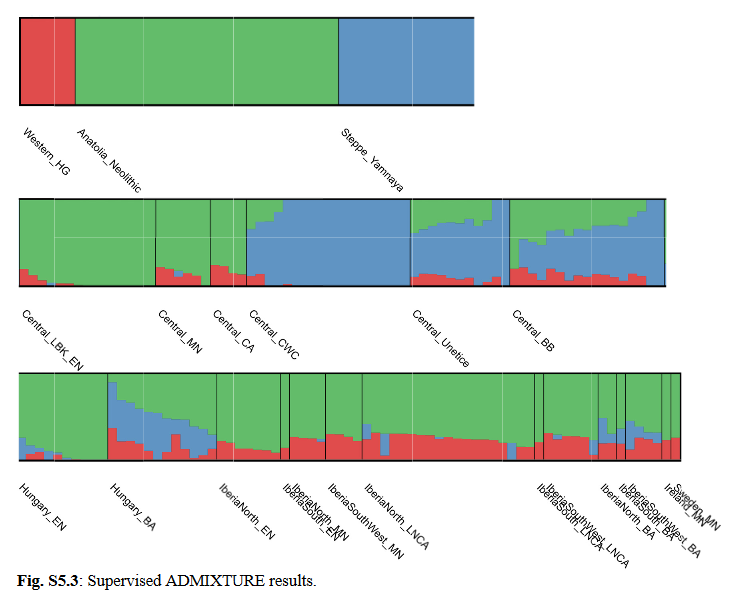
What is wrong? Well, the very title is wrong. It is nothing but an artifact produced by forced (supervised) results of Admixture within the simplistic 3-population model. Even then their result is in fact so weak that it immediately cried to me as "artifact" (noise or whatever you want to call it) and it is effectively nothing but that. 

And to demonstrate it is as simple as digging into the supplementary materials and look at the unsupervised Admixture run (dataset S03), whose optimal columns (lowest CV scores) are K=16-19 (all four are optimal, what is fine with me but makes explanation and understanding a bit more dense). 

As that unsupervised admixture is massive, with lots of global populations ancient and modern, I made a selection using only the four optimal K-values (K=16 to K=19, from left to right):

Click to expand (labels at bottom are mine)

And it is absolutely clear from K=16 to K=18 that there is not a speck of the Caucasus component which is absolutely universal in all the true Indoeuropean samples. There is a tiny speck of it in the K=19 column but there even Sardinians and some Anatolian Neolithic individuals have it at much greater values and thus cannot anymore be automatically interpreted as Indoeuropean marker, but just as extra Caucasus affinity present in some Neolithic-derived populations or individuals more than others since the very beginning of mainline (Vasconic) European Neolithic at the Aegean.

And this is it. Quod erat demonstrandum (Q.E.D): R1b-S116, at least in Iberia, has nothing to do with Indoeuropean expansion, nothing at all: it is absolutely clear that it is a pre-Indoeuropean thing. And it has been present in Lower Rioja since at least the Bronze Age.

Furthermore, when we look at the Central European Bell Beaker (Central BB) samples and compare them with their immediate chronological precursors of (definitely Indoeuropean) Corded Ware culture, we must admit that there is a decrease of the Caucasus component and an increase of the Vasconic Neolithic (light blue) element. This also speaks against the Indoeuropean "explanation" for the expansion of R1b-S116 into Central Europe, because the first known such ancient carriers are from the Bell Beaker period and not a moment earlier, and these clearly express an anti-Indoeuropean tendency in their autosomal genomes.

There is however a sizable Indoeuropean component in modern non-Basque Iberians, smaller than in most other European populations but very clear nevertheless. This must have arrived at later times: (1) with the Celts, who arrived to Catalonia at the end of the Bronze Age, later expanding into Central and Western Iberia, (2) with the Romans, (3) maybe also to some extent with the Germanic invaders of the late Roman period. None of these expansions seem particularly associated with R1b-S116, however the c. 1% R1a and the c. 8% J2 (with plausible Italo-Roman origin) should be related to it, along with an assortment of other haplogroups. 

For those willing to dig in the details, there is also a small treasure trove of other ancient Y-DNA, mostly I (which underlines the Paleoeuropean influence in Neolithic Iberia, regardless of whether this is local or was carried on from further East by the Neolithic settlers), as well as one instance of unspecific R1b, another of G and another of H.

Someone may ask, which is then the origin and means of expansion of R1b-S116, if not Indoeuropean? Good question to which I don't have yet a well defined answer. But my tentative explanation is that it should be related to two ultimately related processes within Western European "Neolithic" (Late Neolithic and Chalcolithic): 
  1. The well documented phenomenon of increase, in most areas at least, of the Paleoeuropean component time passes, this may be to some extent because of simple absorption of local subneolithic "hunter-gatherers" but it probably also produced different subpopulations within the Western Neolithic and in some cases we do see these peripheral "Second Neolithic" groups expanding at the expense of the "First Neolithic" peoples. This is most clear in Central Europe with the expansion of Funnelbeaker cultures from, probably, Denmark and nearby areas of Low Germany. In fact Michelsberg culture and its close relative in France Seine-Oise-Marne basically wipe out the first farmers of LBK (Linear Pottery) at what I usually describe as the Chalcolithic but is often described as Middle or Late Neolithic in other sources.
  2. Clearly Bell Beaker had something to do: we see their impact in Germany, Britain and Ireland and one could argue that Cogotas I is somehow derived from the Bell Beaker of Ciempozuelos, although in this I'm going to remain neutral and a bit skeptic until more evidence shows up. 
But what seems very apparent tome is that R1b-S116 should have expanded from somewhere in France, probably towards the South. And we do need better genetic studies, including archaeogenetic ones, on the Hexagon before we can jump to conclusions. France is not the most affected area by Bell Beaker, so I am cautious about attributing too much weight to only Bell Beaker and I would rather think on a complex succession of expansions associated to various cultures. 

Of great interest here should be the ill-known but fascinating Artenacian culture, which expanded in all West France and Belgium from a core at Dordogne before the BB period and coincident with the Corded Ware expansion in Central Europe. Like Bell Beaker folk, they were adept at bowmanship but their area is not densely affected by Bell Beaker later on (although there is indeed a scatter of findings). I do wonder if somehow Bell Beaker is derived from Artenac, even if it is clearly not the same thing. Food for thought.


Update (March 18): small steppe-like noise appears in diverse Iberian samples since the Late Neolithic/Chalcolithic.

This has arisen in the discussion below (h/t to MZ): when the supervised (forced assignment to rigid three populations) is used, the appearance of "steppe" ancestry is found here and there also before the Bronze Age. As we see above, this is not real: it does not happen in the unsupervised model at all but mere "noise" or "artifact" produced by the excessive simplicity of the three populations model.


This does not make the three populations model "wrong": it is still approximately right but "evidence" produced  ONLY from rigidly applying this model is not evidence of anything, just a hint to be confirmed or rejected via wider analysis at best.

March 16, 2018

Ancient DNA from the Balkans

This study has been for several months around but I have not discussed until now and is well worth a mention.

Ian Mathieson et al., The Genomic History Of Southeastern Europe. BioRXiv (pre-pub) 2017. doi:10.1101/135616

There is a lot of ancient autosomal DNA from the region but it basically says one thing: everything was almost exactly as expected from archaeology. The Karanovo-Gumelnita people, famed for inventing the Bronze Age a whole millenium earlier than anyone else, and nearby related cultures, were within the mainstream (Vasconic) Neolithic genetic grouping. This changed however with the kurgan invasion expressed primarily in the Ezero culture, which I've been told should be considered direct precursors of Thracians. But the change is not something radical: more genetic affinity with the steppe is visible than before and more generalized through all samples. 

Fig. 1-D - Supervised ADMIXTURE plot, modeling each ancient individual (one per row), as a mixture of
populations represented by clusters containing Anatolian Neolithic (grey), Yamnaya from Samara (yellow), EHG (pink) and WHG (green).
  (click to expand)


Well, it is not exactly everything what is as expected, if we consider Polish Globular Amphorae culture, which I would have expected to be at least somewhat steppary, Indoeuropean, already but were not. Thus it seems I have to concede on this culture and its precursors being still part of the Vasconic Neolithic. This makes Indoeuropean penetration into Central-North Europe a much more sudden episode and one directly tied to Corded Ware culture and nothing else. It must have been perceived by its victims like a massive catastrophe, because it was a huge area which they conquered and to a large extent colonized in a very short span of time.


Lots of R1b in Epipaleolithic Balkans

Most interesting anyhow is the huge hoard of ancient Y-DNA R1b in the Iron Gates region (Lepenski Vir) before the Neolithic. This not only demonstrates, again, that this haplogroup is Paleoeuropean, at least in part, but, quite intriguingly makes earlier findings on modern data suggesting a possible origin or R1b-M269 in or near modern Serbia (Morelli 2010 and Myres 2010) at least somewhat plausible. However none of the Iron Gates R1b is described as R1b-M269 and in some cases it is excluded that it could be this sublineage. 

Thus the issue of the ultimate origins of this key lineage remains open, but let me underline that these Iron Gate individuals belonged to the WHG grouping, as did Villabruna (so far the oldest R1b carrier kown) and that they breach this way the assumed haplogroup homogeneity I2 conceived on merely Central and Northern European samples. Just as happened with mtDNA U haplogroup homogeneity when mtDNA H was detected by several independent studies of Iberian ancient DNA. It is normal to expect more diversity towards the south for several reasons but maybe the most critical of them is just average temperature, which makes the southern lands naturally more fertile (notably so for crops domesticated in the Middle East) and easier to inhabit. 

This trend was only broken in the Middle Ages when the heavy plough allowed the improved exploitation of deep Oceanic soils, being useless in the Mediterranean region of shallow soils however. It was only then when the center of European development moved from south to north, to Belgium specifically, where it remains till present day. So let's take Southern Europe a bit seriously, please.

February 17, 2018

Obsidian exchange in Neolithic Sicily and Sardinia (video)

Thanks to Theasparagus for noticing this quite interesting video-lesson on quite obviously seagoing peoples of the Central Mediterranean and their journeys to distant volcanic islands to obtain the valuable obsidian (sharper than a scalpel) and also to the mainland to trade it for whatever goods.


January 1, 2017

Forests burnt in Ice Age Europe

Quickies


Jed O. Kaplan et al., Large Scale Anthropogenic Reduction of Forest Cover in Last Glacial Maximum Europe. PLoS ONE 2016. Open accessLINK [doi:10.1371/journal.pone.0166726]

Abstract

Reconstructions of the vegetation of Europe during the Last Glacial Maximum (LGM) are an enigma. Pollen-based analyses have suggested that Europe was largely covered by steppe and tundra, and forests persisted only in small refugia. Climate-vegetation model simulations on the other hand have consistently suggested that broad areas of Europe would have been suitable for forest, even in the depths of the last glaciation. Here we reconcile models with data by demonstrating that the highly mobile groups of hunter-gatherers that inhabited Europe at the LGM could have substantially reduced forest cover through the ignition of wildfires. Similar to hunter-gatherers of the more recent past, Upper Paleolithic humans were masters of the use of fire, and preferred inhabiting semi-open landscapes to facilitate foraging, hunting and travel. Incorporating human agency into a dynamic vegetation-fire model and simulating forest cover shows that even small increases in wildfire frequency over natural background levels resulted in large changes in the forested area of Europe, in part because trees were already stressed by low atmospheric CO2 concentrations and the cold, dry, and highly variable climate. Our results suggest that the impact of humans on the glacial landscape of Europe may be one of the earliest large-scale anthropogenic modifications of the earth system.


Not sure what to think, really. In any case the data they manage and share with us is very much worth taking a look at.


October 28, 2016

The destiny of a cave lion: to serve as decoration

Quickies

Spanish researchers have concluded that a carpet or other comparable fur ornament (a tapestry?, a cape?) is why a late cave lion remains, the latest ones known in Iberia, were found in an otherwise human (Magdalenian) context in the cave of La Garma (Asturias, Spain): it was a fur, claws included, used as decoration of some sort.

Marian Cueto et al., Under the Skin of a Lion: Unique Evidence of Upper Paleolithic Exploitation and Use of Cave Lion (Panthera spelaea) from the Lower Gallery of La Garma (Spain). PLoS ONE, 2016. Open accessLINK [doi:10.1371/journal.pone.0163591]

Abstract

Pleistocene skinning and exploitation of carnivore furs have been previously inferred from archaeological evidence. Nevertheless, the evidence of skinning and fur processing tends to be weak and the interpretations are not strongly sustained by the archaeological record. In the present paper, we analyze unique evidence of patterned anthropic modification and skeletal representation of fossil remains of cave lion (Panthera spelaea) from the Lower Gallery of La Garma (Cantabria, Spain). This site is one of the few that provides Pleistocene examples of lion exploitation by humans. Our archaeozoological study suggests that lion-specialized pelt exploitation and use might have been related to ritual activities during the Middle Magdalenian period (ca. 14800 cal BC). Moreover, the specimens also represent the southernmost European and the latest evidence of cave lion exploitation in Iberia. Therefore, the study seeks to provide alternative explanations for lion extinction in Eurasia and argues for a role of hunting as a factor to take into account.

Fig 4. Cave lion distal phalanxes from the Lower Gallery of La Garma.
Note that only eight of nine specimens are depicted in the figure.

Above: the claws that are the only remnants found of said lion, whose cut marks are fully coincident with skinning techniques used in more recent times with similar decorative purpose. They are believed to be all anterior claws and that one is missing therefore. That is why they imagine the fur to have been cut with an aesthetic interest, because the hind claws would not be visible if the fur was, for example, hang on the wall, so they were probably cut off.

Whether hunting of lions by humans was a decisive, contributing or negligible factor in cave lion extinction remains unclear.

October 21, 2016

Wisent co-existed with true bison already in the Paleolithic

A fascinating story this one indeed: the European bison or wisent has some ancestry related to the cow, evident in its mitochondrial DNA. This was already known but what wasn't known is that this distinct "hybrid" species of bison dated to the Upper Paleolithic. Thanks to the excellent records of anonymous prehistorical biologists who recorded them in Southwestern European rock art with great detail and naturalism, modern researchers have realized that the wisent, with its bovid heritage, existed already in the Upper Paleolithic. Ancient DNA recovery has now confirmed the artist's impression.

Julien Soubrier et al. Early cave art and ancient DNA record the origin of European bison. Nature communications, 2016. Open access → LINK [doi:10.1038/ncomms13158]

Abstract

The two living species of bison (European and American) are among the few terrestrial megafauna to have survived the late Pleistocene extinctions. Despite the extensive bovid fossil record in Eurasia, the evolutionary history of the European bison (or wisent, Bison bonasus) before the Holocene (< 11.7 thousand years ago (kya)) remains a mystery. We use complete ancient mitochondrial genomes and genome-wide nuclear DNA surveys to reveal that the wisent is the product of hybridization between the extinct steppe bison (Bison priscus) and ancestors of modern cattle (aurochs, Bos primigenius) before 120 kya, and contains up to 10% aurochs genomic ancestry. Although undetected within the fossil record, ancestors of the wisent have alternated ecological dominance with steppe bison in association with major environmental shifts since at least 55 kya. Early cave artists recorded distinct morphological forms consistent with these replacement events, around the Last Glacial Maximum (LGM, ∼21–18 kya).


The depictions of both types of bison are rather distinct but it seems nobody had noticed the difference until now, as the researchers explain in this article.

Fig. 1 - (a) Reproduction from Lascaux cave (France), from the Solutrean or early Magdalenian period (20,000 kya—picture adapted from ref. 53). (b) Reproduction from the Pergouset cave (France), from the Magdalenian period (<17,000 kya—picture adapted from ref. 54).

The ancient wisents sequenced now carry a distinct mtDNA haplogroup, called "clade X", which is sister to that of modern wisents (all descending from just 12 survivors). This wisent macro-haplogroup forms a clade with that of bovine cattle (cows of all sorts, both taurine and indicine) but they are joined only at the root, suggesting that the hybridization event that created the wisents as distinct species is very old, just a bit more recent than the divergence of cow and bison.

Fig. 2 - (a) Phylogenetic tree inferred from bovine mitochondrial control region sequences, showing the new clade of bison individuals. The positions of the newly sequenced individuals are marked in red for CladeX. (b) Bovine phylogeny estimated from whole-mitochondrial genome sequences, showing strong support for the grouping of wisent and CladeX with cattle (cow) and zebu. For both trees (a,b) numbers above branches represent the posterior probabilities from Bayesian inference, numbers below branches represent approximate likelihood ratio test support values from maximum-likelihood analysis and scale bars represent nucleotide substitutions per site from the Bayesian analysis. (c) Maximum-clade-credibility tree of CladeX and wisent estimated using Bayesian analysis and calibrated with radiocarbon dates associated with the sequenced bones. Dates of samples older than 50 kyr were estimated in the phylogenetic reconstruction. (d) Map showing all sampling locations, using the same colour code (red for CladeX, orange for wisent and blue for steppe bison).

So it is not random auroch hybridization but a very specific and very ancient episode of admixture between the ancestors of bisons and cows.

The two species appear to have distinct ecological niches:

The detailed records of the southern Ural sites allow the timing of the population replacements between steppe bison and wisent to be correlated with major palaeoenvironmental shifts, revealing that the wisent was associated with colder, more tundra-like landscapes and absence of a warm summer.

This pattern seems to correspond with the periods in which the two species are portrayed in rock art, as two of the researchers explain in this video (third part):


Post-statement: I must say that, on second thought, I'm not really convinced by the claim of wisent corresponding to colder periods. In fig. 1 above it is apparent that it is the steppe bison which corresponds to the last glacial maximum (LGM) in Southwestern Europe and not the wisent, which only shows up after the end of this coldest period. 

I wonder if the researchers are explaining themselves well enough on this aspect or if it is a case of wishful thinking, maybe caused by different conditions in SW Europe (where the rock art is) and the Southern Urals (where most of the archaeogenetic and paleontological data comes from). 

At the very least, judging on fig. 1, it would be the steppe bison the one corresponding with the coldest spell and the wisent the one corresponding to more temperate conditions. Can someone explain me what is going on here?

Armintxe: new rock art site discovered in the Basque Country

A week ago a new rock art site was revealed to exist right in the town of Lekeitio (Biscay). The art, estimated to be from some 14,000 years ago (Magdalenian culture), is made up of several groups of engraved animals: bisons, horses, goats and deers. The cave is not far from other known sites like Lumentxa, Atxurra and Santa Catalina.

Video of the cave and art[es]:


More information:
Arkeobasque
Pileta de Prehistoria[es] (has several videos and news from several sources, quite extensive)

August 21, 2016

All the Neolithic and Chalcolithic of Ireland in a single paper


This entry should be a "quickie" because I wouldn't even know where to begin in order to analyze this comprehensive synthesis and not at all because it is a lesser study, all the oposite. Just to say that the average reader of this blog will want to read it, much more if they are Irish.

However I think that the paper raises some interesting questions regarding the chronology of "modern genetic Irishness" and the arrival of the Y-DNA lineage R1b to the island, which I cast below for your insights.


T. Rowan McLaughling et al., The Changing Face of Neolithic and Bronze Age Ireland: A Big Data Approach to the Settlement and Burial Records. Journal of World Prehistory 2016. Open accessLINK [doi:10.1007/s10963-016-9093-0]

Abstract

This paper synthesizes and discusses the spatial and temporal patterns of archaeological sites in Ireland, spanning the Neolithic period and the Bronze Age transition (4300–1900 cal BC), in order to explore the timing and implications of the main changes that occurred in the archaeological record of that period. Large amounts of new data are sourced from unpublished developer-led excavations and combined with national archives, published excavations and online databases. Bayesian radiocarbon models and context- and sample-sensitive summed radiocarbon probabilities are used to examine the dataset. The study captures the scale and timing of the initial expansion of Early Neolithic settlement and the ensuing attenuation of all such activity—an apparent boom-and-bust cycle. The Late Neolithic and Chalcolithic periods are characterised by a resurgence and diversification of activity. Contextualisation and spatial analysis of radiocarbon data reveals finer-scale patterning than is usually possible with summed-probability approaches: the boom-and-bust models of prehistoric populations may, in fact, be a misinterpretation of more subtle demographic changes occurring at the same time as cultural change and attendant differences in the archaeological record.

The study should be very useful to anyone trying to understand the prehistory of Ireland, not the least because of its many maps and this extremely cool sequential maps video from pre-Neolithic times (5th millennium BCE) to the gates of the Bronze Age (early 2nd millennium BCE). Notice that in the Isles they tend to call "Bronze Age" to the Chalcolithic (Copper and Stone Age) and hence the title, which is a bit misleading.


An example of the very cool and highly informative maps and data you'll find in this study:
Fig. 3 - Map of Ireland showing Early Neolithic sites


Depopulation and resettlement? When?


An intriguing issue is the boom and bust cycles, particularly the almost total absence of signs of human activity around the end of the 4th millennium (3300-3000), suggesting maybe a depopulation after the first farmer colonization (?). There are clear booms around 4000, 3700, 3500, 2900, 2500 and since 2200 (Bell Beaker era). All this is something to chew about.

Particularly I'd raise the following question here: we know that a woman from c. 3400-3100 BCE (just at the depopulation gap?) was a typical Neolithic European, most similar to SE Spaniards and Sardinians, and that a man from c. 2200-1500 (Bell Beaker boom) was virtually identical to modern Irish and "British Celts" like Scots, Welsh and Cornish, carrying the common and controversial R1b patrilineage. 

The initial reading many of us made was that these new genetics may have arrived with Bell Beaker and that maybe Bell Beaker was more influential in terms demographic than we used to think, at least in Ireland. However, with this archaeological sequence on hand it seems at least reasonable to think that the major resettlement of an almost deserted Ireland happened after 3000 BCE but significantly earlier than the Bell Beaker phenomenon, which only reaches Northern Europe (Ireland included) c. 1500 BCE. What's your opinion?

May 4, 2016

Large Paleoeuropean DNA survey

An unprecedented survey of ancient DNA from Paleolithic Europe has been just published:

Qiaomei Fu et al., The genetic history of Ice Age Europe. Nature 2016. Pay per viewLINK [doi:10.1038/nature17993]

The supplemental materials (PDF) are freely accessible, as are the figures and tables (HTML). 

Quick highlights:
  1. Oldest Y-DNA R1b1 (and therefore R1b and R1) ever documented (Villabruna, Veneto, 14 Ka ago, Epigravettian cultural context). Also more Japan and La Braña related C1!
  2. Oldest mitochondrial DNA H (H7) may be in Gravettian Moravia, also oldest U6 may not be in Iberia or North Africa but in Gravettian Romania.
  3. Very important insights in autosomal DNA: a distinct Paleoeuropean population since Gravettian, two different late UP/Epipaleolithic populations. 
  4. Still very important gaps, notably SW France (the core of Paleolithic Europe) and most of Iberia. Also still missing West Asian sequences altogether, except for the rather anomalous Caucasus population and whatever may be inferred from Early European Farmers, whose ancestry was mostly (aprox. 3/4) West Asian.

A good synthesis of the scope and some of the findings of this study is in fig. 1:

(click to expand)


Y-DNA

The survey confirms (supp. materials 4) that haplogroup I used to be the most common patrilineage in Paleolithic Europe. But it was not the only one:

The oldest ones (pre-Villabruna, c. 14 Ka BP) were largely C1:
  • Kostenki 14 (Russia, Gravettian): C1b
  • Goyet Q116-1 (France, Aurignacian): C1a
  • Vestonice 16 (Moravia, Gravettian): C1a2
Also in this oldest group (arbitrarily defined as pre-Villabruna), there was some I* or maybe pre-I (some markers are missing in many individuals), including: Pavlov 1 (Gravettian, Moravia), Paglicci 133 (Gravettian, South Italy), Hohle Fels 49 (Magdalenian, Swabia), Goyet Q2 (Magdalenian, France) and Bukhardtshohle (Magdalenian, Swabia). Notice that its prevalence and clarity as "I proper" increases after the LGM; the Gravettian ones seem to be pre-I rather than true I.

Other oldest lineages are BT* (Vestonice 15), CT* (Ciclovina 1, Kostenki 12, Vestonice 13), F* (Vestonice 43). Notice that in most cases not all the ideal SNP testing was performed, so it is still possible and even probable, I'd think, that BT* and CT* are actually F*.

In the more recent "post-Villabruna" group:

The revelation of the group is of course Villabruna, which carried R1b1

There are also two I* (Cuiry Les Chardaudres 1 and Berry Au Bac), one I2 (Rochedane) and one F* (Falkenstein).

I must also mention that previous studies found mostly I2 in Epipaleolithic samples, excepted La Braña, which carried C* (maybe some sort of C1 but unconfirmed). R1a1* was found in Karelia as well.

Synthesis: I and R1b1, the most common lineages of Europe West of the Elbe, only show up after the Last Glacial Maximum, at least as far as we know. I probably coalesced in the subcontinent, the issue of where R1b, the most common modern patrlineage of Western Europe, coalesced and how it expanded remains open but the Villabruna data point defines a terminus ante quem for this haplogroup, which MUST be older than 14,000 years necessarily, discarding some of the most outrageous recentist chronologies altogether. The great initial diversity of CT-derived lineages suffered bottlenecks with the LGM and probably also later, pruning most of them (although rare instances of some of those lines such as F* or C1 are still found among modern Europeans).


Mitochondrial DNA

Lots of interesting stuff in this issue of the matrilineages, but also some strange issues in the data that do raise eyebrows quite a bit. The full dataset is in the supplemental materials section 2. 

However they do not provide clear data on how the tests were performed, just a generic listing. This is very problematic, notably when they state that El Mirón is U5b, when Hervella (with more clear methodology) classified her as H just a year ago. Another similar issue is the apparent H7 (H7a1?) in Vestonice 14, which is first classified as "damaged" (based apparently on X-chr contamination, the CI for H7 is 0.9-1) and then listed as "U" in the extended table 1, with no reasoning whatsoever for the change. 

Rumor is already around about a mysterious H-hater "black hand" being at play here. I can't neither confirm nor reject it but I do think that the authors should explain themselves more clearly on this most important matter, which is beginning to be more than just annoying, fueling conspiracy theories and what-not.

Another interesting issue is a possible U6 in Muierii (Gravettian Romania, CI 0.88-0.97), labeled as "damaged" again and refurbished as mere amorphous "U". This is a very important issue and is directly related with the presence of mtDNA H in Paleolithic Europe and the origin of these lineages in North Africa. 

Northwestern Africa (not counting Cyrenaica) did not experience any sort of Upper Paleolithic (UP) until c. 22 Ka BP, when a new culture of very likely Iberian Solutrean affinity, the Iberomaurusian or Oranian expanded from Taforalt (Arif, North Morocco). In my understanding this is the most likely origin of mtDNA H (H*, H1, H3, H4 and H7) in North Africa and maybe also of mtDNA V, and also should be related to the bicontinental distribution of mtDNA U6 (in North Africa but also and quite diversely in Iberia) and the surely related distribution of Y-DNA E1b-M81. 

While it's easy to imagine mtDNA H (and maybe also V) migrating from Europe to North Africa in this context, less clear has been so far the issue of U6 origins: as U-derived lineage it must ultimately derive from the early UP populations of West Asia but then again the first UP in the region must have arrived from SW Europe in the Last Glacial Maximum (LGM) period. So something I've been wondering all this time, particularly since the crucial, rare and basal, U6c lineage was discovered to exist not just in Morocco but also in Andalusia, is if U6 actually arrived to NW Africa from Europe and not, as is often assumed, vice-versa. 

So you will understand how this issue of properly identifying ancient mtDNA H and U6 lineages is important not only for the understanding of the roots of Europeans but also for those of North Africans. There are interests at play here because many geneticists have made a personal issue of "molecular clock" age estimates (whose actual scientific, empirical, value is often close to zero but are "sold" as "scientific" instead) and also of exaggerating the West Asian Neolithic influence in Europe beyond reason, leading to true quasi-ideological "DNA wars" that are totally out of place. 

Please, let's be serious: there is no room for childish games on these matters, you guys and gals are grown ups with a PhD!

Otherwise a lot of U (as usual: U*, U5, U2), notable is U8c (CI 0.91-1 but declared "damaged" in spite of extremely low X-chr contamination), which, if confirmed, could offer clues about the origins of the rare Italo-Jordanian U8c (and indirectly about Basque U8a and the quite common but surely Neolithic haplogroup K). Also discarded are several samples that initially produced lineages under macro-haplogroup M, however Goyet Q116-1 was labeled as "pass" with this lineage. So there is Paleoeuropean M, or at least there was once upon a time, this one beyond any doubt.


Autosomal DNA

This last part is most interesting as well. As you can see in the figure 1 above, the authors described three Paleoeuropean clusters: blue (aka Vestonice), green (aka El Mirón, however El Mirón is actually green-red admixed) and red (aka Villabruna, equivalent to the WHG grouping seen in some recent studies). Black-marked samples are out of any group and the Siberian (Mal'ta) and Caucasus (Satsurbilia) clusters are not too relevant here. 

Annotated by me: in green approx. dates for reference, in gray approx. reconstruction of the ancestry of late Paleoeuropeans

First of all it is clear that all or most Paleoeuropeans form a unique macro-cluster (orange shaded) to the exclusion of the Mal'ta and Satsurbilia clusters and also of Early Neolithic Stuttgart (~3/4 West Asian). This macro-cluster is comparable in affinity to that of Han-Dai-Karitiana, so even the word "race" can be used. Some people have argued that "there was no Europe" back then, because the Bosporus was an isthmus, but from the genetic data it seems clear that Europe was more distinctive then than it is now, after the Neolithic massive admixture event that spanned from Europe to India with West Asian centrality. 

Then we see an older "Gravettian" or blue or Vestonice cluster, that is clearly pre-LGM and that does not include however peripheral Gravettians such as Mal'ta, Kostenki or Goyet Q53-1.

But the most interesting feature is that two different populations existed at the end of the Paleolithic period: the green one (El Mirón) is strictly Magdalenian and vanishes with the Epipaleolithic (at least for this sample, which has mayor gaps), instead the red one (Villabruna or WHG) was initially less common in Magdalenian and spans beyond its cultural borders into Epigravettian Italy too, however it becomes the only thing around in the Epipaleolithic, suggesting the expansion of a single population in that late period, maybe with the geometric microlithism which precedes in most areas the arrival of Neolithic and may well have expanded from France. 

Looking at the orange range of less obvious affinities, I tried to pinpoint tentative origins for those two populations. The green one relates best with GoyetQ116-1 (Aurignacian), while the red one does with GoyetQ53-1 (Gravettian). This is also somewhat apparent in the PCA and I tried to indicate it with the annotated arrows. 

Especial thanks for his insights to Jean Lohizun.

February 14, 2016

A Magdalenian campsite map from Catalonia

Quickies


A neat curiosity from the Ice Age:

Marcos García Díez & Manuel Vaquero, Looking at the Camp: Paleolithic Depiction of a Hunter-Gatherer Campsite. PLoS ONE 2015. Open access → LINK [doi:10.1371/journal.pone.0143002]


Abstract

Landscapes and features of the everyday world were scarcely represented in Paleolithic art, especially those features associated with the human landscape (huts and campsites). On the contrary, other figurative motifs (especially animals) and signs, traditionally linked to the magic or religious conceptions of these hunter-gatherer societies, are the predominant themes of Upper Paleolithic art. This paper seeks to present an engraved schist slab recently found in the Molí del Salt site (North-eastern Iberia) and dated at the end of the Upper Paleolithic, ca. 13,800 years ago. This slab displays seven semicircular motifs that may be interpreted as the representation of dome-shaped huts. The analysis of individual motifs and the composition, as well as the ethnographic and archeological contextualization, suggests that this engraving is a naturalistic depiction of a hunter-gatherer campsite. Campsites can be considered the first human landscape, the first area of land whose visible features were entirely constructed by humans. Given the social meaning of campsites in hunter-gatherer life-styles, this engraving may be considered one of the first representations of the domestic and social space of a human group.

January 9, 2016

Good documentaries on human Prehistory

I just watched the documentary "First Peoples - Asia" (by NOVA) and found it quite good, discussing many of the issues that I and the readers of this blog have been following and discussing the last years on the settling of Asia (and geographical dependencies): the Zhirendong jaw, the Nubian points of Arabia, the archaic admixture events... 

The only issue is that for some odd reason (copyright masking?) interviewed people voices often have a too high pitch.

I hope the other four documentaries of the series are similarly good. I haven't watched them yet but the full playlist is embedded below beginning with the Asian colonization movie. For many readers it won't be that interesting personally (they already know all or most of it, maybe even better than what the movie explains) but it is still a promising tool to share your hobby with family and friends, so watch it in good company. 

Enjoy!


Update (Jan 9):

I've watched already four of them (Africa, Asia, Australia and Europe) and the European one is no doubt the worst: a superficial Neanderthal hybridization neo-myth spearheaded by John Hawks. Also the only map or description of the route followed by modern humans to Europe is absolute nonsense: directly from Africa via Palestine, when in fact it's extremely clear that at least most of the lineages went all the way to SE Asia and back before ever entering Europe. What happened to the spear in the rib of Zawi Chemi Shanidar man? What happened to the very fast replacement in the early Aurignacian, coincident with the Campanian Ignimbrite eruption? What about dogs? Not a word! Just whitewashing of the probably quite violent Sapiens-Neanderthal interaction. You can skip that one, really, it's pretty much nonsense.

Some hyper-hybridationism permeates all the documentaries but the others seem much better: the Asia one is quite good, the Africa one is not bad either (although could be much better if they paid more attention to archaeology, also Africa deserves 50% of the documentary space probably), the Australia one is OK but it simply ignores Papua and Wallacea altogether, what is a bit perplexing to say the least. The Europe one is just horrible: it has some facts but half of it its John Hawks' preaching his particular ideology about people being oh-so-nice that they probably used spears as toothpicks, Paabo making a lot of extra work for the cleaning crew (spectacular admittedly but should be in a separate Neanderthal docu, not in one dedicated to H. sapiens) and some real archaeology scattered around (but definitely not enough at all).

October 24, 2015

The oldest known plague

New ancient DNA research has identified the bacterium Yersinia pestis, which causes the deadly and epidemic illness known as plague, in Chalcolithic and Bronze Age Central Eurasia, from Altai to Poland and the Caucasus.

S. Rasmussen, M.E. Alentoft et al., Early Divergent Strains of Yersinia pestis in Eurasia 5,000 Years Ago. Cell 2015. Open accessLINK [doi:http://dx.doi.org/10.1016/j.cell.2015.10.009]

Summary

The bacteria Yersinia pestis is the etiological agent of plague and has caused human pandemics with millions of deaths in historic times. How and when it originated remains contentious. Here, we report the oldest direct evidence of Yersinia pestis identified by ancient DNA in human teeth from Asia and Europe dating from 2,800 to 5,000 years ago. By sequencing the genomes, we find that these ancient plague strains are basal to all known Yersinia pestis. We find the origins of the Yersinia pestis lineage to be at least two times older than previous estimates. We also identify a temporal sequence of genetic changes that lead to increased virulence and the emergence of the bubonic plague. Our results show that plague infection was endemic in the human populations of Eurasia at least 3,000 years before any historical recordings of pandemics.

The bacterium was yet unable to cause the bubonic form of the plague and could not spread by means of fleas either. Instead it probably caused pneumonic and spticemic plague and was propagated by coughing and sneezing, much like the flu. 


Figure 1
Archaeological Sites of Bronze Age Yersinia pestis
(A) Map of Eurasia indicating the position, radiocarbon dated ages and associated cultures of the samples in which Y. pestis were identified. Dates are given as 95% confidence interval calendar BC years. IA: Iron Age.
(B) Burial four from Bulanovo site. Picture by Mikhail V. Khalyapin. See also Table S1.

In spite of the hype, the prevalence of the plague was low: only 7 out of 101 samples tested positive for the bacterium, ranging from c. 2800 BCE (Altai) to c. 1000 BCE (Southern Azerbaijan, Iran). A 7% prevalence is still significant but it's also obvious that 93% of the people in the period studied did not die from the plague, so let's not exaggerate, alright?

The exaggeration is already seeded in the study with passages as this one:
These early plagues may have been responsible for the suggested population declines in the late 4th millennium BC and the early 3rd millennium BC (Hinz et al., 2012, Shennan et al., 2013).

Neither of the referenced studies (see here and here) deals with Eastern Europe, West Asia or Central Asia, and the analyzed dates only slightly overlap with the period in which Y. pestis is found, so I fail to see the logic. It is true that there could be a coincidence in the case of Little Poland, where both Y. pestis and a demographic decline are apparent c. 2000 BCE but in all other cases it really needs a good deal of imagination to make any association.

In any case, it is clear that even the most virulent plague ever known, the Black Death, only managed to make a dent in the European demography and its consequences were not those of demographic re-expansion of the less affected populations (Polish, Basques) but a double socio-economic transition in two phases:
  1. The lack of manpower in the decades after the Black Death allowed the lower classes to renegotiate their situation in various ways. It was the period in which the feudal system was most dramatically eroded, with peasants gaining control on their farmed lands and lords losing large shares of their exploitative profits, while being forced to compete against each other for whom offered best working conditions to the now scarce farmers, who, legally or not, migrated from the worst places to the ones offering better conditions. 
  2. A reaction by profit-jealous landlords that largely replaced farming by husbandry, which requires less manpower. A well known case were the English enclosures, which would, slowly but steadily, set the foundations of Capitalism.

This is explained by historian, actor and director Terry Jones in the following video:


So the consequences and context of these epidemics must be considered adequately and not distorted nor simplified unduly in the line of the infamous Guns, Germs and Steel book, which greatly exaggerates the consequences of natural epidemics and is one of the favorite books of Eurocentric reactionaries with a distorted and overly simplistic view of things. One of the "virtues" of the epidemic hype is that it somehow absolves the winners from their historical crimes, blaming them on nature almost alone: instead of genocide, they use these deformations of reality to blame the mass destruction of whole nations and populations, be them Neanderthals or Native Americans, on "natural causes". 

Hypocrisy!

Instead I wonder about the real demographic impact, not yet well assessed, of the epidemics, and also about the real socio-economic consequences of such demographic declines. Of course, they could have allowed for localized migrations in the aftermath of the epidemics (or whatever other causes of demographic declines) but they should also have favored at least short-term renegotiations of the social order in favor of the suddenly scarce working classes (farmers). This "upward mobility" and partial "leveling" of what was already in many cases a feudal-like caste society should have dramatic effects in the constitution of the nations of the Bronze Age, regardless of later re-adjustments and expansions, which one can imagine as an imperfectly cyclical process.

October 14, 2015

Neolithic genomes from Northwestern Turkey

Or yet another ancient European DNA study, with some quirks and, critically, the first ancient farmer sample from the Eastern Mediterranean, specifically Northwestern Anatolia, near Yenişehir (Bursa province).

Iain Mathieson et al. Eight thousand years of natural selection in Europe. BioRxiv (pre-pub), 2015. Freely accessibleLINK [doi: ]

Abstract

The arrival of farming in Europe around 8,500 years ago necessitated adaptation to new environments, pathogens, diets, and social organizations. While indirect evidence of adaptation can be detected in patterns of genetic variation in present-day people, ancient DNA makes it possible to witness selection directly by analyzing samples from populations before, during and after adaptation events. Here we report the first genome-wide scan for selection using ancient DNA, capitalizing on the largest genome-wide dataset yet assembled: 230 West Eurasians dating to between 6500 and 1000 BCE, including 163 with newly reported data. The new samples include the first genome-wide data from the Anatolian Neolithic culture, who we show were members of the population that was the source of Europe's first farmers, and whose genetic material we extracted by focusing on the DNA-rich petrous bone. We identify genome-wide significant signatures of selection at loci associated with diet, pigmentation and immunity, and two independent episodes of selection on height.

As you can see from the title and the abstract, much of the study is focused on more or less debatable selection signatures. Interesting, of course, but not what my greatest interest, less so as I perceive that there is missing data that may be crucial for the understanding of some of such selection, notably the mainstream European LCT 13910-T allele.

How can you do an analysis of selection on this allele while ignoring the first known carriers of it: Chalcolithic (proto-)Basques and Swedes (Gökhem particularly)?

Luckily there are other highlights...


Northwestern Anatolian ancient genetics

The new ancient Neolithic samples come from two sites: Menteşe Höyük (n=5) and Barcın Höyük (n=21), both located in the Yenişehir plain, southeast of Istanbul across the Marmara Sea. The archaeological context of the samples, as well as that of many other European ones, resequenced for this study with new technology, is discussed in the Supplementary Information section.

These ancient Northwest Anatolian farmers have shown to be very similar to early European farmers. The authors estimate that these were only some 10% admixed with Paleoeuropeans, relative to the Anatolian samples, although later individuals from the West did of course had further Paleoeuropean admixture.

I must emphasize the adjective "Northwestern" because Anatolia Peninsula is a large territory where the Neolithic had differential implementation in time and cultures. Critically we cannot be certain that there is any identity between these Western Anatolian first farmers and those from South-Central Anatolia, for example those of the world-famous Çatal Höyük village. This is because the Neolithic of South-Central Anatolia is much older and there are archaeological indications that suggest that the settlement of Western Anatolia and Greece took place via coastal migration. The origin of this coastal migration probably involved Cyprus, which in turn was more directly related to the Neolithic of the Levant (PPNB) than to that of South-Central Anatolia. Some genetic data also seem to suggest that the precursors of early European farmers were from the Levant, rather than from further North. But of course the full resolution of this mystery will have to await for ancient DNA from the relevant regions, something that may be aided by the recent technological breakthroughs but that will also require peace, so geneticists and archaeologists can do their field work (there are of course many other much more excruciating reasons to hope for peace and normalization in West Asia, naturally, don't get me wrong).

In any case we finally have a reference genome for what can be termed the Aegean Neolithic and it seems it was even closer to European derivatives. We cannot anyhow discard that there was some backflow from Greece or other parts of the Balcans to Western Anatolia because there was indeed some interaction across the Aegean. However a much more clear cut cultural divide has been argued to exist between the cultures of the Marmara Sea and those of inland Thrace, so, if there was any such backflow, it probably happened before the expansion of Thessalian Neolithic northwards.


Principal Component Analysis

This is the Principal Component Analysis provided by this study (fig. 1B). The modern samples are in gray with no labeling whatsoever but I guess most readers will approximately identify them easily, as the basic layout has been repeated in so many recent aDNA studies:


Figure 1: Population relationships of samples. (...) B: Principal component analysis of 777 modern West Eurasian samples (grey), with 221 ancient samples projected onto the first two principal component axes and labeled by culture. Abbreviations: [E/M/L]N Early/Middle/Late Neolithic, LBK Linearbandkeramik, [E/W]HG Eastern/Western hunter-gatherer, [E]BA [Early] Bronze Age, IA Iron Age.

As in Olalde 2015 or Haak 2015, or even Lazaridis 2014, WHGs appear located rather "towards the South", unlike in some other PCAs, particularly Europe-only ones. I do find this to be interesting and potentially informative, at least while we await for Atlantic European ancient nuclear DNA.

Therefore, you'll forgive me for the redundancy of reusing the above image a couple of times in order to make a couple of points.

The thesis that most of these studies are pushing for is a simplistic triangular scenario for the formation of modern Europeans with a formula that can be described as {x.EEF+y.WHG+z.Kurgan}. I don't deny that this is quite approximative but I am also quite certain that it is missing important clues. In fact, the triangular thesis seems to fail to explain most Northern European genetic makeup, while the origins of Basques also remain somewhat unexplained by it. Let's see:

Annotations on the PCA: triangular thesis fails, extra HG (EHG?) is needed.


It would seem quite apparent that the triangular thesis (described on the PCA by a slashed line) fails to explain most of Western and Northern European genetic makeup, which is clearly much more deviated towards Paleoeuropean hunter-gatherers than it allows.

Just including on the equation Eastern European hunter-gatherers (dotted line) would be enough to solve most of the problem, although it does of course arises other questions about how and when this extra Paleoeuropean blood was incorporated.

This solution would still leave Basques outside of it. It requires instead of a Western hunter-gatherer extra admixture on top of a simple Neolithic cluster basis:

Annotations on the PCA: Basques can be explained (?) as simple {Neo-European + WHG admixture}

Of course that the actual sources of Paleoeuropean admixture can be more complex, as suggested by some studies, like Günther & Valdiosera 2015, who claimed Scandinavian HG admixture not just in Gökhem farmers but also in Ötzi ("Iceman" in the above graph). These did not use EHG samples but in any case, if correct, it is a pre-Kurgan admixture from the Northeast of the subcontinent.

A key excerpt from the Supplementary Information 2 section that someone (Simon, I think) used to argue for steppe ancestry in Basques in a discussion at Eurogenes blog:
The Iberian Chalcolithic population lacks steppe ancestry, but Late Neolithic central and northern Europeans have substantial such ancestry (Extended Data Fig. 3E) suggesting that the spread of ANE/steppe ancestry did not occur simultaneously across Europe. All presentday Europeans have less steppe ancestry than the Corded Ware5, suggesting that this ancestry was diluted as the earliest descendants of the steppe migrants admixed with local populations. However, the statistic f4(Basque, Iberia_Chalcolithic; Yamnaya_Samara,Chimp)=0.00168 is significantly positive (Z=8.1), as is the statistic f4(Spanish, Iberia_Chalcolithic; Yamnaya_Samara, Chimp)=0.00092 (Z=4.6). This indicates that steppe ancestry occurs in present-day southwestern European populations, and that even the Basques cannot be considered as mixtures of early farmers and hunter-gatherers without it4.

What does this say in fact? It says nothing about Western Hunter-Gatherers, only that Basques appear as more Yamna-like than the Iberian Chalcolithic sample. I see no reason why this cannot be caused by simple extra WHG admixture, although it can also imply other Paleoeuropean such as SHG or EHG inflow. What I do see from other studies (and again for all I can discern in this one) is that Basques do lack any clear Yamna signature and notably their Caucasus or Northern West Asian component (always present where Kurgan admixture is unmistakable and therefore a clear indicator of it) is effectively zero (some individuals may have tiny non-zero such component, all very normal).


Admixture analysis with two and three source populations

The authors find that, while many populations can be modeled as product of simple two-way admixture, many need a three-way model, notably from the late Chalcolithic onwards:

Extended Data Figure 2: Early isolation and later admixture between farmers and steppe populations. A [actually B]: Mainland European populations later than 3000 BCE are better modeled with steppe ancestry as a 3rd ancestral population. B [actually A]: Later (post-Poltavka) steppe populations are better modeled with Anatolian Neolithic as a 3rd ancestral population. C: Estimated mixture proportions of mainland European populations without steppe ancestry. D: Estimated mixture proportions of Eurasian steppe populations without Anatolian Neolithic ancestry. E: Estimated mixture proportions of later populations with both steppe and Anatolian Neolithic ancestry. [F is below]

However this varies, because notably the Iberian Chalcolithic sample can still be modeled as a two-way admixture, what is in conformity with the consideration that the increase in the complexity took place not in any single event but rather first in Central and Eastern Europe and only later further West. This is in full conformity with the Kurgan model of Indoeuropean expansion, although it may require some refinement here and there.

For example it is becoming quite obvious that there was not only a westward movement of Eastern European populations but also a subsequent eastward backflow of the resulting admixed Central European ones. This is discussed in the supplementary materials, from page 43 onwards.

Extended Data Figure 2: (...) F: ADMIXTURE plot at k=17 showing population differences over time and space.
(click to expand)

To this I must add my conviction that the triangular model is not enough to actually explain modern European genetics and that greater Paleoeuropean genetic input in Northern and Western Europe is required as well. The great challenge in this regard is to sample Atlantic (and Baltic) Europe properly and extract whatever consequences that ancient genomes from these areas may provide. 

Naturally there is also some other research to be done in West Asia, where a good deal of the European (and also West Asian, naturally) ancestors lived once upon a time. That is the other major challenge. In this sense this study must be commended for its breakthrough in sampling ancient Northwestern Anatolians, which is a step in the right direction.

There are other blank zones to be researched as well in Southern Europe (Italy, Balcans) that may well provide complementary information.


Alleged selection

The authors claim to have found evidence for selection in twelve different alleles. I remain mildly skeptic because it is hard to judge if this was all selection or founder effect was involved as well. 

Some of the alleged targets of selection are:

Lactase persistance: rs4988235, also known as 13910-T, already mentioned above. The authors mention that the allele’s earliest appearance in our data is in a central European Bell Beaker sample (individual I0112) that lived between approximately 2300 and 2200 BCE. Older signals from the Chalcolithic Basque Country (fixated in a subpopulation) and Sweden are totally ignored. Of course it is a draft so far but it is clear that key information, widely available, is being ignored.

A light skin allele known as rs16891982 (in the gene SLC45A2). This allele was low in the studied ancient populations (but again might have been higher in the blank under-researched areas, I can't say). Unlike it, the derived allele of gene SLC24A5, was fixated in Neolithic NW Anatolians, as well as derived European ancient populations, being a clear case of founder effect (although it may have also helped with adaption to the low vitamin D diet caused by transition to agriculture). There are other pigmentation genes that may have been selected in complex interaction, as they seem to be partly correlated with latitude and are hard to explain based on ancient populations alone.

An important datum here is that: unlike closely related western hunter-gatherers, the Motala samples have predominantly derived pigmentation alleles at SLC45A2 and SLC24A5. So... is there another source of these light skin alleles (there are others and much is unknown anyhow) that is not from Neolithic farmers?

Another selection target is in the TLR1-TLR6-TLR10 gene cluster, which seems related to resistance to mycobacteria such as those causing leprosy, tuberculosis, etc. Regarding this complex cluster, I rather quote:
The strongest signal is at rs2269424 near the genes PPT2 and EGFL8 but there are at least six other apparently independent signals in the MHC (Extended Data Fig. 3); and the entire region is significantly more associated than the genome-wide average (residual inflation of 2.07 in the region on chromosome 6 between 29-34 Mb after genome-wide genomic control correction). This could be the result of multiple sweeps, balancing selection, or background selection in this gene-rich region.

The EDAR gene, related to tooth morphology (remember Pippi?) and hair thickness, as well denser sweat and mammary glands, in East Asians is also listed. Curiously enough, half of the Motala individuals (Epipaleolithic Sweden), carried the derived allele of rs3827760. Modern Scandinavians often have this derived allele, although the authors believe that it is because of more recent admixture:
The EDAR derived allele is largely absent in present-day Europe except in Scandinavia, plausibly due to Siberian movements into the region millennia after the date of the Motala samples.

Uh, really? How can you be so sure? I am very skeptic here again and would rather suspect a more complex pattern of partial Paleolithic (or at least Epipaleolithic) continuity, which may indeed have been brought from East Asia with the proto-Uralic migrations (or whatever). 

Another trait for which the authors claim selection is what they call "genetic height", i.e. height not measured from the actual individuals but from alleles that are believed to influence it. They argue for selection for lower height in Neolithic and Chalcolithic Iberia and for greater height in the Steppe instead, both being corrected to greater height in modern populations. Without objective measures to control for the assumed "genetic height", among other reasons, I find the whole story a bit hard to believe but who knows?


The production of this entry took a whole 8 hours working journey, including a half hour break but not preliminary reading and related discussions. If you liked it and have some coin to spare, consider donating. Thank you.

September 29, 2015

Twitter in the Aurignacian?

Heh, why not?

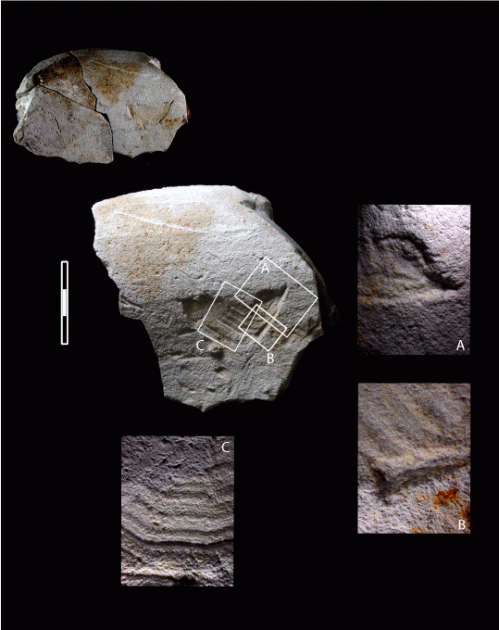
The curious fact is that a flint stone engraving recently found in the Aurignacian layers of Cantalouette II (Dordogne, SW France) bears a striking resemblance to the logo of the social network, what is quite funny at the very least.


Otherwise it is a very impressive early artistic expression of a rare type (avians are not common in Upper Paleolithic rock art). The Cantalouette II site was a flint stone quarry used by groups of the area and Arkeobasque (which is my source) speculates that it could be an expression of "art for the sake of art", an artist's caprice with no further meaning but excellent and very unusual technique, that was probably abandoned after its execution.

September 4, 2015

Revising the Aegean Neolithic genesis

Marnie's blog points today to a very interesting review of the Early Neolithic Aegean. It is from a few years ago and hence totally oblivious to the archaeogenetic information that we are now familiar with. It is however surprisingly consistent with it.

Agathe Reingruber. Early Neolithic settlement patterns and exchange networks in the Aegean. Documenta Prehistorica XXXVIII, 2011. Freely accessible PDFLINK [doi:10.4312/dp.38.23]

ABSTRACT – The Neolithisation process is one of the major issues under debate in Aegean archaeology, since the description of the basal layers of Thessalian tell-settlements some fifty years ago. The pottery, figurines or stamps seemed to be of Anatolian origin, and were presumably brought to the region by colonists. The direct linking of the so-called ‘Neolithic Package’ with groups of people leaving Central Anatolia after the collapse of the Pre-Pottery Neolithic B resulted in the colonisation model of the Aegean. This view is not supported by results obtained from natural sciences such as archaeobotany, radiocarbon analyses, and neutron activation on obsidian. When theories of social networks are brought into the discussion, the picture that emerges becomes much more differentiated and complex.

Fig. 9. First appearance of Neolithic sites in the Aegean.


The overall picture that the author defends, which needs of course not to be the last word but is indeed interesting and well argued, is that of a relatively gradual transition from Epipaleolithic to Neolithic via maritime influxes, which obviously imply partial colonization but quite apparently assimilation of at least some of the pre-existent hunter-gatherer peoples in Greece (no evidence so far of Epipaleolithic or Mesolithic in West Anatolia).
The oldest sites are in the Southern Aegean, with Crete and the Lake District, and date to the first half of the 7th millennium. They are followed by the Central Aegean sites in Thessaly and Western Anatolia, while the youngest sites were founded at the end of the 7th millennium in the Northern Aegean (Fig. 9). Astonishingly, in the Argolid, where there was a strong Mesolithic presence, long-lasting settlements appear comparatively late, around 6000 BC. The islands, as well as Crete, were (re)inhabited continuously only after 5500 BC.

After a detailed examination of both the material culture and 14C dates, the model of a wave of colonisation sweeping over the Aegean as a whole must be rejected: that is, sites appear there at different stages in different landscapes.

The author then argues that only Knossos (Crete), Argissa and Sesklo (Thessaly), Ulucak (West Anatolia) and Bademagacı (Lakes Region of SW Anatolia) remain as well dated Early Neolithic I sites in the whole region. Addint that: "interestingly, the sites in the Lake District are older the closer they lay to the sea", possibly supporting a coastal migration model. 
Therefore, the modelled 14C dates do not support the idea of direct colonisation from Central Anatolia, but testify to a marine-oriented population living in this area in the transition to the EN I.

Reingruber argues for Aegean networks originally dating to the Epipaleolithic (aka Mesolithic) and at least partial continuity from those pre-Neolithic peoples, something that would seem supported by the most up-to-date ancient genetic data, which suggests around 50% Paleo-European ancestry, possibly from the Balcans, in the "purest" early european farmers (EEF) such as samples from LBK or Starcevo, even before additional admixture happened towards the West.
With this concept of regional and supra-regional networks based on the mobility of prehistoric people I do not argue in favour an exclusively autochthonous Neolithisation model. The input of the Anatolian/Near Eastern way of life in the Aegean is obvious. Many of the products and also the items used in symbolic activities were of Anatolian origin. Nevertheless, as has been shown, the Aegean ‘Bauplan’ displayed other priorities, the material culture differing from region to region. What I wish to stress is interaction based on face-to-face contact, on integration and social competence. Also a precise examination of the 14C dates argue against a demic movement ignited by a catastrophe at the end of the PPNB (compare also Thissen 2010.278).

Worth very much a full read anyhow. I just can provide here a glimpse after all.