Thanks to Theasparagus for noticing this quite interesting video-lesson on quite obviously seagoing peoples of the Central Mediterranean and their journeys to distant volcanic islands to obtain the valuable obsidian (sharper than a scalpel) and also to the mainland to trade it for whatever goods.
Showing posts with label Sardinia. Show all posts
Showing posts with label Sardinia. Show all posts
February 17, 2018


January 1, 2017
Reconstructing Sardinian population history
A very interesting pre-pub study, dealing with Sardinian genetics in great sub-national detail but also within the wider European and Mediterranean context, became available in the last weeks. I won't probably be able to make justice to it here, so please take a look yourselves.
Charleston W.K. Chiang et al., Population history of the Sardinian people inferred from whole-genome sequencing. BioRXiv 2016. Open access pre-pub → LINK [doi:10.1101/092148]
Abstract
The population of the Mediterranean island of Sardinia has made important contributions to genome-wide association studies of traits and diseases. The history of the Sardinian population has also been the focus of much research, and in recent ancient DNA (aDNA) studies, Sardinia has provided unique insight into the peopling of Europe and the spread of agriculture. In this study, we analyze whole-genome sequences of 3,514 Sardinians to address hypotheses regarding the founding of Sardinia and its relation to the peopling of Europe, including examining fine-scale substructure, population size history, and signals of admixture. We find the population of the mountainous Gennargentu region shows elevated genetic isolation with higher levels of ancestry associated with mainland Neolithic farmers and depleted ancestry associated with more recent Bronze Age Steppe migrations on the mainland. Notably, the Gennargentu region also has elevated levels of pre-Neolithic hunter-gatherer ancestry and increased affinity to Basque populations. Further, allele sharing with pre-Neolithic and Neolithic mainland populations is larger on the X chromosome compared to the autosome, providing evidence for a sex-biased demographic history in Sardinia. These results give new insight to the demography of ancestral Sardinians and help further the understanding of sharing of disease risk alleles between Sardinia and mainland populations.
The authors call to some question the extreme simplicity of the three populations model of Lazaridis and subsequent studies. They do not flatly reject it but it seems that the lack of nuance bothers them a lot, as it does to me. This is quite clear when they find once and again Sardinian-Basque lines of relationship without going through Italian, Spaniard or French intermediaries, also when they face the issue of the largest Y-DNA haplogroups in the island, I2a1a (M26, almost exclusively a Sardinian and Pyrenean haplogroup) and R1b1a2 (M269), which are not typically associated with Neolithic farmers, suggesting that there is more to Neolithic settlement than meets the eye in the too simplistic three populations' model. They even seem to consider if Paleolithic peoples from Sardinia itself or maybe some other locations contributed heavily to what they feel is a sex-biased genetic pool.
They do confirm that Sardinians have both strong "Neolithic" (Stuttgart) and "Paleolithic" (Lochsbour) ancestry and no (negative even) "Steppe" (Yamnaya) one, although this last is truer for the most isolated sub-populations than for the more cosmopolitan ones.
They also estimate that Sardinians have been generally isolated from the rest of Europeans for some 330 generations, what reads as approx. 9900 years, i.e. since the very early Neolithic settlement of the island. We would actually have to reduce that time span a bit but within reason, else it becomes Epipaleolithic in fact, what is most unlikely. Alternatively, as the main comparison is Northern Europe, this date could refer to the branching out of Painted-Linear (continental) and Impressed-Cardium (maritime) Neolithic cultures in the Aegean or the Balcans.
June 9, 2016
Neolithic DNA from Greece and NW Anatolia and their influence on Europe
This is a most interesting study that brings to us potentially key information on the expansion of European Neolithic and the formation of modern European peoples.
Zuzana Hofmanová, Susanne Kreutzer et al., Early farmers from across Europe directly descended from Neolithic Aegeans. PNAS 2016. Open access → LINK [doi:10.1073/pnas.1523951113]
Abstract
Farming and sedentism first appeared in southwestern Asia during the early Holocene and later spread to neighboring regions, including Europe, along multiple dispersal routes. Conspicuous uncertainties remain about the relative roles of migration, cultural diffusion, and admixture with local foragers in the early Neolithization of Europe. Here we present paleogenomic data for five Neolithic individuals from northern Greece and northwestern Turkey spanning the time and region of the earliest spread of farming into Europe. We use a novel approach to recalibrate raw reads and call genotypes from ancient DNA and observe striking genetic similarity both among Aegean early farmers and with those from across Europe. Our study demonstrates a direct genetic link between Mediterranean and Central European early farmers and those of Greece and Anatolia, extending the European Neolithic migratory chain all the way back to southwestern Asia.
Uniparental DNA
One of the most important findings is that the two Epipaleolithic samples from Theopetra yielded mtDNA K1c, being the first time in which haplogroup K has been detected in pre-Neolithic Europe. Sadly enough these two individuals could not be sequenced for full genome.
The other five individuals are all Neolithic (three early, two late) and did provide much more information.
- Rev5 (c. 6300 BCE): mtDNA X2b
- Bar31 (c. 6300 BCE): mtDNA X2m, Y-DNA G2a2b
- Bar8 (c. 6100 BCE): mtDNA K1a2
- Pal7 (c. 4400 BCE): mtDNA J1c1
- Klei10 (c. 4100 BCE): mtDNA K1a2, Y-DNA G2a2a1b (same as Ötzi's)
I color coded their abbreviated names according to the usage in the study's many maps, for easier reference: green shades are for Greece (Western Macedonia), red shades for Turkey (Bursa district). It is also very convenient to get straight their real geography because many of the map-styled graphs are not precise at all about that:
 |
| Fig. 1. North Aegean archaeological sites investigated in Turkey and Greece. |
Autosomal DNA affinities
This is probably the most interesting part. There is a lot about it in the supplementary information appendix but I find that the really central issue is how they relate to each other (or not) and to other ancient and modern Europeans. I reorganized figs S21 and S22 to better visualize this:
 |
| Ancient samples compared to each other and other ancient samples ("inferred proportions of ancestry") |
 |
| Ancient samples compared to modern Europeans ("inferred proportions of ancestry") |
So what do we see here? First of all that the strongest contribution of known Aegean Neolithic peoples on mainline European Neolithic is from Bar31, which is from NW Anatolia, and not from Greece. Bar8 is a less important contributor but may have impacted particularly around the Alps (Stuttgart-LBK, modern North Italians).
This goes against most archaeology-based interpretations, which rather strongly suggest a Thessalian and West Macedonian origin of the Balcanic and, therefore, other European branches of the mainline Neolithic of Aegean roots, and do instead support some sort of cultural barrier near the European reaches of the Marmara Sea. Of course we lack exhaustive sampling of Greek Neolithic so far, so it might be still possible that other populations from Thessaly or Epirus could have been more important. However the lack of Anatolian-like influence on the Western Macedonian Neolithic until c. 4100 BCE, makes it quite unlikely.
So it seems that, once again, new archaeogenetic information forces us to rethink the interpretative theories based on other data.
However we do see a strong influence of Greek Neolithic and particularly the oldest sample, Rev5, in SW Europe, very especially among Basques, who seem to have only very minor Anatolian Neolithic ancestry, unlike everyone else relevant here. This impact is also apparent in Sardinia and to some extent North Italy (but overshadowed in these two cases by the one from Anatolia, particularly Bar31).
There are also similar analyses for other four ancient samples (Lochsbour, Stuttgart, Hungary Neolithic and Hungary Bronze) but they don't provide truly new information, so I'm skipping them here. As I said before, there's a hoard of analyses in the SI appendix, enjoy yourselves browsing through them and feel free to note in the comments anything you believe important.
A synthesis of the various "inferred proportions of ancestry" analyses is anyhow shown in fig. 3:
The fractions may be misleading however, especially for the ancients. For example: Lochsbour (a total outlier among the ancients in this study) appears best correlated with Pal7 but in fig. S24 it is clear that does no correlate with any Neolithic sample at any significant level. But in general terms it can give a good idea of where does ancestry, particularly for modern samples, come from.
Note: elsewhere someone was being a crybaby about the Polish sample (may well be an error) or the Kalmyk sample (who are obviously most related to East Asians, not used here) but those are minor issues.
Of course there's a lot more to learn from the remains of the ancients. Let's keep up the good work.
This goes against most archaeology-based interpretations, which rather strongly suggest a Thessalian and West Macedonian origin of the Balcanic and, therefore, other European branches of the mainline Neolithic of Aegean roots, and do instead support some sort of cultural barrier near the European reaches of the Marmara Sea. Of course we lack exhaustive sampling of Greek Neolithic so far, so it might be still possible that other populations from Thessaly or Epirus could have been more important. However the lack of Anatolian-like influence on the Western Macedonian Neolithic until c. 4100 BCE, makes it quite unlikely.
So it seems that, once again, new archaeogenetic information forces us to rethink the interpretative theories based on other data.
However we do see a strong influence of Greek Neolithic and particularly the oldest sample, Rev5, in SW Europe, very especially among Basques, who seem to have only very minor Anatolian Neolithic ancestry, unlike everyone else relevant here. This impact is also apparent in Sardinia and to some extent North Italy (but overshadowed in these two cases by the one from Anatolia, particularly Bar31).
There are also similar analyses for other four ancient samples (Lochsbour, Stuttgart, Hungary Neolithic and Hungary Bronze) but they don't provide truly new information, so I'm skipping them here. As I said before, there's a hoard of analyses in the SI appendix, enjoy yourselves browsing through them and feel free to note in the comments anything you believe important.
A synthesis of the various "inferred proportions of ancestry" analyses is anyhow shown in fig. 3:
 |
| Fig. 3. (click to expand) Inferred mixture coefficients when forming each modern (small pies) and ancient (large pies, enclosed by borders matching key at left) group as a mixture of the modern-day Yoruba from Africa and the ancient samples shown in the key at left. |
The fractions may be misleading however, especially for the ancients. For example: Lochsbour (a total outlier among the ancients in this study) appears best correlated with Pal7 but in fig. S24 it is clear that does no correlate with any Neolithic sample at any significant level. But in general terms it can give a good idea of where does ancestry, particularly for modern samples, come from.
Note: elsewhere someone was being a crybaby about the Polish sample (may well be an error) or the Kalmyk sample (who are obviously most related to East Asians, not used here) but those are minor issues.
Of course there's a lot more to learn from the remains of the ancients. Let's keep up the good work.
May 4, 2016
Back to work
My apologies to readers for being for so long in "lazy mode". Actually I got interrupted largely by a request to provide a quality article on Basque, Sardinian and European origins for a soon to be published collective book in Basque language. This took me a lot of time and energies in late March and early April, so basically I put everything else on hold. The last weeks I've been resting indeed, what may be aggravated by a declining health that makes me sleep irregularly and often for much longer than most of you do. Being fed up with Internet information feeds and a quite active political reality also drain my energies to other endeavors, not to mention paperwork.
In this sense I want to announce that I have begun recently a new multi-purpose blog in Spanish language: Bagauda. Most of it is politics, I warn you, but I have also included the unedited raw article for that book I mention in the previous paragraph (prior to translation to Basque and corrections). I'm reasonably sure that those of you who have Spanish as primary or even secondary language will be interested in having a look (→ here).
Another relevant entry was the announcement of the upcoming congress on Iruña-Veleia to be held on May 7 in Vitoria-Gasteiz. You can still register but hurry up.
I will now proceed to comment in a separate entry on the news of the week, the Fu et al. study of a large array of Paleoeuropean ancient DNA. But, before I get to that, I must mention some interesting studies that I have not been able to get time to even properly read, let alone discuss:
- K. Voskarides, S. Mazières et al., Y-chromosome phylogeographic analysis of the Greek-Cypriot population reveals elements consistent with Neolithic and Bronze Age settlements. Investigative Genetics 2016. Open access → LINK [doi:10.1186/s13323-016-0032-8]
- B. Vernot et al., Excavating Neandertal and Denisovan DNA from the genomes of Melanesian individuals. Science 2016. Freely accessible (with registration?) → LINK [doi:10.1126/science.aad9416]
- Y.Y. Waldman, A. Biddanda et al., The Genetics of Bene Israel from India Reveals Both Substantial Jewish and Indian Ancestry. PLoS ONE 2016. Open access → LINK [doi: 10.1371/journal.pone.0152056]
Another intriguing new independent paper by a regular visitor and commenter to this blog, Olympus Mons, that I have not yet read is:
→ R1b from Sulaweri-Shomu to Bell Beaker, available as PDF or in blog format.
He seems to argue for a Caucasus origin of both the lineage and Bell Beaker phenomenon. I have no opinion as of yet, because, simply put, I have not been able to read it in full.
Another regular visitor here to have put an independent paper online, also on the issue of R1b origins, is Paul Conroy:
→ Anatole A. Klyosov and Paul M. Conroy, Origins of the Irish, Scottish, Welsh and English R1b-M222 population. Available at Paul's Academia.edu account.
Again I have not yet got the opportunity to read it, so no opinion.
Feel free to use this entry to comment on any of the aforementioned studies or articles or to provide info about stuff I may have missed.
April 26, 2014
Diversity and legacy of ancient European farmers
Two new Swedish papers, published almost simultaneously, add important extra information and, of course, also some more questions to the previous analysis of European ancestry by Lazaridis et al. (see here, here and here). They are:
Evangelia Dasakali, A late Neolithic Iberian farmer exhibits genetic affinity to Neolithic Scandinavian farmers and a Bronze Age central European farmer. Paper IV of the greater collection Archaeological Genetics - Approaching Human History through DNA Analysis. Acta Universitatis Upsaliensis, 2014. Freely accessible PDF → LINK [ISBN 978-91-554-8816-1]
Pontus Skoglund, Helena Malström et al., Genomic Diversity and Admixture Differs for Stone-Age Scandinavian Foragers and Farmers. Science 2014. Pay per view (supp. info. freely accessible) → LINK [doi:10.1126/science.1253448]
I must say that it seems a bit odd that, being colleagues of the same university, Dasakali and Skoglund/Malström have decided to publish such two strongly related studies separately. But, well, whatever...
The first study briefly compares the genome of a Chalcolithic Iberian farmer from El Portalón (Atapuerca) to modern Europeans and some previously published ancient genomes, mostly Neolithic but also one from Epipaleolithic Iberia (La Braña).
The study is just a very short synthesis and lacks detail but provides this PCA graph:

On it's own, it already provides evidence of ancient European farmers not being as homogeneous as the Lazaridis sample (n=3 but all from near the Alps) may suggest. The Iberian sequence deviates more towards modern Italy than the Alpine ones (here represented only by Ötzi), who tend to cluster towards modern Sardinians. Also the Gökheim sequence from Southern Sweden, the only clearly Megalithic sample so far to be studied, clusters with Basques. But Gökeim is better addressed in the Skoglund paper in fact.
This is because Skoglund & Malström use more samples from Neolithic Scandinavia: four from the Gökheim site (Megalithic and Funnelbeaker farmers) and six from Götland's Pitted Ware late semi-foragers of the Baltic (probably with partial Eastern European roots).
The results are more directly visualized and comparable with those Dasakali and Lazaridis in the Principal Component Analysis:
 |
| Fig. 1. Population structure and genetic affinities of ancient Eurasians. (A) Ancient individuals were projected on principal components computed on 57 modern-day Western Eurasian groups. (...) Notice that ancient samples are projected on the modern PCA, what explains especially the anomalous position of Mal'ta 1 (MA1), which is actually much more divergent from all modern Europeans. SF11 = Stora Förvar 11. |
Obviously not all is just a simple PCA, together we find these heatmaps that help us to better understand the affinities of the ancient farmers:
 |
| Fig. 1. Population structure and genetic affinities of ancient Eurasians. (...) (C) Shared genetic drift between Western Eurasian populations and Ajvide58, a Neolithic hunter-gatherer from Scandinavia. (D) Shared genetic drift between Western Eurasian populations and Gökhem2, an early farmer from Scandinavia. |
In fact Gökheim 2 shares a bit more genetic drift with Sardinians than with Basques, an that's probably the reason why she is located rather towards Spain and Italy in the PCA, even if they don't share greater genetic drift with these than with Basques and Sardinians (PCAs can be misleading). However the shared drift is probably less than among Alpine farmers, owing largely to Gökheim's greater aboriginal hunter-gatherer admixture.
In general, like other early European farmers, Gökheim people seem to align best with Western Mediterranean peoples, particularly those with low paleo-Siberian (MA1) affinity, which are Basques and Sardinians.
Judging on the PCA, there seems to be some diversity among them, with one being more extremely "Atlantic". It is very possible that in the Neolithic and Chalcolithic Atlantic Europe there were others like her (most Gökheim samples are female although I'm uncertain about this unnumbered one).
On the other hand, Pitted Ware sequences share greatest drift with modern Baltic peoples, including the oversampled Swedes but also with Eastern Baltics (Estonian, Finnish, Lithuanians). This last surely owes to the origins of this culture in Eastern Europe but in what regards to Sweden, it must imply that their kind of Eastern-like genetics were very strongly favored when the Kurgan macro-culture (Single Burials, part of the wider Corded Ware culture) took over the region c. 2500 BCE. Instead the ancient megalithic farmers quite obviously suffered a genocide in this part of the world.
Overall, it seems obvious to me by now that Eastern European genetics distributed by the long-term Kurgan expansion
(Indoeuropeans) must have been somewhat similar to aboriginal Western
European hunter-gatherers but with greater paleo-Siberian affinities
(MA1-like), which they also distributed by Europe for the first time.
For a wider comparison with World genomes, take a look at figures S3 and S4 please. In them we can see that Ajv58 is comparatively closer also to South Asians, Siberians and Native Americans, while Gök2 is instead relatively closer to Palestinians, Arabians and slightly to Egyptians too (not apparent in the above graph but certainly in the global one).
This is quite interesting because it directly relates to the mysterious "Basal Eurasian" element that Lazaridis et al. detected in their ground-breaking study, which is more clearly perceived as something "Palestinian", with whatever NE African and/or residual out-of-Africa element in it, which partly detaches the ancient farmers from the main Eurasian ("out-of-India") branch.
Some of all this is also quite apparent in the attempts of Skoglund & Malström to infer the ancestry of the various paleo-populations:
 |
| Fig. 2. (A) Sample locations of ancient human remains that are included in the population history model. (B) Admixture graph of population history fitted to ancient genomes showing more hunter-gatherer admixture in Neolithic Scandinavian farmers than in central European farmers (table S15). |
The above "admixture graph" is identical in essence to fig. S6. However I find even more very interesting the fig. S7:
 |
| Fig. S7. A) Admixture graph of population history fitted to ancient genomes and two modern-day genomes from Europe. (...) |
This alternative result has been produced by merely adding modern French and Sardinians to the analyzed pool and allowing for two extra admixture axes. The result is quite different:
Essentially the overall unity of all Europeans, ancient and modern is restored as a single derived branch distinct from the circum-Pacific populations. The deviation to "Basal Eurasianness" of Neolithic Europeans and Sardinians is instead largely explained by an admixture axis from the Dinka, which act as a proxy for whatever Red Sea area input in the early European Farmers. This is just as I expected and have tried to explain before, so I guess you understand why I do prefer this second admixture graph over the other.
In this sense, I feel that Skoglund & Malström could have done a bit better by testing more alternative models (different samples, different pre-definition of the admixture axes, etc.) but I guess it's good enough for their Swedish focus. Not so much for the pan-European one though.
It is also very striking that the French sample appears unrelated to any of the ancient samples, be them farmers or not. Instead they show up as a branch of their own with proto-Sardinian admixture. This probably owes to the fact that neither of the sampled ancient populations is directly ancestral to the French, unlike what happens with Lochsbour, for which the French show the longest IBD segments, indicating a more direct ancestry. So I guess that we can take the French branch as being partly Lochsbour-like, plus whatever Eastern European (but not Scandinavian) extra ancestry the Celts, Romans and Germanic tribes brought with them (and of course the strong Neolithic element indicated as paleo-Sardinian admixture). Sadly the analysis strategy is not designed to provide us with such information here, but it can still be inferred if we consider all the available data.
Of course most modern samples show less drift because they are more cosmopolitan populations than the ancient ones, whose demographic base should be more like that of Australian aborigines, the only modern sample that shows a similarly high drift parameter.
As concluding remarks, I wish to underline the greater aboriginal European (WHG or blue color) admixture in the Megalithic farmers of Gökheim, which resemble modern Basque genetics. It is very likely that more populations like those existed in the Megalithic axis from Southern Iberia to Southern Sweden, although naturally each one had its own peculiarities and we should not take Gökheim as any sort of ideal representative of such ancient Atlantic population but rather as one of its many likely subpopulations.
Before the Indoeuropean consolidation of the Corded Ware period, these Atlantic farmers must have greatly contributed to at least a preliminary stage of "modernization" of the Central Europan (and possibly also others') genetic pool, as discussed in this entry. Notice also that the demographic expansion was much greater with Megalithism than with Corded Ware and Bell Beaker and that this applies in general terms to nearly all studied regions, with the main exception being Jutland. However in Scania (Southern Sweden), there is a clearly second demographic expansion with the arrival of Corded Ware.
Sadly there is no direct comparison of modern Swedes as hypothetical admixture between Pitted Ware Chalcolithic foragers and Megalithic/Funnelbeaker farmers. It would have been interesting to know more details about that, especially if a third element from Germany, Poland or Russia is needed to explain their modern genetic pool, as I suspect, and in which apportions.
As for the Neolithic farmers, they were clearly somewhat more diverse than the Lazaridis study suggested, varying at least in their amount of "Basal Eurasian" and Western hunter-gatherer ancestry, and possibly also in other subtle aspects we still do not understand well, as suggested by El Portalón sample.
Their most direct legacy is in any case concentrated towards Southwestern Europe.
Their most direct legacy is in any case concentrated towards Southwestern Europe.
January 15, 2014
Ancient Italian ape had human-like precission grip
 |
| Reconstruction of O. bamboli (Pavel Major / ICP) |
Oreopithecus bamboli was primate species, surely a hominine (great ape excluding orangutans) that lived in Tuscany and Sardinia some 8.2-6.7 million years ago.
It has great interest regarding human evolution because it is the oldest known ape to have developed a pad-to-pad precision grip, a characteristic otherwise only found in the human genus.
This trait, hotly debated in the last decades, has been recently confirmed by researchers of the Catalan Institute of Paleontology Miquel Crusafont (ICP). It must be said however that this development is considered convergent evolution and not ancestral to our own precision grip.
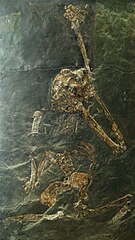 |
| O. bamboli fossil (CC by Ghedoghedo) |
I guess that much of the controversy is caused by the old hypothesis that argued that it was the precision grip itself which elicited human brain development, something that obviously did not happen with Oreopithecus.
Other traits of this species are quite different from our own or our australopithecine relatives. They probably walked upright but with different gait (unlike the more human-like Sahelanthropus, of similar age) and their feet were very much unlike ours, with a very open angle for the big toe (hallux).
It seems that their environment was swampy and not strictly forestal.
Ref.: Sergio Almécija et al., The morphology of Oreopithecus bambolii pollical distal phalanx. AJPA 2014. Pay per view → LINK [doi:10.1002/ajpa.22458]
November 20, 2012
Ancient DNA from Eastern Europe and Sardinia
A very interesting doctoral thesis has been known these days (h/t Jean). The thesis by Clio S. I. Dersarkissian (directed by A. Cooper and W. Haak) includes novel ancient mtDNA from North Eastern Europe (Karelia and surroundings) specially and also some Scythian and Sardinian burials from the Metal Ages.
Clio Simone Irmgard Dersarkissian, Mitochondrial DNA in ancient human populations of Europe. University of Adelaide, 2011 (thesis). Freely accessible ··> LINK [identifier: http://hdl.handle.net/2440/74221]
The most interesting findings may be those from Karelia:
- First pre-Neolithic mtDNA H in Northern and Eastern Europe and one of the few findings strongly confirmed in such haplogroup before Neolithic. It clearly reinforces the already well established notion that mtDNA H existed in Europe before the Neolithic.
- U2e - which might well be descendant or otherwise related to the U2 of Kostenki.
- C1 - suggesting pre-Neolithic Siberian influences in Northern and Eastern Europe. The specific sublineage (named as "C1f") has not yet been sequenced elsewhere.
There are some more interesting data regarding ancient NE Europeans, Scythians and Sardinians but let's see that by parts.
Epipaleolithic peoples from Karelia and Northern Russia
Possibly the most impacting findings of this paper are those regarding two Epipaleolithic sites in Karelia (Uznyi Oleni Ostrov) and nearby parts of Northern Russia (Popovo, in Russia proper but not far from the Karelian border), as well as one more recent site from Sápmi (Lapland).

As I mentioned above, the U2e and C1 ("C1f") findings are unusual and suggestive of ancestral connections with Kostenki (Early Upper Paleolithic site from Southern Russia with U2 mtDNA) and Central Asia and Siberia. In fact an overall comparison with modern populations, shows strong affinities with West Siberians and Uyghurs for these Epipaleolithic Karelians.
Instead the Bronze Age Sami site shows more generic or distributed Siberian affinities, although there are populations in West Siberia (Nenets?) that also fit well with that mtDNA genetic pool. Bashkirs show similar affinity to both ancient populations (see ch. 1, fig. 3 - p. 103).
Not shown here are the results for the 18th century Sami site of Chalmny-Varre, which look a very modern Sami mtDNA pool, dominated by V7e and complemented by U5b1b1 and U5a1.
Confirming the existence of mtDNA H in pre-Neolithic Europe
I really want to underline this, because certain influential people have been dead set into denying the existence of mtDNA haplogroup H in Europe altogether before the Neolithic. Why? Because they have a theory (a hypothesis more properly speaking) and they can't accept to be wrong about it.
That hypothesis (very popular in some circles) states that European aboriginal hunter-gatherers were very radically annihilated by Neolithic invaders from West Asia (never mind that archaeology alone is much more complicated than that, they don't seem to like thinking too much, much less looking at the matter from all the angles).
And a central battle they have fought is denying the possibility that mtDNA H (he most common haplogroup today in Western Europe) existed in the continent before Neolithic. The whole haplogroup, in their imaginary reality, could only have arrived with the industrious (and seemingly quite genocidal) farmers from West Asia (who almost never even mixed with anyone aborigine, how odd).
Reality began questioning their findings since 2005 but back in the day only HVS-I or at best HVS-II (control regions of the mtDNA chain) were used, leading to inconclusive results, specially in regards to short-stemmed haplogroup H. So they could still deny and deny...
But, recently, two different new studies have found unmistakable mtDNA H in Magdalenian people from Cantabria and Epipaleolithic people from the Basque Country. The reaction of some such knowledgeable aficionados has been simply unbelievable: they have flatly rejected the results without any reason; these findings are simply too inconvenient truths for their conjectures to be accepted. They are so obsessed with their fantasies that they can't even accept mounting evidence against them: they have stopped being scientific and begun being fanatics.
Very sad, really.
This finding in Karelia adds to the mounting unquestionable evidence on the matter: mtDNA haplogroup H not only existed in pre-Neolithic Eruope but it was quite extended, roughly through the areas in which is today abundant (and not just SW Europe as I came to suspect for some time). However in most regions was still far less common than it is today (or even totally missing, as seems to be the case in Central Europe).

Said that, it is not too clear yet where does all the improved knowledge of ancient genetics lead us to but what is clear is that mtDNA H is older and specifically older-in-Europe than some (too many) people have been insisting on.
Also it seems more and more obvious that the popular Neolithic farmers did not define the modern genetic landscape of Europe at all. They certainly introduced lineages that surely did not exist before but their overall influence seems limited and it does look like, after an initial burst, they declined also quite abruptly.
This is something that has been in the news these days (but no paper yet) and that I observed also in 2009 in relation to some similar studies (see: here and here). The age that we begin seeing modern-like mtDNA pools actually varies a lot, for example:
- SW Europe: Basque Country: Neolithic (at least) ··> Hervella 2009 (discussed here).
- Central Europe: Elbe Basin: Bronze Age or Chalcolithic ··> Schilz 2006[de], Schweitzer 2008.
- Far North Europe: Sápmi: some time after the Bronze Age and before the 18th century (this study).
- Central Asia: Iron Age (see below).
I conjecture here that (before the Medieval agricultural revolution) Northern latitudes could in general support lower population densities, being also more susceptible to the effect of climatic fluctuations. But more data is needed before we can have some consolidated certainty.
In any case, I took some time to make a couple of updated maps of the European and North African (1) Late Upper Paleolithic (Magdalenian and Oranian cultures) known ancient mtDNA and (2) Epipaleolithic. With this last one I found some conceptual difficulties so I had to take decisions, which were:
- A most recent date boundary of 4000 BCE (which already overlaps with Neolithic in most regions since 1500 or more years before). Actually the most recent sites are c. 4200 BCE from Lithuania and c. 4600 BCE from Navarre.
- No inclusion of any Neolithic data even if contemporary. The only possible exception was Franchti Cave (Greece), which has a sequence beginning in the Epipaleolithic (or Mesolithic) but is largely Neolithic. The exact adscription of the sequenced individual is not known.
The results are:
 |
| Late Upper Paleolithic mtDNA from Europe and North Africa R* and specially R*-CRS can well be H and have often been reported as such but we do not know for sure |
 |
| Epipaleolithic mtDNA from Europe (until 4000 BCE) R* and specially R*-CRS can well be H and have often been reported as such but we do not know for sure |
Some of these data (and others from more recent periods) can be seen in the dedicated Ancient mtDNA maps page at this blog. It needs some updating however: not much time has passed since I created those maps but new findings do pile up quickly these days.
Ancient Scythian mtDNA
Another point of interest of the thesis is the ancient Scythian tombs from the Don basin (Iron Age, proto-historical). The results show some greater Eastern genetic influence than modern peoples (Russians) do.

The results, which place ancient Scythians closer to modern Central Asians than to Eastern Europeans are consistent with other recent studies that show an inflow of Eastern Asian mtDNA lineages into Central Asia even before the Turkic invasions of the Roman period and early Middle Ages.
Bronze Age Sardinian mtDNA
Finally the thesis deals with Sardinians from the Bronze Age (Nuraghic period). The sites are both from the most central parts of Sardinia, so they may be more representative of an early refuge population than to the overall Bronze Age of the island but still they are curious and interesting:

Dersarkissian argues that this suggests continuity but with many doubts, partly because the source of the genetic data (isolated teeth) did not allow for any certain identification of individuals. Still the resulting mtDNA pool (no matter how you look at it) is not really modern but rather reminds of Central European and Mediterranean Neolithic sites.
The may well be some of the last Neolithic immigrants, who, instead of replacing the hunter-gatherer aborigines all around (as some imagined too dearly) were the ones taking refuge in this turbulent period in the highlands of Sardinia.
Who knows?!
September 13, 2012
Italian and Sardinian autosomal genetics
A new paper investigates the genetic structure of Italy:
Cornelia di Gaetano et al., An Overview of the Genetic Structure within the Italian Population from Genome-Wide Data. PLoS ONE, 2012. Open access ··> LINK [doi:10.1371/journal.pone.0043759]
The results confirm that Sardians are a very distinct population and show that Italians essentially seem to cluster with mainland Europeans (NW Europeans in principle but Iberian or Balcanic comparisons are missing), West Asians and Sardinians in this order.
There is some N-S gradient in the Peninsula and Sicily but it's mostly determined by an increasing West Asian affinity in the South. Central Italians stand between North and South but clearly closer to the North but many individuals from NW Italy (Liguria and Piedmont, as well as some Sardinians) actually cluster with Southern Italians as well as with "mixed" Sardinians (those Sardinians who stand between the main insular cluster and the peninsular one).
Let's see:
| Figure 1. SNP-Based PC of 1,262 individuals from 10 sub-populations. The Italian population plotted onto the first two principal components defined by the European HGDP-CEPH populations and CEU HapMap data. Scatter plot of the first two principal components, obtained using R software (prcomp). Analysis based on 125,799 autosomal SNPs. Individuals included belong to Northern Italy (N-IT): black dots, Central Italy (C-IT): red dots, Southern Italy (S-IT): green dots, Sardinian (SAR): blue dots... [the original legend does not explain well the other populations (too many blatant errors in the text) but it's obvious that the group to the top-right corner are other Europeans (French, CEU), while the group to the center-left are West Asians (Druze, Palestinian, Bedouins) and Mozabites. Larger images can be downloaded from the paper]. |
In this first characterization we see a primary duality between Europe and West Asia (the Paleo-Neolithic dichotomy probably) and a secondary one between Sardinia and mainland Europe.
| Figure 2. SNP-Based PC of 1,014 individuals from the Italian dataset. A. A Scatter Plot of the Italian population of the first two principal components obtained via R software (prcomp). Individuals included belong to Northern Italy : black dots, Central Italy : red dots, Southern Italy : green dots, Sardinian: blue dots. B. Italian population without the Sardinian-projected scatter plot of the first two principal components obtained via the R software (prcomp) [larger images can be downloaded from the paper] |
Here we see (A) a main dichotomy between Sardinia and Peninsular Italy (with Sicily) and a secondary N-S gradient. However in (B) it becomes more obvious that to some extent there are two distinct clusters: Southern and Central-North Italy with certain clear separation.
However, and this is quite interesting some North Italians strongly cluster with Southern Italians. Razib mentions this fact as signature of internal Italian migrations but individual migrations would not look that way because the genetic distinction would have diluted in the meantime, appearing at most as intermediate. What we see instead is preserved genetic identity, not too diluted or not diluted at all, with Southern Italy in many Northern Italians.
Who are these Northern Italians, I wondered then. The answer is in the supplements:
 |
Hidden population structure within the Italian dataset. Scatter plot of the first two eigenvectors based on 125,799 autosomal SNPs and 1,012 individuals. Colors represent the four different macro-areas; green- Southern Italy (Apulia, Calabria/Sicily, Campania, Basilicata), red- Central Italy (Tuscany, Lazio, Emilia Romagna and Abruzzo/Marche), black- Northern Italy (Piedmont,Liguria, Aosta Valley and Lombardy), blue- Sardinia (these samples were labeled for the linguistic area). Subjects are symbol- labeled by municipality. Information on municipality was not used for calculations.
[click to expand]
|
In this image we can appreciate how all Northern Italians clustering with Southern Italians are from two specific regions: Liguria and Piedmont (Piemonte), the Northwestern regions of Italy, bordering France. What do these two regions have in common? All I can think is that, in ancient times they were mostly inhabited by the Ligures, a pre-Indoeuropean people plausibly descendant from the first Neolithic colonization (Cardium Pottery, via the Chassey-Cortaillod-La Lagozza cultural complex).
 |
| Roman region of Liguria (Regio IX) |
We are also provided with a bayesian cluster analysis, for which K=4 seems the most valid result (K=3 and K=5 also give low cross-validation values but do not seem more informative):
| Figure 3. Clustering of the European, Northern African and Middle Eastern individuals by the Structure software. Model-based ancestry analysis based on a subset of HGDP-CEPH and HapMap CEU data using the merged data of 126K autosomal SNPs. Ancestry for each individual was inferred using ADMIXTURE [50] at K = 4. Abbreviations as in Figure 1. |
This confirms four clusters: Main European (green), Sardinian (red), West Asian (blue) and North African (purple).
I tend to consider the West Asian component as the main Neolithic input in Europe, although, of course other DNA sections may well have traveled around in that period or later on.
I also find notable that Sardinian affinity exists among Italians, French and North Africans (surely via Iberia) but almost not among North American Euro-descendants (CEU) of NW European origin and West Asians, who instead do sport some notable Mainline European affinity.
It's also interesting that CEU are among the most North African related of all European populations.
Some prehistoric and proto-historic speculation
IF, and only IF, the affinity of Ötzi with Sardinians can be considered representative of how most Italy was in the Chalcolithic (and not a random fluke specific of that man or his mountain community), then, we should consider two further waves into Italy: (1) of West Asian affinity (maybe from the Agean since the Bronze Age or even before) and (2) of mainland European affinity (Indoeuropeans: Italics, Celts).
IF this is correct then the Ligures would not be so much descendant genetically from La Lagozza-Chassey, as I said above but from the "Aegean" wave. This would also be consistent with some individual Tuscans clustering with Southern Italians as well (historical Etruscans are one of the culminations of these Aegean waves together with the Greek colonies).
But sincerely, I am not aware of any such Aegean flow arriving to the proto-historical Liguria, are you?
So I must consider that there is another possibility: that the Sardinian element represents only one of several Neolithic (or maybe even Paleolithic but nothing clear here) elements in Italy, maybe associated to Y-DNA I2a (strong in Croatia, Bosnia, etc.), while the other, the one most akin to West Asia, would be related to Y-DNA E1b-V13 (strong in Greece and Albania) and maybe other patrilineages from the Eastern Mediterranean like J2b, etc. Both E1b-V13 and I2a are know from ancient DNA from the Neolithic of the Western Mediterranean, so they did indeed take part in these migrations.
Then the "Greek" or "Aegean" (or "Albanian" if you wish) component was reinforced by Bronze Age flows while the "Dalmatian" one was diluted instead by the successive Indoeuropean (Kurgan) waves.
I'll leave it this way until more evidence comes forward.
February 29, 2012
On and around with Ötzi's genome
As you're probably more than aware by now there's a new paper on the market (yeah, 32 bucks - but worry not that I already got my hands on it) on the most loved mummy of Europe: Ötzi the Iceman.
A. Keller et al., New insights into the Tyrolean Iceman's origin and phenotype as inferred by whole-genome sequencing. Nature 2012. Pay per view.

 It looks odd indeed... but it might be explained if we assume that from that time on, secondary (post Neolithic) Bronze Age flows from the Aegean (and Central Europe) altered gradually the genetic composition of Italy. This is supported by archaeology as far as I know: even before Mycenaean Greeks, the Aegean was influencing Southern and Central Italy more and more. This trend was reinforced in the late Bronze Age (Mycenaean colonization in the South, Etruscan migration in the Center) and the Iron Age (classical Greek colonization of Magna Graecia).
A. Keller et al., New insights into the Tyrolean Iceman's origin and phenotype as inferred by whole-genome sequencing. Nature 2012. Pay per view.

The most notable conclusion would seem to make Ötzi closest in all to Sardinians or more like Corsicans, at least by Y-DNA. This one has been described now as G2a-L91, what is per ISOGG 2012 G2a2b (although the authors use the old nomenclature G2a4) and is most commonly found in Southern Corsica and the Corsican-speaking parts of Sardinia (Gallura).
The autosomal DNA has been compared with an all-Europe sample (the Behar 2010 one, I think based on the nomenclature used), to which a Sardinian sample was added. The result (right) does suggest a Sardinian (or Corsican) affinity of Ötzi.
Notice please that in the supplemental material the Ötzi dot achieves three different positions depending on the level of refinement: while all place Ötzi to the bottom left corner, he's exact position varies quite a bit - it's not like PC analysis (nor genetics overall) is rocket science, you know.
Also another caveat I have with this kind of analysis is that all it says is that Sardinians and Ötzi are very negative for both PC components, th Northern and the Eastern ones. The only association at the bottom left corner is a negative one: neither Nordic nor Greek, and this is not too informative.
Yes, the Y-DNA points to an association with Corsica (rather than Sardinia), what reinforces the suggestion posited by the autosomal DNA basic (but negative) analysis, still it would be nice if the authors would have bothered to do some 'Admixture' type of analysis as complement.
At the moment all we have is a negative: Ötzi, who belonged to a Cardium Pottery derived cultural group (Bocca Quadrata or La Lagozza, can't recall right now) and bears a quite clear Neolithic marker such as Y-DNA G2a, shows up as strongly non-Balcanic, unlike most modern Italians (Europe S sample).
Before the Romans Italy was all or most of the time a recipient of cultural influences (from the Balcans, from SW Europe and from Central Europe) and did not, as far as I can tell, export culture except as secondary trampoline (the Cardium Pottery Case notably). Excepting the Cardium Pottery case, it acted more as a buffer between West and East and dead end than what its central Mediterranean position would suggest. Even in the Heraklean myth, original Greek version, the route to the fabled Hesperides does not go through Italy but North Africa. Only later, as the Romans rose to prominence, was Hercules made to journey back through Italy, something not specified in the original version.
I'm saying all this because it may explain why the Europe S (Italy) component tends so strongly towards the Balcans (and to lesser extent Northern Europe) but neither Ötzi nor Sardinians do, even if they look Neolithic-blooded to some extent.
November 5, 2011
Escargots crossed the Mediterranean via Sardinia hitchhiking human ships
Snails of the Tudorella sulcata species, which lives on land, are found all around the Western Mediterranean: in France, Spain, Sardinia, Algeria and Malta. A new genetic study deals on how the snails, original from SW Europe, made it to Sardinia and Algeria.
Ruth Jesse et al. Phylogeography of a Land Snail Suggests Trans-Mediterranean Neolithic Transport. PLoS ONE 2011. Open access.
| Sampling sites (color-coded by region) |
| Statistical parsimony networks with based on 604 bp of the mitochondrial COI gene (a) and 219 bp of the nuclear hsp70 gene (b). |
As often happens, the haploid (not recombined) mitochondrial genome is the most informative: the snails traveled to Africa mostly via Sardinia.
The authors estimate (???) ages between 10 and 3,000 years ago, with a m.l. date of 8000 BP and claim this would have some sort of relation with Neolithic spread. However this is far from clear: on one side there is no known Sardinia-North Africa interaction before Megalithism (since c. 6-5000 years ago, dying out gradually only around 3000 years ago), which would also include Malta in the equation. On the other side, Iberia, a possible alternate origin/route has been neglected in the research.
October 14, 2011
Echoes from the Past (Oct 14) - the genetic isolation of humankind
I'm planning an entry on Paleolithic and Neolithic navigation but meanwhile, here it goes some stuff (mariner or not) that I find interesting.
Homo genus became genetically isolate thanks to natural spermicide
 |
| H. erectus (female) reconstruction |
A critical change in a immune system molecule, from Neu5Gc to Neu5Ac, made our ancestors effectively isolated from our cousins from the Pan genus and probably also from the then common australopithecines.
This change would simply kill any non-human sperm in the uterus or, would it manage to succeed, the resultant fetus. This incompatibility with other hominins may have been critical in the process of speciation of the first Homo species such as Homo erectus, Homo habilis or maybe A. sediba.
··> Science Daily, Darius Ghaderi et al. at PNAS (PPV for six months or freely accessible in some world regions).
Human thumb (Neanderthal or H. heidelbergensis) found in Sardinia

The finding of a thumb bone in Sardinia, dated to 250-300,000 years ago, may help break the fantasy of ancient humans not being able to navigate. This finding adds to those of Crete (c. 190 Ka ago and the famous Flores hominin), all of which must have crossed vast spans of sea in order to get to their destinations, implying at least some level of navigation.
In the discussion at NeanderFollia, David indicated further evidence of archaic navigation I was unaware of: H. erectus must have reached Flores c. 900,000 years ago, in what is probably the most ancient navigation feat we can confirm ··> John Hawks, Environmental Grafitti, Adam Brumm et al. at Nature (PPV).
Also there is at least some uncertainty of H. ergaster or some other human species maybe crossing to Europe via the Strait of Gibraltar at similar dates as in Flores or maybe even earlier, but, because of the various possible routes involved this is less conclusive. Instead, Flores, Sardinia and Crete have not been connected to the mainland at any time in the biological history of the genus Homo.
Art workshop found in South Africa
A number of shells with indications of having held ochre have been found in the important site of Blombos Cave, South Africa. The shells had holes which suggest that they were used as containers. Other tools, such as hammers and knives, to work the clay, have also been found.

Babies know justice instictively
While actual perception and interest on fairness varies, a good deal of human babies (15 months old) clearly show interest in fair sharing and will actively share. Other babies have less interest in fairness however but they will share anyhow, even if in a less generous manner.
Malaria research casts doubt on mitochondrial DNA 'molecular clock'

It seems that the molecular clock is not on streak. Recently it was radically challenged for Y-DNA and it seems obvious that it will not survive in general, at least without radical revisions. A crucial assumption for the molecular clock hypothesis is that the clock ticks regularly or almost so.
Well, it does not seem to be the case of mtDNA either: certainly not for the primate parasite Plasmodium sp.
The use of fossils from the host as absolute calibration and the assumption of a strict clock likely underestimate time when performing molecular dating analyses on malarial parasites. Indeed, by exploring different calibration points, we found that the time for the radiation of primate parasites may have taken place in the Eocene, a time consistent with the radiation of African anthropoids. The radiation of the four human parasite lineages was part of such events.
··> M. Andreina Pacheco et al. at BMC Evolutionary Biology (open access).
Celtic astronomical kurgan found in Germany
Dated to the 7th century BCE, the plan of a burial mound (or kurgan) of the Hallstatt period in the early Celtic area of Southern Germany has been reported. Allegedly the disposition of the wooden posts around the mound inform about the astronomy of the Moon, primarily, and the Sun and they may even describe constellations.
··> Science Daily.
Altamira at risk on short-sighted tourism greed
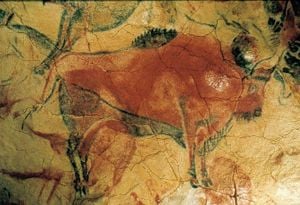
Millán Mozota denounces at his blog, echoing other researchers, the short-sighted attitude of the Cantabrian authorities who have decided to open the Altamira cave to the public again in spite of the dramatic risk for the art in it.
In the last decade, considerable attention has been paid to the deterioration of the caves that house the world's most prominent Paleolithic rock art. This is exemplified by the caves of Lascaux (Dordogne, France) (1) and Altamira (Cantabria, Spain), both declared World Heritage Sites. The Altamira Cave has been closed to visitors since 2002. Since 2010, reopening the Altamira Cave has been under consideration. We argue that research indicates the need to preserve the cave by keeping it closed in the near future.
The public can enjoy a replica of part of the cave at the nearby museum.
Iberian Neolithic idols
While in Spanish language, I can't but call your attention to this fifth article of Neolítico de la Península Ibérica on the diverse array of idols known from the Neolithic and Chalcolithic of Iberia. Even if you can't read any Spanish, you will no doubt gather some information and visual recreation from simply watching the many images and maps included in this blogpost. For example:
 |
| Orange ovals: "eyed" idols (oculados), brown ovals: "plate" idols (ídolos placa) |
··> Neolítico de la Península Ibérica[es].
Last minute news: some iris pattern genetics unveiled ··> The Spitoon.
March 1, 2011
Paleo-Sardinian language: a relative of Basque?
Basque linguist J.M. Elexpuru discusses today at Noticias de Álava[es] the possibility that the lost pre-Romance language of Sardinia could be related to Basque, following the steps of Catalan linguist Eduardo Blasco Ferrer, who just published a book titled Paleosardo, le radici linguistiche de la Sardegna neolítica (Paleo-Sardinian, the linguistic roots of Neolithic Sardinia).
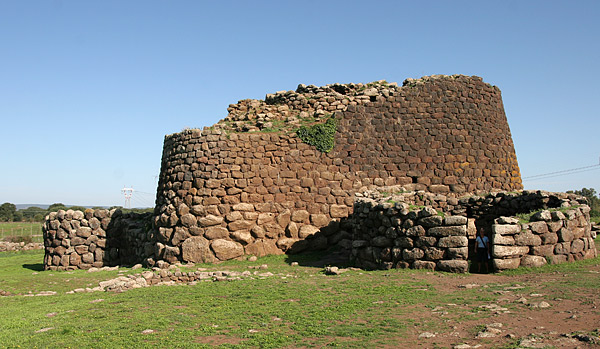 |
| Ruins of a Sardinian nuraghe |
Sardinia belonged to the Carthaginian Empire since the 6th century BCE and then passed to the Roman one in the 3rd century, remaining since then in the Romance linguistic area. However little is known of the history of the island before, except the famous nuraghe forts (similar to SE Spanish motillas) and that it was colonized (after some ill-known Epipaleolithic episode) within the Cardium Pottery culture in the Neolithic, probably from Central Italy.
However Dr. Elexpuru synthesizes this way the position of Blasco Ferrer:
... there was a migration from the Basque area in the Mesolithic (8000-5000 b.C.) which settled the island. There were surely other flows later on. Genetic research on mitochondrial DNA have revealed that haplogroup V, originary from the Basque-Cantabrian area, is very high in the central region. The language carried by the settlers, named Paleo-Sardinian by linguists, was the one spoken through all the Neolithic and Bronze Age in the island and still survived for some centuries to Roman domination in the central region, which was known as Barbaria. In some parts of the island the density of pre-Roman toponyms is well above 40%.
He concludes mentioning some of the river and settlement names that are quite obviously Vasconic:
- River names: (h)aran, ardi, baso, berri, bide, ertz, goni (goi), gorri, iri, istil, iz, lats, lur, mando, on, orri, (h)osto, (h)otz, (h)obi, (i)turri, ur, zuri.
- Village names: Aritzo, Ardaule, Asuni, Goni, Loiri, Luras, Olzai, Orgósolo, Ortueri, Osini, Turri, Ulassai, Uras, Uri, Urzulei...
I must say that all this would make better sense if Iberian and Ligurian could be somehow integrated in the picture. One reason is that haplogroup V is now known to be much more frequent and probably original not from the modern Basque Country nor even Gascony but from farther East: Catalonia probably. However now and again there are other rare or somewhat common lineages that appear shared between Iberia and/or the Basque Country and Sardinia (and sometimes also North Africa).
One of the most common ones is Y-DNA I2a, a West Mediterranean and Pyrenean clade extremely common in Sardinia, which, if of Neolithic origin, would be the only such lineage quite frequent among Basques. But it could also be pre-Neolithic.
 |
| Frequency of Y-DNA I2a, from Rootsi 2004 |
For the record, it was discussed earlier in this blog (also here) the striking similitude of Basque and Sardinian (and some other European) carnival performances, all this in relation to the apparent paleo-European veneration of the bear and the continentally widespread shared root for this animal (hartz in Basque, almost the same in proto-Indoeuropean).
Also for the record I must mention that, in my not so humble opinion, the very word Sardinia seems to have a Basque etymology. Obviously it is derived from the pan-European word sardine but this term only makes etymological sense in Basque: sarda (fish school) + -gin (suffix of doing/making < egin) + -e/-a (nominative declension, like the article "the"). It needs of a loss of a syllabe (would make sardagina) but I still think it's plausible that sardine (and hence Sardinia) means school-doer or school-maker in Basque or a related language from old.
Whatever the case it is extremely difficult to deny the Basqueness of the toponyms listed above, even if I am sure that soon someone will come and contest such obviousness, based not on common sense but on twisted and ill-explained elaborations.
But what I still do not have fully clear is in which direction the Vasconic language spread. Of course the default hypothesis of an expansion from the Franco-Cantabrian region makes good sense but it is difficult to completely discard a Neolithic spread of the language family in the context of Cardium Pottery culture (and loosely related Atlantic ones, including Megalithism).
I also think that this Vasconic substrate is not something peculiar of Sardinia and that anyone who looks around with a keen eye and a half-decent knowledge of Basque language can't but stumble once and again on Basque-like toponimy all around the western half of the continent.
Article found via Ostraka Euskalduna[eu]
Subscribe to:
Posts (Atom)