Showing posts with label linguistics. Show all posts

September 17, 2015

Vasco-Nubian?

This is something I've been chewing on for more than a year now and yet never got myself to blog about (although I have mentioned in private or in comments here and there). Impelled by the minor but quite apparent NE African influence, genetic and cultural, on the Neolithic peoples of the Levant, whose offshoots eventually landed in Greece triggering the European Neolithic, I decided in the Spring of 2014 to explore, via mass-lexical comparison, if Basque language (and by extension the wider Vasconic family, which I believe now to be that of mainline European Neolithic) might have any relation with Nubian languages. I did not expect to find anything but noise but to my surprise the number of apparent cognates is quite significant. 

My primary analysis was this one but now I have combined it with a comparison with Proto-Indoeuropean (PIE), which is also very probably related to the roots of Vasconic: LINK (open office spreadsheet). 

The synthesis is as follows:


Of course the "cognates" are only apparent cognates at this stage of the research and the evaluation is necessarily subjective. But judge yourselves. 

If we discard the "weak" apparent cognates, the vocabulary correlation between Basque and Nubian and between Basque and PIE is pretty similar. But, in my understanding, both are well above the noise threshold, an example of which could be the PIE-Nubian apparent cognates, which are many many less. 

I must say anyhow that the oblique apparent cognates, that is when one word sounds much not like its strict synonym but a related one (for example words meaning hot and fire), look all very solid and most intriguing. 

Also, when attributing probabilities to origins of Basque words, Nubian appears to be at the origin of almost double the words (26%) that can be attributed to PIE (15%). Of course, for lack of data or because they actually have other origins, the unknown origins apply to the majority of words (56%), double than the Nubian origin ones.

However Nubian here is constituted of three different languages (Dilling, Nobiin and Midob), while PIE is just a single theoretical construct. This last must be done this way because many modern and historical IE languages, notably in Europe, have other Vasconic substrate influences, which must be studied separately from general PIE-Vasconic shared vocabulary. This kind of late Vasconic influence is very much unlikely in the case of Nubian instead. In any case I don't know of any a proto-Nubian Swadesh list readily available. 

Finally I must mention that because the PDF format is horrible for copy-pasting, I chose to re-transcribe the Nubian words according to my best approximation using a normal keyboard (not always the same characters that the original list uses).


Strongest Basque-Nubian apparent simple cognates

  • Basque - Nubian languages (English)
  • azal - àzì, àzzì-di (bark)
  • haragi - árízh (meat)
  • odol - ógór, èggér (blood)
  • buru - úr (head)
  • oin - ó:y (foot)
  • esku - ish-i, ès-sì (hand)
  • hil* - di-ìl (to die)
  • euri - are, ara, áwwí, áré, árí, áró (rain)
  • harri - kugor, kakar (stone) [notice also the pre-IE root *kharr- speculated to be at the origin of Karst, etc.] 
  • lur - gùr (soil, ground)
  • haize - irsh-i, éss-í (wind)

There are some others that are shared with Indo-European and with similar subjective "weight", not listing them here to keep things clear. There are also other apparent cognates that are arguably less clear like bat - be (one) that I'm also skipping here but you can find in the spreadsheet.

*Hil (meaning both to die and to kill in Basque, which can't be confused because they conjugate differently) seems ancestral to English ill and kill (this one via a Germanic precursor).


The intriguing oblique cognates

Notice that these words do not mean the same, yet their meanings seem strikingly related.
  • Nubian (English) - Basque (English)
  • hor, koy, kà:r (tree) - harri (stone) [notice that zuhaitz (tree) can be interpreted etymologically as zur-haitz = wood-rock, so the relation is not that weird]
  • ok-i, og (breast) - ogi (bread)
  • a-l (heart) - ahal (can (verb), potential, power)
  • azh, àz-ír, àzza (to bite) - (h)ortz (tooth), aitz (rock, peak) [some argue that originally "to cut", present in many cutting tool names: aizkor = axe, aitzur = hoe, aizto = knife, etc.*]
  • shu, zhúù (to walk) - joan (to go) [often pronounced jun or shun]
  • é:zhi (water) - heze (wet) [also archaic particle *iz-, meaning "water" by all accounts: itxaso = sea, izurde = dolphin, izotz = ice, and common in Vasconic river toponymy]
  • zhuge (to burn) - su (fire) 
  • zhùg, sù, sú:w (hot) - su (fire)
  • úr-i, úrúm (black) - urdin (blue) [archaic also green, grey]

*This one is an obvious and very prevalent Vasconic substrate infiltrator in Western IE languages: axe, adze, azada (hoe in Spanish), etc.


How can this be possible?

It is of course a mere working hypothesis and ultimately you judge but I find it hard to disdain. However there is no apparent connection, notably no significant genetic connection, between Basques and Nubians. So how can we explain this?

I have it reasonably clear myself, so I made a map to explain it:
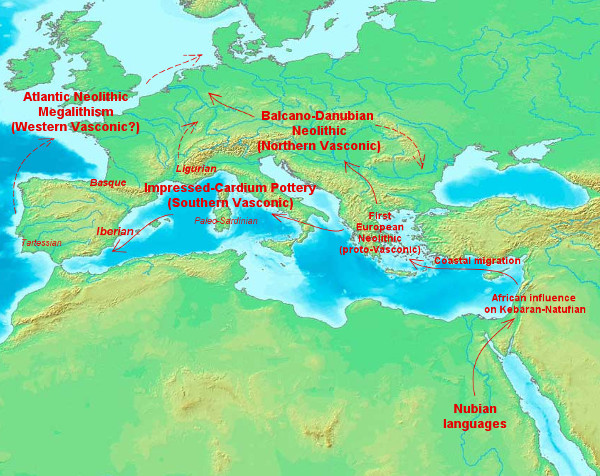


Basque is after all just the last survivor of a once much larger family (Vasconic), a family that most likely corresponds to the languages spoken by the early European farmers (mainline Neolithic of Aegean roots). As that expansion was largely done in about a mere thousand years, I estimate that when both branches met near the Rhine, the two peoples could still understand each other, even if with some difficulty. Only the Southern/Western branch(-es) survived long enough to leave historical evidence, so it is hard to guess how the Northern branch evolved anyhow.

The Nubian linguistic connection is anyhow not the only thing that requires the Levant or Palestinian Neolithic step, also Y-DNA E1b-M78 (mostly V13 in Europe, attested in some early farmers and still very important among Greeks and Albanians particularly) and probably the so-called "Basal Eurasian" component that Lazaridis detected among early European farmers and that could well be the signature of African genetics from the Nile.

Linguistically, also the very notorious presence of Semitic (an Afroasiatic branch) in West Asia is surely another legacy of the same African influences in the Mesolithic Levant. Before this research, I thought it was the only one but now I strongly suspect that at some point Nubian (Nilo-Saharan) languages were also present in the region. Maybe one (Nubian evolving towards Vasconic) corresponded to Natufian proper and the other (proto-Semitic) to Harifian, the semi-desert pastoralist facies of the same wider culture. Can't say for sure.

The chain was once long but now only some of the most distant links remain unbroken. It is difficult to imagine that they were ever connected at all...


To do...

A lot remains to be done, of course:
  • These mass lexical comparisons only apply to a few families in the region and the rest should also be tested for. My energies are limited and so are my qualifications as "linguist", so I encourage others, hopefully more energetic and knowledgeable, to expand.
  • Grammatical features cannot be analyzed by this methodology. Again my means are limited. 
  • Anthropological research would be an interesting complement. So far the only shared cultural trait I could spot would be the use of bells attached to ankles for dancing but there could be others. 
  • ...

July 2, 2014

Sino-Basque is not for real

Unmistakable evidence: beret-wearing Chinese!
(humorously borrowed from Zubia-Qiao blog,
which is about real Basque-China relations)
Linguistic speculation haunts us and today I stumbled on this paper, which has an interesting introduction but ends up claiming the extremely unlikely Sino-Caucasian family (including Basque and what-not):

Murray Gell-Mann, Ilia Peiros & George Starostin, Distant Language Relationships: The Current Perspective. Available at academia.eduLINK

I admit I have been skeptic of the Sino-Caucasian hypothesis since I tried once to learn some Chinese and was surprised of how little this language actually resembles Basque. Probably a random African or Australian language is not more different than Chinese is to Basque, or so I thought without having performed until now any formal test of the hypothesis.

There are a lot of reasons: the general skepticism of most linguists but also the lack of any apparent archaeological or meaningful genetic relationship since maybe 60 Ka ago (or, if Sino-Tibetan is related to Amerind and other Native American languages, since c. 45 Ka ago at the latest).

But the hypothesis continues to have some currency and today I finally decided to test it following the Swadesh-100 method suggested in the paper. The result:

Sino-Tibetan/Basque/English Swadesh-100 comparison (open office ODT format, similar to Excel - if anyone has a problem, please ask and I will upload an Excel version of it). 

Conclusion: Basque is not more related to Sino-Tibetan (either Mandarin or Burmese) than English is. If anything, the opposite is true, although the low level of plausible cognates for both languages (5-7%) seems merely stochastic noise, or maybe in some case wanderworts. Of course, the exact number of similar words (possible cognates) depends on one's permisivity but the pattern is so similar for the three possible pairings that, if there is any relationship at all, it must include English and therefore Indoeuropean.

Check it yourself, of course.

April 17, 2014

Basque-Iberian numerals

Basque-Iberian language family theory is back and very strongly so. Even such an staunchly pan-indoeuropeanist¹ fanatic like Villar has to admit to it, even reluctantly and trying to dismiss its relevance. 

The main argument is the recognition of Basque and Iberian numerals as very similar, including even the once suspect IE loan sei (six), which may in the end be Vasconic after all. 

Euskararen Jatorria has these days a whole series on the matter (in Basque and Spanish):


Ferrer 2009 scheme of Iberian numerals
Orduña 2011: Basque numerals (standard and variants)


So, totally dismissing that self-complacient and power-mongering cultural terrorist of Lakarra, and looking at the obvious facts, we have the following series of correspondences (iberian - Basque). I have transcribed Iberian transcriptional "s" as "z" and "ś" as regular "s", as it seems to correspond with modern and historical Basque spelling:
  1. ban - bat [bana: each, bana-tu: divide]
  2. bi(n) - bi²
  3. irur - (h)iru(r)
  4. lau(r) - lau(r)
  5. borz(te) - bost, borz, bortz³
  6. sei - sei⁴
  7. zizbi - zazpi
  8. zorze - zortzi, zorzi
  9. unknown - bederatzi
  10. abaŕ - (h)amaŕ⁵
Additionally we have also the correspondence (20) oŕkei - (h)ogei. With those numbers you can count up to 99 using the vigesimal system common to both languages⁵.

Less clear is whether there is a Basque-Iberian correspondence regarding the number 100 (ehun in Basque). Orduña argued for it but Ferrer rejected the claim. 

It is interesting that the form for 11 in Basque is irregular: amaika (regular would be hamabat but it does not exist in fact). Considering the abaŕ-ke-# form in Iberian, we can now track its origins surely to a shortening of abaŕkeban⁷. Amaika is also used to mean "a lot" in Basque, possibly because most peasants were not too much into numbers in the past.

________

Notes:

¹ Pan-indoeuropeanism: wild hypothesis that rejects that the Indoeuropean family expanded from any single origin and claims instead that it was preceded only by itself from the beginning of times. Oddly enough there are people (and I mean linguists) who believe in it, even if it makes no sense whatsoever. It is a convenient ideological way to deny any respect to other languages which may have been in the area longer, as may be the case of Basque or Dravidian. Winners write history and now it seems that also linguistic theories of the worst kind.

² Notice the obvious Vasconic influence in Latin particle bi-, which is used in many languages nowadays: binary, bilateral, bifocal, etc. 

³ Iberian syllabary would force borzt or even bortz to be  written borzte or similar, as there is no lone "t" sign, only "ta", "te", "ti", "to" and "tu", which can also be "da", "de", etc. Only in the scarce Ibero-Jonian (Greek) script transcription becomes much easier.

⁴ It was typically believed that the numeral sei (6) was an Indoeuropean borrowing (compare with Sp. seis, Lat. sex), possibly under the influence of Christian doctrine (the very word "sex" comes from the Latin numeral, in reference to the Hebrew chastity commandment usually listed under that number) but judging on the Iberian identical form this must revised. However it is true that there is an independent an maybe related IE pattern of similar cognates for this number whose PIE reconstruction is *swéḱs.

⁵ "ŕ" indicates strong r (alveolar trill /r/, as in Sp. "perro"), "r" indicates a soft r (liquid /ɾ/, as in Sp. "pero"). Hence you decline hamar as hamarra but laur as laura, even if both roots are written similarly in standard Basque, which has long abandoned the "ŕ" character for pragmatic reasons (still used but very rarely). 

⁶ This vigesimal system, unknown to most Indoeuropean languages (staunchly decimal), was adopted by Celtic and later by French, which still retains it for the numbers 70 and 90 and their derivatives. Other languages with vigesimal system are Danish, Albanian and a dialect of Slovenian spoken in Italy (all them IE languages); Georgian and Nakh also have it in the Caucasus region; some traditional numerical expressions in English ("score" and other usages) also seem to retain the memory of a vigesimal system. It is an important piece of evidence supporting the existence of a vasconic substrate in much of Europe.

Micro-update: Gascon and other old romances of present-day France also retained at least some expression of this vigesimalism. 

⁷ If -ke- meant "and" in ancient Iberian (Basque eta has been claimed to come from Latin et), can it be argued that the Latin particle -que (also meaning "and") has vasconic origins? In standard theory it comes from PIE *-kʷe but the evidence of its existence seems a bit feeble to my eyes, with almost no alleged derivate being even remotely similar to their alleged ancestor.

September 6, 2013

More Basque linguistics: the meaning of "Varduli"... and other ancient tribes

A quick linguistic note I just feel I need to write. 

If you make a search on the etymology of Varduli (one of the historical Basque tribes of the early Roman era), we find that it is almost invariably attributed to the alleged Celtic root *bhar- meaning border, frontier. This is the same logic used with the better known tribe of the Vascones, which gave their name to Basques in general later on in Indoeuropean languages. 

Ancient tribes of the Greater Basque Country (blue Celts, red pre-IE)

One of the problems here is that Latin letter v was not originally /v/, much less /b/ but originally just /u/, i.e. the same sound as English w when used as semi-consonant. In fact the letter u did not exist in Classic Latin, just v (i.e. IVLIVS: Julius). Both letters j and u evolved only at a later stage. However both cases are documented with other phonetics: Varduli in Greek are said Bardoúloi, Bardiétes (where the B, beta, should sound like English v). In the case of the Vascones there is a coinage with the word Barscunes, which should sound /b/ and is the main link to the alleged Celtic root *bhar-.

Often the country of the Varduli is assimilated to Gipuzkoa but the actual Varduli did not just occupy most (not all) of that modern province but their domain extended much further south into lands now belonging to the provinces of Navarre and Araba until the Ebro river. Their capital was in fact the town that Romans named Ara Coeli, later Araceli and that Basques know by the compound name of Uharte-Arakil (Sakana valley, Navarre), where Arakil is obviously Ara Coeli but Uharte is a Basque word that means island or more precisely between waters (ur-arte). Therefore Uharte is the genuine Basque name.

My understanding is therefore that Varduli means nothing else than Uharte-Uli (shortened to Uhartuli), i.e. the city of Uharte. Uli, ili, uri, iri: city in Basque and Iberian, as well as many other Mediterranean languages (cf. Ilion, *Irisalem, *Iriko, etc.), being a clear wanderwört of prehistoric origins. Today it's said mostly "hiri" but toponimy includes all variants: Uribe, Basauri, Ulia, Irun, Iruinea, Pompaelo (= Pompaeius-Ilu), etc.

Therefore the rewriting of this ethnonym with Greek beta (/v/) seems a misunderstanding by those cartographers who used it. 

Harder is to be certain about other ethnonyms but if I'm correct about the true meaning of Varduli, it may mean that other tribal names reported by Greco-Roman erudites could also mean locations, such as towns, without further ado, mistaken by collective denominations. I know that it was usual to add the suffix -ani or similar to these cases (example: Basti → Bastetani) but probably the ancient cartographers did not have enough knowledge in all cases, especially if their sources were second or third hand. 

A notorious case is in my opinion the name of the Astures, which could well mean, if Basque (or otherwise Vasconic), Aitz-Uri, i.e. the city (uri) of the rock or mountain (aitz). We know that the capital of the Astures (Asturica Augusta for the Romans, Astorga by the modern name) existed since at least the Atlantic Bronze Age, so it is not like nearby Legio Augusta (León) a Roman foundation by any means. So it seems, on first sight, plausible that the ancient Astures were also named by their capital city: Aitzuri, now Astorga. 

However on second thought, it happens that Astorga is located on flatlands, but, as you can see in this picture, right under an often snowed mountain. Aitzuri can also mean (and would be the natural translation in modern Basque) white peak. I leave this open therefore because it could mean either. 

Another ethnonym of ancient North Iberia that seems very Vasconic is Artabri (sing. Artabrus), who lived in what is now Northern Galicia, next to the Astures. A plausible Basque etymology can well be Arte-Buru, i.e. the head of the holm oak (Q. ilex). The holm oak grows well by the coast, precisely where the ancient Artabri lived, being like other oaks often considered special and a sacred meeting place. The second compound buru (head) may mean either a promontory or hill, if geographic, or maybe chieftain, leader. 

This would lead us to the similarly-sounding name Cantabrus/-i. If -brus is indeed buru (head), what is canta-? Possibly gain, gane (height, peak) maybe in the form ganeta (zone of peaks, the peaks), very common in Basque toponymy. If so, it could well be ganeta-buru: the head of the peak-zone, what makes good sense, especially if we reckon that the Cantabri were a confederation of many smaller tribes (→ approximate map, notice that the eastern border has been displaced surely for modern political reasons).

I don't wish to finish without mentioning the Ausci. Sometimes this Aquitanian tribe, the larger one among northern Basques, is said to be at the origin of the Basque endonym euskaldun, which derivates from euskera (Basque language), having the pseudo-mysterious root eusk-. The apparent similitude between Ausci (/awski/) and eusk- (/ewsk-/) has led some to propose an etymological relationship. 

However I tend to think that euskera derives, like all other words beginning with eusk- from the verb eutsi (hold, persist, resist), where -ts- transforms regularly into -sk-. Hence euskarri (pillar, lit. holding stone), euskailu (bowl, lit. holding gadget), etc. Euskera would therefore be the persistent (eutsi) mode, lifestyle or language (-era), in contrast with erdera (applied to all non-Basque languages but primarily Indoeuropean ones) which should mean the dividing (erditu) mode, lifestyle or language.

It is difficult to find a meaning for the ethnonym Ausci but it does not seem to make sense from the verb eutsi, as there is no suffix attached. The singular form was Auscus, what makes me think of the Navarrese village of Aezkoa (where -a is nominative article and -ko must mean of a place). Aez- here could well be aitz (rock, peak) again (of the rock therefore, no wonder considering its location) or alternatively could well be a shortening of ametz (a type of oak, Q. pyrenaica). But while these etymologies seem to fit well for Aezkoa, they are more difficult to relate to the Ausci, who lived in the northeastern flatlands near the Garona (Garonne). 

A bit far fetched but a possible etymology could be ahozko, meaning oral: aho = mouth, -zko= made of. Ahozko is a real word, not something I just made up. However "the orals" is not something that sounds correct so maybe for them it could mean something else, like those who speak or whatever.

If so I wonder if my previous best guess about the origin of the word euskera was wrong after all, could it be just ahozkera, i.e. the oral (or spoken) mode or language. Could it be that the divide meaning of erdera refers to being partly written, as happened with Latin?

Enough for this quickie linguistic note. Thanks for reading and feel free to add comments, especially if you're open-minded.

Another wacko linguistic speculation: Ibero-Uralic

Just got notice via Jatorriberri[eu/es] of this informal paper on the alleged relationship between Basque (or rather Iberian) with Uralic, via Turkish, it seems.

Eduard Selleslagh-Suykens, Iberian and Uralic Supected Finno-Ugric-like elements in the Iberian language (and maybe even Altaic ones). Revised version of August 25, 2013. Self-publication at academia.edu → LINK (doc format)

Before I forget about it, let's see what this guy really has. Or rather what he does not have.

First of all I must mention that Mr. Selleslagh-Suykens does not have a curriculum on the matter. I have made a throughout search and he looks an aficionado without any linguistic degree. Nothing wrong with that except that he would need to be even more convincing in order to overcome that handicap, something he fails to.


Twisting ibar (river bank) until it becomes unrecognizable

Mr. Selleslagh, avoids the issue of having to learn at least some Basque by dismissing this language's similitudes with Iberian as mere loanwords from Iberian. That way he can ignore Basque meanings and etymologies altogether.

That way the known toponym "ibar" (Iber-Ebro river in Iberia, Ibar river in Kosovo, etc.), which he chooses to write "ybar" for some odd reason, does not need to have any relationship with Basque ibar (river bank), ibai (river), ibon (creek) or even very possibly ibili (to walk) but can be imagined to be whatever, in his case:
Conclusions: 1. Basque ‘ume’ is probably an Iberian loanword, and 2. Iberian ‘Ybar’ probably means ‘father’. And ‘Ybar-Yi’ (like in the Sinarcas stele) would mean ‘my father’, a very plausible meaning in its context.

I do not know what the Sinarcas stele means, for those with interest and knowledge of Spanish I suggest reading the dedicated study by renowned Valencian linguist Luis Silgo Gauche.

In the original transcriptions by Fletcher (1985) and Untermann (1990) there is simply no "-yi-" but "-wi-" or "-ḿi-". This is one of the problems of Iberian script: major differences in transcription. Therefore Selleslagh's Ybar-Yi can well be Wibaŕ-Wi or Ḿibaŕ-Ḿi... or whatever.

Whatever the case the logic of relating ibar with Basque senar (husband) and therefore with seme/sembe (son) looks very much far-fetched, especially when he's totally ignoring Basque itself, that can easily explain the root ib- as referring to rivers (ibai, ibar, ibon) or maybe to the act of flowing or moving, if we dare to include the verb ibili (to walk), which can well be related to bide (path, way) by loss of the initial i- (common in Basque verbs of that type, where the root is -bil-: nabil: I walk, gabiltza: we walk, etc.) Another possible cognate in the same way could be bizi (life, alive).


Turkish, ergo Altaic, ergo Uralic, ergo Sumerian... whatever!

This is the "best" of the paper...
Buru-Burun:

At first sight, they have nothing in common, Bq. ‘buru’ having ‘head’, and Trk. ‘burun’ ‘nose’ as primary meanings. However, both are used in many other meanings that have one thing in common: they all refer to some form of ‘extremity’ or ‘protuberance’, sometimes even for the same concept, e.g. cape (in geography). However, as far as I know, ‘buru’ is not attested in Iberian, which does not necessarily mean it didn’t exist.

Buru does not have the meaning of extremity, although it may have the meaning of notorious ending, such as a hill, cape or the round ends of the lauburu (Basque curved swastika). More importantly it has the meaning of self and about:
Hitz egiten nuen nire buruari: lit. I was talking to my head; actual meaning: I was talking to myself.
Hau hizkuntari buruz da: this is about language.

But nose and head are close enough may say someone... let's see what else he has:
Egun-Gün:

Both mean ‘day’. The Turkish word for ‘sun’, ‘güneş’, is derived from ‘gün’. According to L. Trask “Barandiarán (1972) suggests an original sense of ‘sun’, ‘light’, which is possible but beyond checking for Bq. ‘egun’ “. That would mean that the Basque word for ‘sun’, ‘eguzki’, is derived fom ‘egun’ (in its meaning of ‘day’) by means of a compound suffix: ‘egu(n)-(e)z-ki’.

Some say that it is egu(n)-uzki: asshole of the day, especially because in some dialects sun is indeed said uzki (in others eki, which is also the word for east)

A plausible etymology anyhow, I believe already suggested by J. Paskual, for egun can well be egi-une: the zone or period of truth. Similarly eki (sun, east) might be a variant of egi: truth, limit, in the same emphatic way that ekin (to take action) is related to egin (to do).
Ezina ekinez egina: the impossible [gets] done through action.

Naturally the verbs egin and ekin themselves seem derived from that egi root, as is probably egon (a non-essential variant of to be, as in to stay at a location or to be temporarily affected by a condition, similar to Spanish estar).

But, even if you believe that these two coincidences with Turkish mean something (who knows?), in order to make them imply Ibero-Uralic of some sort, we'd have not just to believe in Ibero-Basque (something that Selleslagh does not quite apparently) but also in Macro-Altaic, a very much contested hypothesis.

More "evidence" for Basque-Turkish (not Ibero-Uralic yet) relations:
Adi(n)-Aydın :

Both a have strong relationship with intellectual capacity and the like: the Basque word has several acceptances like ‘age’ (probably through a link with ‘wise’), ‘understanding’, ‘judgement’; the Turkish word means intellectual, literate, etc.’. The Basque word frequently occurs in Aquitanian names, so an Iberian origin cannot be excluded since Aquitanian names often mimic or copy Iberian names.

Adin (age) seems related to adi (to listen, to pay attention) and there is indeed the "wise" connection: aditu(-a) (someone who understand, expert). But I haven't found any Turkish meaning other than personal name. It does not seem proto-Turkic anyhow (unlike what happens with burun and gün).
Izen-Isim:
Both mean ‘name’. Another pure coincidence? I begin to think there are too many of them.

Isim is clearly derived from proto-Semitic *šim- (documented in many languages ), so if anything it'd be a relationship of Basque with Semitic or with some other West Asian substrate. 

Whatever the case we have again a clear internal etymology in Basque: izan (to be, essential, similar to Spanish ser, to exist). 
Izena duen guztia izan omen da: all that has name may be (exist).
Izena izana: the name, the being.

More:

-kume-Küme:

This time I’m venturing into perilous territory, but it might contribute something. The Basque suffix means ‘offspring, young animal’ and is obviously related to ‘ume’

As perilous as he just rejected the existence of the word ume in pre-proto-Basque when arguing for ibar meaning father.
Of course ume (kid) and kume (cub, whelp, foal) are related or at least everybody thinks so (it's so obvious!) On a side note, I think English cub is derived from Basque (or other Vasconic) kume, something that happens with other non-IE words like ill and kill (surely related to Basque hil: to die, to kill).
But the Turkish alleged cognate is the main problem:
The Turkish word has a basic meaning of ‘conglomeration, group …’, including ‘family’.

Hmmm, this one does look very perilous indeed. 

He also has some other speculations relating Basque (normally not Iberian) suffixes with Hungarian (one case), a variety of European/West Asian languages (another case) or Centum Indoeuropean (another more complex case).


Conclusion
What can be concluded? In my opinion nothing. They can indeed be coincidences. Coincidences of sound and meaning do happen and only a systematic corpus such as mass-lexical comparisons can be of any use... and that only to begin with, because then the comparative method should be used to refine that first approach.

There is just one striking coincidence with proto-Turkish: egun-gün and another one, quite more dubious, with proto-Semitic: izen-*sim-. Some speculations on a common pan-European substrate of some declensions/suffixes. And then those clearly wrong rantings about the word ibar.

There is nothing of substance here, move along.
_________________________________________

Note: a very simple (highly incomplete but a good preliminary exercise) way of comparing languages for possible similitudes is to compare the numeral series, especially 1-5, or maybe up to 10. There is a veteran online database for that. For our purposes (1-5 only):
  • PIE: *oynos/*sem *duwo: *treyes *kwetwores *penkwe
  • Basque: bat bi hiru lau bost 
    • Proto-Basque (??): *bade *biga *(h)ilur *laur *bortz(e)
  • Proto-Finno-Ugric: *ykte *kakte *kolm- *neljä- *vit(t)e
  • Old Turkic: bir iki üch tört besh
  • Akkadian (example of old Semitic): ishte:n shena shalash erbe h.amish
  • Proto-North-Caucasian (??): *cHê *qHwä: *s'wimHV *hêmqi *fh`ä^
  • Sumerian: desh min pesh lim i
  • Georgian: erti ori sami otxi xuti
I can hardly find anything comparable, maybe Sumerian min with Basque bi (ignoring the PB speculation), PIE *treyes with Basque hiru (??), Turkic tört and besh with PIE *kwetwores and *penkwe. But that's about it stretching my imagination all I can. The only half-solid hint is the PIE-Turkic connection, which may be just loanwords of IE substrate to Central Asian early Turkic in the Iron Age.

June 2, 2013

Basque linguistics: Frank criticizes Lakarra

I mentioned recently how the pope of Basque linguistics, Joseba Lakarra, is being more and more criticized. Here however I will briefly discuss another such criticism.

Frank, Roslyn M. 2011. Repasando a Joseba Lakarra: Observaciones sobre algunas etimologías en euskera a partir de un acercamiento más cognitivo (Reviewing Joseba Lakarra: Observations on some etymologies in Basque language from a more cognitive approach). ARSE 45: 17-64. Available at Academia.edu (in Spanish only).

On one side the alleged Latin/Romance alleged etymologies by Lakarra are self-exposed as a total fraud. Some self-explanatory examples:
  • turpe (Lat. foul, dirty) → *durpe*burdeurde (pig, boar; metaphorically only: dirty - the common word for dirty is zikin)
  • timor (Lat. fear) → … *dirbur*birdurbildur (more commonly beldur: fear¹)
  • hierba (Sp. grass, herb) > *erbar > *berar > belar / bedar (grass, there's actually a real Latin/Romance derived word: zerba = herb)
  • caninu (from. Lat. caninus: rel. to dogs) → *ahinu*ahiun*ha.inhagin (molar)
  • *(la)grima (Sp. lágrima: tear; grima: coll. pity) > *girma > *girna > *nirga > nigar (more commonly negar: cry, tears, negar egin: to cry, to express emotion by tears)

One of the many problems with this last 'etymology' is that Basque language hates double consonants (with the exceptions: tx [ch], ts, tz) and that therefore the hypothetical *grima would become *girima or *kirima first of all, again unattested.

But in general all the Lakarran hypothetical etymologies are self-defeating, needing of several unlikely intermediate variants, each of them extremely unlikely, and would not stand any minimally serious scrutiny. The problem is that there is very little of that.

Another criticism is that he uses almost only his own work, often not even published, as evidence of his own conclusions. This is mere pseudoscience but somehow he gets away with it.

Other issues that Lakarran conjectures (calling that 'garbage in - garbage out' speculation "theory" would be way too generous) pose are grammatical. Unlike the late North American linguist Larry Trask, who establishes that Basque has primarily a SOV grammatical structure, for Lakarra the proto-Basque had no grammar whatsoever: no SOV, no ergative, no agglutination, no verbal inflections... In other words: for Lakarra proto-Basque speakers were probably not even human yet, but that proto-Basque is only estimated to have existed some 3000 years into the past, so...

For Lakarra, proto-Basque would not be agglutinative but isolating. This isolating characteristic of some languages is actually restricted to East Asia (the most notable example is Chinese, especially classical Chinese). However real Basque has a clear agglutinative tendency, what seems highly inconsistent with Lakarra's formulation.

The bulk of the study however only touches Lakarrism somewhat obliquely, dwelling in some depth on the etymology of hatzapar² (animal claw), which Lakarra forces to derive from Sp. garra (same meaning) but Frank considers 100% Basque, deriving from the more widespread hatzamar (i.e. the toe that means ten, the big toe), and the grammaticalization of gai, originally ability, able, potential (also matter, substance) but now inserted in many words like zerga(i)tik (why, from zer(en)-gai-tik) or -gale (feeling of the prefix: edagale: thirsty, etc.)

The study ends with a criticism of the group Monumenta Linguae Vasconum, which is led by said Joseba Lakarra (and co-participated by Blanca Urgell, Gidor Bilbao, Ricardo Gómez, Julen Manterola Agirre, Mikel Martínez and Céline Mounole). This group is preparing, at the snail pace of a mere 500 words per year, with public financing, an etymological dictionary of the Basque language, which will be no doubt founded only on Lakarra's own speculations. Since 2007 Lakarra is member of the Academy of the Basque Language, Euskaltzaindia, what means that his work is de facto being backed by this influential organism.


_________________________________________________

Notes (my own ideas):

¹ Beldur (fear) surely derives from bel(tz): black in fact, possibly: *bel-adur: black humor.

² I would also consider *hatz-adar (toe-horn, toe's horn) as possible origin of both forms.

May 22, 2013

Basque language: a criticism of Joseba Lakarra

Further correction to authorship (Jun 2): Euskararen Jatorria as a whole collectivity are the authors of this study (see comments in their entry), so it's not anonymous but collective (yet the various individual co-authors are not named anywhere).

Original article edited in order to clarify authorship:


Euskararen Jatorria collective have recently published a paper in which they criticize the excessive reliance of Basque language studies on the work of Prof. Joseba Lakarra, whose shadowy control of the Basque Academy on this matter is most worrying, notably since his key defamatory intervention against the extraordinary finds of Iruña-Veleia, which challenge to some extent the foundations of his work.

Sadly for many readers of this blog, the new study is published only in Spanish and Basque languages. In spite of that I feel the need to briefly discuss it here.

Euskararen Jatorria (collective work), Joseba Lakarra a examen. Sobre el Diccionario Histórico Etímologico Vasco. Euskararen Jatorria 2013. Freely accessibleLINK 1 (Spanish), LINK 2 (Basque)
 

The paper begins with a pondered praise of Lakarra's efforts to go beyond Mitxelena's paradigms. However they feel that he should also be much more self-critical and humble and ready to back when he's clearly wrong, what he does not. A key concern is that the Academy of Basque Language (Euskaltzaindia) and University of the Basque Country are focused on a major work: the creation of an etymological dictionary, which will be founded almost only on Lakarra's work, what could well be a total disaster and waste of resources if he is mostly wrong.

Naturally Lakarra is the director of the project himself. While a few other authors (Tovar, Trask) are cited in Lakarra's magnum opus project, they are almost only mentioned in a negative manner. The result can therefore be foreseen as a monument to Lakarra's own vanity.

Nothing new in fact, as Lakarra is infamous for citing almost exclusive his own works, often unpublished, what is not accepted as a healthy academic praxis anywhere... except in his own feudal domain, it seems. This problem of self-citation is discussed in section 4 of this paper.

The criticisms of Lakarra's work can be synthesized following the structure of the study:
  1. The monosyllabic root theory of Lakarra is too daring. The available evidence does not support this in most cases.
  2. There is no process of critical revision. This makes Lakarra models mere hypothesis or conjectures and not at all proven theories. Larry Trask did not include a single root by Lakarra in his own etymological dictionary. Michael Morvan and J.B. Orpustan frontally rejected Lakarra's ideas.
  3. All reconstructions are purely theoretical.
  4. Abusive self-citation, often of unpublished materials. Lakarra almost never cites other authors than himself.
  5. No systematization. Lakarra's model has never been systematically described, something that the professor seems to prefer, as it allows him for unlimited freedom in his ramblings.
  6. Frequent changes in the etymologies, revealing extreme insecurity and improvisation in Lakarra's own thought.
  7. Abusive use of typological comparativism. Even if systematically criticizes comparativism, because he only believes in internal reconstruction for the case of Basque, he constantly relies in  grammatic comparison with other unrelated languages.
  8. Incoherence with the reality of languages 3000 years ago. For Lakarra, Basque in that time only had the most rudimentary vocabulary and grammar, while the reality we know is that all languages were as complete as they are today, and therefore (proto-)Basque must have been as well.
  9. Monosyllabic root theory has serious issues. Words like lur (earth, land, soil) are ancestrally monosyllabic for Lakarra, however they are attested in bisyllabic forms like luur or luhur, suggesting that it is in fact a shortening of longer ancient words. There are many other such cases.
  10. It does not even consider dialectal variation. Lakarra invariably uses only the modern standard form (Euskara Batua), totally ignoring the well attested dialectal variation.
  11. It ignores Aquitanian toponymy. For example eihar for Lakarra derives from Lat. cremare, while it is attested as such []eihar in Aquitaine c. 87 CE.
  12. Some proposed evolutions are absolutely incredible. For example:
    *goi-bar ('up-down') > *gwibar > *bi-z-bar > bizkar (anat. back, geog. hill, mountain).
  13. Some etymologies suffer of serious anachronisms. For example, bazter (edge, corner, riverside; secondarily: field, land, place) is made by Lakarra to derive from Lat. praesaepe via Castilian Spanish pesebre and a claimed intermediate word presepre (actually unattested). Sp. pesebre is attested only 130 years after Basque bazter is. [I believe that bazter is actually present in an ancient Iberian text from Mula, Murcia, see note below].
  14. Breaches the principle of regularity when we consider Basque dialects.
  15. Ignores Basque culture. For example hogi (bread) is for Lakarra derivate from hor (dog) and -gi (-gi/-ki common for meat kinds), meaning in his mind originally something like dog-meat. This is simply absurd... but so are so many things around this peculiar individual in his ivory tower.
  16. Sometimes misinterprets words. For example atseden (to rest, turn off, breath, satisfy) is mistranslated by Lakarra as to die.
  17. Does not help at all to the reconstruction of Aquitanian onomastics. Nothing at all in Lakarra's work helps the understanding of this key ancient reference of Basque studies.
  18. Risk of unitary or monolithic thought. Lakarra's single-handed effective domination of Basque philology in the Western Basque Country has almost stopped independent research altogether. His followers limit themselves to make comments to his theories without daring to think independently, much less being critical.
  19. Conclusions. Warning on the use of public funds for the vanity project of this man, who is no doubt fallible.


_______________________________________________________________

Note on bazter: in the Ibero-Ionian text on lead from El Cigarralejo (Mula, Murcia - pictured), in line #7 it reads:

ZABARBAZDEŔKBIDEDENEDIZBEZANELAZ

Which I tentatively read in modern Basque as follows:

Zabal bazterrak bide denetik bezainelako; i.e. something like: such as the ample margins through the whole path. Uncertain particularly about the last word bezanelaz.

Other fragments of this piece, as well as of other Ibero-Ionian texts also sound terribly Basque-like, although of course not identical. Once I asked a friend from Ondarroa, native speaker of Basque, of his opinion on this text and, laughing, he replied: not from Ondarru but maybe from Lekitto (Lekeitio: the nearby town, which has a distinct dialect).

May 17, 2013

'Eurasian' language macro-family or just another bluff?

Andrew (at his blog) leads me to this interesting criticism by Sally Thomason of the much fabled study about a supposed new language macro-family including the most unlikely Eurasian languages such as Dravidian, Indoeuropean and "Eskimo" (sic). 

The original paper by Mark Pagel et al. proposes that a reduced core of 23 words are "ultraconserved", allowing them to formulate their hypothesis only on them (totally substandard even for the more generous mass-comparison approach). 

When Thomason looks at the raw data she finds that of the 23 words, only 2 have consensual proto-words in Altaic, for example, all the rest having several alternatives, of which Pagel and co. cherry-picked this or that one with the sole criterion of the convenience for their speculation. 

Never mind that Altaic, as defined in that database of Starostian inspiration, includes Japonic and Koreanic, something nowadays essentially discarded. 

Also the attribute of ultraconservation, foundation for the Pagel hypothesis, is challenged by Thomason, who finds that only 6 or 7 words of the 23 are conserved from Proto-Indoeuropean into English, a very low rate considering that English vocabulary is overwhelmingly of Indoeuropean origins (be them Germanic, Old French or some other variant).

In other words and in French: rien de rien; nothing at all worth the media hype that the Pagel paper has achieved... in the short run.

February 27, 2013

Iberian script of Iruña-Veleia

A new study of the Iberian script findings withing the (partly disputed but most likely very real) ostraka graffiti at Iruña-Veleia (Basque-Roman city of Antiquity on which I have written extensively in the past) is freely available online.

Antonio Arnaiz-Villena & Diego Rey, Iberian-Tartessian scripts/graffiti in Iruna-Veleia (Basque Country, North Spain): findings in both Iberia and Canary Islands-Africa. International Journal of Modern Anthropology 2012. Freely accessibleLINK

Abstract

760 officially recognized scripts on ceramics from Iruña-Veleia excavated by the archaeology firm Lurmen S.L. (approximately between years 2002-2008)have been analyzed. A number of these ceramics contains scripts which may be assimilated to Iberian/Tartessian writings. This number may be underestimated since more studies need to be done in already available and new found ceramics. This is the second time that Iberian writing is found by us in an unexpected location together with the Iberian-Guanche inscriptions of Lanzarote and Fuerteventura (Canary Islands). On the other hand, naviform scripting, usually associated to Iberian rock or stone engraving may have also been found in Veleia. Strict separation, other than in time and space stratification, between Iberian and (South) Tartessian culture and script is doubted.

Source: Ama Ata[es].

February 10, 2013

Linguist Jürgen Untermann has died

Surely one of the most important researchers of ancient Iberian languages and also of Italian ones, Jürgen Untermann has left his signature all around the bibliography regarding Iberian, Celtiberian and Italic languages. His life ended on February 7th 2013 at the venerable age of 84.


Source: Ama Ata[es], photo from Diario de Navarra.


December 15, 2012

Rodríguez Colmenero on the Iruña-Veleia graffiti (video in Spanish)

The videos of the International Congress on Iruña-Veleia are being gradually released. I recently shared here the conference by Edward C. Harris, and now is time for Antonio Rodríguez Colmenero (renowned Galician archaeologist, historian and epigraphist). Follows video: 45 mins in Spanish language (good quality):


He discusses in some depth, often by contrasting with other Roman era sites, the alphabet, the Christian inscriptions, the errors being product of children education (most of the findings appear to come from a school), the already ongoing Latin→Romance evolution and often also only attributable to mischievous or ignorant misreadings by modern people with limited knowledge but a big mouth (i.e. not errors but in interpretation).

Source: En el Ángulo Oscuro[es].

December 13, 2012

Iruña-Veleia congress: papers and synthesis

The linguistic-cultural association Euskararen Jatorria (The Origin of the Basque Language) has published the reports presented for the International Congress on Iruña-Veleia that took place in late November in Vitoria-Gasteiz. 

All papers have trilingual (Basque, English, Spanish) introductory sections and then each one is in the language chosen by the author. They can all be found HERE.

Among them there is a "conclusions" synthesis (PDF) whose headlines I synthesize here:
  • The dig [by Gil, Filloy et al.] was performed correctly
  • Chain of evidence has been broken - as the judge has not controlled it
  • Iconography and most graffiti are coherent
  • Controlled local digs were not performed to contrast with the findings
  • The archaeometrical datings now being performed in Madrid should have been the first thing to do
  • Graffiti on bone are easy to date [but was not done either]
  • It is only logical that Iberian signs are found among the rest
  • So far 19 reports have declared the graffiti genuine
  • The Advisory Commission did not do anything of what they should have done

Paraphrasing the late linguist Gorka Knörr, the paper concludes that 

If Iruña-Veleia would be a house, datings would be the foundations, controlled digs the first floor, auditions the first floor, history the second, philology the third... Therefore when the Advisory Commission "began building the house by the ceiling" and that is why we are now just as the beginning, because the datings required by Eliseo Gil were never performed.


Background:

As you may already know, Iruña-Veleia is a Vasco-Roman city of Antiquity not far from Vitoria-Gasteiz. In 2006 a large number of inscribed graffiti on pottery shards (ostrakas) was found, most of them in ancient Basque and Vulgar Latin. 

The finding had the potential of rewriting linguistic and historical understanding of Basque language and also Romances, what apparently scared to death some popes of linguistics led by Gorrochategui and Lakarra, who, by means of smearing, abuse of power and cronyism, managed to get the archaeologists in charge (Gil, Filloy and their company Lurmen) out and put instead the only archaeologist who was ready to play their game Luis Núñez, whose management of the site has consisted essentially into digging wildly with a caterpillar until popular clamor stopped his misgivings (since then he seems to do nothing at, what is surely good considering what he did when he dared to).

Gil and Filloy have been charged with "falsification" and in this trial is where the hopes of truth being revealed stand now. After many years, a sample of the ostrakas have been sent to researchers in Madrid to perform archeometry tests.


See also: category Iruña-Veleia for further details.

November 27, 2012

Visual etymological

Spanish archaeological blog Asociación los Dólmenes reports today[es] that a curious and somewhat obscene finding is at the roots of the modern city of Seville (known as Hispalis in Roman times). The finding of a phallic relief on the entrance of one of the oldest buildings of that city, at the port, has open a debate on whether the city has its origins in whore house (as could be normal for a harbor) or are we talking instead of a building-protector deity apparently of North African origins (where is found in many public buildings).


But regardless of the exact meaning of the icon, the depiction of an erect virile member with avian legs made me think of the origin of colloquial Spanish and English words for penis: cock and polla (Sp. chicken, fem.) Obviously Romans were not thinking of T. rex, right?

What about other languages? Berber, Portuguese, Catalan-Occitan, French, Italian? 


PS: The image actually has a lizard-like tail what should get us all a bit perplex because the closest thing that comes to mind is a dinosaur but Romans could not know anything about dinos, could they? 

This is the kind of argument used to reject the authenticity of some archeological findings like in the Iruña-Veleia case, where conjectures about the plausibility or not of this or that text (the non-existent Descartes - is Miscart) or letter (Z for example) have been used as alleged proof of falsification

Whatever the deep logic behind this icon, it's not weirder than gargoyles or centaurs, is it?

October 4, 2012

First International Conference on Iruña-Veleia

The cultural and linguistic organization Euskararen Jatorria (The Future of the Basque Language) has organized the First International Conference on Iruña-Veleia which will have the presence of important international scholars like the "pope" of modern Archeology Edward Harris, among others.

The conference will be on November 24th in Vitoria-Gasteiz, see below for details.

The program so far is just in Basque language, so I will make a synthetic translation here (large sections skipped and some notes and explanations added by me):


Program


Introduction

9:00 Inauguration and introduction

Morning season: archeology, archeometry, paleopathology

09:15 Edward Harris: Iruña-Veleia in the context of the revolution in stratigraphic principles in archaeology

09:55 Antonio Rodriguez Colmenero: Grafitos, textos y diseños de la Veleia romana: la urgencia de una solución (Graffiti, texts and designs from Roman Veleia: urgency of a solution)

10:25 Synthesis of the (2007) report  of Julio Núñez (only archaeologist in the official commission and now most controversial Director of the Iruña-Veleia site)

10:45 Coffee break

11:15 Francisco Javier Santos Arévalo: Métodos de datación por isótopos (Dating methods by isotopes)

12:45 Joaquin Baxarias Tibau: Estudio de las marcas antrópicas sobre hueso halladas en el yacimiento romano de Iruña-Veleia (Study on the anthropic marks on bone found in the Roman site of Iruña-Veleia)

12:15 Round table

14:00 Meal

Afternoon season: linguistics and epigraphy

16:30 Luis Silgo Gauche: Las inscripciones de Iruña-Veleia y la estabilidad de la lengua vasca (The inscriptions of Iruña-Veleia and the stability of Basque language)

17:00 Antonio Arnaiz Villena: Las inscripciones íberas en Iruña-Veleia (The Iberian inscriptions in Iruña-Veleia)

17:30 Synthesis of the (2007) reports of Gorrochategui and Lakarra

17:50 Break

18:20 Verbal communications

19:00 Round table

20:00 Closing


Inscription and information


Inscription: irunaveleiaargitu@gmail.com
Inquiries and complementary information: (+34) 688 887 301

Cost: 45 euros (with meal). Without meal: 33 euros. Pay to the following accounts in advance and then email to the address above with your full name:

Kutxabank: 2101-0092-16-0012334272

Euskadiko Kutxa: 3035 -0038-91-0380081747

It is not convenient to inscribe yourself in the last moment because the hall is in a restricted access zone.


How to arrive

The conference will take place in Vitoria-Gasteiz, specifically in the Europa Jauregia (Europe Palace), site in Gasteiz Av. (avenida, etorbidea) no. 83.

If you arrive by car (from the North or East), you should exit the highway at the Foronda Airport, take the Foronda Gate (atea, portal) then, at the roundabout, the short Honduras street (kale, calle) and then you should be at Gasteiz Av. There are no parking taxes (OTA) in that area.


If you arrive in bus from Billbao, they recommend to get down in the second stop, at Adriano VI st.

If you arrive to the bus station you can walk across the old quarter (which is on a hill and has small irregular streets apt to get lost, although not too much) or go around it. The walk should take some 20 minutes however. There are regular bus services from the other Basque capitals, as well as several Spanish or other European cities like Madrid, Zurich, Barcelona, etc. (see here).

September 24, 2012

Chalcolithic Iberian script?

La Zarcita vessel
This is not really news but something that has been around since the 1950s but that, because of the attitude of (excessive?) scientific prudence of the researchers has never been known except to a few specialists. 

A few years ago however, Dr. Ana María Vázquez Hoys, re-discovered the inscribed artifacts in the Museum of Huelva, proposing that maybe there was a Chalcolithic script in Southern Iberia some in the 4th or 3rd millenium BCE, some two millennia before it is commonly accepted that writing arrived to Iberia, via the Phoenicians (but with scripts that have at best a very oblique connection with the Phoenician abjad).

Personally, I just learned about them today, thanks to an archaeology series in state TV, that is almost always worth watching in spite of the horrible schedule (early in the morning).

Of course the inscribed artifacts are isolated anomalous findings, much as is the case with the even older Vinča symbols from the Neolithic Balcans, but they are well documented and the inscriptions, whatever they are or mean, are very real.

One of the inscribed artifacts is a round ceramic piece with a canalization along its diameter it, arguably resembling a vagina and initially described as "arrow polisher" but that could well have some sort of ritual purpose. This object originated in San Bartolomé de la Casa (Huelva province).

San Bartolomé inscribed "vulva"

Tracing of the signs above by Vázquez Hoys

The other object is a legged tray or vessel, also made of local clay with pyrite granules, only shows a few characters. It has the same Megalithic period chronology and was found in La Zarcita (Huelva prov.) It probably had ritual use as well.

Outline of La Zarcita vessel, showing the inscriptions (by Vázquez Hoys)

Main online source: UNED page on the matter by Dr. Vázquez Hoys[es].

September 1, 2012

Some critical Basque linguistics

Zakurra (Great Pyrenean dog)
Just a quick note to mention these two papers (in Spanish language) that philologist Roslyn Frank has made available these days, criticizing some aspects of the claims that the manipulative power-monger Basque academic Joseba Lakarra pretends to pass as canon.

The papers are in Spanish but with an English introduction available at Dr. Frank's account at Academia.edu (contrary to what I used to believe, you don't seem to need an account to access in fact: I just did without being logged in without any problem).


Reviewing Joseba Lakarra


The first paper is titled: Repasando a Joseba Lakarra: Observaciones sobre algunas etimologías en euskera a partir de un acercamiento más cognitivo (Reviewing Joseba Lakarra: Considerations on some etymologies in Basque language beginning from a more cognitive approach ··> direct PDF link) deals with terms like hatzaparra (claw, paw) or gai (able in all English usages but also substance, matter) and has the following introduction:

Abstract:

Over the past decade the Basque philologist Joseba Lakarra has published a series of articles in which he puts forward his reconstruction of an entity he calls Pre-Proto-Basque, whose exact referential time frame is still quite unclear. In these articles a large number of new etymologies are introduced along with a particular kind of methodology and theoretical basis for investigating them. While the material published by Lakarra is readily available on the web, there has been little critical discussion of its merits. The present study is an attempt to remedy this situation and at the same time to bring into focus the value of applying a more principled approach to the Basque data, one that derives it methodological and theoretical orientation from the field of cognitive linguistics, and more concretely from the emerging subfield of cultural linguistics, also known as ethnolinguistics.

In a broad sense, the term cultural linguistics refers to linguistic research that explores the relationship between language and culture, bringing the sociocultural embedding and entrenchment of language into view and consequently charting the interactions of speakers of the language with their ever changing environment, the latter understood in the amplest sense of the term. Thus, cultural linguistics has a diachronic dimension as it attempts to understand language as a subsystem of culture and to examine how various language features reflect and embody culture over time. ‘Culture’ here is meant in the anthropological sense; that is, as a system of collective beliefs, worldviews, customs, traditions, social practices, as well as the values and norms shared by the members of the cultural group.

Until very recently, there has been a dearth of research on the Basque language and culture that embraces the methodological and theoretical premises of the field of cognitive linguistics and the related sub-discipline of cultural linguistics. Outstanding exceptions have been the investigations carried out by Iraide Ibarretxe Antuñano (1). In short, very little research has been done on Euskera which takes into consideration the fact that the relationship between language and culture has significant implications for diachronic studies of the language: that language is a not only a system firmly grounded in culture, it is a macro-level system that through the individual choices of its agents at the micro-level, changes across time, dynamically. It functions therefore as a complex adaptive system (CAS) (2).
This article is the first in a series in which the methodology and theoretical approaches utilized by Lakarra to develop his etymologies are examined and contrasted with the more cognitively oriented approaches operating today to structure research in cultural linguistics. I argue that these approaches can bring new insights into the role of human cognition and individual speaker choices, most especially when applied to diachronic studies of the Basque language (3).

(1) Cf. http://unizar.academia.edu/IraideIbarretxeAntu%C3%B1ano.

(2) For further reading on the application of theoretical model of language as a complex adaptive system, cf. Roslyn M. Frank and Nathalie Gontier. 2010. On constructing a research model for historical cognitive linguistics (HCL): Some theoretical considerations. In: Heli Tissari, Paivi Koivisto-Alanko, Kathyren I. Allan y Margaret Winter (eds.), Historical Cognitive Linguistics, 31-69. Berlin y New York: Mouton de Gruyter. http://uiowa.academia.edu/RoslynMFrank/Papers/446528/On_constructing_a_research_model_for_historical_cognitive_linguistics_HCL_Some_theoretical_considerations.

(3) There are other papers available on Academia.edu which explore the application of this CAS approach to the Basque language as well as to other European languages. These papers, especially when read in the following order, also provide an overview of the possible significance of such studies for the recuperation of aspects of European cultural and linguistic (pre-)history and identity which have not been detected previously:

a) http://uiowa.academia.edu/RoslynMFrank/Papers/344519/The_language-organism-species_analogy_A_complex_adaptive_systems_approach_to_shifting_perspectives_on_language_ ;

b) http://uiowa.academia.edu/RoslynMFrank/Papers/355424/Shifting_Identities_Metaphors_of_discourse_evolution ;

c) http://uiowa.academia.edu/RoslynMFrank/Papers/471942/A_single_document_containing_three_published_articles_1_Recovering_European_ritual_bear_hunts_A_comparative_study_of_Basque_and_Sardinian_ursine_carnival_performances_2_Evidence_in_Favor_of_the_Palaeolithic_Continuity_Refugium_Theory_PCRT_Hamalau_and_its_linguistic_and_cultural_relatives_Part_1_3_Evidence_in_Favor_of_the_Palaeolithic_Continuity_Refugium_Theory_PCRT_Hamalau_and_its_linguistic_and_cultural_relatives_Part._2._ ;

d) http://uiowa.academia.edu/RoslynMFrank/Papers/471751/Shifting_identities_A_comparative_study_of_Basque_and_Western_cultural_conceptualizations ;
e) http://uiowa.academia.edu/RoslynMFrank/Papers/1193145/Palaeolithic_Continuity_Refugium_Theory_A_New_Approach_to_the_Linguistic_Prehistory_of_Europe._Azken_Glaziazio_Handiko_Babeslekua_eta_Euskara._Bergara_2011-10-19

f) And then most particularly the later sections of these papers where the etymologies of the terms beguine and charivari are subjected to a diachronic analysis with respect to their cultural and linguistic entrenchment: http://uiowa.academia.edu/RoslynMFrank/Papers/462898/Euskal_Herriko_Eginkizun_Erligiosoaren_Inguruko_Azterketa_Diakronikoa_Serora_eta_bere_laguntzaileak. (English language translation: A Diachronic Analysis of the Religious Role of the Woman in Basque Culture: The Serora and her Helpers: http://uiowa.academia.edu/RoslynMFrank/Papers/462178/A_Diachronic_Analysis_of_the_Religious_Role_of_the_Woman_in_Basque_Culture_The_Serora_and_her_Helpers); and 2) http://uiowa.academia.edu/RoslynMFrank/Papers/451548/Singing_Duels_and_Social_Solidarity_The_Case_of_the_Basque_Charivari


All you ever wanted to know about Basque and Pyrenean dogs (txakur, zakur)


The second paper is titled Dos etimologías vascas: Txakur ‘perrito, perro’ y zakur ‘perro’ con un apéndice dedicado al análisis de la etimología de zakur de J. Lakarra (Two Basque etymologies: Txakur 'doggy, dog' and zakur 'dog' with an appendix dedicated to the etymology of zakur by J. Lakarra ··> direct PDF link) and will teach you all you ever wanted to know about Basque and Pyrenean dogs, not just linguistically.

Abstract:

The following article explores the etymology of the Basque word zakur ‘dog’ and the palatalized form of the same txakur, often used today to refer to small dogs and dogs in a generic sense. Particular attention is paid to the question of the relationship between the latter term and Romance forms such as cacharro ‘puppy, young dog’. The study also examines the problems that arise from etymologies put forward in the past including the most recent one of the Basque philologist Joseba Lakarra, who derives the term zakur from a compound form that, according to him, originally meant ‘guardian agazapado’, i.e., ‘crouching guardian’.

Over the past decade Lakarra has published a series of articles in which he puts forward his reconstruction of an entity he calls Pre-Proto-Basque, whose exact referential time frame is still rather unclear. In these articles a large number of new etymologies are introduced, including the one he dedicates to zakur, along with a particular kind of methodology and theoretical basis for investigating them. While the material published by Lakarra is readily available on the web, there has been little critical discussion of its merits. The present study is an attempt to remedy this situation by examining in detail the etymology of the term zakur and by doing so, to bring into focus the value of applying a more principled approach to the Basque data, one that derives it methodological and theoretical orientation from the field of cognitive linguistics, and more concretely from the emerging subfield of cultural linguistics.

In a broad sense, the term cultural linguistics refers to linguistic research that explores the relationship between language and culture, bringing the sociocultural embedding and entrenchment of language into view and consequently charting the interactions of speakers of the language with their ever changing environment, the latter understood in the amplest sense of the term. Thus, cultural linguistics has a diachronic dimension as it attempts to understand language as a subsystem of culture and to examine how various language features reflect and embody culture over time. ‘Culture’ here is meant in the anthropological sense; that is, as a system of collective beliefs, worldviews, customs, traditions, social practices, as well as the values and norms shared by the members of the cultural group.

Until very recently, there has been a dearth of research on the Basque language and culture that embraces the methodological and theoretical premises of the field of cognitive linguistics and the related sub-discipline of cultural linguistics. Outstanding exceptions have been the investigations carried out by Iraide Ibarretxe Antuñano (1). In short, very little research has been done on Euskera which takes into consideration the fact that the relationship between language and culture has significant implications for diachronic studies of the language: that language is a not only a system firmly grounded in culture, it is a macro-level system that through the individual choices of its agents at the micro-level, changes across time, dynamically. It functions therefore as a complex adaptive system (CAS) (2).
This article is the second (3) in a series in which the methodology and theoretical approaches utilized by Lakarra to develop his etymologies will be examined and contrasted with the more cognitively oriented approaches operating today to structure research in cultural linguistics. I argue that these approaches can bring new insights into the role of human cognition and individual speaker choices, most especially when applied to diachronic studies of the Basque language (4).

(1) Cf. http://unizar.academia.edu/IraideIbarretxeAntu%C3%B1ano.

(2) For further reading on the application of theoretical model of language as a complex adaptive system, cf. Roslyn M. Frank and Nathalie Gontier. 2010. On constructing a research model for historical cognitive linguistics (HCL): Some theoretical considerations. In: Heli Tissari, Paivi Koivisto-Alanko, Kathyren I. Allan y Margaret Winter (eds.), Historical Cognitive Linguistics, 31-69. Berlin y New York: Mouton de Gruyter. http://uiowa.academia.edu/RoslynMFrank/Papers/446528/On_constructing_a_research_model_for_historical_cognitive_linguistics_HCL_Some_theoretical_considerations.

(3) The first paper in the series, “Repasando a Joseba Lakarra: Observaciones sobre algunas etimologías en euskera a partir de un acercamiento más cognitivo”, is now available online: http://uiowa.academia.edu/RoslynMFrank/Papers/1895187/Repasando_a_Joseba_Lakarra_Observaciones_sobre_algunas_etimologias_en_euskera_a_partir_de_un_acercamiento_mas_cognitivo.

(4) There are other papers available on Academia.edu which explore the application of this CAS approach to the Basque language as well as to other European languages. These papers, especially when read in the following order, also provide an overview of the possible significance of such studies for the recuperation of aspects of European cultural and linguistic (pre-)history and identity which have not been detected previously:

a) http://uiowa.academia.edu/RoslynMFrank/Papers/344519/The_language-organism-species_analogy_A_complex_adaptive_systems_approach_to_shifting_perspectives_on_language_;

b) http://uiowa.academia.edu/RoslynMFrank/Papers/355424/Shifting_Identities_Metaphors_of_discourse_evolution; ;

c) http://uiowa.academia.edu/RoslynMFrank/Papers/471942/A_single_document_containing_three_published_articles_1_Recovering_European_ritual_bear_hunts_A_comparative_study_of_Basque_and_Sardinian_ursine_carnival_performances_2_Evidence_in_Favor_of_the_Palaeolithic_Continuity_Refugium_Theory_PCRT_Hamalau_and_its_linguistic_and_cultural_relatives_Part_1_3_Evidence_in_Favor_of_the_Palaeolithic_Continuity_Refugium_Theory_PCRT_Hamalau_and_its_linguistic_and_cultural_relatives_Part._2._;

d) http://uiowa.academia.edu/RoslynMFrank/Papers/471751/Shifting_identities_A_comparative_study_of_Basque_and_Western_cultural_conceptualizations;

e) http://uiowa.academia.edu/RoslynMFrank/Papers/1193145/Palaeolithic_Continuity_Refugium_Theory_A_New_Approach_to_the_Linguistic_Prehistory_of_Europe._Azken_Glaziazio_Handiko_Babeslekua_eta_Euskara._Bergara_2011-10-19;

f) And then most particularly the later sections of these papers where the etymologies of the terms beguine and charivari are subjected to a diachronic analysis with respect to their cultural and linguistic entrenchment: http://uiowa.academia.edu/RoslynMFrank/Papers/462898/Euskal_Herriko_Eginkizun_Erligiosoaren_Inguruko_Azterketa_Diakronikoa_Serora_eta_bere_laguntzaileak. (English translation: A Diachronic Analysis of the Religious Role of the Woman in Basque Culture: The Serora and her Helpers: http://uiowa.academia.edu/RoslynMFrank/Papers/462178/A_Diachronic_Analysis_of_the_Religious_Role_of_the_Woman_in_Basque_Culture_The_Serora_and_her_Helpers); and 2) http://uiowa.academia.edu/RoslynMFrank/Papers/451548/Singing_Duels_and_Social_Solidarity_The_Case_of_the_Basque_Charivari.


For some reason the papers themselves are not available in English but I think they are important enough to mention here.