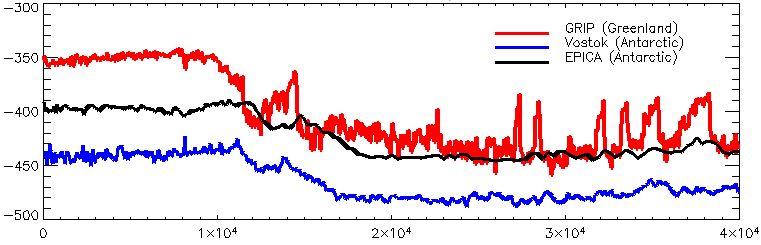
That is what researchers claim in a new study:
Stephan P. Ritz et al., Estimated strength of the Atlantic overturning circulation during the last deglaciation. Nature Geoscience 2013. Pay per view → LINK [doi:10.1038/ngeo1723]
Abstract
The Atlantic meridional overturning circulation affects the latitudinal distribution of heat, and is a key component of the climate system. Proxy reconstructions, based on sedimentary 231Pa/230Th ratios and the difference between surface- and deep-water radiocarbon ages, indicate that during the last glacial period, the overturning circulation was reduced during millennial-scale periods of cooling. However, much debate exists over the robustness of these proxies. Here we combine proxy reconstructions of sea surface and air temperatures and a global climate model to quantitatively estimate changes in the strength of the Atlantic meridional overturning circulation during the last glacial period. We find that, relative to the Last Glacial Maximum, the overturning circulation was reduced by approximately 14 Sv during the cold Heinrich event 1. During the Younger Dryas cold event, the overturning circulation was reduced by approximately 12 Sv, relative to the preceding warm interval. These changes are consistent with qualitative estimates of the overturning circulation from sedimentary 231Pa/230Th ratios. In addition, we find that the strength of the overturning circulation during the Last Glacial Maximum and the Holocene epoch are indistinguishable within the uncertainty of the reconstruction.
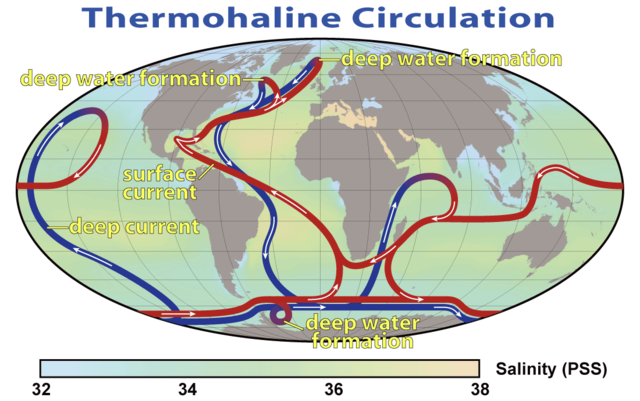 |
| Summary of thermohaline circulation (public domain, NASA) |
In the North Atlantic the best known thermohaline current is the Gulf Stream, which effectively keeps Europe several degrees warmer than it would be otherwise, allowing a relatively dense population at latitudes unheard of elsewhere on Earth. This current was weak at best in the Ice Age.
Notice that they say that they can find any difference between present day (Holocene epoch) and the Last Glacial Maximum, so it cannot be inferred, it seems, that the glaciation itself had anything to do with the thermohaline currents but only with some particular cold spells of the late Upper Pleistocene, particularly the HE1 (c. 18-14.6 Ka ago) and the Younger Dryas (c. 10 Ka ago).