October 2, 2010

Likely murdered family 8500 years ago in NW Turkey

An intriguing and disturbing finding has been reported in Turkey: five people (two adults and three young children) were found in a shared grave with their hands tied on their backs.

The macabre burial is thought to date to some 8500 years ago (Neolithic/Chalcolithic) and is located in the burial mound of Akçalar, in the province of Bursa, south of the Marmara Sea. The children are thought to be some 3-5 years old in preliminary examination, two of them were found between the adults legs and the third one was hogtied (ankles also tied).

It is natural to think on first sight that we are before the murder of a whole family but researchers warn that it is too early to confirm this. They also doubt between using the terms murder or human sacrifice.

They also make brief mention of the context of the site (town?) of Aktopraklık, which also dates to 8500 years ago, though some nearby settlements are older. 


French cattle genetics

This is a new paper that may provide some insight into cattle genetics. However, while Zebuine breeds are widely sampled, European breeds other than French (and a handful of NW European, Swiss and Italian breeds) are not, what makes more difficult to make a comprehensive assessment.

Mathieu Gautier et al, Insights into the Genetic History of French Cattle from Dense SNP Data on 47 Worldwide Breeds. PLoS ONE 2010. Open access.

Unsupervised hierarchical clustering of the 1,121 individuals genotyped for 44,706 SNPs
 
Legend is found at supplementary table S1 (download).

It is interesting that even at K=47 some populations still do cluster, a sign of a very intense relatedness that in some cases may be obvious (Angus varieties, Holstein from Europe and America) but in others maybe not so much.

If we stop at K=5 or K=6 we can appreciate three basic groups in Europe (taurine breeds):

The orange cluster includes most French and Swiss breeds (partial exceptions found only in the NW) and even permeates somewhat into England (Hereford) and Norway. It also includes Italian and Moroccan breeds, even if these have something of zebu. The purest representative is the Blond d'Aquitaine.

Blond d'Aquitaine
Excepting the Brown Swiss, the homogeneity of the main part of this cluster is maintained still at K=10, clearly suggesting a common origin for southern and  eastern French cattle, including North Italian breeds

The yellow cluster has Holstein as only pure representative but makes up the largest part, or at least a sizable fraction, of NW European cattle, from the Loire to Norway. Next to Holstein in purity is Angus, a Scottish breed.

Holstein-Frisian cattle
At K=10, Angus and Hereford already display their unique personalities anyhow, suggestive of an early divergence, possibly within the British Neolithic, a relatively late phenomenon, while the other NW European breeds, continental, still look "hybrid" instead.


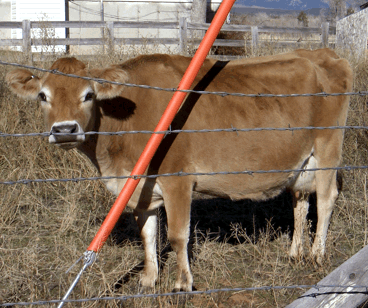
The small green cluster is restricted to the Jersey breed.

Jersey cattle

The non-European or zebuine components don't show but a cline across Africa, with extremes in West Africa and India. Plus the distinct Lagune breed from Benin. This pattern remains pretty much the same at K=10.

The two rightmost breeds are modern North American taurine-zebuine hybrids. At K=10 it is apparent the dominance of Hereford and Angus components in each but at lower K levels they look identical. However at K=47 they appear as totally distinct clusters each on their own right, probably because of extreme inbreeding.

Back to European breeds, the authors speculate somewhat with a dual Mediterranean and Danubian Neolithic origins but the stop short of proclaiming any theory because they have to admit that their sampling is too limited for anything like that.

I must say that I know of no archaeological record of any cattle (Bos sp.) being associated with Mediterranean Neolithic (Cardium Pottery). This culture was specialized in fishing and ovicaprids, probably with some pigs too (and, of course, cereals, pulses and olives), not bovine cattle. But I'm not really sure how cattle was incorporated into these areas' economy, what certainly happened by Chalcolithic times at least, when bulls become a popular artistic and maybe religious motif in south Iberia (competing with deer, sometimes up to the point of transforming an animal into the other).

What seems pretty apparent is that a Chassey-La Lagozza (proto-Ligurian?) Chalcolithic origin can be speculated for this cluster. A lot should depend on Balcanic, Central European and Iberian affinities or differences, not considered here, but I can already say that the Blond d'Aquitaine looks similar to the usual montane Basque types, such as the Betizu, though these are usually reddish in color and have somewhat larger and often characteristically-shaped horns.

Betizu, typical Basque cow

October 1, 2010

Iruña-Veleia: civic association demands that analysis are made

[Slightly updated - Oct 3]

Almost three years since the infamous ad-hoc commission decreed in a single session and without any proper evidence nor hearing that the exceptional findings of Vasco-Roman city Iruña-Veleia were false, a parliamentary commission (of the autonomous provincial parliament of Araba) finally gathered yesterday to listen to the civic association (SOS Iruña-Veleia) and its demands that the physico-chemical analysis are finally made in order to demonstrate whether the findings are genuine or not.

The members of SOS Iruña-Veleia explained to the commission:
  • The origin of the association as convergence of concerned citizens on the situation of the exceptional findings. 
  • The patrimonial damages caused by newly appointed site director and "archaeologist" Julio Núñez, including a document not yet available online that is described as very precise and clarifying.
  • The fraud of the Scientific Assessor Commission of 2008: half-done work, impossibility of appeal, not allowing reply by chief archaeologist Eliseo Gil, lack of demonstrating alleged falsehood with independent methods.
  • The demonstration of the existence of many many indications of carbonate crystallizations in the incisions of the inscriptions (which are blatant evidence that the pieces have been buried for a long time, with the texts on them). This is evident in the only chemical report of the 2008 commission (Madariaga) and in the many available photos of the inscribed shards.
They replied to the questions made by the representatives and mentioned that the provincial government has not yet provided the shards to the police, as demanded by the judge, in order to be analyzed.

They attach the graphic panels used in their exposition in PDF format (Spanish language mostly). The document on the patrimonial destruction will be available in few days.


Background

In 2006 it became known that an abundance of highly informative, exceptional findings, with many many inscriptions, largely in Latin (later found to be Vulgar Latin mostly) and Basque (would be the oldest non-funerary texts in Basque), had been found at the Vasco-Roman city of Veleia, later known as Iruña (the city or the capital), SW of modern Vitoria-Gasteiz. They included also what seemed some of the earliest known Christian imagery and also some apparent Egyptian hieroglyphs, as well as other drawings.

Most of the graffiti were inscribed on shards, later used as part of the foundation of a house. There were also some on bone and even on bricks. The findings impressed everybody with an interest in history and linguistics, of course.

However soon rumors of falsehood began circulating by the faculty of philology (linguistics) of the University of the Basque Country: a pope of Basque linguistics, namely Joseba Lakarra, was not happy with the findings because, it seems, they challenged his theories on ancient Basque.

At that time I was an active editor at Wikipedia and created and filled with content the Iruña-Veleia page (see my latest version as of September 2006, later deprecated by anonymous users and certain Mountolive, who is at least a fanatic and stubborn Spanish nationalist). I knew of those rumors by Alan R. King, a linguist and and member of Euskaltzaindia (Academy of the Basque Language), the same as Lakarra, who was then a collaborator at Wikipedia and was persuaded early that the graffiti were false (on no other grounds but linguistic speculation). Notice that I do not think that King is "evil" in any sense but that he was mislead by his colleagues in the internal dynamics of linguistic clubs.


However I do think by now that Joseba Lakarra (left) is an evil (selfish, false, unethical) person and that he has been the main ringleader in the unwarranted persecution by means of rumor mill, camarilla dynamics, conspiration and fraud against Basque (as well as European) history and cultural legacy.

Why? Because, I understand now (but could not some time ago), he feels threatened in his status as pope of Basque linguistics by the discoveries. It is not just a matter of opinion, because that would have been settled easily with physico-chemical analysis and possibly independent excavations. It is a matter of power.

Whatever the case, Lakarra managed to organize enough and sufficiently powerful people by 2008 as to bring on a defamation campaign in the Basque and Spanish media.

Most Spaniards rushed to support the theory of falsehood because Spanish nationalist historiography has always sustained, with little evidence, that the Western Basque Country was originally of Celtic and not Basque language (together with other wacko hypothesis such as the Iberian origin of Basque language and Basques themselves or even the century-old Berber hypothesis). In brief: Spanish nationalist "historians" and "linguists" like to believe that everything is Celtic or Iberian not giving ever proper room for Basque/Vascoid distinctive personality and very much real ancient presence. If Basque would not exist at all they would be happy.

But while (many) Spaniards supported one side like crazy, the plot is genuinely Basque.

A key piece of support for the Veleia falsehood hypothesis was the Deputy (provincial minister) of Culture of Araba (Alava), Lorena López de Lacalle (left). She held the key power seat that ultimately ruled over the archaeological site of Iruña-Veleia.

Whether she was initially persuaded by the smear campaign or was knowing accomplice all along I cannot say. But she was the main responsible of all what happened since 2008.

Under her authority the infamous Scientific Assessor Commission was gathered. This commission consisted almost exclusively of linguists, all professors at the University of the Basque Country. When they gathered, only one report was ready: a linguistic one by J. Gorrotxategi (the second most visible ringleader of the linguist popes camarilla that is behind all this mess - his name is sometimes spelled Gorrochategui). All the others, including the crucial but shallow and inconclusive report by Prof. Madariaga on the physico-chemical evidence were included later.

In spite of the lack of anything but rumors, suspicions and linguistic speculations of no objective value, the Commission gathered once, only once, and decreed without any formality that the graffiti were false. The decision had been taken a priori and the gathering was just a formality, a very shallow, shameless and almost pointless formality.

In spite of that, the media were suddenly persuaded of the falsehood: it was official. For a year or so only silence existed on the Veleia affair. At least for me, who had remained pretty much apart from the debate.

But by the end of 2009, gradually, new information began appearing. I was interested, I wanted to know, and gradually I discovered the dimensions of the fraud, of what can only be described as cultural crime.

First I knew was Hector Iglesias, a French linguist of Galician origin, arguing that some of the supposed evidence of the falsehood of the shards actually supports its authenticity. He argued (PDF) that what people, including those arrogant linguists of the commission, could not believe as genuine are actually extremely rare names only known to exist to a few experts worldwide. They are not Basque words but the Celtic personal name Deirdre (modernly Deidre) and the Phoenician mythological name Miscart, an ill-known but attested version of Melqart, god protector of Tyre and widely worshiped through the Mediterranean once.

The Miscart/Descartes shard

Then came more and more voices supporting the authenticity of the findings: epigrapher and archaeologist Luis Silgo (PDF), world-famous archaeologist Edward Cecil Harris (PDF), linguist Enrique Fernández de Pinedo (PDF download), geologist Koenraad van Driesche (PDF download), linguist Roslyn M. Frank (press interviews: 1, 2), etc.

I have already gone over all this in my old blog Leherensuge, where more information can be found.

But the worst was still to come. Maybe feeling how they were losing ground, how truth was gradually outpouring the mantle of dirt it had been buried under, de Lacalle decided to give the directorship of Veleia to the only archaeologist that had participated in the infamous 2008 Commission: Luis Núñez.

That alone smell very bad but when he announced that his director plan included mechanical removal of as much as 50cm of soil, when the previous team had detected that the agricultural layer was not deeper than 30 cm in most areas and that archaeological remains laid directly underneath this thin layer, then worry and concern spread around.

The 50cm that became 150
But the director plan was in fact benevolent compared with what would happen in reality. As soon as he began working, Núñez started digging not 50 cm but 150 cm in many cases. He directly removed all the archaeological layers and went to the show stuff: the paved road underneath them without the slightest documentation work or anything.

This atrocity is well documented, thanks to the people of SOS Iruña-Veleia, in many photos and videos.

Sad as it may be, it was this barbarity what finally called the attention of the public, the media and some politicians. I don't want to make any political propaganda here but the first one to speak out, as far as I know, was Iñaki Aldekoa, a name that I have often heard at my parents' home because my father, not knowing him personally much, admires him somewhat because he obtained the first place in their promotion at the Engineering School (my father was the second), even if he had to study the whole career or almost from prison (that was under fascism, in the 1960s).

That was apparently enough for the plotting cowards to stop the cultural crime by the time being. Still they present such aggression as some sort of miraculous finding of great cultural value of some sort. They may be ruthless with the treasuries of the past but they are masterfully delicate with the media.

Maybe it is the pressure of the Internet (the media has not discussed the matter too much, although a little more within Araban media maybe), maybe it is the pressure of the provincial elections next year, maybe the unusual situation of the government ignoring the judge's most normal demands, maybe that some still have some dignity, but at least there has been a parliamentary hearing finally.

That is the story so far, at least the way I see it.

Just remind of some reference links:

Update (Nov 25): those who can read Spanish may also want to read this anonymous paper (pamphlet if you wish, but erudite) on Lakarra's career and why he is the center of all this problem: La Filología Vasca pese a Joseba Lakarra Andrinua (Basque Philology in spite of Joseba Lakarra Andrinua).

    Evidence for New Guinea settlement 49,000 years ago


    New findings in Papua Highlands reveal that people were already there at least as early as 49,000 years ago, living 2000 meters above sea level and using characteristic waisted axes (left), which they probably used to fell down trees and make convenient clearings. 

    Previous research by the same team had located sites as old as 41,000 years near the coast.

    Starch grains found on the axes are from yam (Dioscorea sp.), a tuber that does not grow at such high altitudes. Other vegetable remains found at the sites are charred nut shells from Pandamus sp., a high altitude tree that is used through Oceania for a variety of purposes: food, medicine, housing material, clothing, etc. Bones fragments from unidentified animals have also been found.

    Lead researcher Glenn Summerhayes suggests that clearing was done on purpose, so medicinal plants could grow. He also suggests that some sort of clothing must have been used in order to ward off pneumonia (temperatures at such altitudes vary along the day between the nice 20 degrees Celsius at noon to freezing point at night).

    Sources: Science News, DNA.

    Some news to heat this up

    From Science Daily. None too interesting to write a whole post, in my humble opinion but interesting enough to mention.

    Clovis points
    Clovis impact not needed to explain the end of Clovis culture. People may have changed habits... Read more...

    Rare disease gene may help explain human phenotype diversity. Read more...

    Rate of new species declining, before humans arrived. Why? Read more...

    West Nile Virus mosquito has more genes with smaller genome. Read more...

    Heliosphere much more variable through time than expected. Why? Read more...


    Leherensuge reference links: Genetics

    Leherensuge on Genetics:

    [Updated Oct. 1]

    In reverse timestamp order (newest first) within each category. For quick reference. Leherensuge is my old blog that gave birth to this one.


    Mitochondrial DNA
    Reconstruction of mtDNA spread in Eurasia (again) (my state-of-the-art reconstruction)


    Y-DNA

    Paper on African mtDNA (trans-Saharan flow and Orientalist fantasies)
    Eurasian Y-DNA note (my state-of-the-art Y-DNA flows' reconstruction)


    Autosomal DNA

    Paper on human autosomal phylogenetics (organizing the genome in a phylogeny)
    Central Eurasian genetic specificity detected (neither East nor West but themselves)
    Jews are 'Phoenicians', Palestinians are 'Jews' (the truth of Western Jewish and Palestinian origins finally clarified)
    Genetic comparisons of Basques and Jews (separately: two papers discussed in same article)
    East Asian autosomal genetics (second round) (third look at the HUGO paper)
    East Asian autosomal DNA (working note) (second look at the HUGO paper)
    Genetics of the Mlabri, Austroasiatic hunter-gatherers in Thailand (East Asian autosomal DNA phylogenetic study supporting a southern origin)
    East Asians originated in SE Asia (first look at the HUGO paper)


    Ancient DNA

    X Woman (Denisova finger)
    Neanderthal genes less likely to be with us (some genetic myths dispelled)


    Molecular clock

    Sentence of the year (molecular compass


    Other
    The 'Homer Simpson' gene found (a gene that makes mice and us stupid)
    A couple of genetic papers I'd love to read (African autosomal structure showing Mozambican difference and a good research on European R1b, got the second already)
    Positive selection favoring disease genes (counterintuitive dynamic equilibrium)
    Breaking the seals of Life (functional bacterial DNA engineered out of chemicals)
    Statistical insignificance (not strictly on genetics but relevant for the field)
    Polyamory prevents extinction (in fruit flies at least)
    Severe criticism of Bayesian phylogenetics (favors maximum likelihood instead)
    Mice without father live longer and other genetic news (bad prospects for GWAS, eigenvectors vs. PCA)
    Genes, brains and fractals (quick notes: Pygmy height genes specially)

    Leherensuge reference links: Prehistory and such

    Prehistory (and some history) articles at Leherensuge:

    [Updated Oct. 1]

    In reverse timestamp order (newest first) within each category. For quick reference. Leherensuge is my old blog that gave birth to this one.


    Historical period

    Noain 1521 (the end of Southern Basque freedom)


    Metal Ages and Protohistory


    Neolithic and Chalcolithic

    Hoabinhian Neolithic site (and other Archaeonews)
    Again on Neolithic and European Y-DNA (largely about archaeology in fact)
    Neolithic 'cathedral' at Orkney (and other news from British and Irish Prehistory)


    Upper Paleolithic and Epipaleolithic
    Paleolithic Chinese ate fish regularly (update mentioning coastal habitat in Eritrea 125,000 years ago)


    Middle and Lower Paleolithic

    Late human evolution maps (1.3 Ma to 60 Ka)


    Other

    Physical anthropologist claims again that H. floresiensis was cretin H. sapiens
    Venneman's exposition of Vasconic substrate in Western Europe
    Archaeonews review Aug 2010 (Indian Megalithic ware, bone buttons of Mesoamerica, ancestor stones destroyed in Nigeria, oldest British house)
    Archaeonews review June 2010 (Neanderthal-Homo divergence surely very old...)
    Archaeonews review May 2010 (Otley cairn, coastal migration of Paleo-Indians, Neolithic Omani cemetery, Dilmun mounds will be researched and then destroyed, Tamil Nadu stone circles nearly destroyed...)
    Archaeonews review Jun 2009 (oldest Taiwan hearth 20 Ka old, Starcevo culture 100 years older)
    Archaeonews review Dec 2008 (Welsh fortress, cremation burials of Istanbul, Neanderthals did not hurl weapons, oldest marihuana stash, Black Sea canoe, gravettian art from Russia)