April 21, 2011

A one-dimensional universe at the Big Bang?

This is so weird and intriguing that I can't but make a quick comment on it. Two US scientists, Jonas Mureika and Dejan Stojovic, are proposing a radical rethink of what we understand as the basic physics of our universe: they suggest that, at the Big Bang, the Universe had only one dimension (like a line), acquiring then two dimensions (plane) and then three (space), and probably soon a fourth (if not already). 

This radical rethink seems to have been pushed by the advances (and lack of them) in the fields of Physics and Astrophysics in the last decades, when questions have been piling up and convincing answers have been lacking instead. 

These problems include the fundamental incompatibility between gravito-centric General Relativity and particle-centric Quantum Mechanics, the mystery of the Universe's accelerating expansion (which seems to demand extra dimensions) and serious issues with the elusive (and maybe non-existent) Higg's Boson. 

By reflecting this new proposal I do not mean to adhere to it but I do like the principle they begin from: maybe something fundamental is wrong in the way we think Physics, so exploring radically new venues may be the way out of an otherwise unsolvable problem. 

They are thinking out of the box and that is something I really like and that often brings real solutions in all fields. 

The new theory has been published in the Physical Review Letter (pay per view) and is also discussed in its essentials at Science Daily.

April 15, 2011

Stoning at Dmanisi

Homo Georgicus IMG 2921
H. georgicus
Lots of cobbles have been found in a gully near Dmanisi, Georgia, the oldest known site of Homo erectus (or habilis or georgicus) in Eurasia. The cobbles could not have arrived there naturally and are not found in other areas of the site (Olduwayan style tools have been found instead). 

The researchers suspect that the abundance of cobbles in the gully was caused because it was a pass our ancient relatives used to attack carnivores, by stoning them, and rob them their prey. The unusually high frequencies of carnivore bones in the site would seem to support this kind of strategy and ratify our earliest relatives as active scavengers who could rob their prey to other predators by using the skills nature gave them: sociality, intelligence and two free hands. 

April 14, 2011

Guest post by Argiedude: A West-East Y-DNA gradient in Iberia?

What follows was sent to me by Argiedude with offer of publishing. I believe it has some interest, so here it is, however publication does not necessarily imply agreement by the blog's author (see comments section).

_____________________________


I've made a map of the main y-dna haplogroups of Iberia, using all the y-dna studies I could find, totaling some 3000 Spanish and 2000 Portuguese samples, though it varies depending on the haplogroup. The graph below shows the results:


click to enlarge


There are 10 haplogroups, excluding SRY-2627 and M153, which are redundant with R1b1b2. 7 of the 10 have clear east-west gradients. The other 3 have no gradient, though for G a weak east-west gradient could be argued. None have a north-south gradient.

Not only is there an east-west gradient, but it follows a specific pattern, dividing Iberia into 2 halves. And there is a curious anomaly in the otherwise perfect 2 halves, which can be easily seen in the image below:


Valencia, in the far east, consistently has a y-dna composition that is more akin to western Iberia. The image even underestimates this similarity, because E-M81 is higher in Valencia than in the rest of east Iberia, but it just barely didn't make the threshold to be included with the western half, so the image shows Valencia as scoring 4 of 6 similarity with western Iberia when it should perhaps be 5 of 6 (after including E-M81). I didn't include a few haplogroups because they were too small (1% or less frequency), but 2 of them, E-M123 and E1a1+E1b1a, also had a frequency peak in Valencia higher than in the rest of  east Iberia and similar to western Iberia. So I don't think that the results for Valencia are random. As a final note, Valencia consisted of 300 samples, which is a respectable sample size.

The frequencies in the western half seems to be more uniform, while the frequencies in the eastern half are more jumpy. In particular, the west coastal strip, from south Portugal to Galicia, is remarkably similar, in all haplogroups. I think the y-dna of Iberia used to be like western Iberia today. There was a disruption that altered the eastern half. This would explain the anomaly of Valencia: it wasn't as badly affected by the disruption as the rest of east Iberia, thus retaining a more western y-dna composition.


IMPLICATIONS FOR TMRCA


E-M81 has one of the youngest age estimates (TMRCA) of any major haplogroup, about 2000 years old. The first image shows it to follow the typical east-west pattern in Iberia almost perfectly, second only to R1b1b2 (which is perfect). So was E-M81 part of the original older stratum of y-dna in Iberia? This would fly in the face of the TMRCA age estimates for E-M81. E-M81 is so young, and at the same time identical in haplotype to North African E-M81, that we are forced to adscribe its presence in Iberia to the Arab invasion starting in 700 AD. But the maps paint a completely different picture, not only showing a geographic distribution that makes no sense at all with a historic Arab origin, but also because E-M81's notorious similarity to the repeat pattern of east-west distribution seen in most other haplogroups indicates that its distribution must have been molded by whatever events also produced the distribution patterns in all those other haplogroups. It seems extremely unlikely that E-M81 would have been born 2000 years ago in North Africa, became diffused in Iberia between 700 AD and 1200 AD, and only then something occured which rearranged Iberia's y-dna, all of it, into the now observed patterns of east and west halves. This unlikely scenario would have to be nothing less than a complete and total population rearrangement, no half measures, given that E-M81 is actually higher (much higher) in regions barely occupied by the Moors than in the stronghold of Granada, where the Moors ruled for 800 years.

It should also be noted that North Africa has 2 major haplogroups, E-M81 and J1-L222, found at about 50% and 25% respectively, from Morocco to Libya. But in Iberia, while E-M81 is present at 4% in Spain and 5% in Portugal, J1-L222 is not found at all in Portugal and is only found at 0.05% in Spain. This is also repeated in thousands of Latin American samples, where E-M81 is about 4% and J1-L222 is 0.1%. A historic recent diffusion from North Africa would obviously have spread 2 E-M81 samples for every 1 J1-L222 sample, as per their frequencies in North Africa, but instead we see that the ratio between E-M81 and J1-L222 in Iberia is 75 to 1. Likewise in south Italy the ratio is 20 to 1.

To summarize, on top of previous evidence over the last 2 years undermining the extremely young age estimate of E-M81, which consisted of the obvious east-west distribution of E-M81 in Iberia and the anomaly of J1-L222 not being found even close to proportion with the presence of E-M81 in Iberia, we can now add the fact that E-M81's distribution in Iberia isn't an oddity, but in fact the typical pattern of distribution of most Iberian haplogroups, which obviously points to deeper causes for its diffusion in the peninsula, unless Iberia's population has been completely and totally rearranged in very recent history. This is not just about Iberia, but about the theory of TMRCA itself, which as you may have guessed by now, I completely disagree with: I think all y-dna haplogroups are older than their currently estimated ages (per TMRCA) by orders of multiples.

A final note to round out this observation is the fact that most haplogroups are higher in the west than in the east, which sometimes really doesn't make sense, most notably in the case of E-V13, which would have come from eastern Europe via land and should have had a higher frequency in east Iberia.


ODDS AND ENDS OF IBERIA'S Y-DNA

Ibiza has 2 clusters specific to its island in the haplogroups G and T. The cluster in G has a modal haplotype identical to the general G haplotype, but the T cluster has a very distinctive modal haplotype, which I haven't found in any sample from anywhere else in Iberia or Latin America; so far, it's only observed in Ibiza, not even Majorca and Minorca.

There's something strange going on in the Cantabria/Basque region. Cantabria has an unusually very high rate for R1a and E-M81, and the Basques for R-M153. Very few regions have any single haplogroup with a highly divergent frequency, but these 2 neighbors manage to have 3 such events. The y-dna differences between Basque and Cantabria are the sharpest y-dna clines by far in Iberia. And of course, Cantabria belongs to the western half and the Basques to the eastern half of the Iberian y-dna divide. Cantabria's R1a and E-M81 seem to extend westwards, resulting in lower but still unusually high frequencies of both haplogroups in Galicia, Asturias, and Castile, but in both cases the haplogroups can't manage to diffuse eastwards even as far as the Basque region. Likewise, R-M153, very high in the Basque region, has a notable tendency to spread to the rest of east Iberia, but it can hardly manage to cross west into Cantabria and beyond.

The haplogroups I included in these images amounted to 93% of Iberia's y-dna. Most of the remaining 7% belonged to E1b1b (M35) lineages, except E-M81 and E-V13.


click to expand

_____________________________


See also at Leherensuge (by Maju):

April 8, 2011

The Late Bronze Age crisis in Britain, why?

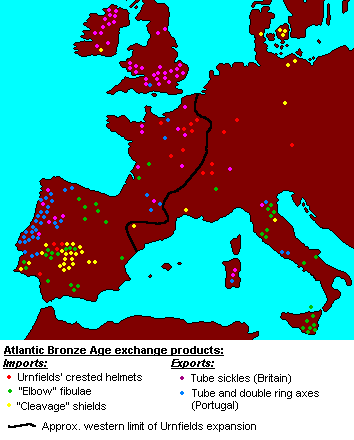
Atlantic Bronze Age
There is a lengthy article today at BBC on what appears to be an economic crisis in Late Bronze Britain, between roughly 800 BCE and 500 BCE, when Iron begins showing up and a recovery seems to take place.

The article is lengthy but inconclusive. However I have my own ideas of why this decline: the Celtic invasion of Western Iberia, which, together with other parts of Atlantic Europe constituted an economic region since the beginnings of Megalithism beyond Portugal, in the fourth millenium BCE.

Hence, when we contemplate this crisis in Britain we are surely contemplating the last, extremely decadent, episode of an international civilization that had some three millennia of unwritten history.

Very briefly (dates may change slightly depending who you read):
  • c. 4800 BCE the first dolmens (chamber tombs) appear in Southern Portugal, with their characteristic "collective" (clannic, sequential) burial style. This type of tomb defines the cultural phenomenon we can well call Domenic Megalithism.
  • c. 3800 BCE Dolmenic Megalithism migrates to Armorica (Brittany, Mid-West France), where it acquires an elitist flavor peculiar of this country. 
  • c. 3500-3000 BCE Dolmenic Megalithism expands through all Atlantic Europe, often hybridizing with other pre-existent of co-arriving traditions and in some cases at least signifying the first or almost first serious Neolithic, with the demographic implications this may have.
  • Further expansion happens then into parts of Central Europe (Danubian area north of the Alps) and, later, into parts of Italy and North Africa.
  • c. 2600 BCE two civilizations appear in Iberia: Los Millares and Zambujal (VNSP), the latter surely central to the Dolmenic Megalithic cultural area
  • c. 2400 BCE Central and Northern European parts of this area (east of the North Sea-Rhine line) are lost to Indoeuropean culture (Corded Ware), however Western France and Belgium are consolidated into it (Artenac culture).
  • For a whole millennium this ethno-cultural divide at the Rhine is stable. Bell Beaker (a secondary mercantile phenomenon) acts as a unifying force probably at between Westerners and Indoeuropeans. 
    • Around 2000 BCE the center of Corded Ware is at Zambujal, which is a thriving civilization.
    • c. 1800 BCE Los Millares is replaced by El Argar, a larger state probably, and one influenced by Mycenean Greece, specially in its last phase. 
  • c. 1250 BCE Indoeuropean tribes (proto-Celts more or less) descend along the right bank of the Rhône river penetrating into Catalonia. It is the Urnfield culture expansion that has reflections in other parts of Europe (but does not affect other parts of the West yet).
  • c. 1200 BCE Zambujal civilization ceases to exist, coincident with a silting of its 10 Km long "marine branch" or canal, which joined it to the Atlantic Ocean (tsunami?) At a similar date El Agar state collapses and its cities become independent (it seems: post-Argarian culture). 
  • Atlantic Europe, not really anymore Megalithic in any intense sense of the word, retains its distinct personality within the Atlantic Bronze trade networks.
  • c. 700 BCE Hallstatt-Urnfield Celts of NE Iberia invade the Northern Plateau and the Atlantic areas. It is likely, judging from the archaeological record, that at this time (or maybe a little earlier) the city of Tartessos was destroyed by the Phoenicians of Gadir (modern Cádiz). The Atlantic Bronze economic (and cultural) area is broken for good.
This last is what I think that caused the apparent economic crisis in Britain and not just the generic concept of technological advance of Iron: the destruction of their main economic partners in the South, with links to the Mediterranean (Sicily, Cyprus) and such. Only later, as new networks were established with continental (Celts of Belgica and Armorica) and naval (Phoenicians) partners, would Britain experience some economic recovery. But that would also be the seeds of their own Celtization a few centuries later (La Téne).

April 6, 2011

Malaysians fall in diverse genetic clusters

A paper of some interest on Malay autosomal genetics and their relations with other Asian peoples has just been published:


Most interesting is fig. 1, which displays a neighbor-joining of the various Malaysian populations (four Malay, one Proto-Malay and two Orang Asli or Negrito populations) and other populations studied here (see table 1 for details). Here goes my annotated version of this tree (all color elements are my addition):

click to expand

The authors go to some quite incredible speculations to explain the various clusterings of Malays (Melayu, boxed populations in graph), notably imaginary massive admixture with Indians and Chinese. 

I understand that they are very wrong and that what the tree is crying out loud is the following:
  • Cluster I represents more or less genuine Austronesians by blood. I say this because the Thoraja (ID-TR) have in the past been shown to be quite archetypal Austronesians in autosomal studies.
  • Cluster II represents more or less genuine pre-Austronesians, proto-Malay or whatever you wish to call them. They cluster well with "Chinese"... from Yunnan (SE Asian Tibeto-Burman and Mon-Khmer speaking peoples), which are the only "Chinese" in this paper. Yunnanese, Proto-Malay, Melayu Jawa and Javanese Indonesians cluster too tightly to be any admixture: they are one single stock.
  • The so called cluster III is no cluster (it needs at least two elements to be called that way) but an isolate. It may indicate an even older stock than proto-Malay but it may also indicate admixture with either Indians or Negritos.
There is also a 3D PC analysis but, besides showing that the same dual clustering among SE Asian Mongoloids, it is very difficult to read. I'd say that it is suggestive of both Melayu Minang and Melayu Kelantan showing a slight tendency towards Indians along dimension 3 rather than towards Negritos but it may well be an optical illusion. It does place these two populations somewhat apart within the region anyhow.

Bonobo and chimpanzee brains differ in wiring

Bonobo relaxing
They have similar sized brains, they look alike enough for bonobos to have been called once "pygmy chimpanzees", and in fact they belong to the same genus (Pan) having diverged some 1.3 to 2 million years ago (or 1.7-2.6 Ma following the logical thread of a newer paper). Their differences are therefore perfectly comparable to those among Homo species (all but H. sapiens extinct by now).

For this reason and because they are very close relatives of us (we diverged some 8-10 Ma ago), the two Pan sp. species are a major reference for anthropology, not the least because they display so different psychologies and sociologies in spite of being so closely related: while chimpanzees are male-centric, hierarchical, violent and retain female sexual (and not just reproductive) cycles, bonobos are female-centric, cooperative, peaceful and joyful and have sex all the time. Bonobos are also empathic like us, while the empathy of chimpanzees is, if it exists at all, quite shallow.

Now a new paper, using non-invasive brain scan techniques, has managed to discern the differences in what we can well call central wiring in the brains of chimpanzees and bonobos:


The paper is discussed at Science Daily. 

A look at chimpanzee (L) and bonobo (R) central network (from the press release)

Interestingly (from the SD article):

The results showed that bonobos have more developed circuitry for key nodes within the limbic system, the so-called emotional part of the brain, including the amygdala, the hypothalamus and the anterior insula. The anterior insula and the amygdala are both implicated in human empathy.

"We also found that the pathway connecting the amygdala and the prefrontal cortex is larger in bonobos than chimpanzees," Rilling says. "When our amygdala senses that our actions are causing someone else distress, we may use that pathway to adjust our behavior in a prosocial direction."

Chimpanzees have better developed visual system pathways, according to the analysis. Previous research has suggested that those pathways are important for tool use, a skill which chimpanzees appear better at than bonobos.

April 1, 2011

Horse's double origins

Pootok arra Orbelaunen
Pottoka
The archaeological evidence was very much inconclusive in this matter of where modern horses originated. While horses were obviously central to Paleolithic cultures of SW Europe, who ate and painted them with almost religious devotion, since the end of the Ice Age and until the Metal Ages there is a fossil gap on horses, not just in SW Europe but also everywhere else.

Then the first domestic horses show up in the Eurasian steppes, north of the Caspian Sea, (notably Botai culture but also Samara and Dniepr-Don) and there is a clear expansion of this animal along the routes taken by the Indoeuropean invaders of the Kurgan cultural phenomenon.

In this sense, some believed that horses had gone extinct in SW Europe upon the arrival of Holocene. A new paper challenges this idea based on genetic diversity:


Abstract

The role of European wild horses in horse domestication is poorly understood. While the fossil record for wild horses in Europe prior to horse domestication is scarce, there have been suggestions that wild populations from various European regions might have contributed to the gene pool of domestic horses. To distinguish between regions where domestic populations are mainly descended from local wild stock and those where horses were largely imported, we investigated patterns of genetic diversity in 24 European horse breeds typed at 12 microsatellite loci. The distribution of high levels of genetic diversity in Europe coincides with the distribution of predominantly open landscapes prior to domestication, as suggested by simulation-based vegetation reconstructions, with breeds from Iberia and the Caspian Sea region having significantly higher genetic diversity than breeds from central Europe and the UK, which were largely forested at the time the first domestic horses appear there. Our results suggest that not only the Eastern steppes, but also the Iberian Peninsula provided refugia for wild horses in the Holocene, and that the genetic contribution of these wild populations to local domestic stock may have been considerable. In contrast, the consistently low levels of diversity in central Europe and the UK suggest that domestic horses in these regions largely derive from horses that were imported from the Eastern refugium, the Iberian refugium, or both.


BGD Ranch's Caspians
Caspian horse
Notice that all but one of the samples from the Iberian peninsula are from the North and that also Occitan horse breeds like the famous Camargue show very high diversity. Hence talking of Iberian refugium may be a misnomer and we should better talk of SW Europe.


In the Eastern area, there is a limitation of sampling sites, with only two breeds representing all the potential diversity once extant in Eastern Europe, West and Central Asia. These are the Caspian horse from Northern Iran and the Ahal Teke breed from Turkmenistan (also very popular in Russia and the North Caucasus).

The essence of the results of this study is visible in fig. 1:


3 horses on pasture
Camargues
Following table 2, the highest genetic diversity (Nei's H) of all surveyed breeds corresponds to the Occitan and Basque horse breeds: Camargue and Pottoka (H=0.776 and H=0.775 respectively). Follow closely the Caspian horse of Iran (H=0.770) and the Garrano of Portugal (H=0.763) and the Galician horse (caballo gallego, H=0.762).

Another way to measure diversity is allelic richness (Rs). By this measure, the most outstanding breed is the Galician horse (6.82), followed by the Caspian horse (6.70), Garrano (6.56), Pottoka (6.52) and Camargue (6.43).

Overall we find that these five breeds cope all the highest diversity positions, being all from SW Europe, except the Caspian horse.

Caballo tipico gallego
Galician horse
Garrano-02
Garrano

See also in this blog: Horse had multiple domestication events (ancient equine mtDNA) (Dec 2010).