March 4, 2011

California islands' settlement confirms coastal colonization of America

The finding of three settlements in Santa Rosa and San Miguel islands off the coast of California confirms a sea-oriented cultural context of the first settlers of America, including clear coastal navigation capabilities, as they must have crossed nothing less than 10 km of open sea to reach the island.

The peoples, who inhabited the island some 12,000 years ago, at the end of the Ice Age, also had technology that seems oriented to the exploitation of the marine resources, with a highly refined kind of workmanship, very different in any case to that of better known Clovis and Folsom cultures from the North American interior.

In spite of the fact that much of the places where these peoples lived are now underwater, the archaeologists were able to document the exploitation of varied sea resources. The quite unique crescent-shaped arrow projectiles, a special design for bird hunting, had been documented without context before in continental coasts but never in such amounts nor associated to so many bird bones.

Also, until now no reliable dates existed.

California Channel Islands locator (Wikimedia Commons)

Source: Science Daily (another version of the same story can be read at BBC, including a more complete photo of the toolkit).


March 3, 2011

Childhood and death in Neolithic and Bronze Age Iberia

The reference Andalusian archaeology blog Pileta de Prehistoria mentions these days two papers of at least some interest on infantile burials in Bronze Age La Mancha and in Neolithic Catalonia. Both papers are freely available online in PDF format, however they are, with the exception of the abstract, in Spanish language, what is surely an inconvenience for many readers. In any case:


The spectacular motilla (motte-and-bailey) of El Azuer was mentioned in this blog in December, in a post that I largely used to put these forts in their space-time context.

They are pretty much technical papers with a lot of details on inferred health and other bio details of the infants (and adults) buried in these sites.


Bronze Age La Mancha (El Azuer)

An interesting detail is for instance the presence of some burials in giant jar (pithos) in El Azuer, a Greek cultural borrowing that I thought until now as restricted to El Argar cultural area and that, in El Azuer, underlines how these fortifications of the Manchego semidesert belong fully to the Argarian political area, being probably in their time a marche of the more or less centralized state that must have controlled all SE Iberia from Castelló to Granada and that was strongly influenced (as is obvious in the pithos burial fashion) by Mycenaean Greece.

Nájera-Colino 2010 fig. 18

Above we can observe the mortality curve in El Azuer, expressed as percentage of all deceased people (solid line) and as percentage of death expectations per age segment (dashed line). Instead of absolute ages, age segments are used instead: Infantile I (age: 0-6), Infantile II (age: 6-12), juvenile, adult, mature and senile.

It is quite evident (and confirmed in text) that almost half of all deaths in El Azuer happened among children (49%), mostly very young children (inf. I). Only the mature segment (above 40?) reaches similar mortality ages. Even among survivors of what was without doubt a quite harsh childhood, most died without reaching old age. However they could expect to reach maturity if they had experienced puberty.

The main cause of death among children are infectious and parasitic diseases, stimulated by malnutrition. Diarrhea, still today one of the main causes of infantile death worldwide, is speculated to have been one of the main killers in El Azuer as well but illnesses proper of infancy are also considered, as they usually leave no markings in the skeleton. 44% of the children show signs of ill-health, often until their deaths. 

Impressive air view of El Azuer fortress (from the paper)

Nutritional aspects are analyzed specially in regards to children diet however the presence of several adults in the high protein segment (along with some breastfed children) is highly suggestive of some class differences. If we are to linearly interpret class from the amount of protein intake among adults (what makes some good sense, specially in a rather homogeneous site such as this fort), we can conclude from fig. 20 (page 92) that:
  • 21 adults belong to the low protein segment or low classes
  • 9 adults belong to the middle protein segment or middle classes
  • 5 adults belong to the high protein segment or upper classes
It is easy to imagine that the low classes were servants, the middle classes soldiers (or their wives) and the upper classes aristocrats but we do not know enough of Argarian (proto-Iberian) social structure to be certain.

Excluding the six infancy I deaths in the high protein segment, surely all being breastfed at the moment of their deaths, all other dead children under the age of 6 are females with low protein profiles, probably the malnourished daughters of servants. I count five of them.

Things are a bit more balanced in the infancy II (6-12 y.o.) segment, where most casualties belong to males (5, versus 2 females and 3 unknown) and in some cases to the middle and high protein segments (but all from phase III). Still the apportions are clearly unfavorable for the lower classes.

Detected pathologies are all restricted to infants and, excepting two toddlers, to the low protein segments. So it is easy to conclude that in El Azuer (and probably in all the Argarian area by extension) malnutrition, illness and early death were largely concentrated among the low classes.


Catalan Neolithic

Instead the Catalan (Neolithic) burials describe a quite different picture: only 23% of deaths belong to children (both segments plus perinatal), which is less than half the observed figure for El Azuer. On the other hand most people (46-51%) died in adulthood, with only 10% reaching maturity.

In Catalonia it is also notable the almost total absence of caries, with only one woman showing them in more than one piece and no infants having them at all. Instead several individuals show dental deformations indicating major malnutrition or illness, very possibly the cause of their deaths.

Besides, the populations of the lowlands and the highlands in Baix Llobregat  specifically show quite different nutritional profiles with the latter eating largely meat, allegedly from hunt, which still made a good deal of the diet in the hills.

Honey-colored flint cores (source)
In many cases the burials have valuable grave goods often imported from afar:  honey-colored flint from SE France, obsidian from the Central Mediterranean, jadeite from the Alps and locally extracted variscite. However the presence of grave goods varied a lot along time, being rare in the early Neolithic and increasing in the Chalcolithic (or late Neolithic). The honey-colored flint stone, often found in form of ready-to-work cores (which were imported that way from the mines) or large axes, underline the connections of Chalcolithic Catalonia with the once important Chassey culture (possibly of proto-Ligurian ethnicity), where this beautiful material had become extremely important in the socio-economical structure.

March 2, 2011

Tibetans are most related to Yi peoples

A new paper on Tibetan autosomal genetics holds some information relevant not just for Tibetans but for other East Asian and in general human peoples:


The generic place of Tibetans within Humankind

This is maybe the information of most generic interest, as it requires to map not just Tibetans and neighbors but also peoples from all over the world, notably Eurasia.

For this, figure 1 holds nearly all the relevant information. Some sub-graphs follow:


Above, the global Frappe structure results (A) place Tibetans clearly within East Asian populations (green) but show a distinctiveness of their own since K=6 (purple). In spite of sharing Y-DNA macro-haplogroup D with Japanese, Tibetans show no particular affinity with these (JPT).

In the East Asian specific results (B), at K=6, Tibetans again appear on their own, as do the other ethnic groups, except the Yi and Mongolians, who are subsumed within their neighbors to a great extent.


In the neighbor-joining phylogenetic tree (above), we can see that Tibetans again fall fully within the East Asian group (right fan). This structure is more interesting at this point for the global context anyhow because it can explain, for example, why in some cases West Eurasians and Africans may cluster together versus East Asians, depending on sampling conditions and probably the presence or absence of Indians (only some Pakistanis represent South Asia in this graph, as in so many others) as well as the numbers of sampled African (typically low because they are used as control only). If you draw a median line in this NJ tree, East Asians, in spite of their tight affinity with each other, fall to one half and West Eurasians and Africans fall to the other together.

Whatever this means, we can easily see that East Asians share an ancestral founder effect (including also Melanesians per previous research). However I must warn that this is more genuinely apparent in the HUGO consortium paper than here, because of the lack of Indian samples in this case. See here, here and here, for my own old entries in this matter (it is particularly clear in this graph).

By comparison only very homogeneous groups share such marked apparent founder effects, for example Europeans, West Africans, Pygmies, some (but not other) Indians. All these in the HUGO paper, in this paper instead, we can see again Europeans (but only represented by CEU, what is less meaningful), most Mozabites, most Bedouins, the other Levant populations (Palestinians, Druze and some Bedouins) and, very markedly, the Kalash.

However in the haploid genetic aspect East Asians do not seem so extremely "bottlenecked" as they do appear with autosomal genetics, not at all. In fact they host huge diversity within Eurasian haploid genetics. This is hard to explain, admittedly, but it clearly sends an alert signal for us to be extremely cautious and try to comprehend what really happened in this part of the World.


Tibetans are most closely related to the Yi

The term Yi (Nuoso in one of their languages, Lolo in Vietnam and Thailand) is a catchall term from Chinese ethnography to refer to an array of Tibeto-Burman-speaking peoples from Yunnan and nearby areas.

The close affinity between Tibetans and Yi in the context of East Asian populations is apparent when we apply the microscope, so to say, to the NJ tree (pictured above), as I did here:


It is easy to appreciate that, excluding the Mongol-Daur-Yakut loose group (suspect of minor West Eurasian admixture), the narrow East Asian founder effect split soon in three groups (of those shown here): Tibetans+Yi, the main group (Chinese, Cambodian and Lahu) and the Japanese - each of which diversified rapidly from those specific roots. 

However this result is not coincident with the HUGO consortium tree (different method: maximum likelihood), where Cambodians fall in a SE Asian specific group and Chinese in a distinct SEA/EA/America shared one. So, as always, be careful before rushing to conclusions based only on one paper's data.


High altitude genes have been selected among Tibetans

Here we have another of those rare cases of selective sweeps in humans: adaption to high altitude among Tibetans. Two genes have been found to produce this striking adaption to hypoxia and confirmed in this paper: EGLN1 and EPAS1. The authors suspect that other genes, notably ANGPT1, ECE1, and LEPR, are probably also involved in this adaption to such a demanding ecology. 

March 1, 2011

Paleo-Sardinian language: a relative of Basque?

Basque linguist J.M. Elexpuru discusses today at Noticias de Álava[es] the possibility that the lost pre-Romance language of Sardinia could be related to Basque, following the steps of Catalan linguist Eduardo Blasco Ferrer, who just published a book titled Paleosardo, le radici linguistiche de la Sardegna neolítica (Paleo-Sardinian, the linguistic roots of Neolithic Sardinia).

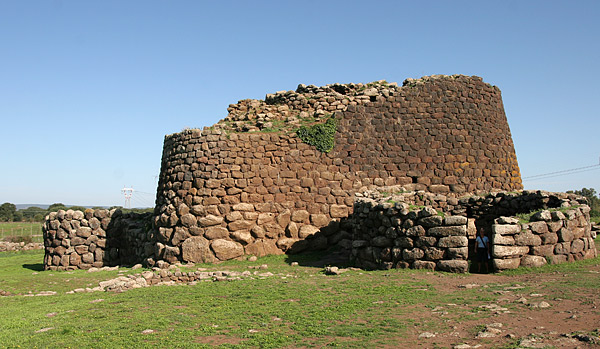
Ruins of a Sardinian nuraghe
Sardinia belonged to the Carthaginian Empire since the 6th century BCE and then passed to the Roman one in the 3rd century, remaining since then in the Romance linguistic area. However little is known of the history of the island before, except the famous nuraghe forts (similar to SE Spanish motillas) and that it was colonized (after some ill-known Epipaleolithic episode) within the Cardium Pottery culture in the Neolithic, probably from Central Italy.

However Dr. Elexpuru synthesizes this way the position of Blasco Ferrer:

... there was a migration from the Basque area in the Mesolithic (8000-5000 b.C.) which settled the island. There were surely other flows later on. Genetic research on mitochondrial DNA have revealed that haplogroup V, originary from the Basque-Cantabrian area, is very high in the central region. The language carried by the settlers, named Paleo-Sardinian by linguists, was the one spoken through all the Neolithic and Bronze Age in the island and still survived for some centuries to Roman domination in the central region, which was known as Barbaria. In some parts of the island the density of pre-Roman toponyms is well above 40%. 

He concludes mentioning some of the river and settlement names that are quite obviously Vasconic:  
  • River names: (h)aran, ardi, baso, berri, bide, ertz, goni (goi), gorri, iri, istil, iz, lats, lur, mando, on, orri, (h)osto, (h)otz, (h)obi, (i)turri, ur, zuri.
  • Village names: Aritzo, Ardaule, Asuni, Goni, Loiri, Luras, Olzai, Orgósolo, Ortueri, Osini, Turri, Ulassai, Uras, Uri, Urzulei...

I must say that all this would make better sense if Iberian and Ligurian could be somehow integrated in the picture. One reason is that haplogroup V is now known to be much more frequent and probably original not from the modern Basque Country nor even Gascony but from farther East: Catalonia probably. However now and again there are other rare or somewhat common lineages that appear shared between Iberia and/or the Basque Country and Sardinia (and sometimes also North Africa). 

One of the most common ones is Y-DNA I2a, a West Mediterranean and Pyrenean clade extremely common in Sardinia, which, if of Neolithic origin, would be the only such lineage quite frequent among Basques. But it could also be pre-Neolithic. 

Frequency of Y-DNA I2a, from Rootsi 2004

For the record, it was discussed  earlier in this blog (also here) the striking similitude of Basque and Sardinian (and some other European) carnival performances, all this in relation to the apparent paleo-European veneration of the bear and the continentally widespread shared root for this animal (hartz in Basque, almost the same in proto-Indoeuropean).

Also for the record I must mention that, in my not so humble opinion, the very word Sardinia seems to have a Basque etymology. Obviously it is derived from the pan-European word sardine but this term only makes etymological sense in Basque: sarda (fish school) + -gin (suffix of doing/making < egin) + -e/-a (nominative declension, like the article "the").  It needs of a loss of a syllabe (would make sardagina) but I still think it's plausible that sardine (and hence Sardinia) means school-doer or school-maker in Basque or a related language from old.

Whatever the case it is extremely difficult to deny the Basqueness of the toponyms listed above, even if I am sure that soon someone will come and contest such obviousness, based not on common sense but on twisted and ill-explained elaborations.

But what I still do not have fully clear is in which direction the Vasconic language spread. Of course the default hypothesis of an expansion from the Franco-Cantabrian region makes good sense but it is difficult to completely discard a Neolithic spread of the language family in the context of Cardium Pottery culture (and loosely related Atlantic ones, including Megalithism).

I also think that this Vasconic substrate is not something peculiar of Sardinia and that anyone who looks around with a keen eye and a half-decent knowledge of Basque language can't but stumble once and again on Basque-like toponimy all around the western half of the continent.

Article found via Ostraka Euskalduna[eu]

Basque language origins' 6th meeting: genetics and Basque origins

The 6th meeting of the Association of Basque Language Origins (Euskararen Jatorria Elkartea) will take place this May 7th at Gares, Navarre. Notably this gathering will have geneticists Stephen Oppenheimer and Antonio Arnaiz Villena as special guests.

Announcement and schedule are to be found at the blog Euskararen Jatorria (in Basque), but I'll reproduce the schedule here in English for the general interest:

9:30 Arrival, accreditation and book exposition
9:45 Welcome and presentation
10:00 Marian Martínez Pancorbo and Sergio Cardoso: Basque lineages speak of their past
10:45 Antonio Arnaiz: Basque genetics and linguistics: Iberian language in Veleia and Pamplona (in Spanish)
11:30 Break
11:45 Stephen Oppenheimer: the Origins of the British and the relevance for the Basque Country (in English)
12:30 Round table: the input of Genetics to understanding the origins of Basque language
14:15 Meal
17:00 Visit: Andelos, a Roman town and the Iberian script
18:30 Josu Naberan and Bienvenido Mascaray: the meaning of the sentences of 2nd century Andelos (in Basque)
19:00 200th birthday of Agosti Xaho: Aitor, the Cantabrian legend
19:30 Seberino Onaindia and Gabino Seijo: considerations on the Basque language (in Basque)
19:45 Last year of Iruña-Veleia in pictures. By Juan Martín Elexpuru, Dr. in Basque Philology and author of the book Iruña-Veleia euskarazko grafitoak (Iruña-Veleia: the Basque graffiti)
20:00 End of meeting

Cost: €45.00 (including meal and visit to Andelos), students and unemployed people: €30.00. 

Details of inscription at original post (in Basque).

Artistic impression of the two Europe-specific Y-DNA R1b major clades (details)

Selective sweeps lacking in human evolutionary history

There is a (quite mainstream) school in Genetics that just loves the idea of small genetic changes being so extremely adaptive that they quickly replace all or most other variants in frequency, clinging to fixation not by founder effect or drift but because of sheer adaptive power.

The followers of this school are plainly wrong. It was common sense before (I really never liked the idea at all: it's plain silly, overly simplistic, sensationalist, irrational) but now it has been reasonably demonstrated: selective sweeps are extremely rare in the human genome, while small, gradual, less important shifts, maybe in dynamic equilibrium... are the norm instead.

Full story at Science Daily.

February 26, 2011

Lack of vitamin D also causes allergies among children

In another example of the critical role that vitamin D plays in human development, it has been demonstrated now that children with low levels of this key nutrient develop allergies.

Vitamin D is relatively difficult to obtain from food (mostly fish) but we make it in our skin when irradiated by sunlight. Skin color variation is directly related to this necessity.

In the past lack of vitamin D in children (or their mothers) has been linked to rickets, incorrect brain development, autoimmune diseases and other immunity related problems. Allergies also fall within the problematic of inappropriate immunity and can well be considered autoimmune diseases, even if often mild and with very specific triggers.

Source: Science Daily.


See also: