Showing posts with label Atapuerca. Show all posts

March 16, 2016

H. heidelbergensis is Neanderthal ancestor and not 'Denisovan' cousin

Quickies

The unprecedented sequencing of a small fraction of the autosomal DNA of Homo heidelbergensis from the Sima de los Huesos of Atapuerca proves that they are in direct ancestral line to H. neanderthalensis and not particularly related to Denisovans.

Matthias Meyer et al., Nuclear DNA sequences from the Middle Pleistocene Sima de los Huesos hominins. Nature 2015. Pay per view → LINK [doi:10.1038/nature17405]

Abstract

A unique assemblage of 28 hominin individuals, found in Sima de los Huesos in the Sierra de Atapuerca in Spain, has recently been dated to approximately 430,000 years ago1. An interesting question is how these Middle Pleistocene hominins were related to those who lived in the Late Pleistocene epoch, in particular to Neanderthals in western Eurasia and to Denisovans, a sister group of Neanderthals so far known only from southern Siberia. While the Sima de los Huesos hominins share some derived morphological features with Neanderthals, the mitochondrial genome retrieved from one individual from Sima de los Huesos is more closely related to the mitochondrial DNA of Denisovans than to that of Neanderthals2. However, since the mitochondrial DNA does not reveal the full picture of relationships among populations, we have investigated DNA preservation in several individuals found at Sima de los Huesos. Here we recover nuclear DNA sequences from two specimens, which show that the Sima de los Huesos hominins were related to Neanderthals rather than to Denisovans, indicating that the population divergence between Neanderthals and Denisovans predates 430,000 years ago. A mitochondrial DNA recovered from one of the specimens shares the previously described relationship to Denisovan mitochondrial DNAs, suggesting, among other possibilities, that the mitochondrial DNA gene pool of Neanderthals turned over later in their history.


Some articles that describe the findings:
→ at Público (in Spanish)

Matthieson also found that the Sima de los Huesos hominids were closer to Denisovans and Neanderthals in mtDNA two years ago. But this sequencing of their nuclear DNA puts them much closer to Neanderthals instead.

Prüffer et al. found in 2013 that Neanderthals form a cline with "Denisovans" in nuclear DNA but not in mtDNA, in which they are closer to us. This one is a very interesting read for background, as it explores in great detail the various possible scenarios.

That "Denisovans" could be closely related to H. erectus (a catch-all term for most archaic populations, particularly in Asia) has been considered as very possible before (Waddell et al. 2012) but there is no genetic confirmation so far, neither strong rejection. Getting DNA from such ancient specimens is considered a breakthrough and this partial sequencing of 400,000 years ago is believed to be within the very limits of absolute possibility.

[Conclusions edited on Mar 19th because I got it all wrong and don't wish to keep confusing anybody else. Instead I listed several relevant background studies, judge yourself].

December 5, 2013

The Denisovans were not alone

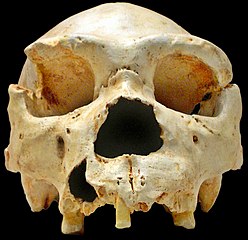
H. heidelbergensis from Atapuerca
Cranium 5 "Miguelón"
(CC by José Manuel Benito)
About half an hour ago, somewhat cryptic comments in this blog and my email woke me up, more abruptly than I would have desired maybe, to a new game-breaking finding: researchers have sequenced the mtDNA of a 400,000 years old Homo heidelbergensis from Atapuerca (Iberian Peninsula, Europe) and it was not at all like most would have expected.

Mathhias Mayer et al., A mitochondrial genome sequence of a hominin from Sima de los Huesos. Nature 2013. Pay per view → LINK [doi:10.1038/nature12788]

Abstract

Excavations of a complex of caves in the Sierra de Atapuerca in northern Spain have unearthed hominin fossils that range in age from the early Pleistocene to the Holocene1. One of these sites, the ‘Sima de los Huesos’ (‘pit of bones’), has yielded the world’s largest assemblage of Middle Pleistocene hominin fossils2, 3, consisting of at least 28 individuals4 dated to over 300,000 years ago5. The skeletal remains share a number of morphological features with fossils classified as Homo heidelbergensis and also display distinct Neanderthal-derived traits6, 7, 8. Here we determine an almost complete mitochondrial genome sequence of a hominin from Sima de los Huesos and show that it is closely related to the lineage leading to mitochondrial genomes of Denisovans9, 10, an eastern Eurasian sister group to Neanderthals. Our results pave the way for DNA research on hominins from the Middle Pleistocene.


The key figure is this one, which phylogenetically relates the newly sequenced mtDNA with the known Homo ones:


Figure 4: Bayesian phylogenetic tree of hominin mitochondrial relationships based on the Sima de los Huesos mtDNA sequence determined using the inclusive filtering criteria.
All nodes connecting the denoted hominin groups are supported with posterior probability of 1. The tree was rooted using chimpanzee and bonobo mtDNA genomes. The scale bar denotes substitutions per site.


It has been argued by all sides (myself included) that the H. heidelbergensis of Atapuerca and other European locations are ancestral to Neanderthals. Some say that also to H. sapiens, while others argue that ours is a wholly distinct line, derived from H. rhodesiensis, and yet others claim that H. rhodesiensis is not different from H. heidelbergensis in spite of being older and rooted, it seems, in South Africa.

The clear evidence for migrations out of Africa, before our species, is limited to two periods: (1) the c. 1.8 Ma old migration of H. erectus/georgicus with Olduwayan technology (mode 1, "choppers"), and (2) the c. 1 Ma old migration of H. ergaster/antecessor (sometimes also confusingly called H. erectus) with Acheulean technology (mode 2, typically "hand axes"). Archaeological evidence for later migrations does not exist.

See: Late human evolution maps at Leherensuge.

So we could well ask, if H. heidelbergensis is not ancestral to Neanderthals, then where do Neanderthals come from?

It must be answered that we do not know yet if H. heidelbergensis is or not ancestral to Neanderthals or in what degree it is. The mitochodrial (maternal) lineage may well be misleading in this sense. Denisovans themselves were much more related to Neanderthals via autosomal (nuclear) DNA than the mtDNA, so it may also be the case with European Heidelbergensis.

In fact it is still possible that these individuals represent some sort of admixture between older and newer layers of human expansion. But there is no clear answer yet. What is clear is that no Neanderthals have these mitochondrial sequences but others closer to those of H. sapiens - and this is the most puzzling part in fact. 

But one thing is clear: the World is much bigger than just Europe, and that was also the case back in Paleolithic times. Our answer may well lay under the sands of some tropical desert, the waters of the sea or whatever other place in Asia or Africa.

Even if we'd find the "missing link", so to say, we might not be able to discern it as such without genetic sequencing and that is often not even possible at all. However this pioneer research, as well as its precursors on a bear also from Atapuerca and a 700,000 years old horse (the true record of ancient DNA recovery), give us some hope of getting an improved, even if sometimes perplexing, understanding of the complexity of the human adventure.