December 15, 2013

Ancient East Asian Y-DNA maps

I'm fusing here data from two different and complementary sources:
  • Hui Li et al. Y chromosomes of prehistoric people along the Yangtze River. Human Genetics 2007. → LINK (PDF) [doi:10.1007/s00439-007-0407-2]
  • A 2012 study integrally in Chinese (so integrally that I don't even know who the authors are → LINK) but whose content was discussed in English (after synthetic translation) at Eurogenes blog. I deals with a variety of ancient Y-DNA from the Northern parts of P.R. China.

Update (Dec 25): much of the Northeastern aDNA is also discussed in an English language study (h/t Kristiina):

Yinqiu Cui et al. Y Chromosome analysis of prehistoric human populations in the West Liao River Valley, Northeast China. BMC 2013. Open access LINK [doi:10.1186/1471-2148-13-216]


    Combining the data from both sources, I produced the following maps:


    Neolithic (before ~4000 BP):


    Metal Ages (after ~4000 BP):


    Discussion

    I find particularly interesting the first map because it outlines what seem to be three distinct ethnic (or at the very least genetic) regions in the Neolithic period:
    • A Central-South region dominated by O3
    • An Eastern area around modern Shanghai dominated by O1
    • A Northern region dominated by N
    Later on, in the Metal Ages, a colonization of the North/NE by these O3 peoples seems apparent, followed, probably at a later time, by a colonization of the West (Taojiazhai).

    We do not have so ancient data for the West but we can still see a diversity of lineages, notably Q (largely Q1, if not all), C (most likely C3, also in the NE) and N (also in the NE). While the arrival of O3 to this area was probably late, the arrival of R1a1a is quite old, however it is still almost certainly related to the first Indoeuropean migrations eastwards, which founded the Afanasevo culture in the area of Altai.

    I find also very interesting the presence, with local dominance often, of N (including an instance of N1c) and Q in the Northern parts of P.R. China, because these lineages are now rather uncommon but are still dominant in Northern Asia, Northeastern Europe and Native America. The fact that they were still so important in the Northern Chinese frontier in the Neolithic and even in the Metal Ages should tell us something about their respective histories and, in the case of N, origins as well.

    It is also notable that no D was detected anywhere. However the regions with greatest D frequencies like Tibet, Yunnan or Japan were not studied.


    December 11, 2013

    Rhône-Provence Bell Beaker

    Just a brief note on two French language papers from a decade ago that have shown up in my academia.edu alerts.

    The most relevant one because of its wider scope is:

    Olivier Lemercier, Muriel Pellissier & Yaramila Tchérémissinoff, Campaniforme et sépultures, au-delà du standard. La place du Campaniforme dans l évolution des sépultures du sud-est de la France au 3e millénaire avant notre ère. Proceedings of the International Conference held at the Cantonal Archaeology Museum (Sion, Switzerland), 2001. → available (with free registration) at academia.edu.

    Abstract (only part in English)

    Where are the famous Bell Beaker individual burials in the south east of France? What is the nature of the burials wherein we actually find Bell Beaker elements ? And what kind of Bell Beaker is it ? And also : where does the Bell Beakers stand in the evolution of the funeral architectures and rites between the end of the Middle Neolithic and the Early Bronze Age? Answering these questions, thanks to the presence of more than a hundred funeral sites in the area, would change our vision of the Bell Beakers fenomenon itself. These questions are also the occasion to present the diversity and the traditions of the funeral practices by the 3rd millenium BC.


    I took some time to read it in spite of my limited skills at French (but it's still Romance, so well... any educated Romance speaker can read it with some effort) and the overall conclusions are not too surprising: Bell Beaker is not only a burial thing, Bell Beaker appears in burial contexts of older local tradition, etc. 

    The details and nuances are many more, of course. On one side the authors discern (much as it happens overall within European Bell Beaker) three groupings: 
    • Corded style in Ardèche
    • International style in the left margins of the Rhône
    • A local variant in the later period
    Notice that the authors argue that both the Corded and International styles are roughly contemporary. I can't judge this but, if real, it may mean a blow against the classical notion of Corded style being older and arriving to SW Europe via the Rhône. 

    Another interesting aspect of the paper is that the authors argue for overall continuity of burial styles, which are varied:
    • individual burials with roots in early Neolithic
    • collective burials of both dolmenic-megalithic and cave typology
    • other rarer types, with a handful of examples each
    Bell Beaker seems mostly related to collective burials, although in the BB period Megalithism seems to recede somewhat in favor of collective burials in caves, a tradition common in other parts of Europe, especially in the South and SW. This really casts all kind of doubts about BB in this region being able to be explained as some sort of migration from Central Europe (or anywhere else) because, unlike in this Indoeuropeanized area, BB individual burials as such are extremely rare; instead we must talk of BB elements inserted in local traditions of collective or "clannish" nature, just as we can see in Iberia and other Western areas where Indoeuropean influences was still non-existent. 

    The other paper is:

    Robin Furestier et al., 1974-2004 le site du Fortin-du-Saut (Châteauneuf-les-Martigues, Bouches-du-Rhône) et le Campaniforme 30 ans aprés. Congrès du Centennaire: Un siècle de construction du discours scientifique en Préhistoireavailable at academia.edu (registration needed as well).

    This is about a particular Bell Beaker site near Marseilles, whose typology seems mostly influenced by the Portuguese VNSP civilizational center. Otherwise there is other non-BB pottery without decoration and what seems locally rooted stone tools and arrow points.

    If you are fluent in French and happen to find out any error in my interpretation, please feel free to correct me in comments, thanks in advance.

    A note on comments

    I'm keeping pre-moderation on comments as some individuals who have been banned keep posting and posting and I want them out (also the occasional spambot but not the main reason). 

    However I've realized that I do not always get notice of all comments awaiting moderation (as I should), so some comments sit in limbo for longer than they should (until I notice on my own, what may take days or even weeks). My obligate and truly felt apologies but sadly is something beyond my control (although I'll try to look at the comments awaiting moderation list more often). 

    If you find that your comment has not been published (and you and your comment are legit - the usual trolls abstain, of course, but most people and comments are much welcome here) please send me an email and I'll solve that ASAP. My public email can be found in my Blogger profile, although you have to delete the anti-spam protection "DELETETHIS" (it won't work otherwise).

    December 9, 2013

    East African mtDNA charts at Ehio Helix

    There's a (thankfully) growing interest in African genetics, both because of its importance for the origin of Humankind as a whole and also for its more direct relevance for Africans and people of recent African descent elsewhere. Therefore I can't but emphasize again the great work that Ethio Helix blog is doing in this aspect.

    Today Ethio Helix gifts us with a most informative visual synthesis of East African mtDNA in form of bar charts. These are extremely interesting because of the wild array of lineages that this African region has, including quite significant amounts of less frequent lineages like L4, L5 or L6, or also the more extended but still worth studying L0 (and of course L2 and L3, as well as the occasional L1).

    So I strongly recommend you to take a look. If you have any problems with the graphs (Google seems a bit buggy on them, he says), I solved them by mere zooming out (some sort of white layer was obscuring the rightmost part of them).

    Update: it does not work well with Chrome (slow on Windows, does not work at all on Ubuntu) but it works perfect with Firefox.

    A complementary Y-DNA chart is linked at this older post.

    December 5, 2013

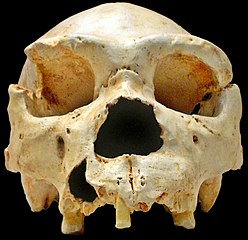
    The Denisovans were not alone

    H. heidelbergensis from Atapuerca
    Cranium 5 "Miguelón"
    (CC by José Manuel Benito)
    About half an hour ago, somewhat cryptic comments in this blog and my email woke me up, more abruptly than I would have desired maybe, to a new game-breaking finding: researchers have sequenced the mtDNA of a 400,000 years old Homo heidelbergensis from Atapuerca (Iberian Peninsula, Europe) and it was not at all like most would have expected.

    Mathhias Mayer et al., A mitochondrial genome sequence of a hominin from Sima de los Huesos. Nature 2013. Pay per viewLINK [doi:10.1038/nature12788]

    Abstract

    Excavations of a complex of caves in the Sierra de Atapuerca in northern Spain have unearthed hominin fossils that range in age from the early Pleistocene to the Holocene1. One of these sites, the ‘Sima de los Huesos’ (‘pit of bones’), has yielded the world’s largest assemblage of Middle Pleistocene hominin fossils2, 3, consisting of at least 28 individuals4 dated to over 300,000 years ago5. The skeletal remains share a number of morphological features with fossils classified as Homo heidelbergensis and also display distinct Neanderthal-derived traits6, 7, 8. Here we determine an almost complete mitochondrial genome sequence of a hominin from Sima de los Huesos and show that it is closely related to the lineage leading to mitochondrial genomes of Denisovans9, 10, an eastern Eurasian sister group to Neanderthals. Our results pave the way for DNA research on hominins from the Middle Pleistocene.


    The key figure is this one, which phylogenetically relates the newly sequenced mtDNA with the known Homo ones:


    Figure 4: Bayesian phylogenetic tree of hominin mitochondrial relationships based on the Sima de los Huesos mtDNA sequence determined using the inclusive filtering criteria.
    All nodes connecting the denoted hominin groups are supported with posterior probability of 1. The tree was rooted using chimpanzee and bonobo mtDNA genomes. The scale bar denotes substitutions per site.


    It has been argued by all sides (myself included) that the H. heidelbergensis of Atapuerca and other European locations are ancestral to Neanderthals. Some say that also to H. sapiens, while others argue that ours is a wholly distinct line, derived from H. rhodesiensis, and yet others claim that H. rhodesiensis is not different from H. heidelbergensis in spite of being older and rooted, it seems, in South Africa.

    The clear evidence for migrations out of Africa, before our species, is limited to two periods: (1) the c. 1.8 Ma old migration of H. erectus/georgicus with Olduwayan technology (mode 1, "choppers"), and (2) the c. 1 Ma old migration of H. ergaster/antecessor (sometimes also confusingly called H. erectus) with Acheulean technology (mode 2, typically "hand axes"). Archaeological evidence for later migrations does not exist.

    See: Late human evolution maps at Leherensuge.

    So we could well ask, if H. heidelbergensis is not ancestral to Neanderthals, then where do Neanderthals come from?

    It must be answered that we do not know yet if H. heidelbergensis is or not ancestral to Neanderthals or in what degree it is. The mitochodrial (maternal) lineage may well be misleading in this sense. Denisovans themselves were much more related to Neanderthals via autosomal (nuclear) DNA than the mtDNA, so it may also be the case with European Heidelbergensis.

    In fact it is still possible that these individuals represent some sort of admixture between older and newer layers of human expansion. But there is no clear answer yet. What is clear is that no Neanderthals have these mitochondrial sequences but others closer to those of H. sapiens - and this is the most puzzling part in fact. 

    But one thing is clear: the World is much bigger than just Europe, and that was also the case back in Paleolithic times. Our answer may well lay under the sands of some tropical desert, the waters of the sea or whatever other place in Asia or Africa.

    Even if we'd find the "missing link", so to say, we might not be able to discern it as such without genetic sequencing and that is often not even possible at all. However this pioneer research, as well as its precursors on a bear also from Atapuerca and a 700,000 years old horse (the true record of ancient DNA recovery), give us some hope of getting an improved, even if sometimes perplexing, understanding of the complexity of the human adventure.

    December 2, 2013

    The Mal'ta aDNA findings

    The recent sequencing of ancient DNA from the remains of a Central Siberian young boy, corresponding to the Gravettian site of Mal'ta, West of Lake Baikal, dated to c. 24,000 years calBP, has caught the interest of many anthropology enthusiasts. During my hiatus of more than two months, most people who asked me to retake blogging with an specific request, talked of these findings. Let's see:

    Maanasa Raghavan et al., Upper Palaeolithic Siberian genome reveals dual ancestry of Native Americans. Nature 2013. Pay per viewLINK [doi:10.1038/nature12736]

    Abstract

    The origins of the First Americans remain contentious. Although Native Americans seem to be genetically most closely related to east Asians1, 2, 3, there is no consensus with regard to which specific Old World populations they are closest to4, 5, 6, 7, 8. Here we sequence the draft genome of an approximately 24,000-year-old individual (MA-1), from Mal’ta in south-central Siberia9, to an average depth of 1×. To our knowledge this is the oldest anatomically modern human genome reported to date. The MA-1 mitochondrial genome belongs to haplogroup U, which has also been found at high frequency among Upper Palaeolithic and Mesolithic European hunter-gatherers10, 11, 12, and the Y chromosome of MA-1 is basal to modern-day western Eurasians and near the root of most Native American lineages5. Similarly, we find autosomal evidence that MA-1 is basal to modern-day western Eurasians and genetically closely related to modern-day Native Americans, with no close affinity to east Asians. This suggests that populations related to contemporary western Eurasians had a more north-easterly distribution 24,000 years ago than commonly thought. Furthermore, we estimate that 14 to 38% of Native American ancestry may originate through gene flow from this ancient population. This is likely to have occurred after the divergence of Native American ancestors from east Asian ancestors, but before the diversification of Native American populations in the New World. Gene flow from the MA-1 lineage into Native American ancestors could explain why several crania from the First Americans have been reported as bearing morphological characteristics that do not resemble those of east Asians2, 13. Sequencing of another south-central Siberian, Afontova Gora-2 dating to approximately 17,000 years ago14, revealed similar autosomal genetic signatures as MA-1, suggesting that the region was continuously occupied by humans throughout the Last Glacial Maximum. Our findings reveal that western Eurasian genetic signatures in modern-day Native Americans derive not only from post-Columbian admixture, as commonly thought, but also from a mixed ancestry of the First Americans.


    Haploid lineages

    The Mal'ta boy, MA-1, carried distinct yDNA R* and mtDNA U* lineages. While both are clearly related to those dominant in Europe and parts of Asia (West, South) nowadays, they are also distinct from any specific dominant lineage today.

    R* (yDNA) is neither R1 nor R2 but another distinct branch of R. This kind of R(xR1, R2) is most rare today and found mostly in and around NW South Asia. Following Wikipedia, this "other R" is found in:
    • 10.3% among the Burusho
    • 6.8% among the Kalash
    • 3.4% among the Gujarati
    However I must say that I recall from old discussions that some R(xR1) is also found among Mongols and some North American Natives. I would have to find the relevant studies though (maybe in an update).

    U* (mtDNA) is also quite rare today but has been found in Swabian Magdalenian hunter-gatherers, as well as in some Neolithic samples, although it may well be a totally different kind of U* (I could not discern the specific markers in the paper nor the supplementary materials and it must be reminded that the asterisk only means "others").


    Autosomal DNA

    The study also shows some statistical inferences from the autosomal (or nuclear) DNA of the Mal'ta boy:


    Figure 1 [b & c]
    b, PCA (PC1 versus PC2) of MA-1 and worldwide human populations for which genomic tracts from recent European admixture in American and Siberian populations have been excluded19.
    c, Heat map of the statistic f3(Yoruba; MA-1, X) where X is one of 147 worldwide non-African populations (standard errors shown in Supplementary Fig. 21). The graded heat key represents the magnitude of the computed f3 statistics.


    Here we can appreciate that MA-1 is closest to Native Americans but still rather intermediate between them and South and West Eurasians. Interestingly East Asians are quite distant instead, suggesting that MA-1 was still not too much admixed with that continental population, unlike what happens with Native Americans, who are essentially East Asian in the autosomal and mtDNA aspects. So this kid appears to be some sort of a "missing link" in the Paleolithic ethnogenesis of Native Americans.


    Figure 2 | Admixture graph for MA-1 and 16 complete genomes. An admixture graph with two migration edges (depicted by arrows) was fitted using TreeMix21 to relate MA-1 to 11 modern genomes from worldwide populations22, 4 modern genomes produced in this study (Avar, Mari, Indian and Tajik), and the Denisova genome22. Trees without migration, graphs with different number of migration edges, and residual matrices are shown in Supplementary Information, section 11. The drift parameter is proportional to 2Ne generations, whereNe is the effective population size. The migration weight represents the fraction of ancestry derived from the migration edge. The scale bar shows ten times the average standard error (s.e.) of the entries in the sample covariance matrix. Note that the length of the branch leading toMA-1 is affected by this ancient genome being represented by haploid genotypes.

    Even if I am not too keen of TreeMix, in this case the results seem consistent.

    We can appreciate here that a sample of Native Americans (the Karitiana, maybe not as "pure" as the Xavantes but still very much so) show up in a different branch from MA-1, reflecting their overwhelmingly East Asian ancestry, mostly by the maternal side (mtDNA). MA-1 instead hangs from the South-West Eurasian branch, soon after the split between South Asians and West Eurasians. Both have extremely drifted branches, surely indicating the small size of their founder populations, typical of the Far North. 

    In addition to this basic tree, two admixture events are signaled: one is the already known Denisovan (H. erectus?) weak one into Australasian Natives (represented by Papuans) and the other one, quite more intense, is the one hanging from upstream of MA-1 to Native Americans (Karitiana), reflecting the partial South-West Eurasian ancestry of Native Americans (noticeable also in their dominant paternal ancestry: haplogroup Q). 

    The fact that the admixture signal stems from quite upstream of MA-1 indicates that this boy (or rather his relatives) were not direct ancestors of Native Americans in any significant way but rather a different branch from the same trunk. Probably proto-Amerindians were already in this period at the North Pacific coasts, not sure if in Beringia or around Okhotsk or what but certainly they had already separated from the Mal'ta population.


    What did we know of Native American genesis before this finding?

    There are three principal lines of evidence:
    1. Y-DNA, which among Native Americans is essentially haplogroup Q (plus some C3, which is from NE Asia). By phylogenetically hierarchical diversity, haplogroup Q must have coalesced in West or Central Asia (or maybe South Asia?), very possibly in or near Iran. The NE Asian and Native American branches are clearly derived, even if more important numerically today.
    2. mtDNA, which among Native Americans is essentially from NE Asia (A, C, D), middle East Asia (B) but also in a small amount from West Asia (X2). 
    3. Archaeology: we can track, more or less directly, the proto-NAs by means of following the Upper Paleolithic sequence in Siberia and nearby areas. 
      1. C. 47,000 years ago (calBP) H. sapiens with Aurignacoid technology (i.e. linked to West Eurasian earliest Upper Paleolithic) reached Altai, displacing the Neanderthals to the Northern fringes of the district.
      2. C. 30,000 years ago, Upper Paleolithic ("mode 4") technology with roots in Altai reached other parts of Siberia, Mongolia and North China, from where it expanded eastwards and southwards gradually in a process of, probably, cultural diffusion. 
      3. By c. 17,000 years ago they were already in North America and c. 15,000 years ago in South America. In the LGM they were probably in Beringia already (but this is only indirectly attested so far). 
    So we already had a good idea about the origins of Native Americans: their ultimate roots, at least patrilineally, seem to be in Altai (where they were part of the wider West Eurasian colonization at the expense of Neanderthals with Aurignacian-like technology and dogs). Then, probably around 30,000 years ago they expanded eastwards through Siberia and maybe nearby areas, entering in intense and intimate contact with the already existent East Asian populations, with whom they admixed once and again, mostly by the female side. 

    It would seem therefore that their society was already patrilocal because otherwise their patrilineages would have just got dissolved among the locals and would have never reached Beringia nor America in such dominant position.

    Overall this is the quite clear notion that I have on Native American earliest genesis and for me there is no reasonable doubt about this narrative (except maybe in the fine details). However I must reckon that some individuals have reacted very negatively against it. But no matter how much they yell, I fail to see their arguments. 


    How does this new finding affects this narrative?

    It simply confirms it with further evidence. By 24,000 calBP the proto-NAs were surely already, as I said before, in NE Asia close to the Pacific coasts, so this Mal'ta population is a branch left behind in their migration (plus whatever new inflows from the West, which we can't evaluate). The very low affinity level with East Asians, in spite of its quite Eastern location, shows that early East Asians had not yet reached, at least in significant numbers, so far North. If they had, they probably did only at more eastern longitudes, probably near the sea, where resources were more plentiful.

    In other words: the first Central Siberians were of South+West Eurasian stock and the current East Asian genetic and phenotype hegemony in that area reflects post-LGM flows, mostly lead by yDNA N1. 

    Early Native Americans were the product of admixture of these earliest Siberians with NE Asians, admixture that surely happened East of Lake Baikal, although the exact details are still unclear. 


    What does MA-1 say about the West?

    His mtDNA is generally consistent with other common U-derived lineages found in West Eurasian Upper Paleolithic, so not much other than he was somehow related, what is confirmed by autosomal analysis. 

    His yDNA is more interesting maybe, nonetheless because it is probably the oldest sequence of this kind but also because it belongs to haplogroup R. It certainly discards whatever "molecular clock" guesstimates for R that are shorter than this site's age but on its own it is not able to set a real age other than a bare minimum. 

    So for example Eupedia's estimate of 29 Ka for R as such could still be valid, although I would say that extremely unlikely. 

    Indirectly however it does say something by confirming the overall narrative of Native American origins as above and that means that Eupedia's estimate of a mere 24 Ka age for haplogroup Q is almost certainly wrong by a lot. 

    Using that tree, we would have to at least double the age of Q in order to fit with the Altai narrative (which begins at c. 47 Ka ago), what, extrapolating, implies an age for R of at least 58 Ka. I have estimated some 48 Ka of age for R1 and 68 Ka for P, so it makes good sense after these so necessary corrections. The exact ages we may never know but the approximate ages should be something like these. 


    And that's about all I can say. More in comments (and/or updates) if need be.


    Update (Dec 6): R* and P* (and other rare clades) among Central Asians

    A reader sent me copy of the study by Wei-Hua Shou et al. (2010) titled Y-chromosome distributions among populations in Northwest China identify significant contribution from Central Asian pastoralists and lesser influence of western Eurasians, published by Nature (doi:10.1038/jhg.2010.30).

    While it is not the bit of info I was recalling above, it does add some information about unmistakable R(xR1,R2) and P(xQ,R) among Central Asian populations (from P.R. China territory). In detail:
    • R* is found in 5/31 Tayiks, 1/41 Kazakhs and 1/50 Uyghurs.
    • P* is found in 1/31 Tayiks and 1/43 Kirgizes. 
    Also of interest should be the presence of:
    • Q(xQ1) in  8/35 Dongxiang (a Mongol ethnicity), 1/45 Kirgizes and 1/50 Tu (another Mongol ethnicity).
    • F(xG,H,I,J,K) in 2/32 Yugu (Yugurs, a distinct Uyghur sub-ethnicity), 2/41 Kazakh, 1/31 Tayiks and 1/50 Tu.
    • K(xN,O,P) in  32/533 total (i.e. 6% in Easternmost Central Asia), among which are most notable: 9/50 Uyghurs, 6/23 Uzbeks, 6/27 Bao'an (another small Mongol ethnicity), 3/32 Xibo (a Tungusic ethnicity), 2/32 Yugu and 2/5 Mongols. I guess that it is possible that this is a distinct K subclade, although it can well be either part of MNOPS (NO*?) or also belong to LT (L?).
    • R2 in 1/31 Tayiks and 2/27 Bao'an.
    Back!

    Today I'll retake my activity in this blog, as promised, with an entry on the Mal'ta aDNA findings, which I have yet to write.

    But I'll probably take it easy anyhow. I guess I'm not as enthusiastic as I used to be and I definitely need/want more leisure time for myself.

    Enjoy.