April 14, 2013

'Neanderthal' allele that is probably not Neanderthal in modern humans

This is a generally well finished study on an allele shared by (some) modern humans, Neanderthals and "Denisovans" but which the authors properly gouge to be probably not Neanderthal in origin among us.

Omer Gockumen et al., Balancing Selection on a Regulatory Region Exhibiting Ancient Variation That Predates Human–Neandertal Divergence. PLoS Genetics 2013. Open access → LINK [doi:10.1371/journal.pgen.1003404]

Abstract

Ancient population structure shaping contemporary genetic variation has been recently appreciated and has important implications regarding our understanding of the structure of modern human genomes. We identified a ~36-kb DNA segment in the human genome that displays an ancient substructure. The variation at this locus exists primarily as two highly divergent haplogroups. One of these haplogroups (the NE1 haplogroup) aligns with the Neandertal haplotype and contains a 4.6-kb deletion polymorphism in perfect linkage disequilibrium with 12 single nucleotide polymorphisms (SNPs) across diverse populations. The other haplogroup, which does not contain the 4.6-kb deletion, aligns with the chimpanzee haplotype and is likely ancestral. Africans have higher overall pairwise differences with the Neandertal haplotype than Eurasians do for this NE1 locus (p<10−15). Moreover, the nucleotide diversity at this locus is higher in Eurasians than in Africans. These results mimic signatures of recent Neandertal admixture contributing to this locus. However, an in-depth assessment of the variation in this region across multiple populations reveals that African NE1 haplotypes, albeit rare, harbor more sequence variation than NE1 haplotypes found in Europeans, indicating an ancient African origin of this haplogroup and refuting recent Neandertal admixture. Population genetic analyses of the SNPs within each of these haplogroups, along with genome-wide comparisons revealed significant FST (p = 0.00003) and positive Tajima's D (p = 0.00285) statistics, pointing to non-neutral evolution of this locus. The NE1 locus harbors no protein-coding genes, but contains transcribed sequences as well as sequences with putative regulatory function based on bioinformatic predictions and in vitro experiments. We postulate that the variation observed at this locus predates Human–Neandertal divergence and is evolving under balancing selection, especially among European populations.


The paper discusses an allele (NE1) of APOBEC3G, a gene arguably related to anti-viral immunity, which is found primarily in its derived variant among non-Africans (especially South Asians, Europeans and Native Americans). In similar cases other similar studies have claimed that it should be a Neanderthal introgression, ignoring the presence of the relevant allele at low frequencies in Africa. The authors of this study do not commit this error but finding it at low frequencies not just among the Maasai and the Luhya but also among Pygmies, they consider that there is a high likelihood of the allele found among Eurasians and Native Americans to have originated among Homo sapiens in Africa and then maybe favored by natural selection or other mechanisms outside the ancestral continent. 


Figure 3. Ancient African origins of the NE1 haplogroup.
(A) Models of scenarios that could lead to NE1 haplotypes observed in humans and Neandertals. The frequency of the NE1 haplogroup is depicted in red and the frequency of the nonNE1 haplogroup in yellow. The red corresponds to higher frequencies, whereas yellow corresponds to lower frequencies of the NE1 haplotypes in the population. The arrows represent the direction of possible admixture events. The left panel represents a model, under which the NE1 haplotypes admixed into Eurasian populations (Asn and Eur) after Human-Neandertal divergence. The second model, which is depicted in the central panel, is similar to the first model, except with the addition of more recent back migration of Eurasian NE1 haplotypes into Africa (Afr). The right panel shows the third model, under which the NE1 haplotypes among humans are explained by persistence of ancient African substructure. All these scenarios were based on the assumption that the NE1 haplotype occurs at high frequency or is fixed in the Neandertal population given that the available Neandertal sequences align well to the NE1 haplotype. (B) Geographical distribution of the NE1 haplogroup. We estimated the proportion of chromosomes that carry the CNVR8163.1 deletion from various sources described in Materials and Methods. The dark red portion of each circle represents the frequency of the homozygous nonNE1 genotypes, the white represents the homozygous NE1 genotypes and the light red represents the frequency of heterozygote genotypes. Note the existence of the NE1 haplotypes (i.e., as heterozygotes, light red) among sub-Saharan African populations (e.g., LWK and ASW) as well as the high frequency of heterozygotes (light red) in the European populations. (C) The pairwise distances between the African (Afr) NE1 haplotypes, the Asian (Asn) NE1 haplotypes, and the European (Eur) NE1 haplotypes, calculated using phase 1 data from the 1000 Genomes Project. p-values were calculated by the Mann-Whitney test.
Figure 4. Selection acting on the NE1 locus.
(A) Maximum likelihood tree based on select NE1 (red) and nonNE1 (blue) haplotypes, with the chimpanzee haplotype as an outgroup. The gray-box indicates the estimated interval for the Human-Neandertal divergence between 400,000–800,000 years ago [51]. Note that the coalescence at this locus is extremely long and very unlikely to have evolved under neutral conditions as modeled here. (B) Comparison of FST and Tajima's D values of 10 kb intervals across the human genome. The red to dark blue gradient indicates decreased density of observed events at a given location in the graph. The NE1 locus, and other loci with similar profiles, are highlighted in white.

While the Neanderthal-Sapiens divergence estimate they use (fig. 4A) is clearly more recent than I would gladly accept (I'm more into 1.3-0.9 Ma BP, based on archaeological and paleoanthropological data), it does not seem to matter for the conclusions, as they estimate that the two main haplotypes in chromosome 22 related to this allele diverged much earlier, at the beginnings of the history of the genus Homo. 

Chimpanzees by the way have the non-NE1 allele, which is therefore considered ancestral.

April 13, 2013

Huge palisade enclosure in Wales

The small village of Walton (Powys, Wales) was, it seems, long ago a ceremonial center for the ancient peoples of Britain between 3800 and 2300 BCE. At the very least it had a huge palisaded enclosure that could have accommodated five buildings of the size of the London Olympic Stadium within its circa 1200 posts, each said to be 4 m. high. 

Digital reconstruction of the ceremonial site


Besides the structure itself, which has been investigated for decades, pottery, flint tools and food remains have been found. Apparently the site hosted some kind of regular festival of unknown characteristics. 

Source: Wales Online.

Fish soup in Japanese pots from 15,000 years ago

The revealing pot
Not the oldest known pottery on Earth, which is from Southern China and dated c. 20,000 BP, but close enough: Paleolithic peoples of Japan (proto-Ainu?) used ceramic pots to cook fish some 15,000 years ago.

O.E. Craig et al., Earliest evidence for the use of pottery. Nature 2013. Pay per view → LINK [doi:10.1038/nature12109]

Abstract

Pottery was a hunter-gatherer innovation that first emerged in East Asia between 20,000 and 12,000 calibrated years before present1, 2 (cal bp), towards the end of the Late Pleistocene epoch, a period of time when humans were adjusting to changing climates and new environments. Ceramic container technologies were one of a range of late glacial adaptations that were pivotal to structuring subsequent cultural trajectories in different regions of the world, but the reasons for their emergence and widespread uptake are poorly understood. The first ceramic containers must have provided prehistoric hunter-gatherers with attractive new strategies for processing and consuming foodstuffs, but virtually nothing is known of how early pots were used. Here we report the chemical analysis of food residues associated with Late Pleistocene pottery, focusing on one of the best-studied prehistoric ceramic sequences in the world, the Japanese Jōmon. We demonstrate that lipids can be recovered reliably from charred surface deposits adhering to pottery dating from about 15,000 to 11,800 cal bp (the Incipient Jōmon period), the oldest pottery so far investigated, and that in most cases these organic compounds are unequivocally derived from processing freshwater and marine organisms. Stable isotope data support the lipid evidence and suggest that most of the 101 charred deposits analysed, from across the major islands of Japan, were derived from high-trophic-level aquatic food. Productive aquatic ecotones were heavily exploited by late glacial foragers3, perhaps providing an initial impetus for investment in ceramic container technology, and paving the way for further intensification of pottery use by hunter-gatherers in the early Holocene epoch. Now that we have shown that it is possible to analyse organic residues from some of the world’s earliest ceramic vessels, the subsequent development of this critical technology can be clarified through further widespread testing of hunter-gatherer pottery from later periods.

Main source: Pileta[es/en].

Rock art from Baja California dates to c. 9,000 years ago, maybe even older

Catalan researchers from the IPHES have been studying the impressive rock art of the caves of Baja California Sur (Mexico) and concluded that some of the art is from c. 8-9,000 years ago. However contextual dates are sometimes older, of c. 10-11,000 years ago. 

Source: El Universal[es], which has many more photos.


For decades it was believed, following the pioneer work of Clement Meighan, that the art was from the 13th century CE. However in the 1980s the more in-depth research by Catalan scientists revealed that it is in fact from much older dates, at least 5,000 years ago. These days it has been revealed that they are even older in some cases. 

The rock art is distributed by many areas of Baja California Sur, very especially the Sierra de San Francisco, which alone hosts more than 250 sites. These sites were often occupied through millennia, until the 18th century CE in some cases. Even later they have been used as shelters for sheep, however nowadays they do enjoy state and UNESCO protection. 

The most outstanding cave, La Pintada (the painted one), appears to have indications of astronomical knowledge. In the words of Viñas Vallverdú:

In the particular case of La Pintada there are many markings of astronomical type, spots where it is indicated that the Sun illuminates in certain time of the year, signaling a date in their calendar. That way they knew that, when the Sun hit one of those marks, it was time to collect the pitahaya or that the rain period was nearing.

The research is part of an international project by IPHES and the Instituto Nacional de Antropología e Historia (INAH) of Mexico, which is surveying the prehistory of the North American federation. 

The study will be published as the doctoral thesis of lead researcher Ramón Viñas Vallverdú (IPHES).

Source: El Universal[es] (includes a very beautiful photo-gallery).

Sahara 5000 years ago: from grassland to desert in no time

Saharan dust storm blowing into the Ocean (NASA)
Live science reports about a new study, to be published in the Earth and Planetary Science Letters journal, that concludes, based on the dust sediments in the Atlantic Ocean, that the change from grassland to desert of the Sahara some 5000 years ago was very quick. 

In the wet period, known as Neolithic Semi-Pluvial, the dust accumulated in oceanic sediments was only 20% of present day. But that changed very fast around 5000 BP. 

Not many details are provided however.

Bisphenol A severely disrupts fetal epigenetics

Water bottle containing bisphenol A
The most controversial chemical compound bisphenol A is found in many plastics, including sometimes those used as food or water containers. This study adds to the long list of known harms of this chemical, which nevertheless remains widely allowed.

Martha Susiarjo et al., Bisphenol A Exposure Disrupts Genomic Imprinting in the Mouse. PLoS Genetics 2013. Open access → LINK [doi:10.1371/journal.pgen.1003401]

Abstract

Exposure to endocrine disruptors is associated with developmental defects. One compound of concern, to which humans are widely exposed, is bisphenol A (BPA). In model organisms, BPA exposure is linked to metabolic disorders, infertility, cancer, and behavior anomalies. Recently, BPA exposure has been linked to DNA methylation changes, indicating that epigenetic mechanisms may be relevant. We investigated effects of exposure on genomic imprinting in the mouse as imprinted genes are regulated by differential DNA methylation and aberrant imprinting disrupts fetal, placental, and postnatal development. Through allele-specific and quantitative real-time PCR analysis, we demonstrated that maternal BPA exposure during late stages of oocyte development and early stages of embryonic development significantly disrupted imprinted gene expression in embryonic day (E) 9.5 and 12.5 embryos and placentas. The affected genes included Snrpn, Ube3a, Igf2, Kcnq1ot1, Cdkn1c, and Ascl2; mutations and aberrant regulation of these genes are associated with imprinting disorders in humans. Furthermore, the majority of affected genes were expressed abnormally in the placenta. DNA methylation studies showed that BPA exposure significantly altered the methylation levels of differentially methylated regions (DMRs) including the Snrpn imprinting control region (ICR) and Igf2 DMR1. Moreover, exposure significantly reduced genome-wide methylation levels in the placenta, but not the embryo. Histological and immunohistochemical examinations revealed that these epigenetic defects were associated with abnormal placental development. In contrast to this early exposure paradigm, exposure outside of the epigenetic reprogramming window did not cause significant imprinting perturbations. Our data suggest that early exposure to common environmental compounds has the potential to disrupt fetal and postnatal health through epigenetic changes in the embryo and abnormal development of the placenta.

April 7, 2013

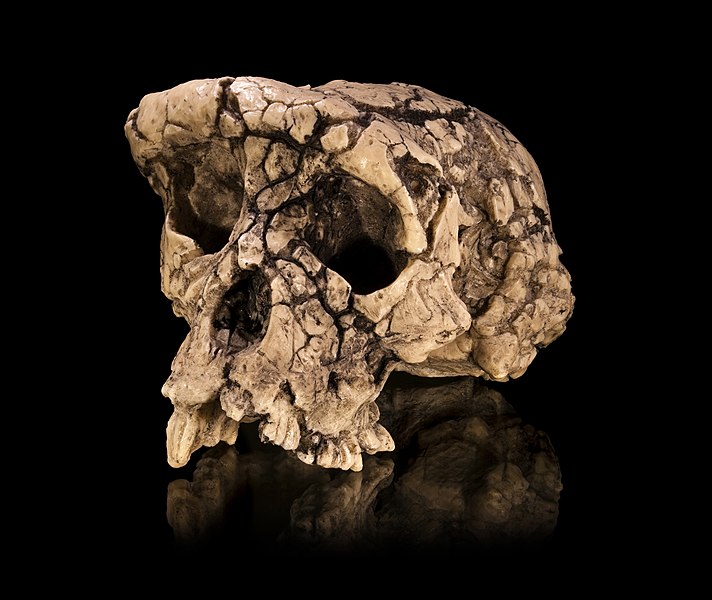
Brain shape favors 'Toumaï' as a human ancestor

The seven million years old Sahelanthropus tchadensis (i.e. Sahel man from Chad), nicknamed Toumaï, already had a hominin structure in its small brain:

... though Toumaï’s brain was apelike in its small size, it was apparently homininlike in other ways. In a presentation given on April 2 at the annual meeting of the Paleoanthropology Society, Bienvenu reported that the endocast shows strongly posteriorly projecting occipital lobes, a tilted brainstem, and a laterally expanded prefrontal cortex, among other hominin brain characteristics.

Other human-like traits in Toumaï are small canines and the forward position of its foramen magnum (where the backbone connects to the skull), which suggest upright walking, which is now argued to be related to brain reorganization. 

This clearly confirms, as I have insisted so much, that the Pan-Homo divergence date is necessarily older than 7 million years, because Toumaï  was already closer to us than chimpanzees and bonobos, our closest living relatives.