Showing posts with label Mesolithic. Show all posts

January 1, 2017

Oldest evidence for cooking in pots comes from Libya

Quickies

Kambiz Karami at Anthropology.net (a most interesting blog to follow) mentioned this week that Libyan pottery remains, maybe as old as 10,000 years ago, have provided the oldest evidence of vegetable cooking of we know of, at least in pots (see below for the disclaimer). The remains indicate cooking of vegetables and meat and are associated to pictures of people gathering plants, as well as grinding stones (hand mills) with remains of such provisions.


Ref. Nature Plants.


Oddly enough, just two days later, he contradicted himself, mentioning that the charred remains of nuts and seeds from Palestine, dated from 780,000 years ago, actually provide the oldest evidence of vegetable cooking, even if it's clearly a more primitive way of cuisine and not yet at all the "refined" stew of ancient Libyans, which won them three stars in the Paleo-Michelin Guide for Nomads and five pitchforks in Popular Mesolithic Cuisine

Ref. PNAS.


Update (Jan 4): origin of Libyan and West Asian pottery could be Sudan

Jm8 mentions it in the comments, referencing to Anthromadness. I would need more data to judge (the ref. paper is behind paywall) but  it does sounds as probably correct to me, being Sudan/Nubia one of the earliest Mesolithic areas in the Western half of the Old World, one that is way too often and unfairly neglected but that definitely influenced the Levant prior to the development of Neolithic proper (what should explain a lot of things both linguistic and genetic).

Happy 12,017

Yeah, 12,017. Why not? And I do mean the year that begins today per the Gregorian Calendar.

This is a surprisingly well thought idea that some prehistorianists (i.e. those who like Prehistory, regardless of wage-earning profession) have proposed: to get rid of the clearly uncomfortable Christian Era, alias Roman Era, alias Common or Conventional Era (CE) by adding 10,000 years to it and roughly starting counting at Göbekli Tepe (approx. date, because it's impossible to pinpoint an exact date, but the same happens with the alleged birth of baby Jesus anyhow), without doubt the first "civilizational" type of monument ever built, incidentally getting rid of negative counting for at least the whole Holocene (a most convenient feature indeed). 

They propose to call it the "Human Era" (HE), although I'd rather think that the Human Era begins with humans and that would be c. 200,000 years ago for Homo sapiens and two million years ago for the overall Homo genus, Humankind generally speaking. So maybe it's better to call it the Monumental Era, the Megalithic (big stone) Era or just the Mega-Era, for short. It'd be ME in any case.

The proposal, as far as I can tell, was made by Kurzgesagt, one of the YouTube channels that provide a good mix of entertainment and information for people interested in history and prehistory, young and elderly alike:


And I like it quite a bit, of course. So maybe worth spreading around, don't you think? 

In any case, I wish you all a happy and productive new year, one in which things may hopefully change for the better and not for the worse, for a change. 

And, like in every New Year Day, the holiday where most work is made, because of that floating notion that you are supposed to made up for all the laziness and procrastination of the past year, I will now proceed to assault my quite fatty "to do" list, and tell you about things that you may or not know already but that I think are worth taking note of.

August 5, 2015

Weed evolution in the context of earliest proto-farming in Palestine

Ohalo II, at (often under) the Sea of Galilee, is probably the oldest site of sedentary proto-farming, dating to before the Last Glacial Maximum, experiment that may have been interrupted afterwards. A new study finds the first signals of not just many edible plants that would eventually become crops but also the signature of evolution of weeds already towards the forms we are familiar with nowadays.

A. Snir et al., The Origin of Cultivation and Proto-Weeds, Long Before Neolithic Farming. PLoS ONE 2015. Open accessLINK [doi:10.1371/journal.pone.0131422]

Abstract

Weeds are currently present in a wide range of ecosystems worldwide. Although the beginning of their evolution is largely unknown, researchers assumed that they developed in tandem with cultivation since the appearance of agricultural habitats some 12,000 years ago. These rapidly-evolving plants invaded the human disturbed areas and thrived in the new habitat. Here we present unprecedented new findings of the presence of “proto-weeds” and small-scale trial cultivation in Ohalo II, a 23,000-year-old hunter-gatherers' sedentary camp on the shore of the Sea of Galilee, Israel. We examined the plant remains retrieved from the site (ca. 150,000 specimens), placing particular emphasis on the search for evidence of plant cultivation by Ohalo II people and the presence of weed species. The archaeobotanically-rich plant assemblage demonstrates extensive human gathering of over 140 plant species and food preparation by grinding wild wheat and barley. Among these, we identified 13 well-known current weeds mixed with numerous seeds of wild emmer, barley, and oat. This collection provides the earliest evidence of a human-disturbed environment—at least 11 millennia before the onset of agriculture—that provided the conditions for the development of "proto-weeds", a prerequisite for weed evolution. Finally, we suggest that their presence indicates the earliest, small-scale attempt to cultivate wild cereals seen in the archaeological record.

May 18, 2014

Oldest Cappadocian Neolithic site changed swiftly from hunting to herding

Reconstructed home entrance
(credit: Kvaekstad)
Aşıklı Höyük (Aksaray province) is the oldest known Cappadocian Neolithic site, located to the Northeast of the famous Çatalhöyük.

The site was inhabited since c. 9000 BCE, having a diet based on varied wild meat sources. But c. 8200 BCE the meat became almost exclusively that of sheep and goats, whose remains increased around this date from less than 50% (presumably wild) to around 90% of all meat sources, indicating that the community had become dependent on them, almost certainly because of transition to herding.

Not just that, young male sheep and goats make up the bulk of those remains, indicating the typical lamb culling proper of agricultural economies. Also analysis of the archaeo-dung indicates that the animals were kept captive in the settlement itself.
Altogether, these findings suggest the people in this area shifted from hunting to herding in just a few centuries.

Importantly, everything suggests that there was no immigration to the area: just a local change of economic paradigm. The homes were built just in exactly the same fashion as the previous ones, using their remains as foundations (typical of "tells", artificial hills formed by this long term continuity in habitation).

It is unclear from the source if they were involved in farming yet but it seems apparent that it was sedentarism what caused the economic change.

I find notable and needed to be mentioned that the life expectancy of men and women in Aşıklı Höyük was extremely unequal, with the latter dying often in their early 20s and showing signs of hard work, while the former generally survived to their 50s. Class inequality have also been proposed, considering the relative lack of burials compared to expected population size - however this last is controversial.

March 27, 2013

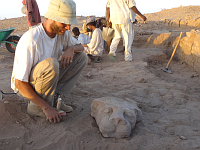
Epipaleolithic site dug in Sudan

Archaeologist watches a lioness head
not mentioned in the sources
A late hunter-gatherer necropolis has been discovered and researched by Czech scientists. The area of Sabalonka, some 80 Km north of Khartoum, includes a large necropolis of some 400-450 burials, believed to be from 8-10,000 years ago. Along with the burials, still awaiting radiocarbon dating, the archaeologists found a network of nearby settlements.

So far 30 skeletons have been recovered, many with personal ornaments made of shells, ostrich egg and bone. Other objects found are bone needles and domestic tools made of bone and horn.

The site is at risk in the mid-run because of a planned dam, also the researchers are somewhat concerned about funding, even though the project is low-cost. 

Sources[es]: Paleorama en Red, Radio Praga

March 25, 2013

Millet Mesolithic and Early Neolithic in Northern China

Panicum miliaceum
(GFDL by Kurt Stüber)
I'm getting my backlog up to date, so you will have to excuse some lack of in depth analysis in this and some entries to follow. My most sincere apologies because I'd really like to be able to offer an in-depth analysis in every other entry but the harsh reality is that my mind and my energies only reach that far.

This one is a paper from a year ago but that has some interest regarding the Mesolithic (wild cereal harvesting) transition to Neolithic (agriculture)  in China.

Xiaoyang Yang  et al., Early millet use in northern China. PNAS 2012. Freely accessibleLINK [doi:10.1073/pnas.1115430109]

Abstract

It is generally understood that foxtail millet and broomcorn millet were initially domesticated in Northern China where they eventually became the dominant plant food crops. The rarity of older archaeological sites and archaeobotanical work in the region, however, renders both the origins of these plants and their processes of domestication poorly understood. Here we present ancient starch grain assemblages recovered from cultural deposits, including carbonized residues adhering to an early pottery sherd as well as grinding stone tools excavated from the sites of Nanzhuangtou (11.5–11.0 cal kyBP) and Donghulin (11.0–9.5 cal kyBP) in the North China Plain. Our data extend the record of millet use in China by nearly 1,000 y, and the record of foxtail millet in the region by at least two millennia. The patterning of starch residues within the samples allow for the formulation of the hypothesis that foxtail millets were cultivated for an extended period of two millennia, during which this crop plant appears to have been undergoing domestication. Future research in the region will help clarify the processes in place.

...

Conclusions

The data from these studies extends the archaeobotanical record of millet exploitation to 11 cal kyBP in East Asia. The presence of the starch grains on processing tools is a strong indicator that millet seeds were ground into flour or meal using stone tools, then cooked in earthenware vessels as early as 10 cal kyBP. Other grasses and geophytes were also part of the diet during this time in the North China Plain. We believe these data may indicate that the domestication of foxtail millet occurred over an extended period, perhaps two millennia or more. Future research in this region should help clarify the trajectory of this important crop plant.