Major update (Feb 12 2016): the authors have publicly corrected their conclusions: the alleged Eurasian admixture in Yoruba and Mbuti does not exist. See HERE for further details.
 |
| Mota cave |
Whatever we may think of the conclusions (see below), this study is a most important breakthrough because it shows that ancient DNA can be obtained from remains preserved in hostile (hot) conditions, removing the technical barriers for research in these areas, which make up most of the inhabited world. The method, which relies in the vault-like conditions of the inner petrous earbone, was demonstrated earlier this year by
Pinhasi et al. (
open access) and is in itself a technical revolution in ancient DNA research.
M. Gallego Llorente, E.R. Jones et al., Ancient Ethiopian genome reveals extensive Eurasian admixture throughout the African continent. Science 2015. Pay per view → LINK [doi:10.1126/science.aad2879]
Abstract
Characterizing genetic diversity in Africa is a crucial step for most analyses reconstructing the evolutionary history of anatomically modern humans. However, historic migrations from Eurasia into Africa have affected many contemporary populations, confounding inferences. Here, we present a 12.5x coverage ancient genome of an Ethiopian male (‘Mota’) who lived approximately 4,500 years ago. We use this genome to demonstrate that the Eurasian backflow into Africa came from a population closely related to Early Neolithic farmers, who had colonized Europe 4,000 years earlier. The extent of this backflow was much greater than previously reported, reaching all the way to Central, West and Southern Africa, affecting even populations such as Yoruba and Mbuti, previously thought to be relatively unadmixed, who harbor 6-7% Eurasian ancestry.
Massive and late European Neolithic-like migration into Africa, even into the Bushmen, Pygmy and Hadza hunter-gatherers?! Well, that's the thesis and the authors seem to have some reasons to believe it. However I am a bit skeptic to say the least.
The logic behind Llorente & Jones' conclusions is that, when replacing the "non-admixed African" baseline from the usual reference populations such as the Yoruba (a major SW Nigerian population) and Mbuti (Eastern Pygmies from the Ituri jungle of NE Congo) to this newly sequenced paleo-Ethiopian genome from Mota cave, all Africans appear more similar to West Eurasians, particularly to the reference ancient farmer "Stuttgart" (LBK) or his closest modern relatives: Sardinians.
However this is untrue for some of the populations from the same region as Mota: most Ethiopian populations actually show a slight but significant decrease in their putative Eurasian ancestry (table S5). This is very intriguing, as is the main thesis of the study, and I have the impression that at least part of that appearance of European-like admixture may be explained by ancient internal African structure rather than true immigration. This possibility is not addressed in the study, so we will have to wait for counter-studies, be them professional or amateur. It would not be the first case where a pioneer study "finds" things that become less clear as new research is done, I am thinking of course on stuff like the problematic "ANE" component of Lazaridis 2014 or the extreme "Indoeuropean admixture" conclusions of Haak & Lazaridis 2015, which are much milder and clinal in other comparable studies.
So let's keep calm and wait for more data or improved analyses.
 |
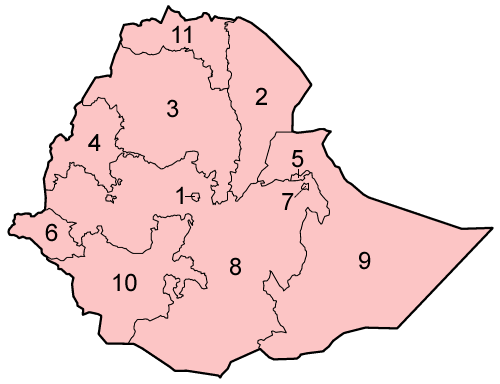
| Fig. S6. The proportion of West Eurasian ancestry in modern eastern African populations. λYoruba,Druze (using Yoruba as the non-admixed reference and Druze as the source), estimated for individuals belonging to a number of Ethiopian populations. |
Affinities
Mota seems to be most akin to modern
Ari people of SW Ethiopia, who speak an Omotic language. He is also rather similar to the
Sandawe of Southern Tanzania, who speak a distinct click language. These similitudes underline the importance that "tribal" nations have, among other reasons, for deciphering the ancient African demographic landscape.
 |
| Fig. S5. PCA showing the relationship between Mota and contemporary Ethiopian populations. Components were loaded on contemporary Ethiopian populations using ~480k SNPs, with Mota projected on these dimensions. |
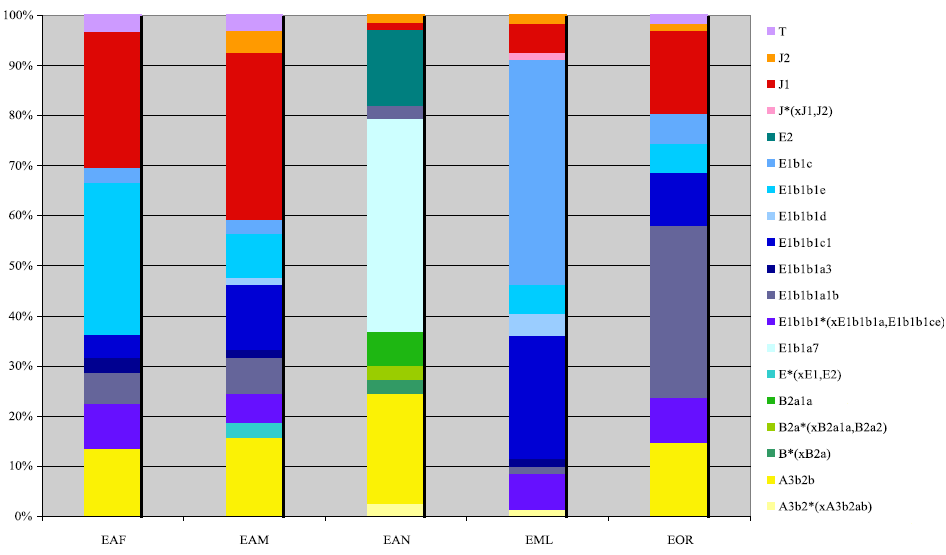
His mtDNA haplogroup is L3x2a (table S3), described by Behar 2008 in Ethiopia and the Arabian peninsula (but most likely original from The Horn) and his Y-DNA one is E1b1 (table S4), a major African haplogroup, most likely original from the same Upper Nile region, with some offshoots in West Eurasia.
He did not carry any known allele for lactase persistance (table S13) but he was homozygous for three alleles that seem to confer altitude adaptation (resistance to hypoxia, table S14).
He had brown eyes and dark or black hair, skin color determination was inconclusive (the matter is still ill-understood) but he did not carry any European alleles associated with lighter pigmentation, so most likely he was black (or, with more chromatic descriptive precision, brown).
Neanderthal admixture testing
This seems to be the detail that most strongly supports the thesis of the study: Mota is even less akin to Neanderthals than modern Africans. From article S11:
The two African genomes, Yoruba and Mbuti, also have slightly positive D values, indicating that they are slightly more similar to Neanderthal than Mota is. This result is likely driven by the West Eurasian component found in modern Africans.
However when we look at the raw data (table S9), we can see that, while the Yoruba Neanderthal admixture estimate is slightly larger than the error margin, the Mbuti one is markedly smaller, so we can still consider the latter to be effectively zero or at the very least negligible.
This is potentially contradictory with the alleged 6-7% West Eurasian admixture that the study claims for Mbuti (table S5), which would be almost the same as that of Yorubas (7-8%), so I think that there is something not properly pondered and that, while Yorubas may have some (very minor?) West Eurasian admixture, the case for the Mbuti is very much suspect of false positive caused by confounding factors, such as ill understood ancient African diversity.
Most strange is the case of Khoisan populations. While two of them (Nama and Khomani) do seem to have clear Eurasian admixture, as they stick up well above the average, several others (Xun, Juhoansi or GuiGhanaKgal) are very low when using Yoruba as reference and the tiny bit can be attributed to the pull effect caused by the mere fact that Yoruba and Khoisan are very different populations, which diverged (at least in the essentials) even before the Out-of-Africa migration took place. I strongly suspect that this confounding factor is also at play when comparing with Mota and even more strongly so, because Mota quite obviously lacks the later intra-African partial homogenization tendency caused by migrations such as the Nilotic or Bantu ones.
 |
| Fig. S7. Maps showing the proportion of West Eurasian ancestry in African populations. The proportion of West Eurasian ancestry calculated using either (A), Druze. λMota,Druze, or (B), LBK, λMota,LBK, as a source, and Mota as the non-admixed African reference in both cases. |
Early European farmers or...?
Sure, among the tested populations, Sardinians are the best apparent matches for the source of the alleged Eurasian admixture in Africa (tables S6 and S7). But next in line are Belorussians and Lithuanians, what is a bit perplexing, because in the European analyses these are two completely opposite poles along the PC1. Basques and Russians however are surprisingly bad matches, with French, Italian, Spaniards, etc. being in between.
Among ancient populations, Stuttgart (LBK) appears as a good match when using a Yoruba reference but not so good when using a Mbuti one. Inversely, Lochsbour (Epi-Magdalenian) looks a very bad match when using Yoruba but a bit better when using Mbuti. As Mbuti seem still to be a more clear outgroup than Yoruba, I think that table S7 holds preference over S6.
Hence I'd rather discard that the source of the apparent Eurasian admixture is LBK-like. However Sardinians (or a similar ancient population) are a better candidate. But what about Belorussians and Lithuanians, whose scores are also very high? Perplexing.
So basically I have all kind of doubts and I look forward to further research that may clarify them.