January 15, 2011

Austroasiatic peoples of India: the autosomal DNA

An interesting paper published online in October 2010 (official publication date is however 2011) but that I had not visualized to date is:


My head is still dizzy from the pains of quitting up heavy smoking without any help whatsoev (and without the real conviction of it being worth the effort, just bored of going through an unhelpful and demanding bureaucracy of self-righteous institutionalized robbers and drug dealers to get my dose), so I won't extend much upon this one. 

Most importantly it comes up clear that Indian Austroasiatics are, in spite of often obvious East Asian male-mediated ancestry, mostly South Asian by overall ancestry:

Fig. 3 - PCA and K=7 analysis

In the structure analysis, we see that the main component (black) of Indian Austroasiatic speakers is shared with Dravidian populations of South India (but not Brahuis, who are typical Pakistanis in spite of speaking a Dravidian language). This component is also shared at lower frequencies by South and SE Asian populations. 

This is also apparent in the PC graph, where Indian Tibeto-Burman peoples cluster with East Asian ones but not Austroasiatic Indians, in spite of some lesser tendency in that direction.

In an aside, it is also notable to mention that the North Indian component (green) is clearly different from those in West Eurasia, even if there is a lesser presence of this South Asian component. This rather goes against those who claim that North Indian/Pakistani specificity is of West Eurasian origin: if anything some West Eurasian element would need to be explained as originating from South Asia. The only WEA population lacking it are, as usual, Basques, indicating it is at least a marker from outside Europe and, in Europe, surely marks Neolithic or Metal Ages (Indoeuropean) arrivals.

Back to Austroasiatics, it is worth quoting this:

The mtDNA haplogroup allocation of Munda speakers is similar to Dravidian and Indo-Europeans of the Indian subcontinent (Basu et al. 2003; Metspalu et al. 2004; Chaubey et al. 2007; Chaubey, Metspalu, et al. 2008; Chaubey, Karmin, et al. 2008; Thangaraj et al. 2009). We carried out a high-resolution analysis of those haplogroups of Munda speakers, which account for >4% of their maternal gene pool. All the seven maternal haplogroups found frequently in Munda speakers are autochthonous to India (supplementary fig. S5, Supplementary Material online) (Chandrasekar et al. 2009) and references therein, accounting altogether for 57% of the maternal gene pool of present Munda speakers. The extensive analysis of these haplogroups revealed relatively recent sharing of most recent common ancestors within these groups between AA and non-AA speakers (MRCA), suggestive of admixture; a similar result was observed recently for hg R7, which is the most frequent among these in AA speakers (Chaubey, Karmin, et al. 2008). The mtDNA lineages of Munda speakers do not cluster in basal parts of the tree (to founder haplogroups M, N, or R) but are spread among the derived branches that date to <10KYA (Supplementary fig. S5, Supplementary Material online) suggests that the mtDNA diversity found in contemporary Munda speakers is the result of admixture from neighboring populations of India.

In sharp contrast, among the geographically proximate Khasi-Aslian–speaking Khasi population, approximately one-third of the mtDNA lineages have southeast Asian ancestry (Fig. 2 and table 2).

Having these distinctions present is important to understanding what in these peoples related to SE Asia, is autochthonous from South Asia or recent (Neolithic) immigrant from SE Asia.

January 12, 2011

Romani mtDNA

There is a new paper onthe genetics of the Roma People (Gypsies), with emphasis in mtDNA:


The lineages of this European people of South Asian origins can be divided in a clearly South Asian component (M5a1 specially, also M18, M25 and M35b), a most likely West Asian component (X2 and J1 clades specially), a possibly Balcanic component (H7 and U3) and "others" (clearly European lineages). The exact apportions vary among populations as follows:

Fig. 1

I think it is interesting demonstration of drift and founder effect how most pre-Europe "founder" lineages have vanished in most populations, specially in the rather well known "bottleneck" leading to non-Balcanic Roma: of all the Indian lineages almost only the largest one, M5a1, survives beyond that bottleneck. The same happens with West Asian X clades (barely surviving among Polish Roma).  Instead other lineages have been amplified in destiny regions, no doubt by founder effect. This is particularly true for U3 but also H7 and some of the J1 clades and even an Indian lineage barely found in the Balcans (M18, which has thrived in Spain instead).

If you now compare Spanish or Lithuanian Roma with the Bulgaria 1 sample (probably the one best representing the ancestral Roma, at least in their "founder" lineages fraction), it is almost difficult to recognize much affinity. Only M5a1 remains as a clear link. The Bulgaria 3 sample (Vallachian Roma arrived to Bulgaria in the 19th century) is maybe a more clear ancestral link but still the differences are notorious.


Indian origins

The authors argue, on statistical methodology (table 3), on a Punjab origin for the Roma, which is consistent with their language. However, as Manju points out at his blog, this is not so consistent, it seems with their patrilineages, which are probably from SE India, lacking R1a1, the most common NW Indian lineage (and I would add R2, L, J2, etc., all of which were in India some 2000 years ago when the Roma exodus must have happened, at the earliest).

Actually the state of Orissa has also high statistical likelihood for the origin of the Roma people, being only second to Punjab by the authors' methodology. Also the main Roma founder mtDNA lineage, M5a1, is much more common in SE India than in the NW. This is also true for M18.

Fig. 3
So it is surely worthy to consider, as Manju does, whether the proto-Roma are ultimately original from Eastern or SE India, although incorporating lineages maybe from the NW, such as M35b, the same that they later did in West Asia and Europe. 

In this sense it is maybe worth considering in future studies comparing with the Domba people of South Asia and the Dom people of West Asia, generally considered to be likely relatives of European Roma.

January 11, 2011

Mitochondrial DNA of West Europe

Maria Lluïsa, of NeanderFollia[cat], points me to this interesting paper:


I am unsure about the access status of this particular paper, but at the moment of writing this, it is openly available online as advance online publication

Most interesting is surely the quite important database (mtDNA) covering most of West and Central Europe, from the Northern parts of Spain to Denmark and Poland (including many populations from France), available in the supp. material table S3.


Some fun with bidimensional representation

Let's begin the linearized Fst distances in a bidimensional graph (colors are mine, see below):

(click to enlarge)
In order to clarify a bit all that nightmare of acronyms, I marked Basque and Bearnese samples in red, those from the Paleolithic Franco-Cantabrian region in orange and those from the Rhine-Danube region in blue. The larger orange dot FCT is Perigord (Dordogne), the most important single district of Paleolithic Europe. 

You can maybe guess some of the simpler acronyms such as ENG (England) or AUS (Austria), I won't list them here (they are in the supp. material) but I must say for clarity that all beginning with F are from France, initial G means Germany and initial I means Ireland. All the others have unique areal acronyms and those ending in MI mean "miscellanea". 

Not much apparent structure is observed: basically there is a big blob in the middle (albeit divided in two not too well defined subclusters, I drew a dotted line to mark this internal division) and then four very isolated samples that actually describe the two axis of the graph. 

These "polar" samples are the following ones:
  • ALA is Araba (Álava in Spanish), a Southern Basque province mostly looking to the Upper Ebro. It defines the positive polarity of the first dimension and its main characteristic is to have 80% R-CRS (surely all H).
  • PAS is Valle del Pas (Cantabria), a mountainous district famous for its soft cheese biscuits, its religious architecture and the frequent visits of geneticists... to their archived data (a pity because they miss the delicious quesadas). They define the negative pole of the first dimension. They are particularly high in haplogroup V (24%) but low in CRS (27%). They are also high in U5 (13%), I (6%) and T2b (8%).
  • GUI is Gipuzkoa (Guipúzcoa in Spanish spelling). Their most salient characteristic, as far as I can tell, is an unusual high frequency of H2a (22% within H, 12% of all). They also have rather high frequencies of V (12%) and U5 (17%) and are quite to very low in the Neolithic clades (J, T, K, W, X).
  • COR is Cornwall. Their most notable characteristic is very high J (20%).
It is curious that all the first dimension of West and Central European diversity is synthesized in a line of some 50 Km or maybe a little more just SW of where I live. The authors seem to agree:

Northern Iberia appears to be microgeographically differentiated. Excluding the highly divergent Pasiego isolate (Maca-Meyer et al., 2003), there are also significant differences between the Basque provinces or between Catalonia at the north-eastern edge and Galicia-Asturias in the northwest. In fact, when these results were represented in an multidimensional scaling plot (Figure 2), the Pasiegos and Spanish Basques from Guipuzcoa and Alava were the most outstanding outliers, also followed by samples from Catalonia and Galicia, the French Basque sample and the British samples from Cornwall and Wales.

Even if we decide to disdain the extreme Araban and Pasiego samples, the next in line marking this polarity are Bearnese/North Basques (FSW) and Catalans (CAT), what implies a somewhat longer line from ESE to WNW along the Pyrenees. Somewhat different in the direction and distance but not too much in the geographical regions involved.

The second dimension is  quite different, defining a S-N axis along the Atlantic coasts of France, between Cornwall and Gipuzkoa. After ignoring the outlier poles, we can redefine this second dichotomy as being between West Ireland and Cantabria or something like that (same axis mostly, though moved to the West a bit).

The two main clusters show tendencies in these two axes: one (low, left) tends to Cornwall and the Pasiegos (or Catalans if you wish), while the other (up, right) tends to Basques (Arabans and Gipuzkoans specifically). The clusters are not too well defined anyhow and there is also a smaller third cluster formed by Biscayans, Provenzals and Cantabrians, which stands between the Pasiegos and Gipuzkoa (what, excepting the Provenzals, makes almost perfect geographic sense).

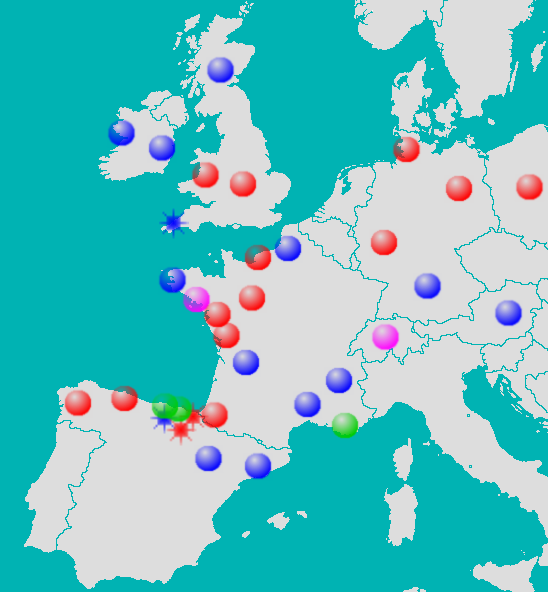
I have tried to represent the findings from the Fst graph in maps:

1. The polarity axes: red is dimension 1 (dotted line after replacing Pasiegos by Catalans) and blue is dimension 2:


It is... curious, right?

2. The clusters: blue and red are the populations in each of the two main clusters, marked with stars the four "polar" or outlier populations, with colors representing the cluster they are closer to. Green is the third minor cluster. Magenta are two populations (Switzerland and Morbihan) for which two different samples exist and each falls in a different cluster. I ignored the "miscellanea" samples.


If we are to hypothesize a Franco-Cantabrian origin to some of this duality (which is surely more complex than just that), we'd see that northern Franco-Cantabrian populations (Dordogne, Herault and Lyonais) fall in the blue cluster, together with several Atlantic populations from France, Scotland and Ireland, the Danubian fraction of  Central Europe and the Mediterranean fraction of Iberia. 

The red cluster instead looks more specifically Atlantic, with Basques/Bearnois and Asturians being the only ones from the Franco-Cantabrian region and otherwise being concentrated towards the North-West.

The lesser green cluster is totally Franco-Cantabrian but should represent a peculiar intermediate alchemy rather than a distinctive ancestral group, I suspect. Not that the other larger clusters are safely any representation of shared ancestry necessarily either but at least of some intriguing coincidence in their alchemy that seems to ask for further exploration.


Some intriguing details of specific haplogroups

The authors seem to take a critical stand, based in previous work, on the Franco-Cantabrian or even Catalan origin of haplogroup V. Different papers have offered strikingly different results on the frequency of this clade specially in Catalans (earlier claimed to be 24%,  now just 3%) and Gipuzkoan Basques (initially said to be 20%, now more like half that amount). García and colleagues seem to hint that V may have a southern Iberian origin after all:

Diversity values for V are significantly higher in Southern Iberia than in the Cornice (P<0.05). Excluding Scandinavia, the lowest diversities are found in Northern Africa and the Iberian northeast.

I say that this would totally fit in my model of important Ibero-African contacts in the context of the Last Glacial Maximum and the genesis of Oranian culture in North Africa. It is also consistent with the known fact that North African mtDNA H (sister of V, together making up c. 30% of North African mtDNA) is of Iberian or otherwise SW European derivation. 

There is also some mention to HV4, with a novel sublineage, HV4a1, of apparent origin in the Cantabrian strip (also found in one Italian and one continental European). Other HV4 sublineages are Eastern Mediterranean however, with its closest relative HV4a2, being found in Jordan and Egypt. 

In regards to H, it is worth mentioning the general high frequencies in the Cantabrian strip and specially high frequency of H6a among Cantabrians (12%), however it lacks diversity. 

H7 is confirmed as being most frequent in NE Iberia and SE France, it is one of the four H subclades with significant presence in North Africa as well. The authors however yield to the Mediterranean origins temptation, claiming presence in West Asia that is actually quite anecdotal (4/253 per Enafaa 2009). Excepting Catalonia, H7 is rare in Iberia but it is quite common in France instead, where it is largely concentrated (Álvarez-Iglesias 2009). The newly revealed presence in Catalonia offers a plausible origin for its North African presence in the context of the LGM transmediterranean contacts, which would be quite parsimonious considering that in general all mtDNA H in the region is of Iberian origin (Cherni 2008). But whatever. 

A key haplogroup however is H1, the largest H sublineage. In this aspect the authors find surprising heterogeneity. While the highest frequencies are in the Cantabrian strip, the highest diversity seems to be in the Mediterranean area (Italy and Balcans). Next in line come Scandinavia (Finns included), NE Europe and North Central Europe, all three tied at the same value (9.4). Paragroup H1(xH1a,H1b) appears to have also greatest diversity in Italy-Balcans, followed Scandinavia and then the Western Islands and NE Iberia (Catalonia and Aragon). H1a is clearly most diverse in NE Europe and North-Central Europe. H1b, a smaller scattered lineage, is most diverse in the southern Iberian Peninsula. Within H1:

FST pairwise comparisons based on haplotype frequencies detected unexpected heterogeneity. France showed close affinities with only the nearby north-east Iberian sample. In addition, the Scandinavians seem to be very different from north-central Europeans, showing more affinities to Slavs.

H3, the second largest H sublineage probably, is most diverse in North-Central Europe, in spite of being much more common in SW Europe (3-8%).

All this suggests that haplogroup H spread to SW Europe from Central Europe and not the other way around. At least H1b has been detected in Epipalelolithic Portugal (Chandler 2005, revised sequence assignment by me) establishing a maximum date for this spread. I would therefore think that mtDNA H subclades expanded at the latest with the Gravettian wave because there are no more cultural flows towards SW Europe with that origin before the late Bronze Age (or the late Chalcolithic if you wish to consider Bell Beaker - not me).

It is quite surprising anyhow to find such relative low nucleotide diversity levels for these so abundant clades not just in the smaller NW and NE Iberian regions but specially in France, while South Iberia generally shows greater diversity instead. The results raise more questions than provide answers in this sense.

Recently described haplogroups H1r and H1t were found to exist among Basques. H1t seems to be an Iberian-exclusive clade, while H1r seems instead continental (found in one French and one "European", as well as one Basque now). 

In partial contrast haplogroup K has highest diversity in NE Iberia. However the differences are not too large for all Europe except the NE, where diversity is very low. 

T2b has highest diversity in Northern Iberia (both NW and NE), followed by North Africa.

Excluding two too low in number, the greatest diversity of W is in Balcans-Italy, followed by Iberia (all three regions).


Franco-Cantabrian post-Glacial expansion?

Apparently not. This seems the main conclusion from this paper and, on light of the perplexing diversity values, even for H3, I have to agree. H arrived here from Central Europe and probably Italy, already diversified to a large extent, and did not move much after that. This arrival probably happened in the Gravettian or Aurignacian periods.

It is however still possible that a male-biased expansion happened with Magdalenian, as suggested by the patterns of R1b1b1a1a2, the most common R1b sublineage, at least in Europe, which seems to have most of its phylogenetic diversity (safer than nucleotide diversity, which is the one analyzed by García et al. in the mtDNA) around the Pyrenees (see here). However a local Central-North European component is still evident in its smaller brother haplogroup R1b1b1a1a1.

Another caution is that no meaningful sampling of French mtDNA has been undertaken since 2004 (Dubut et al., data recycled for this paper) and, considering the many errors and flukes happening in other cases without enough second and third samplings, it is very possible that a lot is still hiding in that area, so important in European prehistory.

January 10, 2011

Working on a free repository of info on prehistory and genetics

As you may know, I do not collaborate with Wikipedia anymore (since years ago) on ideological reasons. But I do feel that that a wiki on human prehistory and genetics is something almost necessary. 

So I looked up wikifarms and found one that is free and does not use adverts (they request donations hence, of course). Also they seem to have a quite libertarian (as in anarchist, i.e. free and cooperative) philosophy. Hence I have created an account and submitted a project to OurProject. They will reply, hopefully in approval, in 72 hrs. (three days) and I'd like to begin working in it as soon as it is ready. 

So, even before the project is available to begin working with, I want to ask to the readers of this blog if they would be interested in helping with creating quality unbiased content on these matters. I think I can produce some quite decent stuff alone but slowly but it'd be much better and faster with other collaborators.

While I do not understand yet quite well the details, I see in their documentation that they emphasize multilingualism to at least some extent, so, if you are not fluent in English, this should not be any major obstacle. However my priority is of course in the modern lingua franca, English.

I chose as license type public domain, what means that any collaboration automatically becomes owned by 7 billion people altogether on this planet. There was a host of licenses to choose from (though no private copyright or anything like that) but I think public domain is simplest. 

While I have not thought much in further details, there are some things I have in mind already:
  • Comprehensive and as objective as possible pages on each of the haplogroups, including relevant paper references and known distribution and phylogenies.
  • Dumping some of my best maps there, so they are not just in my blogs.
  • Mapping archaeological cultures throughout the World.
In brief, gradually building a comprehensive repository, available to all for free, on human origins, emphasizing objectivity and neutral point of view. As no current affairs/politics are directly involved this should not be a big deal, however I am also considering, if possible and compatible with the project, the existence of distinctive, signed and clearly marked as such, opinion articles if someone feels the need. But my priority is to gather all or most relevant information in a publicly available site. 

What do you say?


Update: the project has been approved and it should be available withing 6 hrs. The address is http://humanorigins.ourproject.org/  and the full title is Human Prehistory and Genetics. As far as I understand, you need to create an account with this project in the corresponding field (the full name) in order to be able to edit the wiki. However I am still a noob and I will need some practice before I become acquainted.

Actually you may need to create an OurProject account, visit this page and request to join. 

Policies and administration privileges will be discussed as need arises and we see who is taking the wiki seriously. I just realized that there is the possibility of having more than one license but all are in the line of open access (no private copyrights) - also to be discussed as need arises.

Update(2): I have (as recommended) categorized the project as:
  • Topic: Encyclopedia, Archaeology and Anthropology (3 categories are possible and there was no "genetics" one)
  • License: Public Domain (two other can be added, probably Creative Commons is a good idea)
  • Natural language: English (two other can be added but I wonder how to work in multiple languages)
  • Status: planning (to be changed to initial development as soon as something is in)

Update - Jan 11

I managed to figure out how to create a "MoinMoin" wiki within the main OurProject wiki. (LINK, feel free to edit with good reason - create a user first anyhow prefereably). This is however quite disappointingly complicated to manage (of course it may depend on your expectations but I am used to Wikipedia and other user-friendly GUIs).

There is the possibility of uploading some wiki software to the main subdomain but I fear I am not sufficiently techy for that (at least not yet).

    January 9, 2011

    Atapuerca Director: Tel Aviv teeth are Neanderthal or similar. Judeo-Christian bias blamed for the hype

    José María Bermúdez de Castro, Director of Spain's National Center for the Research of Human Evolution (the "Atapuerca team"), writes today at Público newspaper[es] clarifying the matter: the human teeth found near Tel Aviv and hyped in the media as the first humans and blah-blah... are Neanderthal or quite so. 

    Some key excerpts (my translation and bold type):

    (...) the authors offer three similarly likely hypothesis to interpret their findings. But then they adopt the one that can offer more notoriety and discard the one that, in my opinion, is the most likely one, judging from the excellent images of the findings. The teeth are very similar (if not identical) to those of Neanderthals (...)

    Eight teeth cannot be enough argumentation to demolish a hypothesis supported by dozens of works made in the fields of palaeoanthropology and genetics. I am persuaded that the authors are well aware of this. (...) Some media have been carried away by the symbolism of the region and of the Christmas period. I am afraid that some 400,000 years ago God did not inhabit the minds of human beings, or at least there is no data supporting such hypothesis.

    I was admittedly waiting for some Atapuerca expert to demolish the wild and so-blatantly superstitious and populist conjecture. I did not have to wait much, thanks Jose Mari and thanks to Fonso for the link (at Mundo Neandertal[es], comments section).

    Dalmatia as a central hub for South European Neolithic

    I cannot find the relevant paper and I am not sure how this news item is different from what we already knew, though it is true that the Eastern Adriatic region, at the origin of Cardium Pottery Neolithic is often ignored and misunderstood, with the focus often being in Central and East Balcanic Neolithic and its derived variant in Central Europe: the Danubian Neolithic (Linear Pottery culture, LBK).

    Yet at least as important as these was the Mediterranean Neolithic and, for this, it all began in Dalmatia and nearby areas (Bosnia, Montenegro, coastal Albania), soon spreading to Italy and beyond, to SE France, the coasts of Iberia and some coastal enclaves in North Africa. 

    The news item I am referring to is at Science News today and it has some interesting paragraphs, obtained from archaeologist Marko Mendušic and his US colleague Andrew Moore:

    Their discoveries support the idea that agricultural newcomers to southern Europe built villages without encountering local nomadic groups, Moore asserts. Earlier excavations at Neolithic sites in Germany and France raise the possibility that hunter-gatherers clashed with incoming villagers in northern Europe, he notes.

    Surprisingly, Pokrovnik and Danilo Bitinj residents grew the same plants and raised the same animals, in the same proportions, as today’s Dalmatian farmers do, Moore says. Excavated seeds and plant parts show that ancient villagers grew nine different domestic plants — including emmer, oats and lentils — and gathered blackberries and other wild fruits.

    Animal bones found at the two villages indicate that residents primarily herded sheep and goats, along with some cattle and a small number of pigs.
    This dominance of sheep and goat herding, along with all the classical array of Neolithic domesticates in the wider region, is a characteristic of Mediterranean Neolithic.

    Aside from farming, Neolithic villagers in Dalmatia were “oriented toward the sea, and enjoyed extensive long-distance contacts,” Moore adds. Chemical analyses of obsidian chunks found at Pokrovnik and Danilo Bitinj, directed by archaeologist Robert Tykot of the University of South Florida in Tampa, trace most of them to Lipari, an island off Sicily’s north coast.
    This seafaring inclination, not fearing even the high seas, is another characteristic of Cardium Pottery Neolithic. 

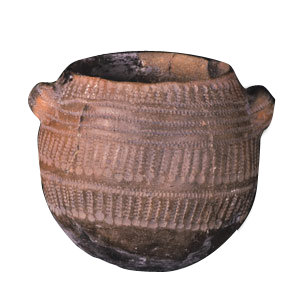
    Of course, the third trait is their unique pottery (left: an example from Catalonia), not painted but imprinted, often with the shell of what used to be the genus Cardium, now superfamily Cardidae (cockles in English, berberechos in Spanish and Galician, escopinyas in Catalan, berbigoes in Portuguese, cocques and bucardes in French). 

    However both in the original area of the Western Balcans and in the extended area of Italy and the West Mediterranean, soon the pottery styles evolved into other forms known as a whole as Epi-Cardial. 
    There is also some presence of this pottery in at least one of the earliest Greek Neolithic sites, Otzaki, and later also in Lebanon and coastal Syria (Byblos facies of the Amuq-Byblos culture), where it must have arrived from Europe (because of the rather late time frame).

    The expansion of this Neolithic culture is, with some exceptions, characterized by the assimilation of earlier populations, something evident in the continuity of local Epipaleolithic toolkits. 

    January 8, 2011

    Archaeonews: South Iran and South China Neolithic findings, London's oldest artificial structure

    Some interesting snippets from Stone Pages' Archaeo News section:


    Southern Iran's findings from 5000 years ago

    Teheran Times reports the finding of a a site related to Jiroft culture.

    The site, Kajeh Askar, near Bam (Kerman province) was discovered during emergency digs because of a road construction. Part of the site was damaged while excavating. 

    Among the findings are pottery and two burials, one in fetal position and another in extended face up position.  These bodies had been interred with diverse artifacts, including a seashell apparently used to store cosmetics. 


    New Neolithic culture from Jiangxi, China

    A new Neolithic culture has been named in South China as Terracotta and Painted Pottery Culture. The site is known as Lahodun and is near Gaohu (Jiangxi). 

    The finding includes stone walls and tools (hatchets, adzes, ploughs) as well as pottery and are preliminarily dated to c. 6000 years ago. Archaeologists also report a large sacrificial table made of high purity yellow clay (3000 m², up to 80 cm thick), 114 so-called sacrificial tombs and a structure made of red scorched earth.


    London's top secret

    The nickname comes because the newly found wooden structure is right in front of the headquarters of the infamous British secret service MI6. The archaeologists even had some trouble when the wannabe James Bonds suspected that they were planning some sort of attack.

    Fortunately the dig and topographical measures could proceed normally after the misunderstanding, revealing a wooden structure, which is neither straight nor round but could well have served to support a platform on what was then a small island within the Thames river. 

    The site is dated to c. 7000 years ago, in the Epipaleolithic period and is the oldest known structure in the English capital.


    As always you can discuss these news and more at Archaeo Forums.