April 7, 2013

Polynesian mtDNA in extinct Native American population

The evidence seems to accumulate in favor of some Polynesian impact in South America:

Vanessa Faria Gonçalves et al., Identification of Polynesian mtDNA haplogroups in remains of Botocudo Amerindians from Brazil. PNAS 2013. Pay per view (six months embargo) → LINK [doi:10.1073/pnas.1217905110 ]

Abstract

There is a consensus that modern humans arrived in the Americas 15,000–20,000 y ago during the Late Pleistocene, most probably from northeast Asia through Beringia. However, there is still debate about the time of entry and number of migratory waves, including apparent inconsistencies between genetic and morphological data on Paleoamericans. Here we report the identification of mitochondrial sequences belonging to haplogroups characteristic of Polynesians in DNA extracted from ancient skulls of the now extinct Botocudo Indians from Brazil. The identification of these two Polynesian haplogroups was confirmed in independent replications in Brazil and Denmark, ensuring reliability of the data. Parallel analysis of 12 other Botocudo individuals yielded only the well-known Amerindian mtDNA haplogroup C1. Potential scenarios to try to help understand these results are presented and discussed. The findings of this study may be relevant for the understanding of the pre-Columbian and/or post-Columbian peopling of the Americas.

Questioning the India-Australia link and timeline

Darshi Arachige recently made me aware of a study of his authorship, which is broadly coincident with the criticisms I made to Pugach 2013:

Darshi Arachige, Do the Estimated Admixture Times Confirm the Proposed Holocene Gene Flow from India to Australia? Social Science Research Network 2013 → LINK

Abstract

This paper argues that the current estimates for the time of influx of Indian genes into some sections of Australian Aboriginal population during Holocene bear large uncertainties which make elimination of the probability of a more recent gene flow less likely. It also highlights that indications for the plausibility of a later gene flow exist and can also be placed in a likely archaeological perspective.


My own very brief synthesis of the criticisms (all very legitimate) is as follows:

  • Excessive conclusions come from subjective interpretation the PC (eigenvector) analysis. 
  • Too large, diverse dataset: Pugach et al. use an excessively broad dataset, what tends to hide important information unless you look at great depths, which they do not.
  • Confidence intervals were hugely underestimated (a way too common academic malpractice).
  • The arbitrarily wrong interpretation of the Holocene techno-cultural changes in Australia, which in no way are related to India but to SE Asia.
  • Ignoring Kumar 2009, whose estimates for the South Asia - Australia gene flow is of 60-50 Ka BP. 

Intriguingly however, Arachige mentions the Aboriginal legends about the Bajini, which he considers as possible Dravidian migrants, with all cautions. 

Conclusion

In the preceding discussion, it was shown that the possibility of a Holocene gene flow between Indian people and Australian Aboriginal people is real. However, the external evidence quoted to support the thesis of such genomic fusion around four thousand years ago is inadequate and does not enjoy the support of many experts in the field. Given the errors associated with the estimated times of a localised admixture between these populations, it is not impossible to find a more recent time for an encounter between South Indian migrants to South East Asia and Aboriginal people from northern parts of Australia. Such an encounter is far more plausible from the archaeological evidence available in the neighbouring islands. Even though it is not possible to link the Baijini gypsies with the Dravidians due to flimsiness of the available information about the former, it is a possibility worth pursuing.

April 1, 2013

Eye and skin pigmentation genetics: Cape Verdeans as informative population

Cape Verde from space
Still getting updated with the backlog. Here there is an interesting study on human pigmentation using the heavily admixed Cape Verdean (essentially West African + West Iberian) population as reference.

Sandra Beleza et al., Genetic Architecture of Skin and Eye Color in an African-European Admixed Population. PLoS Genetics 2013. Open accessLINK [doi:10.1371/journal.pgen.1003372]

Abstract

Variation in human skin and eye color is substantial and especially apparent in admixed populations, yet the underlying genetic architecture is poorly understood because most genome-wide studies are based on individuals of European ancestry. We study pigmentary variation in 699 individuals from Cape Verde, where extensive West African/European admixture has given rise to a broad range in trait values and genomic ancestry proportions. We develop and apply a new approach for measuring eye color, and identify two major loci (HERC2[OCA2] P = 2.3×10−62, SLC24A5 P = 9.6×10⁻⁹) that account for both blue versus brown eye color and varying intensities of brown eye color. We identify four major loci (SLC24A5 P = 5.4×10⁻²⁷, TYR P = 1.1×10⁻⁹, APBA2[OCA2] P = 1.5×10⁻⁸, SLC45A2 P = 6×10⁻⁹) for skin color that together account for 35% of the total variance, but the genetic component with the largest effect (~44%) is average genomic ancestry. Our results suggest that adjacent cis-acting regulatory loci for OCA2 explain the relationship between skin and eye color, and point to an underlying genetic architecture in which several genes of moderate effect act together with many genes of small effect to explain ~70% of the estimated heritability.

Children of Praia
(CC by Otimarte)
Most interestingly maybe the authors conclude that KITLG, a gene which displays large differences in allele frequency between Africa and Eurasia and has been therefore suggested to be a cause of pigmentation differences, does not actually play any obvious role in this matter.

HERC2 (OCA2) is confirmed to be very important in eye color (semi-recessive inheritance for blue color), the only other gene known to affect eye color is SLC24A5, which is mostly involved in skin pigmentation however.  

SLC24A5 and SLC45A2 are confirmed as important pigmentation genes. However two otherwise unsuspecting genes, APBA2 (near OCA2) and GRM5-TYR, are found to have also important impact in skin pigmentation.

Still most (~3/5) of the inherited pigmentation traits remain unexplained and are probably caused by some sort of complex interactions. Eye and skin pigmentation have no strong genetic correlation apparently.

Some interesting images from the paper:

Figure 1. Relationship of geography and ancestry to skin and eye color.
Individual ancestry proportions for Cape Verdeans displayed on all four panels were obtained from a supervised analysis in frappe with K = 2 and HapMap's CEU and YRI fixed as European and African parental populations. (a) Bar plots of individual ancestry proportions for Cape Verdeans across the islands. The width of the plots is proportional to sample size (Santiago, n = 172; Fogo, n = 129; NW cluster, n = 192; Boa Vista, n = 27). The proportion of African vs. European ancestry of the individuals is indicated by the proportion of blue vs. red color in each plot. (b) Individual African ancestry distribution in the total cohort of 685 Cape Verdeans (histogram) and in 802 African Americans (kernel density curve) from the Family Blood Pressure Program (FBPP) [21]. (c) Scatter-plot of skin color vs. Individual African ancestry proportions. Skin color is measured by the MM index described in Material and Methods. (d) Scatter-plot of eye color vs. Individual African ancestry proportions. Eye color is measured by the T-index, described in Figure 2 and Material and Methods. Points in scatter-plots are color coded according to the island of origin of the individuals.
Figure 3. GWAS results for skin and eye color in the total Cape Verdean cohort.
Results are shown as −log10(P value) for the genotyped SNPs. Plots are ordered by chromosomal position. (a,c) Genotype and admixture association scan results for skin color. (b,d) Genotype and admixture association scan results for eye color. (a,b) show the P values obtained in the initial scans and (c,d) the P values of the following scans adjusting for the strongest associated SNP (in SLC24A5 for skin color and in HERC2 for eye color). Dashed red lines correspond to the genome-wide significance threshold (P<5×10⁻⁸ in the genotype scan; P<7×10⁻⁶ in the ancestry scan [see Material and Methods]). The location and identity of candidate genes are colored to correspond with chromosomal location; individual SNPs are given in Table 1.
Figure 7. Genetic architecture of skin color variation.
(a) Effect sizes of the loci associated with skin color. Effect values represent the beta values obtained from a regression model containing the four associated loci plus ancestry. (b) The pie chart represents the proportion of phenotypic variation accounted for by the different components, including non-heritable factors (~20%), the four major loci (~35%, color-coded as in [a]), and average genomic ancestry (44%). The heritable contributions were estimated by regression and variance decomposition as described in Material and Methods, and are also represented below the pie chart separately as grey (genomic ancestry) or open (four major loci) areas. However, because of admixture stratification, the heritable contributions overlap as described in the text.

Blog issues

Not sure if this affects everybody but in the last few days I noticed that the (unclicked) links in the blog are being displayed in plain blue color that strongly contrasts with the overall theme of the blog in a quite ugly manned. I have revised the template a couple of times and even gone through the HTML code and can't find any error, so either Blogger is doing something strange or my browser needs updating. I'd be glad to get feedback on this: do you see unclicked links blue or (as it should be) of an ochre color?

Update on the color issue (Apr 3): it was caused by HTML code in the table at the end of the Italian Neanderthal mtDNA entry. Only pages with that entry displayed links in blue. The specific code, which was surgically removed once detected was:

A:link { color: rgb(0, 0, 255); }

Thanks to all people who produced feedback but very specially to Toos, without whose help I would have never detected the source of the problem.

__________________________________  . __________________________________

Comment moderation

I'm still licking the emotional wounds caused by trolls (not just here but also elsewhere) and therefore, in order to be able to better enjoy this vacation, I have decided to keep preliminary comment moderation for a bit longer. My most sincere apologies to all commenters of good will but what I  really need some rest. I also have very clear that I will not tolerate anymore any trollish behavior, even if camouflaged. I will however issue warnings for those who are not extreme but I will also apply the baseball rule: three strikes and you're out. 

I realize that satisfactory discussion environment needs of some "gardening", what means getting rid as soon as possible of the undesirable weeds. Even if the overall number of comments falls down, that is not necessarily a bad thing, although not my objective at all.

Internet trolls playing their sick and stupid mind games (source)

March 28, 2013

Neanderthal mtDNA in alleged Italian hybrid from late Mousterian context

The alleged hybrid characteristics are only attributed to morphological data of the bones (the bulk of the paper), what is always subject of great debate. Otherwise most people would just think in terms of Neanderthal, as the individual from Monte Lessini is also from a Mousterian context. By this I do not mean there was no interbreeding in the Neanderthal direction, just that without clear genetic data, I fail to see such morphometric speculations as conclusive in any way.

S. Condemi et al., Possible Interbreeding in Late Italian Neanderthals? New Data from the Mezzena Jaw (Monti Lessini, Verona, Italy). PLoS ONE 2013. Open accessLINK [doi:10.1371/journal.pone.0059781]

Abstract

In this article we examine the mandible of Riparo Mezzena a Middle Paleolithic rockshelter in the Monti Lessini (NE Italy, Verona) found in 1957 in association with Charentian Mousterian lithic assemblages. Mitochondrial DNA analysis performed on this jaw and on other cranial fragments found at the same stratigraphic level has led to the identification of the only genetically typed Neanderthal of the Italian peninsula and has confirmed through direct dating that it belongs to a late Neanderthal. Our aim here is to re-evaluate the taxonomic affinities of the Mezzena mandible in a wide comparative framework using both comparative morphology and geometric morphometrics. The comparative sample includes mid-Pleistocene fossils, Neanderthals and anatomically modern humans. This study of the Mezzena jaw shows that the chin region is similar to that of other late Neanderthals which display a much more modern morphology with an incipient mental trigone (e.g. Spy 1, La Ferrassie, Saint-Césaire). In our view, this change in morphology among late Neanderthals supports the hypothesis of anatomical change of late Neanderthals and the hypothesis of a certain degree of interbreeding with AMHs that, as the dating shows, was already present in the European territory. Our observations on the chin of the Mezzena mandible lead us to support a non abrupt phylogenetic transition for this period in Europe.

While there is little reason to doubt the Neanderthal attribution of these remains, the method of using only HVS-I is a bit antiquated and prone to errors and uncertainties. Follows table S10, with the genetic data (HVS-I) of this and other Neanderthal mtDNA sequences:


Table S10.

Fossil specimen
Country
mtDNA region
Length (bp)
Diagnostic Neanderthals trasversion in HVR1 according to
Reference
Feldhofer 1
Germany
Complete mtDNA
16565
16139 A/T
16256 C/A
Insertion 16263 A


Feldhofer 2
Germany
Complete mtDNA
16565
16139 A/T
16256 C/A
Insertion 16263 A

Mezmaiskaya
Russia
Complete mtDNA
16565
16139 A/T
16256 C/A
Insertion 16263 A

Vindija 75
Croatia
HVR1
357
16139 A/T
16256 C/A
Insertion 16263 A

Vindija 77
Croatia
HVR1
31
16256 C/A

Vindija 80 (33.16)
Croatia
Complete mtDNA
31
16139 A/T
16256 C/A
Insertion 16263 A

Vindija 33.25

Complete mtDNA
16565
16139 A/T
16256 C/A
Insertion 16263 A

Engis 2
Belgium
HVR1
31
16256 C/A

Le Chapelle-aux-Saint
France
HVR1
31
16256 C/A

Rochers de Villenueve
France
HVR1
31
16256 C/A

Scladina
Belgium
HVR1
123
16256 C/A

Monte Lessini
Italy
HVR1
378
16139 A/T
16256 C/A
Insertion 16263 A

Monte Lessini Mandibula
Italy
HVR1
31
16256 C/A
This paper
El Sidron SD-441
Spain
HVR1
47
16256 C/A

El Sidron SD-1252
Spain
HVR1
303
16139 A/T
16256 C/A
Insertion 16263 A

EL Sidron 1253
Spain
Complete MtDNA
16565
16139 A/T
16256 C/A
Insertion 16263 A

Valdegoba
Spain
HVR1
303
16139 A/T
16256 C/A
Insertion 16263 A

Teshik Tash
Uzbekistan
HVR1
190
16139 A/T
16256 C/A
Insertion 16263 A

Okladnikov
Russia
HVR1
348
16139 A/T
16256 C/A
Insertion 16263 A


March 27, 2013

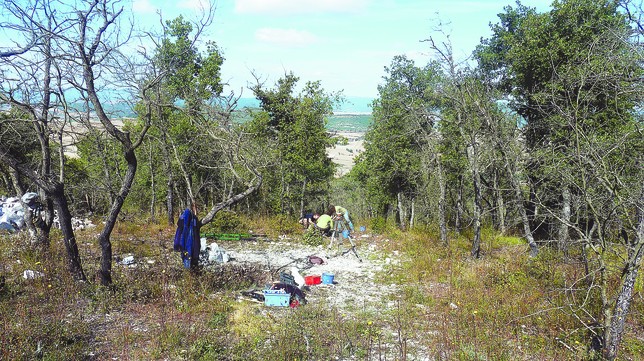
Trebiño: major flint stone quarry of the Upper Paleolithic

Trebiño (also Treviño in Spanish), just south of Vitoria-Gasteiz, Western Basque Country, includes de the sierra of Araiko, which was, we get to know now, in the Upper Paleolithic one of the main sources of flint stone of SW Europe, "exporting" to most of the Franco-Cantabrian Region, the core of Late UP Europe. 

The quarry left rather massive remains, hard to discern today, as they have been reclaimed by Nature again, such as 300m long ditches and rubble piles seven meters tall. Mining tools have also been found. The high quality Trebiñese flint stone was used by most Upper Paleolithic peoples in the region, underlining the notion of extense socio-economic networks already in those times, and the site continued in exploitation through the Neolithic and Chalcolithic eras. 

The archaeological site is in danger because of the planned erection of a wind energy generation park right atop of it. Update: the wind park planned on it was actually suspended on October 2012, it seems.

Source: Diario de Burgos[es] (via Pileta[es]).

Epipaleolithic site dug in Sudan

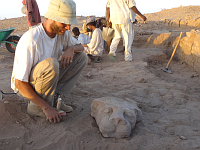
Archaeologist watches a lioness head
not mentioned in the sources
A late hunter-gatherer necropolis has been discovered and researched by Czech scientists. The area of Sabalonka, some 80 Km north of Khartoum, includes a large necropolis of some 400-450 burials, believed to be from 8-10,000 years ago. Along with the burials, still awaiting radiocarbon dating, the archaeologists found a network of nearby settlements.

So far 30 skeletons have been recovered, many with personal ornaments made of shells, ostrich egg and bone. Other objects found are bone needles and domestic tools made of bone and horn.

The site is at risk in the mid-run because of a planned dam, also the researchers are somewhat concerned about funding, even though the project is low-cost. 

Sources[es]: Paleorama en Red, Radio Praga