January 8, 2011

Clothes, lice, Homo sapiens and Neanderthals

New genetic research on clothing lice and its relative hair lice, using molecular clock estimate methods, suggests that our ancestors began using clothes only some 170,000 years ago, roughly the age of Homo sapiens as distinct species per the archaeological record. 

But the usual warning of all molecular clock estimates applies (with special emphasis, see below).


Loss of body hair is estimated to have happened c. 1.2 million years ago, in the H. ergaster phase, or arguably even earlier based on the genetics of pubic lice (3 Ma.) However it seems now that people did not use clothes until much later.

Or at least people within the H. sapiens lineage...

Fig. 1

Notice please the first evidence of hide scrapers in the graphic above: it is a clear indication of working skins. Of course skins may have been used for other purposes than just clothing, like containers maybe...

However it is worth noticing that this reference directs to Carbonell 1999, which discusses the archaeology of Atapuerca, a famous Iberian site related to Neanderthals and their predecessors. In Europe the need for clothes was much more urgent obviously and the ancestors of Neanderthals got to work on it out of need.

I'd like to know when are dated the first scrapers from Africa because I do not think they are so old. Are they? Obviously in Tropical Africa, the evolutionary homeland of our species, the need for clothing was almost none. Even today many peoples live almost or even totally naked in Sudan, while in India, many religious people do as well and in Papua clothing is often just a penis cover (or delusional enhancement maybe) out of a gourd. 

It is worth mentioning that this paper incurred in the common error of calibrating using Chimpanzee louse as outgroup, attributing to the Pan-Homo divergence the lowest possible age per the literature: 5.0 to 5.5 Ma. (when we know it is of at least 8 Ma.) Hence the age estimate should be multiplied by 1.45 or 1.6, getting a more likely age of at least 250,000 years for the coalescence of modern clothing lice and hence use of clothes by our ancestors (excepting probably Neanderthals). 

At that time (all of them) we were still living in Tropical Africa. Why would people begin to use clothes then? I am hunching here that maybe there was some need in order to colonize or otherwise exploit the Ethiopian highlands. Certainly the oldest fossil generally acknowledged as Homo sapiens, dated to c. 190,000 years ago, is from the southern slopes of that impressive massif. Also this area between Ethiopia and Southern Sudan looks to me, based on mtDNA spread, a most likely candidate for the original homeland of our species.

Location of Omo (black bubble) on a topographical map of Ethiopia

Exploring the ancestry of African-Americans

Preliminary note: in this post African-American means people of African descent living in America (aka the Americas), not just people from the USA.


The authors acknowledge that they find difficulties in tracking regional African ancestry because of the limited genetic data available for this continent, with some important countries in the Atlantic slave trade, like Ivory Coast or Ghana, being still largely not researched. The situation may be even worse for Y-DNA and autosomal markers.

I'd say that this sad situation is product of several factors: first of all lack of interest by Western or Asian researchers, then unequal access to the DNA pools of the continent, often for political reasons (this happens elsewhere, specially in parts of Asia but also in France), other factors are the huge size and diversity of Africa and its population and the relative lack of obvious structure, with many lineages scattered across the continent. This last element actually seems to demand greater research and finer-grained haplotyping but this only comes in small drops. 


Inter-continental admixture, the well known sex-bias

A simpler analysis can be done in regards to inter-continental admixture (fig. 1):

Fig. 1 - Ancestry of African-Americas: (a) mtDNA, (b) Y-DNA and (c) autosomal DNA
We can see in these maps, for example, that Afro-Brazilians are largely of European and Native American ancestry (c), even if African descent is still dominant.  We can also see that European ancestry is overwhelmingly of male lineages (b), while Native American one instead is almost only of female origin (a). 

This seems quite peculiar of Afro-Brazilians, with no other American population displaying such pattern. Although it may be arguable in the case of Afro-Caribbeans. The population displaying most European female ancestry are African-Americans from Philadelphia.

Notice that minor European and Native American components are present in the autosomal samples of pure West Africans, indicating that these minor amounts are actually imprecisions of the clustering method. 

In the reverse direction, there is a map (fig. S1) in the supplementary materials that shows important African and Native American ancestry among white Brazilians, again showing sex-bias in the admixture, with nearly all being attributable to female ancestry. Some admixture is also apparent in white Philadelphians but it is much smaller.


African regional ancestry estimates

But the greatest effort of the authors of this paper is trying to unravel the African regional ancestry of these populations. For this they had to resort to mitochondrial DNA, which is admittedly just part of the whole picture and is often not sufficiently well structured by regions anyhow:

Fig. 3 regional African ancestry estimates (mtDNA)
The impression we get is that SE African (Mozambique) and Gabonese ancestry is restricted to South America. Instead Cameroon ancestry is concentrated towards the North of the new continent. Angolan and West African ancestry are widespread, however there is no detected Angolan ancestry in the former Spanish colonies. 

The authors argue some of these differences based on the chronology of the Atlantic slave trade, that in its first phase almost exclusively preyed in Westernmost Africa and Angola, while looking for other sources West-Central Africa and Mozambique in its late phases.


West African insular peoples

A map available in the supplemental material, fig. S6, also addresses the matrilineal ancestry of the populations of Cape Verde and São Tomé, two insular areas uninhabited before the colonial period and settled essentially with slaves from the continent (though Cape Verdeans  specially also have some important European admixture, less important probably in São Tomé). Cape Verde African ancestry is exclusively from Westernmost Africa, including Mauritania, instead São Tomé shows a mixture of Westernmost Africa and Central Africa (Gabon, Angola), to the exclusion of the Nigeria-Cameroon area.

Some new insights in the phylogeny of Y-DNA E1b1


There is a brand new paper on Y-DNA haplogroup E1b1:


The new phylogeny is available in the graphic at the left (B, click to expand). And it includes the following changes:


Haplogroup reorganization

E1b1c is now known to be part of a shared upstream haplogroup with E1b1a, which become E1b1a2 and E1b1a1, respectively. In this clade a new downstream haplogroup is also described by the name E1b1a1g1d (V39).

The other haplogroup E1b1b, also sees some changes in its downstream clades: two new small subclades are described: E1b1b1f (V42) and E1b1b1g (V92).  Former E1b1b1f (P72) becomes now part of the somewhat larger haplogroup E1b1b1e (M293). Also a new small clade is described by the SNP V23 and named E1b1b1c1c.

In this major lineage, maybe more intriguing is the finding that the two haplogroups with notable presence in Europe, are now subsumed into larger clades: E1b1b1a (V68) and E1b1b1b (V257). These two haplogroups are notable because:

Within E-M35, there are striking parallels between two haplogroups, E-V68 and E-V257. Both contain a lineage which has been frequently observed in Africa (E-M78 and E-M81, respectively) [6], [8], [10], [13][16] and a group of undifferentiated chromosomes that are mostly found in southern Europe (Table S2). An expansion of E-M35 carriers, possibly from the Middle East as proposed by other Authors [14], and split into two branches separated by the geographic barrier of the Mediterranean Sea, would explain this geographic pattern. However, the absence of E-V68* and E-V257* in the Middle East (Table S2) makes a maritime spread between northern Africa and southern Europe a more plausible hypothesis.

How can this be?

This is most intriguing, really. And it is worth hence considering which populations harbor these two paraphyletic clusters:

  • E-V68* (E1b1b1a*) is found only in Sardinians.
  • E-V257* (E1b1b1b*) is found (at low frequencies) in a larger array of populations: Iberians (Cantabrians and Andalusians), Corsicans, Sardinians, Marrakesh Berbers and Borana (Oromo) from Kenya.
For comparison with their larger sister clades (and in general Y-DNA E), I include here fig. 1 from Semino 2004, after annotated current YSOGG nomenclature (in red) and, where needed, the new proposed nomenclature of this paper (in blue):


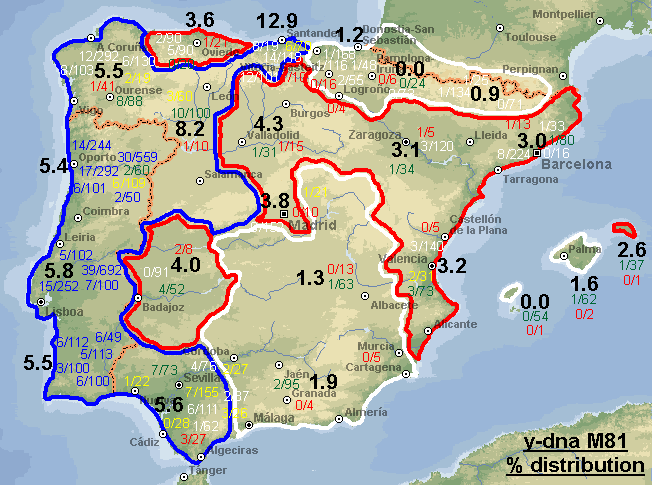
Notice that the actual distribution of these lineages is somewhat imprecise, for example, if you look at the more detailed compilation by Argiedude, you will notice that E-M81 in Iberia has a mostly Western distribution, with some presence in the East but very low in the SE, it is not the simplistic South-North cline depicted above (E-M78 follows a very similar pattern). It may be the same in other areas. 

I would think that this maritime migration proposed for these two paragroups, is highly suggestive of a flow into Iberia in the context of the Oranian (or Iberomaurusian) culture genesis in North Africa and the related changes (back-tip and wings in arrow heads notably) in the Iberian Gravetto-Solutrean complex, which influenced West Iberia up to Asturias but not for example the Basque area, which remained closer to the Aquitanian and Occitan Solutrean (a purer variant of this techno-culture, not influenced by Gravettian, which appears intrusive in any case, nor the Aterian-Dabban North African substrate). 

As I have said before in many occasions, I strongly suspect that this prehistorical episode is responsible for the mtDNA H and V in North Africa, as well as from mtDNA U6 and probably also some L(xM,N) in Iberia. 

Similarly it is probable that the small presence of Y-DNA R1b and I in North Africa (which must be somewhat old if we have to judge from the Guanche mummies DNA) and the presence of Y-DNA E1b1 in Iberia (with "strange" extension towards the NW specially) dates from this Paleolithic episode, which happened around the Last Glacial Maximum.
The flow to Corsica and Sardinia might well be of Megalithic age. 

I must admit that just a few years ago I would have been most surprised if anyone would have told me that the presence of African lineages in Iberia and other European locations was a proof of the deep Paleolithic roots of European Y-DNA (and mtDNA). Nobody told me... but it seems it is the case.


Overall haplogroup E distribution

Just for the reference, I am closing this brief review with a map of the overall distribution of haplogroup E, taken from Chiaroni 2009:


Notice how the European and West Asian presence of this major haplogroup is just an epiphenomenon in an otherwise clearly African clade.

January 5, 2011

Video: Magdalenian astronomy (in Spanish)

This video (51'36'') is sadly only available online in Spanish language in spite of having been shot originally in English (titles) and French (language of most of the people appearing in it). It deals with the research by French astronomer Chantal Jegues-Wolkiewiez of the astronomical knowledge of ancient Paleolithic people of what is now Southern France.

[Note: an English-language copy seems to be available for purchase HERE]


Synthesis:

Sagittarius and Scorpio?
She began her research at the Southern Alps where she discovered that the dagger symbols on a stone indicate the rise of the Sun in the Autumn equinox. Eventually she began also researching caves from the heart of Paleolithic Europe: Dordogne (near modern Bordeaux), discovering that all or nearly all the caves with paintings have a clear solar orientation, being illuminated in either an equinox or a solstice. She also found several indications that the cycles of the Moon were being recorded as well.

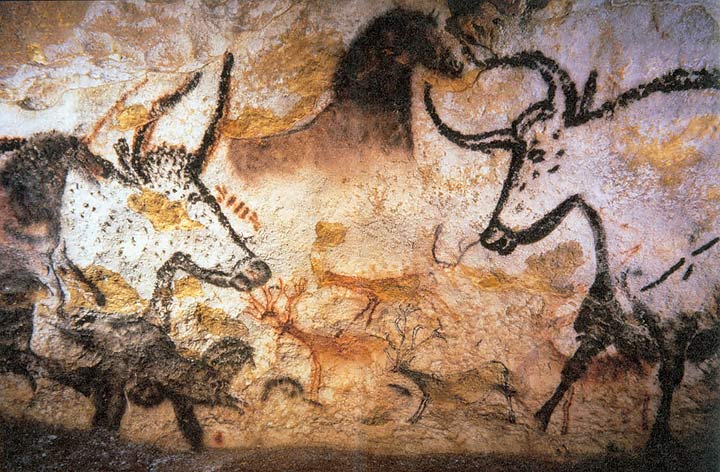
Most fascinating (and controversial) is anyhow her claim that the famous paints of Lascaux represent the zodiacal constellations as perceived by the ancients. This last claim is however met with scepticism by many prehistorians, even if some also sympathize with her view. Paradigm-shaking in any case. 


Note: a similar claim was staked for the paintings of not less famous Altamira cave in modern Cantabria, Spain, in the book Arqueoastronomía Hispana, which also deals with other archaeoastronomical research in the Iberian Peninsula and the Canary Islands.

Video: Armenia's "Stonehenge"

An interesting CNN video on which may be the oldest stone ring of the world, in modern day Armenia:


From Pileta de Prehistoria.

January 3, 2011

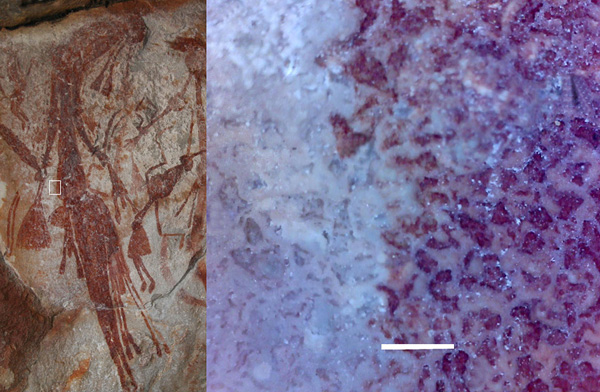
Some rock art of Australia does not retain any paint but pigmented microbes

This is quite unexpected and rather shocking: rock art from Bradshaw, West Australia, keeps no paint all, but remains  drawn and visible because of microbes of red and black colors which have colonized the painted area. 

This makes dating the paintings almost impossible because they are alive, literally so. However the possibility of indirect dating using DNA sequencing remains open.

The implicated microbes are a black fungus and a red bacteria whose species are yet to be identified but which apparently survive cannibalizing their ancestors.

Amplified boundary of a a drawing
Sources: Antiquity, BBC, Stone Pages

January 1, 2011

Green wet Sahara

Happy new year, by the way.

I want to call your attention to a post by Razib in which he reviews a new paper on the archaeology of transitional Pleistocene-Holocene "wet Sahara", including many interesting maps and quotes from the original paper, which is:

Nick A. Drake et al., Ancient watercourses and biogeography of the Sahara explain the peopling of the desert. PNAS 2010. Pay per view (depending on world region and at worst for six months only).

I won't comment on it at least until it becomes freely available but the maps are quite interesting, as is the suggestion that this lush scenario may have been related to the flow of Nilo-Saharan languages (and some genetic packages probably associated with them).


Update (Jan 3): another review can be found at LiveScience.